
Air quality alerts. Emergency rooms fill with those suffering from wildfire smoke. A child dies from an asthma attack. Families are reminded to keep rescue inhalers nearby and stay indoors if possible. Then, the news cycle moves on. However, for those whose loved ones suffer a critical attack or pass away, life is changed forever.
I felt compelled to write this blog after reading a recent article. It was about a Milwaukee mother who lost her two-year-old son to an asthma attack in 2024. While not a recent incident, the story was revisited as wildfire smoke degraded air quality across Wisconsin.
The sad reality is that stories like this appear almost every week somewhere in the world. Every one of them is heartbreaking. Every one of them should also force us to ask a more important question: Are we doing enough to prevent these tragedies before they happen?
These Metrics Are Not Hyperbole
The article cited that Children’s Hospital in Milwaukee had ten children hospitalized for asthma attacks during June 2026, and that two children died from asthma-related complications. The numbers are not just statistics. They represent real children, real families, and outcomes that may have been prevented.
“Asthma Can Be Controlled by Medicine”
What particularly stood out to me is that the family never fully realized that asthma can be deadly. It was something that medication could treat – and that is true to an extent. Asthma can be controlled with medication. However, that is no guarantee that an individual will not experience a set of conditions, that for someone without asthma may be benign, for someone with this condition the situation can rapidly turn lethal
Asthma should never be viewed as a condition managed by medication alone.
Controller medications and rescue inhalers save lives. Absolutely! These treatments are essential components of asthma management, and no one should stop taking medications prescribed by their healthcare provider.
However, medications are only one side of the equation. The other is reducing exposure to the environmental triggers that cause inflammation in the first place. The challenge? Each person’s situation is highly individual. What is safe for one person with asthma may cause extreme issues in the person next to them. Not only that, but your individual triggers can also change as your health or environment changes. That is why it is so important to monitor and learn your own trigger.
Common triggers may include:
Wildfire smoke
PM2.5 pollution
Ozone
Pollen
Mold spores
Dust
Traffic emissions
Industrial pollution
Indoor allergens
Asthma patients should be trained to look for exposures, identify them, and consider if any action is needed to protect their health. Every exposure avoided is one less inflammatory response to already sensitive airways.
Playing Russian Roulette
This may sound like a strong statement, but I believe it deserves to be said.
Attempting to control asthma with medication without addressing environmental triggers is like playing Russian roulette.
It is true that not every exposure causes an asthma attack. Not every high-pollen day leads to an emergency room visit. Not every smoke event results in hospitalization.
But sometimes it does. And the one common theme I see in these tragic stories is that the situation came on fast and the family was shocked. They thought the condition was being managed. The reality is that no one can predict when or what type of exposure will be the one that overwhelms someone’s lungs.
“You Don’t Know When It Can Happen”
The mother also said something that resonates with nearly every family affected by severe asthma. “You just don’t know when it can happen.”
She is correct. None of us can predict the exact moment an asthma exacerbation will occur, but that doesn’t mean we are powerless. What we can do is change the treatment narrative by approaching every day with awareness and the question, “How can I reduce my chances of having an asthma attack?” That is a fundamentally different approach.
Modern environmental data allows us to know much more than we did five years ago, and it also includes tracking
We can monitor:
Air Quality Index
PM2.5 concentrations
Ozone levels
Pollen counts
Smoke movement
Heat
Humidity
Wind patterns
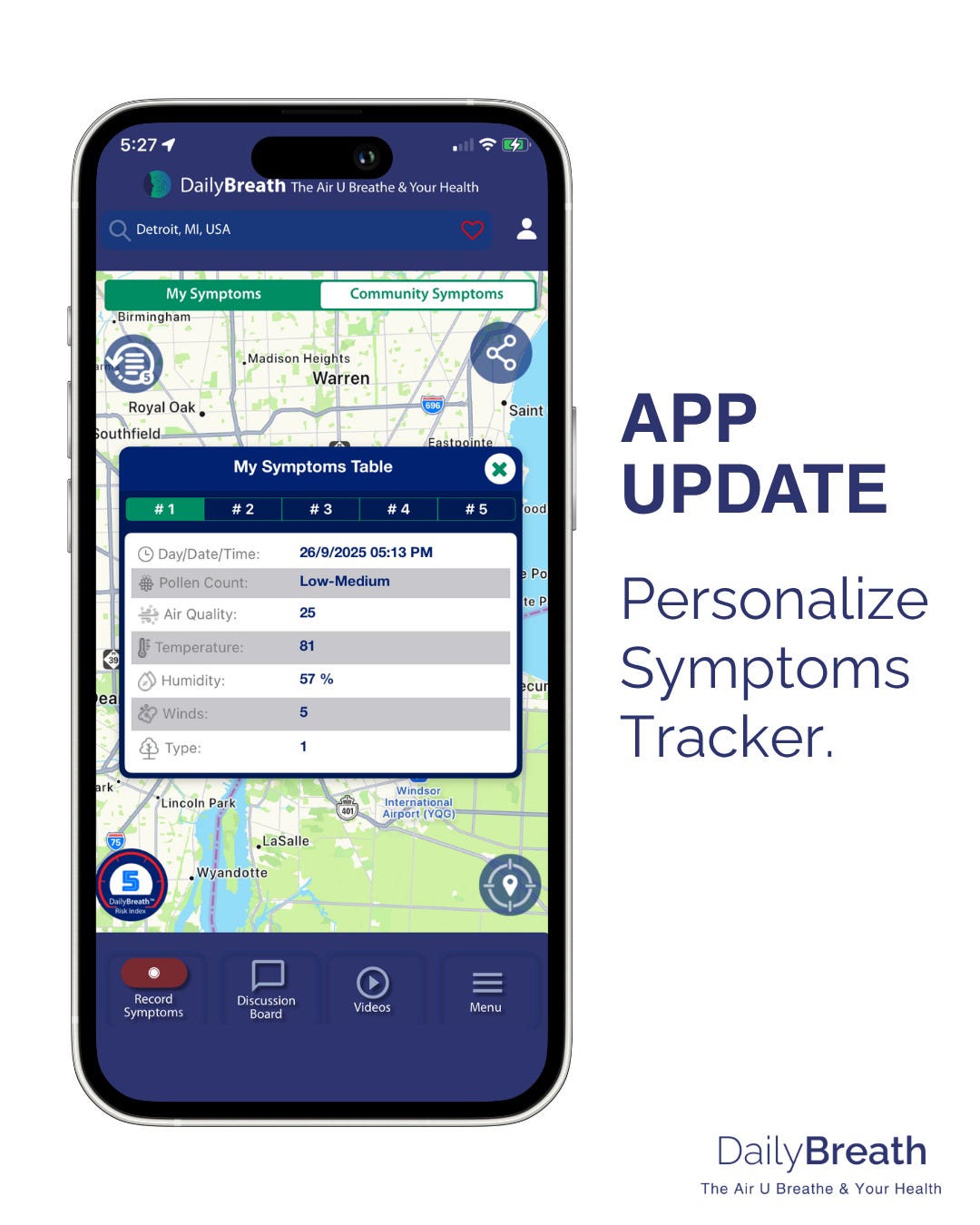
A Personal Environmental Health Record.
Imagine being able to look back over months or years and understand:
Which pollutants consistently worsened your breathing.
Whether wildfire smoke affected you more than pollen.
How often symptoms occur after high PM2.5 exposure.
Whether medication adherence reduced symptom severity.
Which interventions worked.
Which environments helped you breathe your best.
This creates a feedback loop that has largely been missing from respiratory care. Without measuring exposures alongside outcomes, we are left guessing.
We Can Do Better
We need to help people understand their own environmental risks, anticipate periods of higher vulnerability, reduce avoidable exposures, and learn from their own experience over time.
We need to translate awareness into action; data into prevention; and knowledge into personal health empowerment. This is how we can begin to reduce the number of stories like the one that inspired this blog.
Final Thought
Every child lost to asthma is one too many. Every hospitalization should motivate us to ask whether something upstream could have been prevented.
Medicine saves lives. But medicine and environmental awareness working together save more. The future of asthma care should not simply be about treating attacks.
It should be about helping people avoid them in the first place. That is the vision behind DailyBreath.
Because the air you breathe should become part of your health record—not just the emergency that follows.
Haven’t tried DailyBreath yet? There’s no better time to take a more informed, proactive approach to the air you breathe. The DailyBreath platform helps you understand today’s air quality, spot potential triggers, and plan your day with confidence. Get started to stay informed and make smarter daily decisions.
Start your journey in personalized environmental health intelligence by downloading the DailyBreath-The Air U Breathe mobile app. Explore the free version, but to customize and personalize your experience, DailyBreath Plus lets you track patterns over time and see how allergens, pollution, and weather uniquely affect YOU, so you can plan ahead with even greater confidence.
You are not at the mercy of environmental triggers. You can protect your health. You can change behaviors. You can purchase solutions that serve as upstream interventions that help you avoid a path towards acute symptoms, and, overall, to a better quality of life every day.
The Air U Breathe Store offers a marketplace of solutions that are part of a constant effort required to reduce and avoid pollutants, allergens, and weather exposures that contribute to a symptom march towards potentially preventable acute symptoms or just a general deterioration in health over time.
DISCLAIMER: The Air U Breathe Store includes affiliate links, and DailyBreath may earn a small commission at no extra cost to you.
By subscribing, you are joining a movement to provide a personalized approach to the air you breathe and your health. You can’t manage what you don’t measure and it’s time to measure the personalized impacts of allergens, pollutants, and weather conditions on your health.
Keep an eye out for our next edition, where we continue to explore and support your path to managing the air you breathe every day. With DailyBreath, you’re equipped not just to face environmental challenges, but to thrive amidst them. Stay well and breathe healthy!
Comments
Nothing yet. Say the first thing.
Sign in to join the conversation.