
This is unflattering stories. I asked unflattering readers what they would want to share about their own evolution of style or barriers to it and I’ll be sharing their thoughts regularly.
I met Diana Fox Tilson, LICSW in the comments of this newsletter. I always found her comments thoughtful and insightful. When I started the unflattering chat in 2024, I got to know Diana a bit better, and now she’s a staple in our Friday outfit threads. She’d drop intriguing little tidbits about her life here and there and I was excited when she started her own newsletter, Other Interests, also in 2024. I wanted to hear more about her story, so I asked her to share here.
I’m a little uncomfortable with how much credit Diana gave me in this piece for unlearning society and her mother’s rules, but I decided to leave them in because I do think shifting this type of thinking can be extremely powerful. I know there are so many of you out there who also internalized fashion rules, and I think you’ll really resonate with this story.
Content warning: this essay contains many references to disordered eating and body image, specific sizes and measurements, and anti-fatness. Please take care of yourself and skip this one if it’s not something you should take in today.


In 2002, as a student at the New School in Greenwich Village, I showed up to my undergraduate English class wearing an outfit that was typical for me at the time: a vintage brown plaid cape from the 70s over an ivory turtleneck sweater, wide-leg tan trousers, and a pair of sleek brown leather boots.
My frenemy in the class looked me up and down. She wore the early ‘aughts hipster uniform of a greasy mullet, low-rise jeans, and an ironic graphic t-shirt, likely all sourced from the Urban Outfitters around the corner. She looked like a college student, while I was admittedly overdressed for class, especially with my pearl earrings. After giving my outfit side-eye for another beat, she asked, “Where would you even get the idea to wear that?” Her tone landed somewhere between envy and insult.
I shrugged. “From my mother,” I said. “Doesn’t everyone get their sense of style from their mother?”
She shook her head. “My mom is a public defender who wears power suits from the 80s. She is the last person I would want to dress like.”
I was twenty years old and admittedly, this was the first time it had occurred to me that other people didn’t learn the rules of fashion at their mother’s knee. My mother has many shortcomings, but bad taste is not one of them. Vogue was her bible. She wanted to go to fashion school, but my grandfather wouldn’t pay for it, insisting that college degrees were wasted on women, even though he met my grandmother when they were both college students.
My mother harbored a lifelong insecurity about her lack of formal education, but it didn’t stop her from starting her own business in San Francisco designing custom bridal gowns.
My stepfather was a violinist, and they had a side business as character entertainers for parties, strolling around high-end events in my mother’s exquisitely crafted costumes. They most often went as Harlequin and Columbine from the Commedia dell’arte, but my mother also had an elaborate gold satin Marie Antoinette costume, complete with a towering white wig. The garage in their Sunset district townhouse stored rolling racks full of magical costumes in sumptuous fabrics.

I stopped talking to my mother a couple of years after I graduated from college and haven’t spoken to her in over twenty years. To say we have issues would be an understatement, but my fondest memories of her are of watching her work: her steady concentration as she cut silk or draped satin on a dress form, light streaming in through the tall windows of the converted warehouse where she had her bridal studio.
She taught me to sew when I was twelve, explaining how to customize a pattern to fit your measurements; how to pick the right fabric for the garment; and how to pin the pattern to the fabric and cut it carefully, using long strokes to avoid choppy seams. She taught me about how bias-cut fabric drapes around the form, and how a princess seam hugs the curve of a bust; how synthetic fabric has an appealingly low price point, but can’t compare to the hand-feel of natural fibers.
She was also a master thrifter. San Francisco in the 90s was a thrifter’s paradise of high-quality clothes, unlike thrift stores today, which are overflowing with fast fashion castoffs. My mother never had much money, but adorned in thrift store treasures, she looked like a million bucks. Her favorite store was in the Mission District, back when the Mission was a neighborhood where you had to make sure not to leave so much as a grocery bag in plain sight in your car or your window would be broken by the time you returned.
She led me down the aisles in the thrift store running her hand along the clothes, explaining that you could tell that something was good quality just by feeling it. She discarded the cheap, trendy clothes I pulled from the racks, turning them inside out to compare the seam construction with the designer clothes she rescued. She taught me to compare the fabric content labels, rejecting anything polyester or acrylic in favor of clothes with a high natural fibre content instead. I got good at running my hand along the racks and pulling out silk, wool, linen, and cashmere items. She offered rare praise when I succeeded at this task, exclaiming, “You have a good eye!” That was the highest compliment, coming from her.
She also had a gift for picking accessories that looked more expensive than they were. She liked to brag about the time someone asked her if the hummingbird brooch she bought in Chinatown was from Tiffany. She gave me a Bulova watch when I turned 18 and explained that Bulova didn’t have the status of Rolex or Cartier, but was considered a respectable brand, and that people were less likely to question the provenance of your knockoffs if you wore them along with a name-brand piece. By combining high-end thrifted items with well-chosen dupes, she passed for someone from a much higher tax bracket and used this to gain trust and credibility with the kind of client who could afford to commission a couture bridal gown.
My mother taught me to dress so I could enter any room with confidence, and that was an invaluable skill when I moved to New York City and entered a publishing world full of old-money WASPs. When I could barely afford to feed myself, her lessons allowed me to move with ease in spaces that were not meant for me, and to blend in with people who never suspected that I didn’t belong there. There is no question that her fashion lessons opened doors for me.
There was a downside to her good taste, though, most notably a constant undercurrent of fatphobia. The word “fatphobia” doesn’t really capture my mother’s attitude toward fat people. Fat-loathing might be a better descriptor. My mother’s aesthetic was all about conveying status, and being thin was the foundation of that status.
I was not a fat child, but that didn’t stop my mother from criticizing my body. I have a distinct memory from when I was around 6 years old of her tapping my mid-section in front of several onlookers at a family party and telling me to “suck it in.” It was clear that she didn’t want the rest of the family to think she was raising a fat kid. It hadn’t occurred to me before then that there might be something wrong with the shape of my body.
Her criticism of my looks started young and never let up. She pointed to the cellulite on my thighs and told me the texture was caused by “trapped carbonation.” She criticized the dark circles under my eyes, urging me to wear concealer. She openly admired the “discipline” of skeletal eating disorder patients on the news. She pressured me to lift hand weights “to add definition” to my slender arms. She pointed to my stomach and said it could be flatter if I would just stop being so lazy and join her in doing crunches. I didn’t develop an eating disorder mostly to spite her, and I enjoyed riling her by ordering the most decadent dishes on the menu at restaurants.
My mother’s style advice religiously followed the rules of wearing what was flattering, which is to say, what was maximally slimming. She told me I was short-waisted, so I should avoid anything cropped or boxy, as it would accentuate my short waist and make me look wider. She favored princess seams and Basque waists on me, which she said elongated my waist and offset my hips, which she deemed too wide. She had very specific rules about the length of pants and dresses, deploring any skirt that landed halfway between the ankle and knee. Hems should land just below the knee to show off the curve of the calf, or else reach all the way to the ankle to accentuate the length of the legs.
My mother didn’t need Color Me Beautiful to help her identify flattering colors. She had her own byzantine color rules. I was never to wear yellow, which clashed with my skin, but should wear coral, which brought out the natural blush in my cheeks. She held up a taupe blouse to my skin in front of a mirror at the thrift store, declaring that it made me look like a cadaver (she wasn’t wrong; I still don’t wear taupe above the waist), then swapped it with ivory, illustrating how the ivory made my skin look bright in contrast.
I could fill a whole book with my mother’s style rules. The unifying theory of all her rules was to look as thin, chic, and high-status as possible at all times. Even when gardening, her goal was not the utility of her gardening clothes, but how she looked in them. She only deigned to wear jeans when gardening and wore a crisp button-down shirt with a popped collar, sleeves rolled back to exactly three-quarter length, with colour-coordinated floral-print gardening gloves. She dressed as if a photographer for Martha Stewart Living might be hiding in the bushes, waiting to capture the perfect shot of her wielding pruning shears.
What was lacking from my mother’s approach to style was joy, comfort, or individual preferences. No, I take that back. She dressed to please herself, but my preferences and comfort were irrelevant. I’ve written elsewhere about my mother’s motives for teaching me to apply make-up and her insistence that I model. Physically, I was a carbon copy of her—tall, slender, blonde-haired, blue-eyed—and she was intent on maximizing my looks for profit in a way she never managed to do herself. She repeatedly married starving artists, but was intent on marrying me off to the richest man possible.
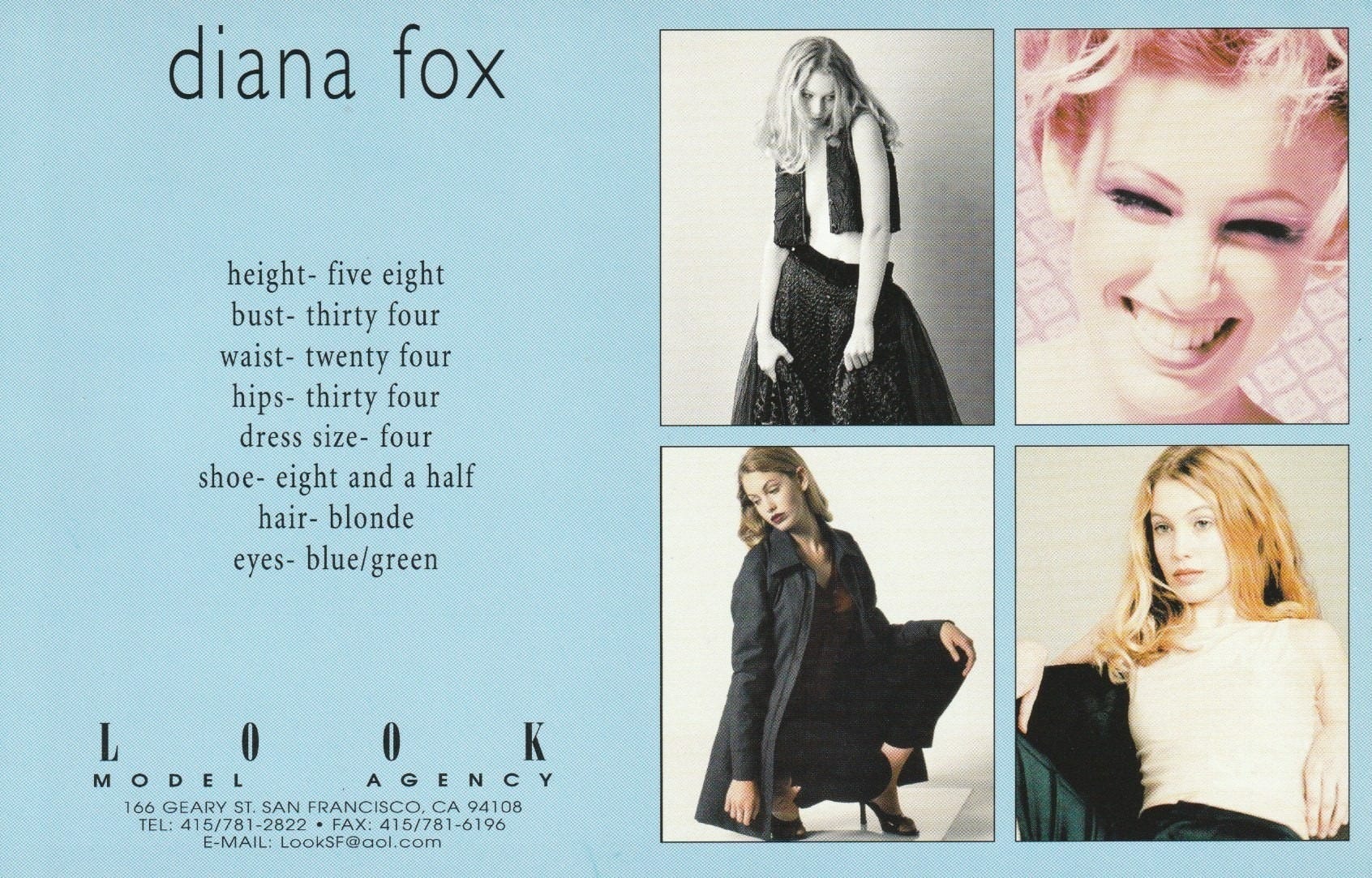
I quit modelling when my agent kept pressuring me to drop out of school to devote more time to attending open calls. My mother was dismayed when I dyed my hair hot pink at 16 and got a nose stud at 18. It wasn’t really until midlife, though, that I truly began to undo much of my mother’s conditioning about how I should dress.
My mother’s voice lives in my head to this day, even though I haven’t talked to her in decades. It’s quieter now than it used to be, but it’s like having my own personal Miranda Priestley or Stacy London narrating every sartorial choice.
When I found Dacy’s work a few years ago, it was the first time I encountered the idea that one might deliberately choose to wear clothes that were “unflattering” because they were comfortable or aesthetically pleasing in some way that went against conventional beauty standards. Dacy re-parented me with her philosophy that women should choose clothes because they make you feel joyful or confident; to prioritize how clothing feels over how well it creates slimming optical illusions; and to treat getting dressed as an act of creative expression, rather than a way to maximize status.
I don’t live in New York City anymore, and I no longer need to keep up with the old money snobs. I live in the Seattle suburbs, where I’m a mom and a psychotherapist, and where the dress code is almost aggressively casual.
No one in my neighborhood is noting the brand of my watch or wondering if my accessories come from Tiffany. I work from home, seeing clients remotely via telehealth, so I don’t even need to dress for an office anymore. I’ve embraced the gray streaks in my hair and my larger body, abandoning my mother’s diet rules and fashion maxims.
In this environment, my style has dramatically changed. I still like to buy clothes second-hand and prefer natural fibres, but the rest of my mother’s rules have gone out the window.
Much of my experimentation with style in recent years can be traced directly to Dacy’s influence. I love to pair a boxy, cropped top with a pair of barrel pants, short waist be damned. I’ve been playing with loose silhouettes that do nothing to minimize my shape, and wearing bold prints in bright colors.
I’ve fully embraced the ethos of dressing for the girls and the gays, hoping to send the signal to like-minded folks that I’m a creative and interesting person, rather than dressing to attract the male gaze.
Participating in Dacy’s Friday outfit threads has been an exposure exercise that has emboldened me to break all my mother’s rules, supported by a like-minded group of fashion rebels. My mother would be appalled to see that I am not only flaunting style choices she would disapprove of, but also posting photos of myself while fat for thousands of people to see.
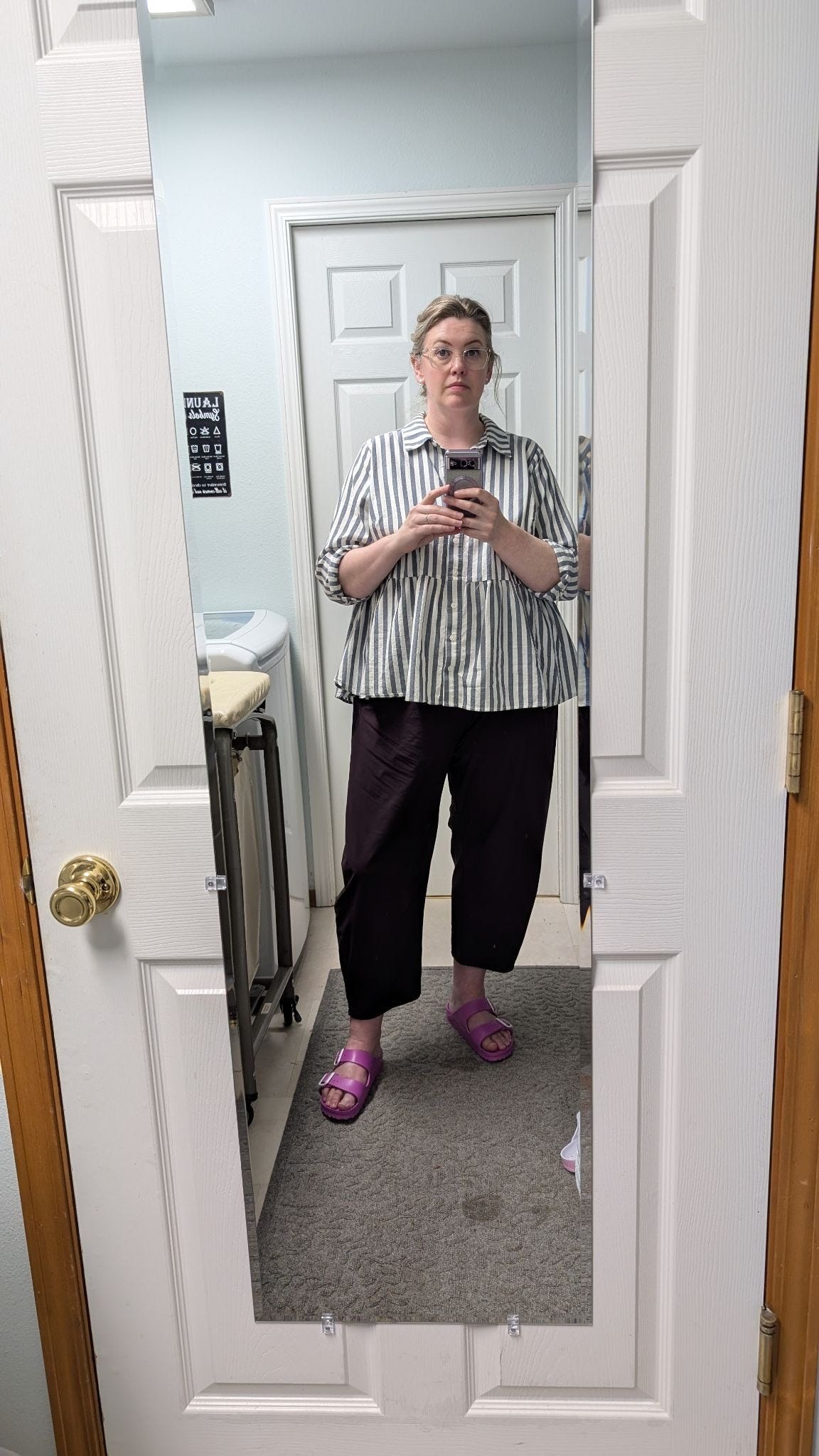
This was an outfit Dacy admired when I shared it in the chat recently. I hesitated to post this because my mother’s voice was loud in my head. She would admonish me for wearing this top because the peplum adds volume to “the widest part of my body.” She would have tsked at pairing it with voluminous barrel pants because combining an oversized top with oversized pants is “dumpy.”
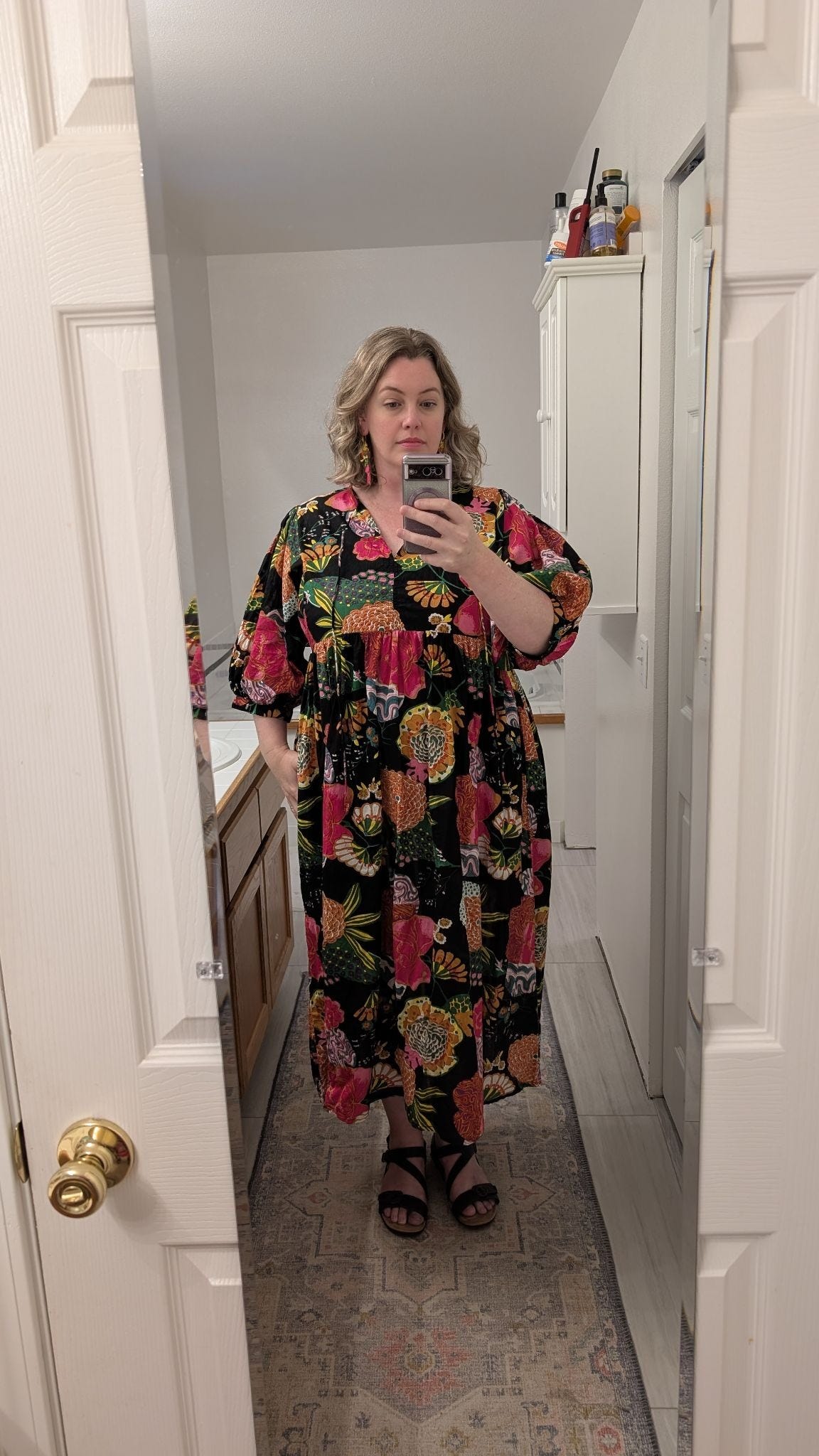
My mother would disapprove of this dress as well, both for being abundantly voluminous, but also because she would say the bold print and bright colors are overpowering and wash me out.
I’m raising a daughter of my own now and being careful not to pass on many of the messages my mother conveyed to me. My daughter is exuberant in her love of color, clashing prints, and unexpected combinations. I encourage her experimentation and am often inspired by her unconventional choices.
Being a mother is the hardest task I’ve ever taken on, and parenting a daughter feels especially fraught. I like to think that my mother was trying to prepare me for a hostile world with her fashion lessons—and in many ways, she did.
I was often complimented at the beginning of my career on how “professional” and “poised” I appeared, and I had my mother to thank for that. In a world that doesn’t take women seriously, she taught me to dress in a way that conveyed privilege and power so that I would not be dismissed.
I appreciate those lessons, and am grateful that at this stage of my life, I can dress to delight myself instead of dressing to impress.

Thank you so much, Diana! As I read Diana's story, I couldn't help wondering how many of us are still getting dressed with someone else's voice in our heads.
Is there a style rule you've inherited that you're finally learning to let go of?
I'd love to hear your story in the comments.
Comments
Nothing yet. Say the first thing.
Sign in to join the conversation.