
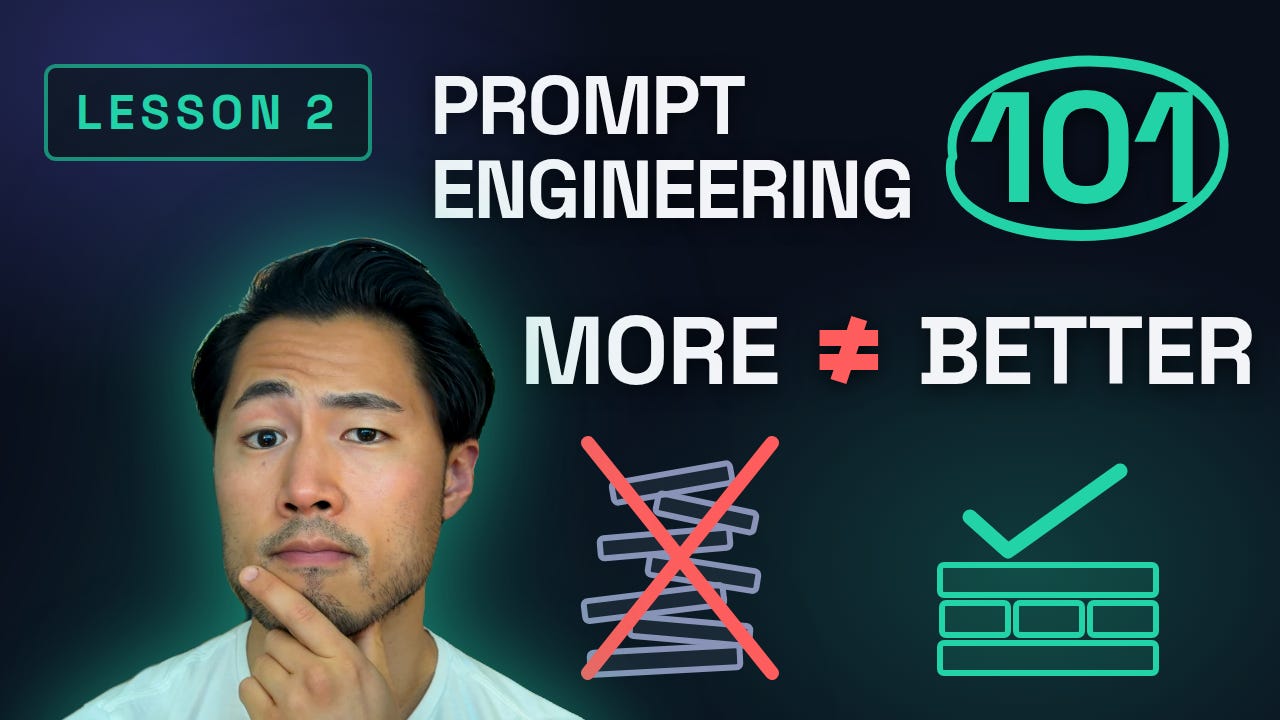
Lesson 2 of the fully-free Open Augments AI Academy is out today: “How to Make AI Less Bad: Context Is Everything”
First, a big thank you to folks for sharing and digging in: the AI Academy launched just a week ago, and we’re on track break a thousand subscribers on YouTube today or tomorrow. W I L D. These videos are a LOT to put together at the level of production quality and accessibility I’m shooting for, and I’m so grateful it’s resonating with folks (things to remember when I’m frantically editing videos with Claude past midnight!!).

Lesson 1 covered how these large language model AI systems actually work under the hood (i.e., Autocomplete with an extremely fancy hat on). While many see this as a fundamental and fatal flaw (and it is!), this lesson is where we learn how to start making that autocomplete engine work *for* you as its greatest strength, as well: endless flexibility and adaptability. In an 18 minute lesson, you’ll learn:
The most practically useful mental model in the entire course: thinking of your AI assistant as having two very different kinds of memory (one fuzzy and unreliable “long-term” memory, one sharp and steerable “short-term” memory)
How to start “loading the dice” on these autocomplete engines to get dramatically more useful and reliable responses back (what people call prompt engineering)
Why more context is NOT always better: two extremely common failure modes called context rot and auto-compaction that explain an enormous amount of everyday “why did my AI suddenly get dumb?” frustration -- and one simple habit you can start practicing that prevents them outright
If you’re just hearing about the AI Academy: I strongly recommend starting with Lesson 1 and running through its practice exercises in the interactive Context Gym first -- this lesson builds directly on both (with a lot of persistent mental models and visual diagrams you’ll want to get familiar with). And there are eight brand-new hands-on Gym exercises accompanying today’s lesson (auto-compaction in action, memory files, custom system prompts, and more). Free and in your browser.
And we are still just getting started. One way to think about it: My goal is that this series is a crash course to catch people up on these utterly crazy past two years in AI. Lesson 1 catches you up to where the AI world stood in ~2024. Today’s lesson on prompt engineering gets you to the beginning of 2025. Next Wednesday’s lesson -- on tools and agents and context engineering -- catches you up to roughly the end of 2025. From there, we’ll get everything practiced and really digested through the end of Level 1, and Level 2 is where we start getting through the advances of 2026.
I’m trying to make this the smoothest yet *accelerated* on-ramp I can for anyone who wants to genuinely understand this moment, not just skim the headlines. I genuinely don’t think there’s a better way to get caught up (that’s why I’m making this: for free, forever, for everyone!), and I hope you’ll take the time to dive in!
Comments
Nothing yet. Say the first thing.
Sign in to join the conversation.