
It’s been just a little over a month since I first shared DAAF, the Data Analyst Augmentation Framework, with the world.

Brian Heseung Kim@brhkim
Today, I’m launching DAAF, the Data Analyst Augmentation Framework: an open-source, extensible workflow for Claude Code that allows skilled researchers to rapidly scale their expertise and accelerate data analysis by as much as 5-10x -- without sacrificing the transparency,
2:51 PM · Feb 16, 2026 · 73.5K Views
14 Replies · 78 Reposts · 438 Likes
In that time, I’ve been deeply grateful to have so many fantastic conversations with colleagues, friends, family, fellow researchers, and more than a few skeptics, about what AI could and should mean for research and academia.
The consensus among people who’ve thought a lot about this is basically:
Everyone sees there is immense power and potential
Everyone sees there are a LOT of problems to grapple with
Everyone is looking at the general state of the world and the power-holders in our society and expecting the issues of #2 to greatly overpower the benefits of #1
I’d definitely agree with that assessment, and it’s in that assessment that I’m as motivated and energized as ever to keep building DAAF into something that can help contribute to getting us #1 while mitigating #2. As I say in my “Peer Review is Dead; Long Live Peer Review” article: we aren’t just passive observers here, and we have the opportunity to make the change we want to see. It’s a wild, upsetting time, but it feels good to at least try and channel that into something useful for others.
And thanks to all that nervous energy, DAAF v2.0.0 is a straight-up rebuild of DAAF; where v1.0.0 was functional, there were a LOT of meaningful limitations to it. It was highly focused on the Full Pipeline mode -- which, while very neat and a strong stress-test for its overall capabilities, was FAR heavier (and also WAY more token intensive) than most users would be comfortable with for using AI in their current workflows. Moreover, this focus on getting the Full Pipeline figured out was at the cost of really fleshing out how DAAF thinks about data and work. The basics were there, but ask it to do anything like a difference-in-differences, and you’re kind of out of luck (i.e., you’d end up relying on the generalist knowledge of vanilla Claude Code).
DAAF v2.0.0 tackles these two problems head-on in a couple of really neat ways, in my opinion (and you can see the quick showcase above for some nice explanations of the new modes):
The Orchestrator system is rebuilt from the ground up by building out a comprehensive daaf-orchestrator Skill. This allows us to be way more token efficient, loading in precise workflow instructions at the right time, rather than trying to load comprehensive information about basically every workflow all at once. It took a little finagling to get it to load properly when interacting with the human (and, e.g., not being loaded by subagents doing work), but this was an enormous win allowing us to rapidly build out new engagement modes with relatively much less effort and risk (since all of them are now modularized and independent of one another, for the most part).
That work to modularize the orchestrator facilitated the rapid creation of several new engagement modes. This included:
Upgrading the data-ingest process to a full-blown Data Onboarding mode with the level of care and rigor we really want when profiling new data sources (as high quality data profiling/Skills is the fundamental crux on which basically every other feature of DAAF hinges)
Building out a much ligher-weight and more collaborative Ad Hoc Collaboration mode for those who want the flexibility of vibe-coding with the data smarts and care of DAAF
Setting up a Reproducibility Verification mode that allows users to use DAAF to rapidly re-verify past projects from DAAF (or from other colleagues using DAAF!)
And -- my personal favorite and most used -- the Framework Development mode, which allows users to make extensions and core adjustments to DAAF in a guided and highly rigorous way. This last one is huge: it makes it so that anyone should be able to extend and customize DAAF to their own liking, without necessarily needing the deep level of expertise and battle-knowledge of being deep in the guts of it all the time. Not surprisingly, I used it to build almost everything else in DAAF v2.0.0.
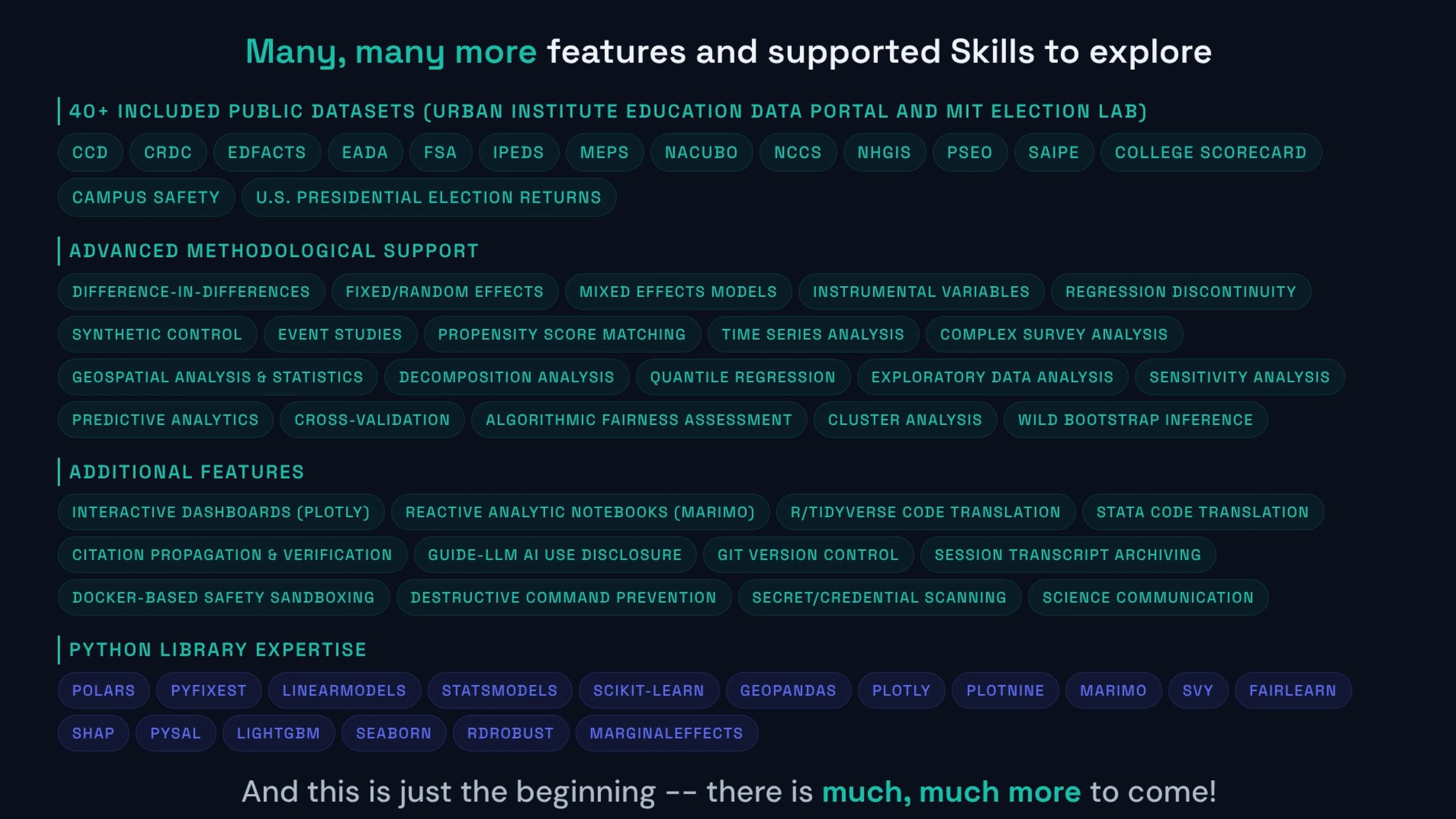
Framework Development mode allowed me to also rapidly develop new toolsets and Skills for DAAF to use across workflow modes. For example, the data-scientist skill providing data analysis expertise and thoughtfulness to basically every agent in the system now has a deep, deep roster of extended expertise it can pull upon as-needed for various methodological tasks: geospatial analysis, difference-in-differences designs, regression discontinuity, fixed/random/mixed effects models, complex survey analysis, and WAY WAY more. This is in addition to some really nice utility/support Skills like science-communication best practices, helping users translate between R/tidyverse and Python and also Stata and Python, and really nice incorporation of new best practices on AI use disclosure (GUIDE-LLM). The below is my absolute favorite scene in the new showcase demo, because it is REALLY overwhelming to think about how much more DAAF can do well now.
There’s much more to say across the board (improved logging, improved safety, improved environment reproducibility, better and safer Hook management), but I think those will be some of the core things people should be really excited about and will immediately notice on using DAAF since version v1.0.0. If you’re really interested in the nitty-gritty, you can see a full changelog on the GitHub here.
I can’t emphasize enough: It’s a different animal now, and I would LOVE to hear how people who are both new and not new to DAAF take to the new changes and capabilities to do actually useful work from here.
As part of this launch for v2.0.0, it’s probably prudent to share three bits of news:
I recently left my job as Director of Data Science at Common App to push on DAAF and related projects to better support public-interest organizations, non-profits, and researchers working in pursuit of the common good in using AI technology responsibly via my new venture, Open Augments. It’s a big risk in some ways, but I’m betting on myself and utterly convinced of the urgent value of being able to provide more educational resources and support in this space full-time!
As part of that identified need, I’m spinning up a new Community of Practice via Discord (it’s basically just Slack) for like-minded researchers wanting to explore this frontier of AI for Responsible and Rigorous Research. My dream is to bring together people of all disciplines, with all sorts of experience and perspectives, to help us hammer out these really critical and pressing questions of how we wrangle AI for something truly useful for science and society more broadly.
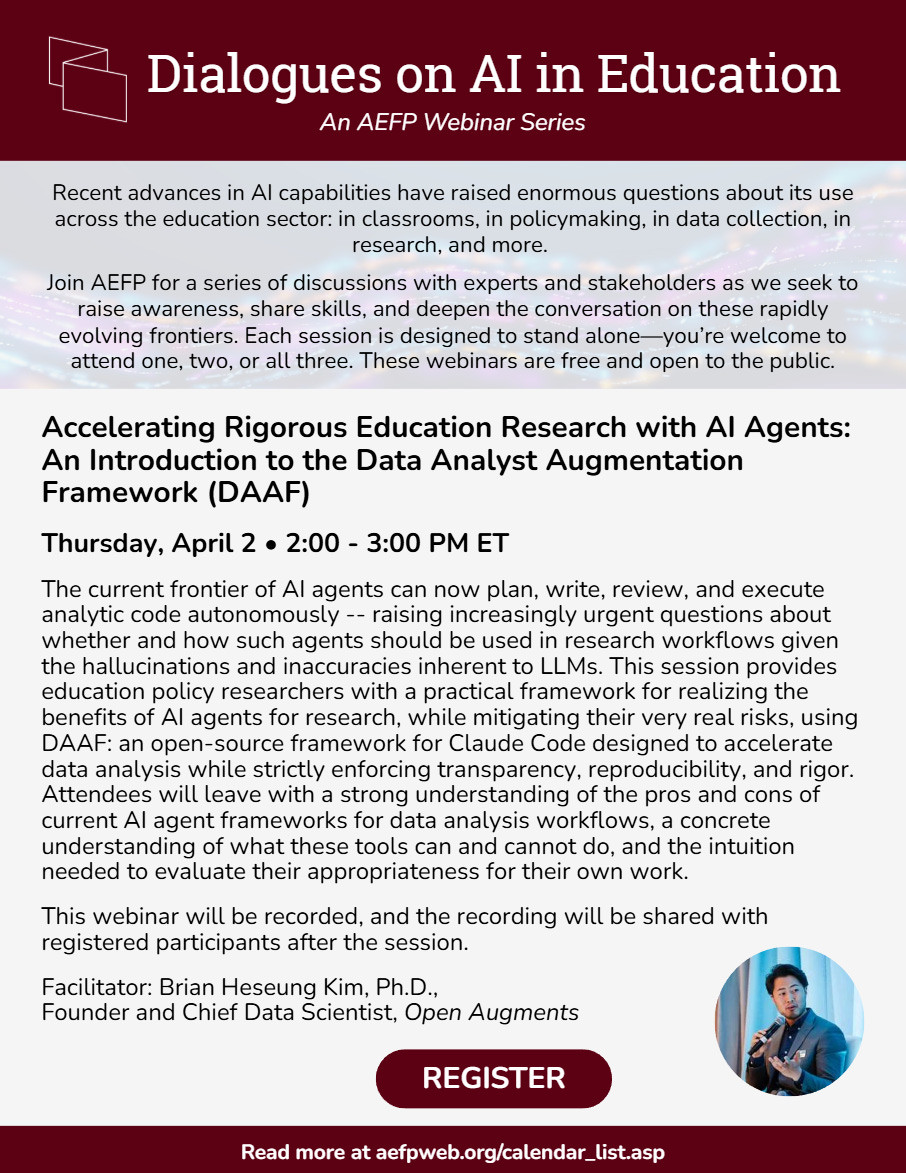
Lastly, this Thursday (April 2), I’m giving a webinar introducing peer researchers to DAAF through the Association of Education Finance and Policy. You can register here -- it is free and fully open to the public! It’ll be recorded and shared here afterward for anyone who can’t make it live.
Phew, I think that’s everything for now. Truly and deeply excited to hear what people think of DAAF v2.0.0, and equally excited to hopefully see some of you in the new community Discord to talk about DAAF and all other things percolating through our various corners of the research world.
Thanks to everyone who’s been along for the ride since the early days; it’s meant a lot!! You know where to find me for more, until next time!
Comments
Nothing yet. Say the first thing.
Sign in to join the conversation.