
I watched a Corbett Report video about technocracy earlier. The idea that society should be ran by scientific experts. Or, as Corbett points out in the video, the idea that society should be socially engineered by the experts. Anyhow, the famous Pavlov’s dog experiment popped up. The technocracy advocates seeing it as an enormous insight into the “human animal.”
The experiment’s fairly well known. In short, Pavlov rang a bell every time he fed his dogs. The dogs would salivate in anticipation of the food. Pretty soon the dogs came to salivate simply at the ringing of the bell. Even if the food wasn’t there.
He’d conditioned the dogs to salivate. Thus, Pavlovian conditioning was born.
The general takeaway tends to be that dogs are stupid animals: input/output machines, driven (and easily deceived) by their biological urges.
And further, that we, being animals as well, are also stupid and easily programmed.
However, my takeaway is more that people are easily impressed by anything that has the appearance of science. After all, it’s a pretty basic observation. That dogs (and humans) associate things that are in fact associated in their natural environment. It shouldn’t really take a scientific experiment to illustrate this. Obviously if you ring a bell every time you feed a dog the dog will come to associate the one with the other.
“WOW! Great work there, Pavlov. Time and money well spent. You’ve really expanded our understanding of how the world works.”
*slow handclap for Pavlov*
Not exactly Newton is it.
If you grow up in a household where every time your mam bakes a cake she wears an apron you’re naturally going to think, “Mmm, cake!” when you see her put the apron on. If one day she puts it on and there’s no cake you’ll be all excited for nothing.
“Where’s the cake?”
“What cake?”
“I thought we were getting cake?”
“Ah, no, I’m wearing the apron for a different reason ..I’m preparing broccoli. We’re gonna start eating more healthily.”
“Damn this Pavlovian conditioning! I’ve been fooled into salivating.”
Again, it’s all quite standard. It shouldn’t be surprising that associations are formed. It’s just what you’d expect.
What would’ve been more interesting was if the experiment had shown that the dogs didn’t respond to the bell. That dogs used telepathy to anticipate meals, not cues from their real world environment.
“The dogs just ignore the bells. They’re not like us. They use some type of ESP to see through the walls. If there’s nothing in the bowl they won’t salivate. No matter how much we ring the bell and shout, “Food time!”
That would’ve been something ..but alas, no. We got common sense observation dressed up in the garb of science - so people could say, “Look how stupid the human meat creatures are. And yes, aren’t I so very smart for understanding all this.”
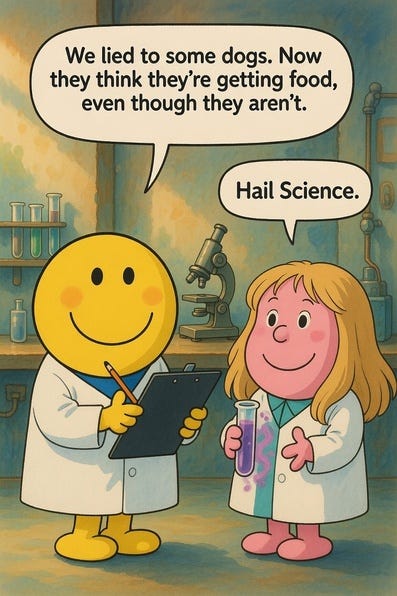
But who’s the real idiot? The salivating dog, or the humans that need to spend weeks and months ringing bells at dogs to figure this basic aspect of reality out?
Now yes, I’m being a tad facetious here. I’m sure people will point out that Pavlov already understood all this, and that the experiment was just to prove the hypothesis. That the real takeaway is that these associations are somewhat more subconscious than would be assumed. That they happen on a deeper, biological level. And, more to the point, that the observation lays the groundwork for the deliberate use and exploitation of it.
Still, does it really necessitate the, “WOW, science!” open-mouthed reaction? Coupled with the arrogant sense that animals (including the “sheep-like” humans) are somehow lessened by being influenced by environment in such a way.
I really think here we see the beginnings of when science fell into scientism.
No posts
Comments
Nothing yet. Say the first thing.
Sign in to join the conversation.