
I tell people that I don’t know how I managed to finish a PhD while suffering acutely from borderline personality disorder (BPD), but that’s not entirely true. I was born under the sign of Cancer, and my crablike tenacity helped a lot. This character trait stuck as I raced through the ecliptic, adopting the temperaments of the eleven other zodiac signs via endless mood swings and personality shifts.
Of the nine criteria for BPD, which include “frantic efforts to avoid real or imaginary abandonment” and “recurrent suicidal behavior,” the one that troubles me most when trying to explain the disorder to others is “markedly and persistently unstable self-image or sense of self.” “Unstable self-image” sounds vague. Some people even jump into philosophical questions about selfhood or the soul, drawing on Buddhism and Foucault, arguing that no “self” exists within the universe’s continual flux or outside the social and discursive construction of personhood. But I explain it this way. We all know what it’s like to go to a party, get tipsy, and act out of character. When most people wake up the next morning, they might smile at the previous night’s shenanigans, glad to return to who they really are at the start of a new day. But a borderline might feel the party self is just as real as the morning-after self. She can never be sure which, if either, is her. In Japan, someone once accused me of being koro-koro, an onomatopoeic phrase used about people and things that seem to change all the time.
Luckily, I have stayed true to my love for writing and studying all my life. During childhood and most of adolescence, a steadier Cynthia took over at school. There, I gained some traction. I earned high grades, and because I never bragged about them, my classmates were usually kind to me. When I entered my sixth-grade gifted program late because I had been hospitalized for anorexia, my peers and teachers treated me gently. I was considered fragile and protected accordingly.
Used to feeling unsafe at home, I was bewitched by protection. I never wanted to leave school after that.
Despite the fact that studies have shown borderlines to possess above-average intelligence (one found an average IQ of 130 among participants), BPD most often affects people with less formal education. Given that people with the disorder often find it hard to stay focused on long-term goals, it seems likely that BPD is the cause rather than the result of lower levels of education. Undergraduate and graduate programs demand a level of concentration and commitment that many borderlines can’t manage over a period of years. Still, I had dreamed of a doctorate since my mother attained one when I was nine years old, and I did function better while at elementary, middle, or high school than at home. I hoped that this functionality would persist when I moved to my liberal arts college.
But when I was 17, an aunt told me one of the most brutal and honest things I’ve ever been told: “It’s going to get worse.”
She was right.
Through grade 12, I never heard the phrase “borderline personality disorder,” yet I started acting out its criteria. By senior year, my inability to cope with my abusive home environment and my mood swings made me a frequent truant. I missed days of school at a time, journaling on a dock by the river or taking photos with my friend Veronica around town. In fact, if I hadn’t applied to one of the top-ranked liberal arts colleges in the United States by early decision and been accepted in December, I wonder if I would have gotten into a good school at all. By the middle of senior year, I had dropped several of my courses for a swath of study halls. I didn’t even show up to take the AP test for my world literature class, my favorite.
I also dropped out of college during the spring semester of my freshman year, distraught over a failed relationship, but I returned in the fall. Since my spring tuition wasn’t fully refunded and the college was ridiculously expensive, I had to squeeze my remaining seven semesters into six to keep my mother happy; she was covering what tuition financial aid and student loans didn’t. Somehow, I managed to complete college on time, even with the heavy workload. But I switched majors at the start of senior year, precipitating a near-crisis until the department waived some requirements for me. That eleventh-hour switch was a very borderline thing to do, and it ensured, along with my increased workload, a baseline of high stress, which I seemed to crave.
I looked for self-destruction in every nook and cranny.
I looked for lovers’ bodies to flesh my ghost, their outlines rescuing me from negative space.
And as I continued with my education, pursuing my PhD in Comparative Literature, I looked for myself in books and art.
**
BPD, I now see, conditioned my research interests. Words—the promise and betrayal of language—were paramount among them. I poisoned myself with words of self-hatred, but when I read, I fed myself nutrient-rich prose: George Eliot, Virginia Woolf, William Faulkner, Vladimir Nabokov, Bruno Schulz, Yasunari Kawabata, Toni Morrison. Just as I caressed and inhaled the stickers in my childhood albums, I held favorite book pages up to my nose like pressed-flower bouquets, longing to scratch and sniff their magic. Would I have been anorexic if I could have eaten words?
But we all want choice in that feast. Sometimes I wonder if I became a writer because I heard the complaint from a lover, “You’re putting words in my mouth,” just one too many times, and I intuited that my journal was a better place for them. People with BPD, some experts argue, don’t master object constancy as a child, so words hold the world in place when a loved one is absent. According to Emotions Matter’s guide for helping students, we also “display a diminished ability to mentalize emotional states without making assumptions about other people’s thoughts,” scoring high on emotional empathy but flunking cognitive empathy. Dr. John Oldman, a psychiatrist specializing in personality disorders, compared the dysfunction in our brains to a faulty car. Our hyperactive amygdala causes us to overreact to stimuli like facial expressions, and our underactive prefontal cortex fails to calm us, as if “the engine is running hot, and the brakes don’t work.”
So when I argued with boyfriends and girlfriends, I whisked their past words into the present not to pettily criticize them for contradictions in their statements, as they thought, but because contradictions alarmed me so greatly. I couldn’t grasp their states of mind from body language and facial cues alone. My trust rested on their utterances, formed by the hot breath of our common ground and fragile as morning dew. They evaporated with new sentences and different phrasing, and so did my faith in the person I adored.
Studying deconstructionists like Jacques Derrida and their insistence on the indeterminacy of language both vindicated and undercut my concerns. How can anyone trust a lover’s sentence given words’ endless connotations and interdependence? The idea of language as levity and havoc—as an infinite deferral of sense-making—lifted my spirits somewhat. Maybe I couldn’t trust the people I loved to say what they meant because language never meant what people meant it to mean.
Above all, I was drawn to the Japanese literature and language for both aesthetic and psychological reasons. From early on in my college years, its slim twentieth-century novels transported me. The kinkiness that pervades much of the canonical fiction was part of that escape, as were the demimonde settings that chronicled the realm of geisha, their customers, and other outcasts. But back then, I never consciously acknowledged that the frequent suicides also fueled my attraction to these texts. When reading them in their original language, Japanese abstracted pain, blurring it into beauty like Monet’s water lilies. Trauma was pried apart by an unfamiliar script. Vexed by form.
Japanese literature also gifted me my favorite artistic rendering of the harried border between neurosis and psychosis, found in The Tale of Genji. This book is a thousand years old. Scholars debate whether it’s the world’s first novel, and it may be. The first psychological novel too, focusing on the inner lives of women and men, written by Murasaki Shikibu, a lady of the Japanese court.
The Tale of Genji is populated by hundreds of characters, many of them Genji’s lovers. These objects of desire circulate through a hothouse environment where every syllable and calligraphic stroke is judged. In the imperial court society of that era, as well as in the novel, aristocrats couldn’t function in society without knowledge of the literary canon and the ability to ink highly allusive poetry. What passes for consent among the novel’s women is called rape today, yet even when women are ravished by Genji behind their screens and curtains, they are expected to respond with a morning-after poem appropriate to the season.
Something about this world, incensed and literary and full of predation, felt familiar but more glamorous. If you’re going to dwell in a realm full of dangerous men, I reasoned, it might as well abound with wordplay and color-coordinated robes. And I loved the book’s waka poetry, twisting on pivot words such as matsu, which means both “pine tree” and “waiting,” and tama, decipherable in syllables as a jewel or a soul. Through such homophones, the characters compact emotions like so many selves piled into one body.
One woman in The Tale of Genji, called Rokujō after her location in the capital city, is portrayed with marked sympathy even though her actions would, in the hands of many authors, position her as a villain. The consort of a late emperor, she is older than Genji and resentful of his divided attention, but she is so regal that he keeps returning to her. To call her the world’s first borderline fictional character would be anachronistic. Yet in Murasaki Shikibu’s descriptions, I can’t help but discern BPD-like traits, including Rokujō’s uncontrollable moods, her oscillation between idealization and devaluation of Genji, and her intense reactions to perceived slights and abandonment.
Within Genji’s court, the concept of mental health does not exist. Volatile moods are blamed on evil spirits, as is physical sickness. But moods may also produce spirits that possess and kill one’s enemies. As Rokujō roils with longing for and anger with Genji—“the lady . . . had never in all her life experienced the kind of torment brought on recently by her dark, obsessive thoughts”—she discovers that her excessive emotions have apparated into a demon. She thinks to herself,
They say it’s common for people to leave behind their obsessive attachments and resentments when they die. I’ve always considered such a thing deeply sinful and ominous, even when it has happened to people with whom I have no connections. But now there are rumors that it’s my living spirit that’s acting in such a grotesque, unearthly way. It must be retribution for the sins of a former life. I must never give another thought to that cruel man.
After Genji’s wife dies, possessed by Rokujō’s evil spirit during childbirth, the scorned lady has to piece together what has happened through the traces of an exorcism: “She continued to feel weird, as though she were not herself, and her robes reeked of the smell of the poppy seeds that exorcists burn to drive out a lingering spirit. Strangely, the smell would not dissipate, but continued to permeate her body no matter how often she tried washing her hair or changing her robes. She was disgusted with herself.”
What has always struck me most forcefully in Rokujō’s story is Genji’s—and by extension, the author’s—forgiveness of her. Even after he encounters Rokujō’s murderous phantasm twice, Genji admires the lady’s taste and elegance. Reflecting on how her male admirers are eager “to part the dew-drenched path to her quarters,” he says that “it’s quite natural for them to do so . . . since the lady has an innate sense of courtly refinement.” The idea that Rokujō could retain charm despite her transgressions gave me hope that I could be forgiven, especially since I’d never inhabited another person’s body and frightened them to death (at least, not that I knew of). Her portrayal gave me hope that even when my emotions spewed forth like baby spiders from their sac, I might still be loved.
I loved books with such pain-sprayed edges not in spite but because of my BPD. Trigger warnings are recommended for borderlines who are asked to read about topics like suicide and rape, and I do use them now that I am a teacher. Yet I have always been partial to trauma-heavy texts. Holding such stories in my hands makes agony more manageable, more legible. Some of my colleagues say that they don’t want to make their students read such “dark” or “hard” works. But I anonymously survey my students about their favorite reading at the end of each semester. In my contemporary literature course, Art Spiegelman’s Maus, a graphic novel about the Holocaust, always wins hands down. Miriam Toews’ Women Talking, about the real-life, systematic gang rape of drugged Mennonite women in a Bolivian colony, seized the top prize in a women’s lit class. Clearly, I’m not alone in being mesmerized by such narratives.
Stories about horrific abuse find some sort of closure. They end. Often, the protagonist achieves peace or is lifted by epiphany. You can close the book and go on with your day. That’s what I wanted decades ago: forward movement. Not to be bobbing in the muck for years on end, my head barely above water, the undertow biting at my feet but never quite pulling me down.
When I was younger, I wanted to be a story. I wanted to be whole. But my letters broke apart, an L lopping off its serifed foot and leaving nothing behind but I. And I was what I couldn’t stand, could never stand, because it seemed I had no I. Easier, I thought, to search for U.
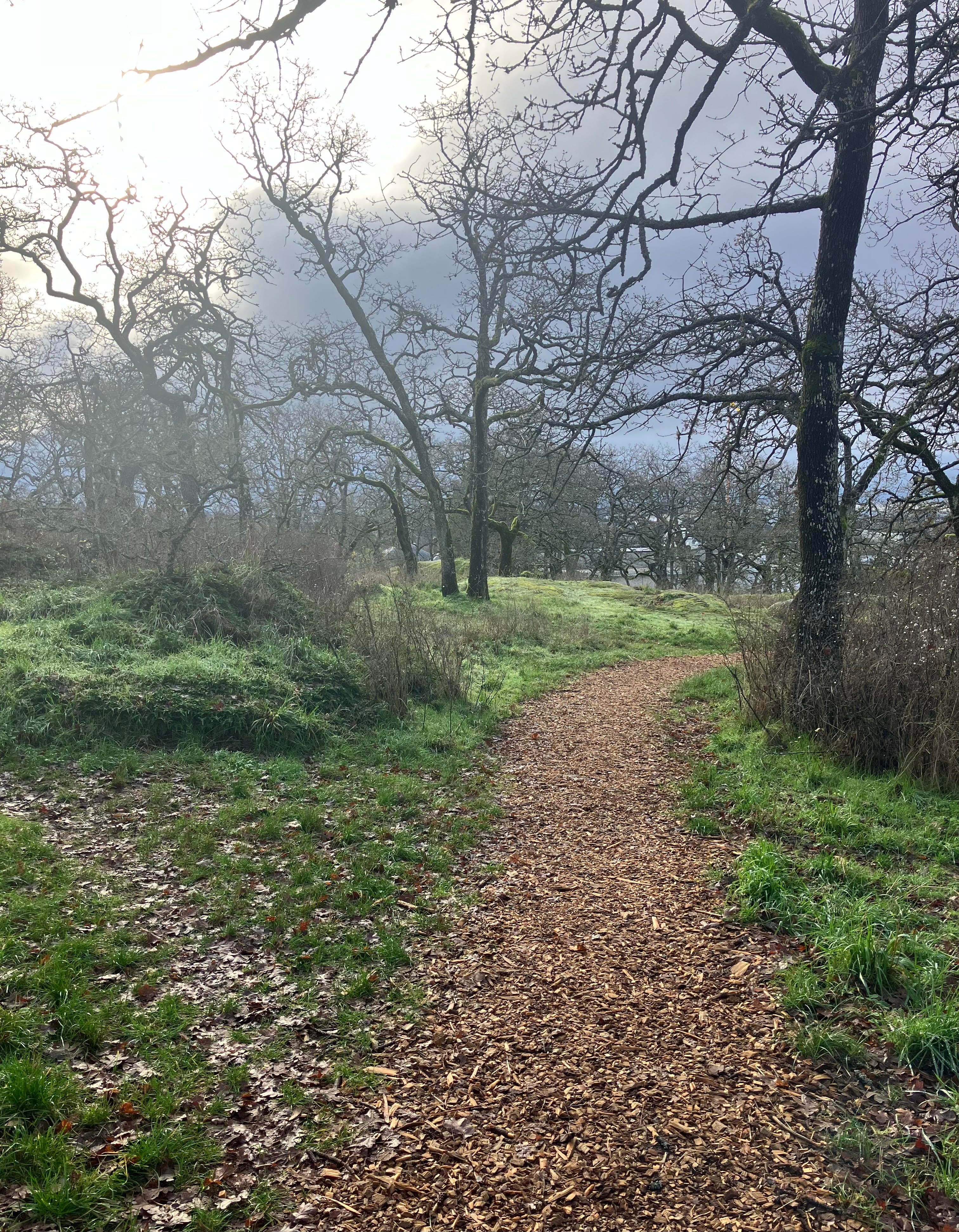
Decades later, after I finish teaching literature for the day, I’m walking by the ocean on the southern tip of Vancouver Island. The sky breaks open, drenching me with rain. Not the typically torrid British Columbian rain, but the wondering rain of California. It smells like the space between openness and need. It feels like the skin on the insides of my wrists, the smoothness I seldom feel.
On the ridge behind me, arbutus trees twist their blood-orange branches into fairy tale paths. They fork in midair like dozens of stories left hanging. Behind them, the pines wait. The soul jewels.
And I realize: selfhood is always a story, and I studied literature to write it.
No posts
Comments
Nothing yet. Say the first thing.
Sign in to join the conversation.