
I’m for us, which means I’m not for a political and economic system that is for the wealthiest and for whom life is already very good. I’m for people who need change.
-Andy Burnham
The count came in during the early hours of a Friday in June, and by breakfast the language had already curdled into legend. Andy Burnham had taken Makerfield with fifty-five per cent of the vote and a majority of more than nine thousand, and the man he beat into second place was a Reform candidate, a plumber making his debut, which allowed the whole event to be filed under a heading the Labour Party desperately wanted to be true. The King of the North had ridden south. The insurgent tide had broken against him. Here, at last, was someone who could look Nigel Farage in the eye and win.
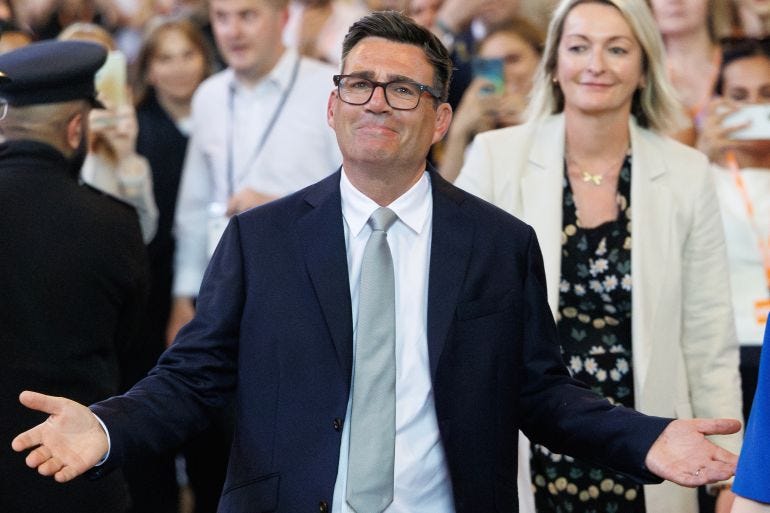
It is a wonderful story. Burnham, who has spent a decade building a brand as the most plausible person in British public life, understands its power better than anyone, which is why his victory speech reached immediately for the vocabulary of destiny. This was Labour’s “last chance to change”. Makerfield would become “forever synonymous” with the turning of the tide. A man does not talk like that about a by-election in Greater Manchester unless he intends the sentence to be quoted in a different building entirely, the one at the end of Whitehall with the famous door.
So let us grant him the moment, because he has earned a great deal of it, and then let us do the thing the coverage is mostly avoiding: look at what actually happened rather than what it has been agreed to mean. Burnham did not defeat Reform on Thursday, not in any sense that proves what it is being made to prove. He improved Labour’s own vote in a seat Labour already held, against a Reform debutant nobody had heard of, in a contest that functioned for most of the people voting in it as a referendum on the Prime Minister. The seat had, in any case, been vacated expressly for him, the sitting Labour member standing down so that Burnham could win his way back into the Commons and qualify to stand for the leadership, the first time since 1965 that a by-election had been engineered to hand one particular man a seat. Reform came second, as Reform now does almost everywhere. Beating a first-time candidate in a safe Labour seat by persuading your own voters to turn out is a fine night’s work, and it is no evidence whatever that you can hold the thing off across the country. Where the threat actually lives, and what it actually feeds on, is the question the romance of the King of the North is superbly designed to stop you asking.
To understand why Burnham is the person Labour reaches for in a crisis, you have to understand that he made himself powerful by walking away from power, which is a trick almost nobody in British politics has managed.
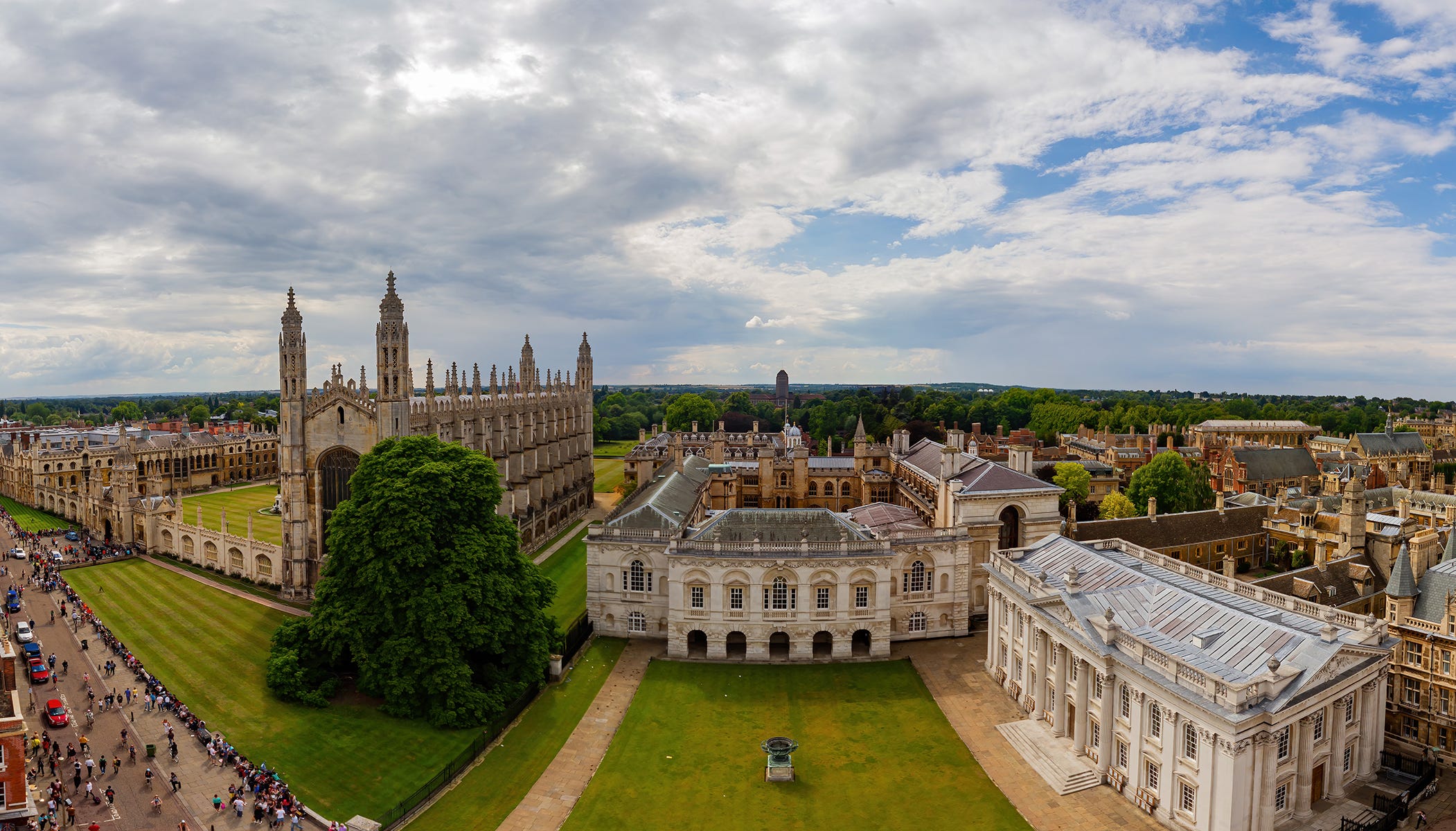
He was born in Aintree in 1970 and raised in Culcheth, an Everton supporter with a worker bee, the old symbol of industrial Manchester, tattooed on his arm. He read English at Cambridge, where he has said he struggled with impostor syndrome on account of his accent and his background, the kind of detail that sounds like spin until you remember it was true for a great many clever working-class people who arrived at that university and were treated as visitors. He joined Labour at fifteen, became the MP for Leigh in 2001, and under Gordon Brown rose through the Cabinet to Health Secretary, where he handled the swine flu outbreak and opened the inquiry into the horrors at Stafford Hospital.
Then he tried twice to lead the party and was beaten twice, finishing fourth behind Ed Miliband in 2010 and second behind Jeremy Corbyn in 2015. These are not footnotes. They are the spine of the story. Burnham has now spent fifteen years as the man Labour keeps deciding it does not quite want, and the the version of him that has just been crowned is a man who learned, the hard way, that Westminster was never going to hand him the throne, so he went and built one of his own.
The throne was Hillsborough. In 2009, as a minister at a memorial service in Anfield, Burnham was heckled by Liverpool supporters who had spent twenty years being told that their dead had killed themselves through drunkenness and disorder. Rather than absorb the moment and move on, he used it to push, from inside government, for the fresh inquiry that eventually exposed the cover-up by South Yorkshire Police and led, in 2016, to the verdict that the ninety-six had been unlawfully killed. His Commons speech after that verdict, in which he called the force “rotten to the core” and pointed at the press rooms of Downing Street, is the moment a competent politician became something harder to dismiss. He had taken a grief the state had spent a generation managing and forced the state to answer for it.
The crown itself came in 2020. By then Burnham had left Parliament entirely, won the Greater Manchester mayoralty, and started rebuilding the region’s buses under public control through the Bee Network, the first place outside London to claw that power back. When the pandemic put the North into the harshest tier of restrictions, Burnham stood on the steps of Manchester Central Library and demanded proper financial support for the low-paid workers about to lose their hours. The defining image, the one that made him, was of Burnham at that lectern learning, from a phone held up by an aide, that the government had already decided to impose the restrictions without the money, while he was still speaking. He had been negotiating with a door that was already shut. The papers called him the King of the North, and the title stuck because it described something real: a man who had discovered that the centre would never include him, and had therefore made the periphery into a power base the centre could not ignore.
Hold that image, the man finding out too late that the decision had already been taken somewhere else. We are going to need it again.
Burnham’s return would be impossible if Keir Starmer were not the most spectacular underachievement in modern British political history, and it is worth being precise about the nature of the failure, because most of the commentary mistakes the symptom for the disease.
Starmer won the largest seat majority Labour has had in a generation, a hundred and seventy-two seats, on the smallest share of the vote that any majority government has received since reliable records of the popular vote began in 1830. He won, in other words, a landslide of seats and a rounding error of enthusiasm, a victory built almost entirely on the collapse of the Conservatives rather than on any positive feeling about him. He inherited not a mandate but a vacancy, and he proceeded to govern as though the vacancy were love.
The catalogue of what followed is long, and the temptation is to list it, but one example carries the whole argument. Within weeks of taking office, the new Labour government’s first significant act of fiscal seriousness was to means-test the Winter Fuel Payment, stripping the heating subsidy from millions of pensioners. The payment had been introduced in 1997 by Gordon Brown, a Labour chancellor, as one of the small, legible kindnesses that told a certain kind of voter which side the party was on. Labour’s opening move in power was to take that exact signal and reverse it, and to do so not in service of some thrilling vision but in order to satisfy a forecast. It was a decision a competent lawyer would make about a difficult client: technically defensible, fiscally tidy, and completely illiterate about what politics is for. Everything else, the welfare rebellion over disability payments that forced a humiliating climbdown, the tax burden driven to its highest level in recorded history across two grim budgets, the appointment of Peter Mandelson as ambassador to Washington only to dismiss him when his friendship with Jeffrey Epstein resurfaced in the files, the union affiliations cut, the defence secretary resigned in June over a spending plan he found contemptibly thin, all of it is a variation on the same original sin. Starmer kept solving the equation and losing the room.
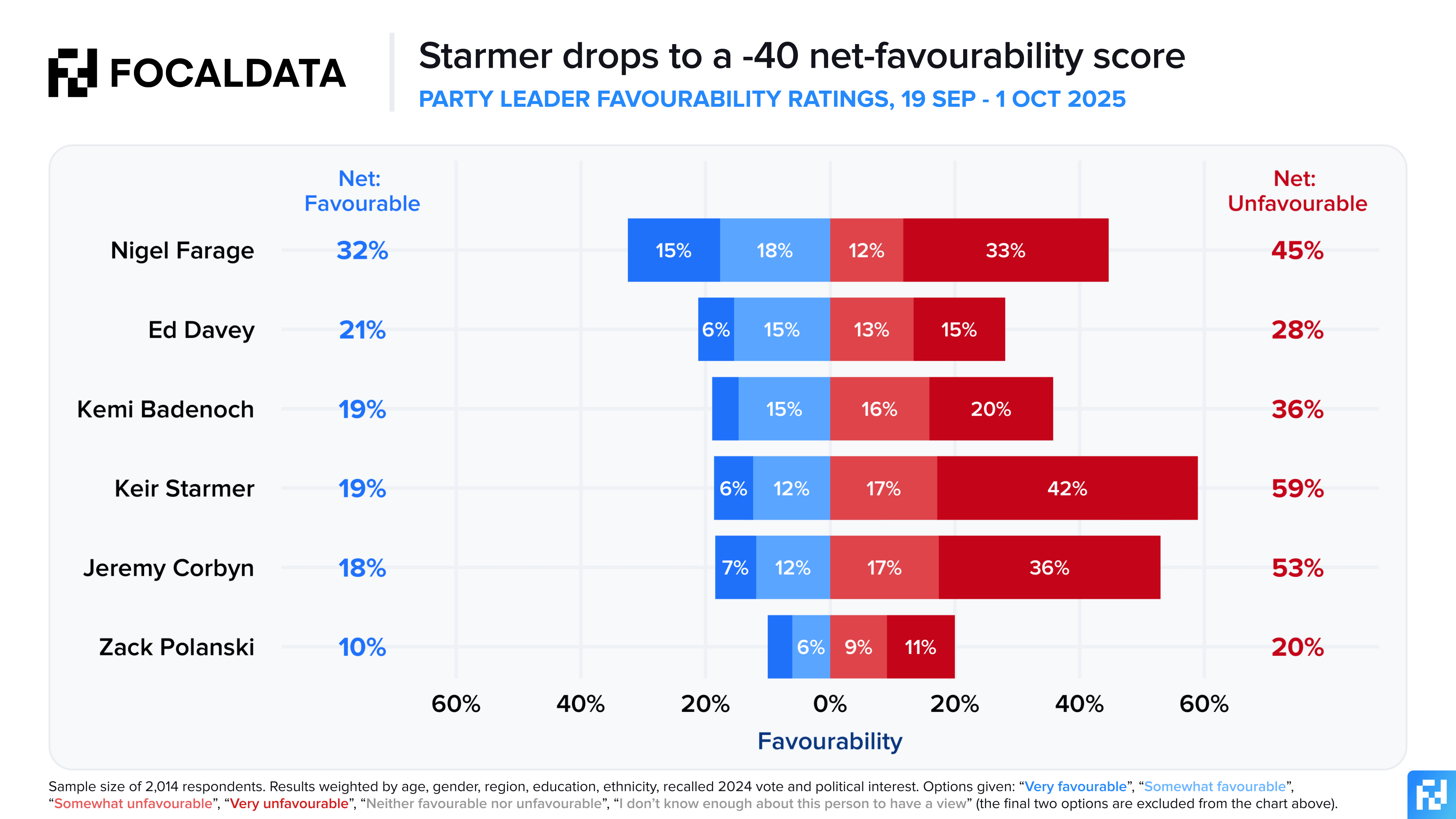
The polling captured it with an almost poetic brutality. One pollster described him as having become “a vessel for people’s frustration with the system”, which is the single most damning thing you can say about a leader, because it means he had stopped being a person with a project and become a surface onto which the public projected its contempt. By the spring his net approval had collapsed into territory previously reserved for Liz Truss. Then May arrived and the punishment became electoral. Labour shed roughly fifteen hundred councillors. In Wales the party lost the Senedd for the first time in a hundred years, finishing third, with its leader becoming the first sitting head of a government in British history to lose her own seat. A century of Welsh Labour dominance ended on a Thursday, and the Prime Minister carried on insisting he would not walk away, which by then had the quality of a man assuring the passengers that he remained fully in control of an aircraft that was, observably, in the sea.
Here is the part the heroic narrative cannot survive, and the reason the mainstream coverage keeps gesturing past it.
If Labour is being devoured, the question worth asking is what is doing the devouring, and the answer is not the thing everyone has agreed it is. Polling taken after the May local elections found that of everyone who voted Labour in 2024, just five per cent had since defected to Reform. Thirty-two per cent had gone to the Greens or the Liberal Democrats. The wound is not on the right flank. It is on the left and in the soft, disappointed centre, among people who wanted a Labour government and got an actuary, and who have wandered off to Zack Polanski’s resurgent Greens and to the Lib Dems in roughly six times the numbers that defected to Farage.
The single cleanest illustration sits in Burnham’s own back yard. In January the party’s ruling committee blocked him from contesting a by-election in Gorton and Denton, a manoeuvre widely understood as Starmer slamming a door on a potential rival, with the Prime Minister personally voting against him. The seat was then won not by Reform but by the Greens, with Labour pushed into third. Burnham had beaten that same Green candidate in the 2024 mayoral race by a margin of three hundred and seventy-five thousand votes. A year later, denied the chance to stand, he watched a seat in the Labour heartland fall to the left while his party came third. That is not the geography of a Reform surge. That is the geography of a centre-left coalition coming apart in someone’s hands.
And it is widening, not settling. Under Polanski, the Greens have become the most popular party among voters under twenty-five, and the seat projections now have them multiplying their presence at Labour’s direct expense, eating into precisely the young, urban, graduate vote that Labour spent a decade assuming it owned. This is not a protest that subsides once Starmer goes. It is a generational drift with its own momentum, and the answer Labour is reaching for is a fifty-six-year-old man offering them cheaper buses and nationalised water.
And Reform itself, the supposed juggernaut Burnham has been crowned for stopping, has been quietly declining for nine months. It peaked at around thirty-four per cent last September and has slid to the high twenties since, as immigration faded from the headlines and the party set about, in its own strategists’ phrase, scraping the barnacles off the boat. It still leads the national polls. It leads them on roughly twenty-seven per cent.
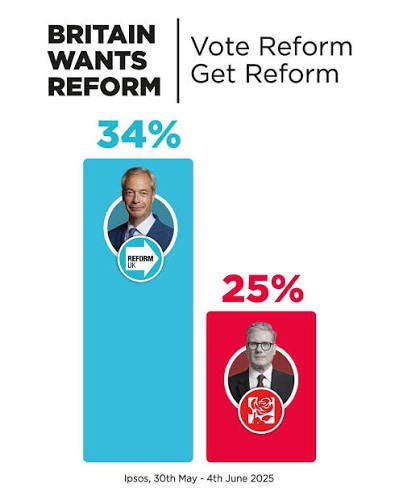
Sit with that number, because it is the only one that matters, and then sit with the thing the coronation gets exactly backwards. The fact that Labour’s lost voters are scattering to the Greens and the Liberal Democrats rather than marching over to Farage is not the consolation it sounds like. It is the catastrophe. A party that bleeds its coalition to a single rival can win it back by beating that rival. A party that bleeds its coalition in four directions at once has no single fight to win, and every vote that drifts off to the left is a vote subtracted from the only bloc large enough to keep Reform out of the seats. The leftward bleed is not the alternative to the Reform threat. It is the engine of it.
Twenty-seven per cent should not be able to govern Britain. Under a sane voting system it would buy you a respectable bloc of seats and a place in somebody else’s coalition. Under the system Britain actually has, it can buy you the keys to the entire country, and the people who cannot see this are making almost exactly the same error they made in 2016.
First-past-the-post does not reward the party most people want. It rewards the party that comes first in the most places, and in a field fractured five ways, the threshold for coming first collapses. When the opposition to Reform is split between a wounded Labour, a recovering Conservative Party, a surging Green Party and a buoyant set of Liberal Democrats, all clustered within a few points of each other, Reform does not need to persuade a majority of anything. It needs the anti-Reform majority to remain divided across four boxes while its own quarter of the electorate marches, disciplined and unsplit, into one. The constituency-level modelling now routinely projects Farage’s party as the largest in the next Parliament and the likeliest to form the next government, in some versions outright, in others needing only the Conservatives to lend a hand, on a vote share in the high twenties that would have embarrassed a third-place finisher twenty years ago. One pollster set out the mechanism in plain figures: a clear majority of seats won on barely thirty per cent of the vote, most of them taken on local pluralities below thirty-five, among the most disproportionate outcomes in modern British history, achieved, in its own phrase, by a split opposition. The numbers are not close because Reform is loved. They are close because the people who loathe it cannot agree on whom to love instead.
This is the Brexit lesson, and it is worth saying plainly because it is the lesson the comfortable classes are once again declining to learn. In 2016 the assumption in the right postcodes was that it would not happen, and that assumption was not stupid, exactly. It was simply reasoning about a referendum as though the country were the people one happened to know. The result was not a failure of polling so much as a failure of imagination, an inability to believe that the mechanism would deliver an outcome that the comfortable found unthinkable. The mechanism delivered it anyway, because mechanisms do not require your belief. They require only your turnout, and yours was lower.
The same trap is closing now, wearing a more flattering costume. The costume is Andy Burnham. The reassurance runs that Reform is fading, that the centre-left will surely consolidate now that Starmer is gone, that a popular northern saviour with a worker bee on his arm is standing between the country and the abyss, and that one can therefore relax. Every clause of that is a sedative. Reform fading from thirty-four to twenty-seven still leaves it first. Consolidation is a hope, not a plan, and the actual movement of voters is towards more fragmentation, not less, as the Greens hoover up the disillusioned young. And the saviour reaches Downing Street without having won a contested vote for it: a by-election arranged for him, a leadership nobody stood against.
Which brings us to the wager, because Burnham is not merely a mood. He is a programme, and the programme is a genuine bet about how you beat a populist, one that deserves to be taken seriously rather than swooned over.
He calls it Manchesterism, and dresses it, with the instinct of a man who has been burned before, as “business-friendly socialism”. The substance is a soft-left economic populism: water renationalised, including Thames Water, energy and housing and transport hauled under what he calls stronger public control, the Bee Network model of cheap, accountable, publicly run buses exported to the country at large. The theory underneath it is the most interesting thing about him. It holds that Farage’s support is not, at root, about immigration at all, but about a justified fury at a country that has stopped working for ordinary people, and that the way to drain that fury is not to chase Reform rightward on borders but to undercut it on economics, to offer the angry the material improvement that the populist only offers them a scapegoat for. Out-populist the populist on the cost of a bus fare and a water bill, and the immigration question loses its heat.
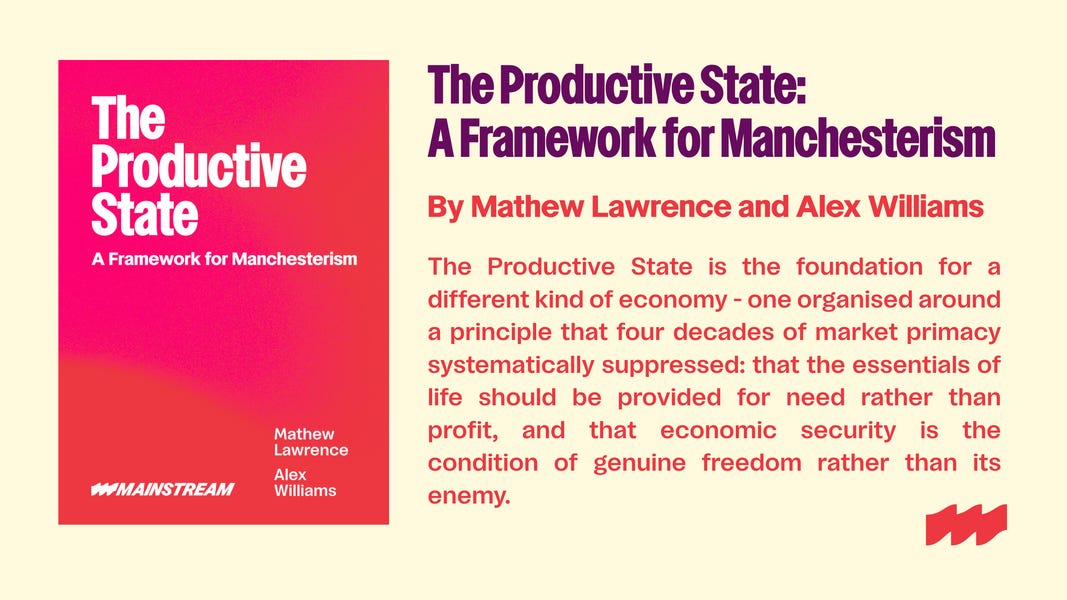
It might even be right. It is certainly a more honest reckoning with the rage than anything Starmer managed, and it has the considerable advantage of being a thing Burnham has actually done, in one city, at small scale, with results he can point to. But notice what is being asked of you, which is to believe that the third time is the charm. Labour has reached for Andy Burnham as its more rooted and electable alternative twice before, in 2010 and in 2015, and twice the party gazed at him, found him reassuring, and chose someone else; on both occasions, the structural problem he was supposed to solve outlasted the change of personnel entirely. The danger is not that Burnham is a fraud. He plainly is not. The danger is that he is a symbol the party keeps reaching for to feel it has acted, and that swapping the vessel does nothing to stop the tide. A leader can be the most popular man in British politics, as Burnham currently is, and still preside over a centre-left that splinters beneath him into Green and Liberal and disenchanted fragments, while a unified quarter of the country walks through the gap they leave.
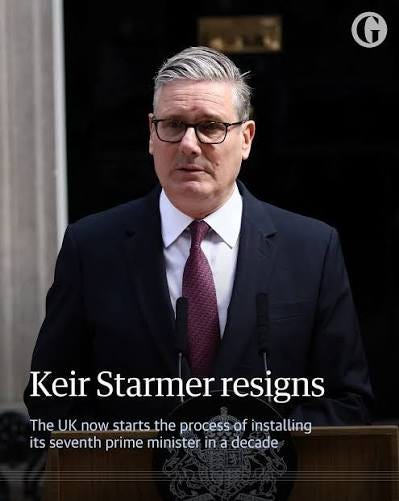
Coronation was always the right word, and on Friday it stopped being a metaphor. Burnham was declared Labour leader unopposed, nominated by three hundred and seventy-nine of the party’s four hundred and three MPs, with no rival on the ballot and not a single party member asked for a view. On Monday Starmer goes to the Palace to give up the office and Burnham follows to take it, the seventh prime minister in ten years and only the second Labour one in a century to inherit the job mid-term rather than win it. He told the hall he would give the country its hope back, and that he has a plan. For a few golden weeks it will feel as though the danger has passed and the adults have returned, the thing that could not be allowed to happen quietly seen off by a decent man from the North with the right enemies and the common touch.
I would not bet the country on that feeling. The image that keeps returning to me is the one that made him: Burnham at the lectern outside the library, mid-sentence, watching on a stranger’s phone as the decision he was arguing against was taken without him, somewhere else, by a mechanism that had never been listening. He built a kingdom out of that humiliation. But the position he occupied that afternoon, assuming there was still a negotiation to be had, still a door to push against, still time, is not his any more. It is ours. It belongs to everyone who is presently reassuring themselves that Andy is in the way, that the arithmetic will sort itself out, that this is the kind of thing that happens to other countries. The decision is already moving, and it asks nothing of us but our division, which we are supplying in quantity. We are the ones on the library steps now, telling ourselves there is still time to be heard, while the phone lights up with the result.
☕ Love this content? Fuel our writing!
Buy us a coffee and join our caffeinated circle of supporters. Every bean counts!
Comments
Nothing yet. Say the first thing.
Sign in to join the conversation.