
Welcome to the newest edition of SpaceTech Weekly, your go-to source for space news. This recap is for informational purposes only and does not constitute any investment advice.
“This week shows space markets getting more connected. NASA put nearly $600 million into lunar science, backing more government Moon missions. ULA moved Amazon’s Leo constellation forward, now past 375 satellites. Europe is building its own launch capability too. Berlin manufacturing is now tied to Isar’s Spectrum rocket and China’s Hongqing is ramping up satellite production on its side. SatVu’s HotSat-2 is starting to bring in real revenue as defense demand grows. Rocket Lab looks ready to scale with Iridium. And SRRC’s governance push adds a longer term risk to keep an eye on.“ - Commentary by Matej Pretković
I do consulting sessions in space and AI. If you want a structured research session or a sounding board, email mpretkovic@cyclopcorp.com.
Here is a quick overview of news that happened this week:
Rocket Lab is buying Iridium
Hongqing Technology raises over 1.3 billion yuan in Pre-B round financing for satellite networking services.
SpaceBorn United and SRRC publishes first white paper on human reproduction in space, advancing global roadmap initiative
Final Atlas 5 mission for Amazon Leo launches
SatVu resumes commercial operations with HotSat-2
Isar Aerospace to launch German Planet imaging satellite
NASA gives nearly $600 million for lunar lander missions
Read our latest weeklies for more recent SpaceTech updates
Subscribe to keep up with the latest market movers in SpaceTech through carefully curated weekly updates
Weekly SpaceCap - These tables track weekly stock performance and key metrics for global and European SpaceTech companies, giving a quick snapshot of market trends. Data sourced from Yahoo Finance.
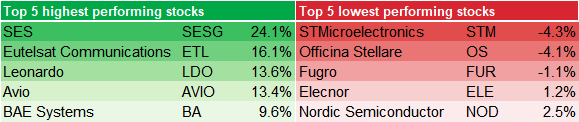
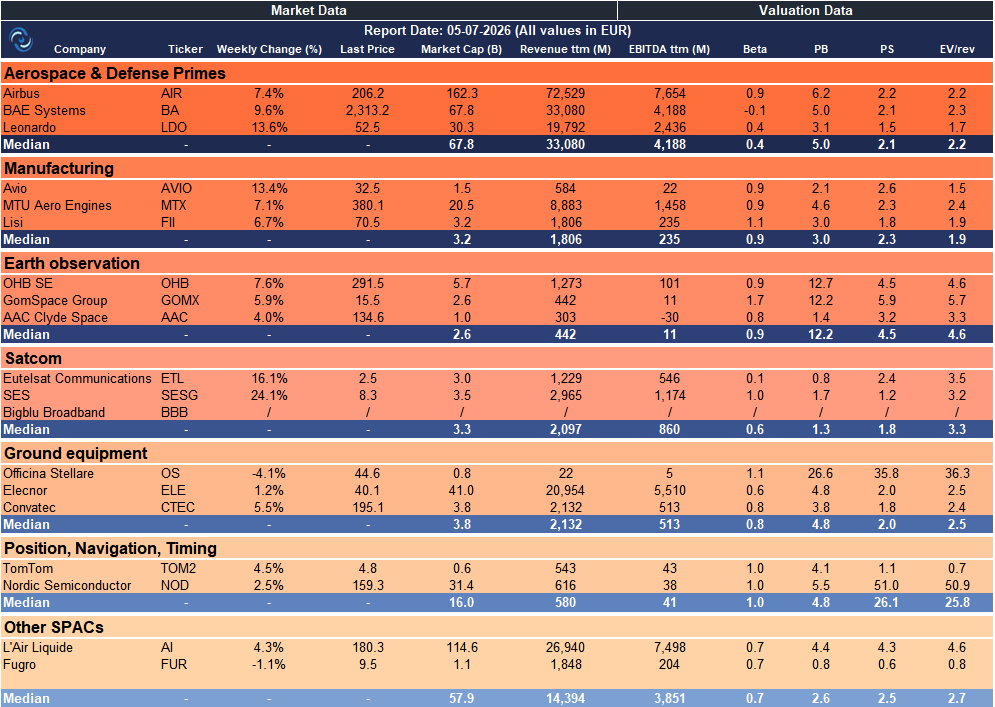
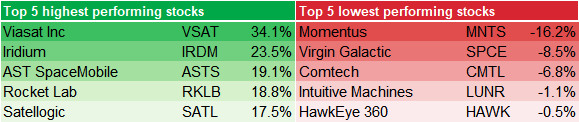
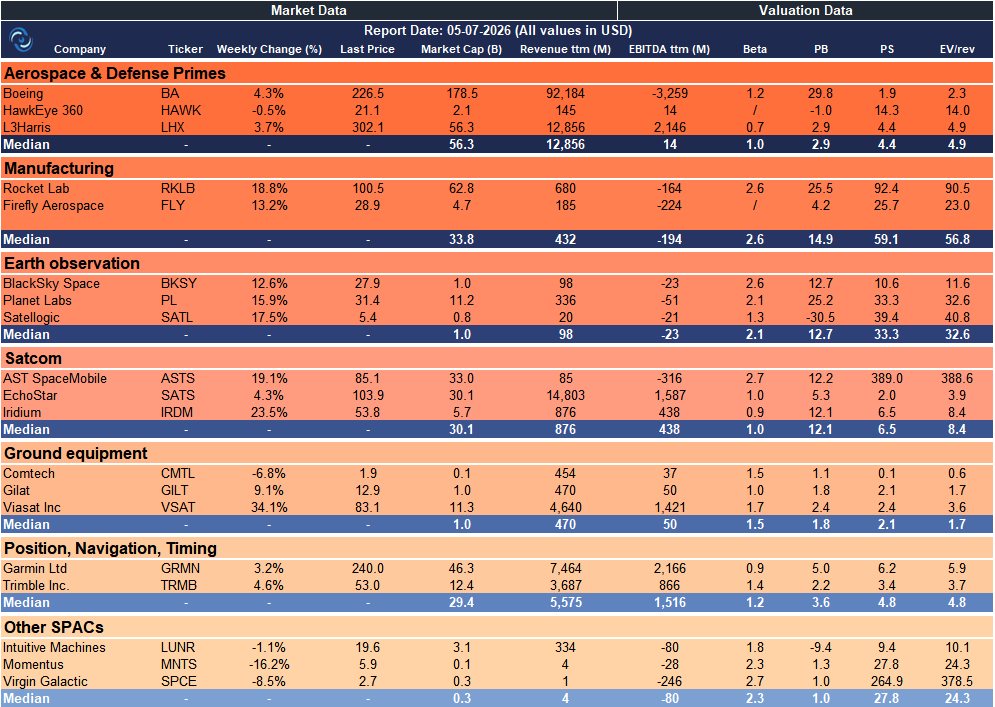
What happened: Rocket Lab announced a definitive agreement to acquire Iridium Communications for $54 per share in a cash and stock deal, valuing Iridium at about $8.0 billion enterprise value. The transaction would merge Rocket Lab’s launch and satellite manufacturing with Iridium’s global satellite network, spectrum, and ecosystem.
Why it matters: This deal is transformative for the space industry, uniting two U.S. innovators to create a vertically integrated space company that designs, builds, launches, and operates its own constellations. Iridium’s L-band spectrum and broad subscriber network could enable space-based IoT, D2D, PNT, and safety services at scale.
Investor angle: For investors, the deal offers material revenue scale and is significantly accretive to Rocket Lab’s cash flow and profitability. By leveraging Iridium’s network and 2.55 million subscribers, the combined company could broaden access to government and commercial markets, expanding IoT, D2D, PNT, and safety-of-life services.
What happened: Beijing-based Hongqing Technology completed a Pre-B round financing of more than 1.3 billion yuan, bringing total funding to over 2.5 billion yuan. The round was led by Jianxin Investment, ICBC Capital and Jinpu Capital, with participation from Sichuan Development SciTech Fund, Guotai Haitong, Bank of China International, CITIC Construction Investment and Industrial Securities, and additional investments from Beijing Advanced Manufacturing Fund and Yizhuang State Investment.
Why it matters: The funding supports operations, research and development, and team building to boost Hongqing Technology’s satellite network service capabilities. The company operates a 12,000 square meter satellite intelligent manufacturing base in Xiong’an, capable of producing more than 100 flat satellites annually, and plans to enhance mass production and large constellation services.
Investor angle: For investors, the round signals strong backing from a broad syndicate and funds to scale up in satellite manufacturing and large constellation services, leveraging the company’s existing manufacturing base and pipeline to strengthen its position in the evolving space infrastructure market.
SpaceBorn United and the Space Reproduction Roadmap Consortium (SRRC) published their first white paper, Towards a Community Roadmap for Future Human Reproduction Beyond Earth, following its inaugural 2025 symposium with 40 international experts across space life sciences, medicine, ethics, law, and technology. The consortium also launched its platform at SRRC website and released the paper via Zenodo: SRRC white paper.
What happened: The paper outlines the first structured roadmap effort addressing human reproduction in space, a key requirement for long-term lunar and Mars settlement. It organizes research priorities across biomedical science, space technology, ethics & law, and space business & geopolitics.
Investor angle: The initiative signals early-stage formalization of space life sciences as a strategic niche within the space economy, strengthening SpaceBorn United’s positioning ahead of future research collaborations and roadmap development phases.
What happened: A United Launch Alliance Atlas V rocket launched from Cape Canaveral at 12:30:15 a.m. EDT on July 2, 2026, carrying Amazon’s Leo 8 mission. The launch delivered 29 satellites, increasing the Amazon Leo constellation to 375+ deployed satellites, with ULA accounting for 224 of them and about 60% of the on‑orbit fleet.
Why it matters: This milestone pushes Amazon Leo closer to commercial operation, expanding its global broadband network. It underscores ULA’s growing role in commercial space launches, with commercial customers making up about half of ULA’s business, while signaling a transition toward Vulcan and a planned increase in deployment cadence.
Investor angle: The deployment reinforces Amazon Leo’s progress and highlights rising demand for large constellation launches, potentially bolstering ULA’s commercial revenue and market position. With hundreds of flight-ready satellites and a new vertical integration facility, the pathway to higher launch cadence and contract opportunities could influence near‑term valuations.
What happened: SatVu announced Start of Commercial Operations for HotSat-2, initiating routine tasking and delivery of commercial thermal intelligence worldwide. It marks the shift from technology demonstration to operational delivery for Defence & Intelligence, Economic Intelligence, and Climate Resilience, with decision-grade data integrated into EO and SAR workflows. A Kongsberg agreement underpins early adoption.
Why it matters: HotSat-2 thermal intelligence helps reveal an asset’s operational heartbeat—status, intensity, and change—completing the GEOINT picture. Market demand is strong, with contracts and strategic investment from defence, intelligence, and commercial sectors, including a commercial agreement with Kongsberg, reinforcing SatVu’s position in high-fidelity thermal data.
Investor angle: Progress to SCO indicates customers are integrating thermal data into operational workflows rather than evaluating it, expanding the addressable market. The combination of scale-ready data and partnerships (e.g., Kongsberg) could positively influence SatVu’s growth trajectory and valuation as demand for space-based, high-fidelity thermal intelligence grows.
What happened: Planet Labs Germany and Isar Aerospace announced a strategic launch agreement to fly one of Planet’s Pelican satellites on Isar’s Spectrum rocket. The mission is planned as early as late 2026 from Isar’s launch complex at Andøya Space, with the satellite assembled in Planet’s Berlin facility, making both satellite and rocket German-built.
Why it matters: The deal marks a milestone for German sovereign space capabilities, with both satellite and rocket built in Germany, demonstrating rapid progress in national space assets and supporting Germany’s goals for security, resilience and civil applications, while expanding Europe’s integrated space ecosystem and industrial base.
Investor angle: Investors may view this as a signal of growth in Germany’s space sector: Planet plans a Berlin manufacturing facility to double Pelican production and could add up to 70 new Berlin employees, while Isar will scale production to as many as 40 launch vehicles per year from a 40,000 square meter factory near Munich, supported by automation and vertical integration.
What happened: NASA announced awards totaling nearly $600 million for lunar lander missions. The release highlights ongoing support for Moon base science and previews new opportunities tied to the program, signaling a continued push to advance lunar exploration and related technology.
Why it matters: This funding underscores a continued commitment to lunar exploration and science, supporting the development of lunar lander technologies and science payloads, and signaling a pipeline of opportunities for researchers and contractors involved in Moon missions across public and private sectors.
Investor angle: For investors, the announcement points to near-term revenue visibility for aerospace contractors and suppliers involved in lunar lander programs, given the nearly $600 million funding size. It also highlights potential growth in space-related hardware and services, though funding cycles and project scopes can affect timelines.
Disclaimer: This article is provided for informational purposes only and does not constitute investment advice. While we strive to ensure the accuracy and timeliness of the information presented, we cannot guarantee its completeness or correctness. Readers should conduct their own research and consult a qualified financial professional before making any investment decisions. Past performance is not indicative of future results.
No posts
Comments
Nothing yet. Say the first thing.
Sign in to join the conversation.