

As digitalization, cloud computing, and AI continue to evolve, the role of cybersecurity services is undergoing a structural transformation.
Cybersecurity services are no longer merely auxiliary functions within technical systems. Increasingly, they are becoming part of the “trust infrastructure” of digital society itself — not simply providing defense capabilities, but establishing sustainable and verifiable order across increasingly complex systems.
If industrial-era standards were designed to solve the problem of scalable production, digital-era standards are fundamentally concerned with the problem of trustworthiness.
Compared with the security product sector, which has gradually developed mature certification and standardization frameworks, cybersecurity services remain deeply dependent on experience, organizational reputation, and individual expertise. Their capability boundaries are difficult to define, their delivery processes difficult to verify, and their service quality lacks a universally recognized framework for cross-market validation.
As a result, although markets are becoming increasingly dependent on cybersecurity services, they still lack a truly institutionalized mechanism of trust.
This absence is not merely an issue of industry efficiency. More fundamentally, it reflects a vacuum of order emerging within the evolution of digital civilization itself.
For customers, the central challenge is determining who is genuinely trustworthy. For service providers, the challenge lies in transforming operational capability into a form of public credibility that can be continuously validated over time.
As global digital systems become more deeply interconnected and interdependent, the production of trustworthiness itself is emerging as one of the defining questions of the cybersecurity industry.
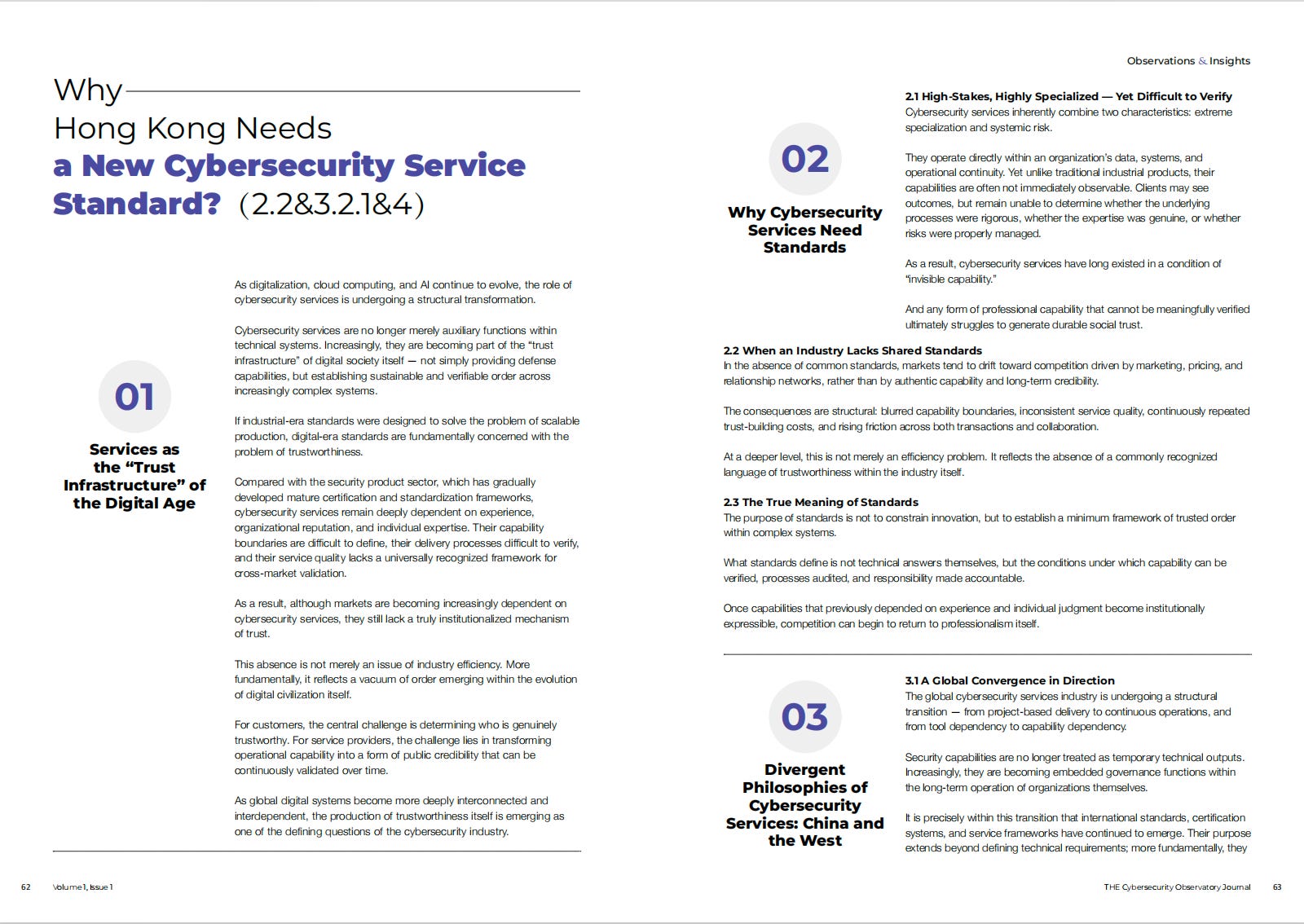
Cybersecurity services inherently combine two characteristics: extreme specialization and systemic risk.
They operate directly within an organization’s data, systems, and operational continuity. Yet unlike traditional industrial products, their capabilities are often not immediately observable. Clients may see outcomes, but remain unable to determine whether the underlying processes were rigorous, whether the expertise was genuine, or whether risks were properly managed.
As a result, cybersecurity services have long existed in a condition of “invisible capability.”
And any form of professional capability that cannot be meaningfully verified ultimately struggles to generate durable social trust.
In the absence of common standards, markets tend to drift toward competition driven by marketing, pricing, and relationship networks, rather than by authentic capability and long-term credibility.
The consequences are structural: blurred capability boundaries, inconsistent service quality, continuously repeated trust-building costs, and rising friction across both transactions and collaboration.
At a deeper level, this is not merely an efficiency problem. It reflects the absence of a commonly recognized language of trustworthiness within the industry itself.
The purpose of standards is not to constrain innovation, but to establish a minimum framework of trusted order within complex systems.
What standards define is not technical answers themselves, but the conditions under which capability can be verified, processes audited, and responsibility made accountable.
Once capabilities that previously depended on experience and individual judgment become institutionally expressible, competition can begin to return to professionalism itself.
The global cybersecurity services industry is undergoing a structural transition — from project-based delivery to continuous operations, and from tool dependency to capability dependency.
Security capabilities are no longer treated as temporary technical outputs. Increasingly, they are becoming embedded governance functions within the long-term operation of organizations themselves.
It is precisely within this transition that international standards, certification systems, and service frameworks have continued to emerge. Their purpose extends beyond defining technical requirements; more fundamentally, they attempt to answer a deeper question: how should trust be established within complex, interconnected, and cross-border digital systems?
International markets have historically placed greater emphasis on the trustworthiness of process itself.
Methodologies, procedural controls, personnel certification, audit mechanisms, and clearly defined accountability structures are typically embedded within relatively rigorous institutional frameworks. Within this logic, outcomes alone are insufficient; results must also be explainable, traceable, and verifiable through process.
At its core, this reflects a philosophy of institutionalized trust.
Organizations place confidence not merely in individual expertise, but in the ability of systems and processes to produce repeatable and auditable outcomes over time.
By contrast, the Chinese market has generally evolved around a more outcome-oriented logic.
Clients tend to focus more directly on whether risks were identified, problems resolved, and systems restored to operational continuity, while placing comparatively less emphasis on procedural formalism, documentation structures, or standardized process frameworks.
This approach has strengthened real-world operational capability, rapid response capacity, and adaptability within highly complex environments. It has also cultivated an industry culture that values experiential judgment and execution efficiency.
At the same time, however, capability assessment becomes more dependent on practical outcomes and accumulated organizational experience, rather than on institutional forms of verification.
At a deeper level, this distinction is not merely about market preference, but about two fundamentally different mechanisms for producing trust.
The Chinese model tends toward trust through validated outcomes — trust established through demonstrated effectiveness.
The international model tends toward trust through institutional process — trust produced through systems, procedures, and formal accountability.
The former prioritizes the ability to solve real-world problems; the latter prioritizes verifiable order within complex collaboration environments.
And this distinction directly shapes the underlying logic of how standards themselves are designed.
Yet as global collaboration, cross-border operations, and interconnected digital infrastructure continue to deepen, these two approaches are gradually converging.
Outcome-oriented systems increasingly require process frameworks capable of supporting scalable collaboration, while process-oriented systems must remain grounded in real operational threats and evolving attack realities.
The most effective cybersecurity service standards of the future may therefore be neither purely process-management frameworks nor merely systems of outcome validation, but new trust architectures capable of connecting operational effectiveness with institutional trustworthiness simultaneously.
One of the greatest costs in cybersecurity services is not procurement itself, but uncertainty regarding the authenticity of capability.
The primary function of an effective standard is therefore to establish a commonly intelligible framework for evaluating competence — enabling users to identify professional capability more clearly, define service boundaries more accurately, and reduce the trust costs created by information asymmetry.
At its core, a standard provides the foundational language through which trustworthy judgment becomes possible within a complex market.
Once service processes, methodological frameworks, and accountability structures become verifiable, security capability ceases to exist merely as an internal organizational asset based on experience.
Instead, it begins to evolve into a form of public credibility that can be externally understood, assessed, and recognized.
This shifts the object of trust itself. Users no longer rely solely on outcomes, but increasingly on the underlying capability structures capable of producing sustainable and repeatable results over time.
Transparency, therefore, becomes a precondition for trustworthiness.
The deeper significance of standards lies in their ability to reshape the relationship between cybersecurity providers and their clients.
Standards encourage the industry to evolve from one-time project delivery toward continuous, accumulative, and long-term capability collaboration — from reactive responses to isolated incidents toward persistent security governance embedded within organizational operations themselves.
And once security becomes understood as a long-term institutional capability rather than a temporary technical procurement, service relationships themselves begin to evolve from transactional arrangements into enduring trust relationships.
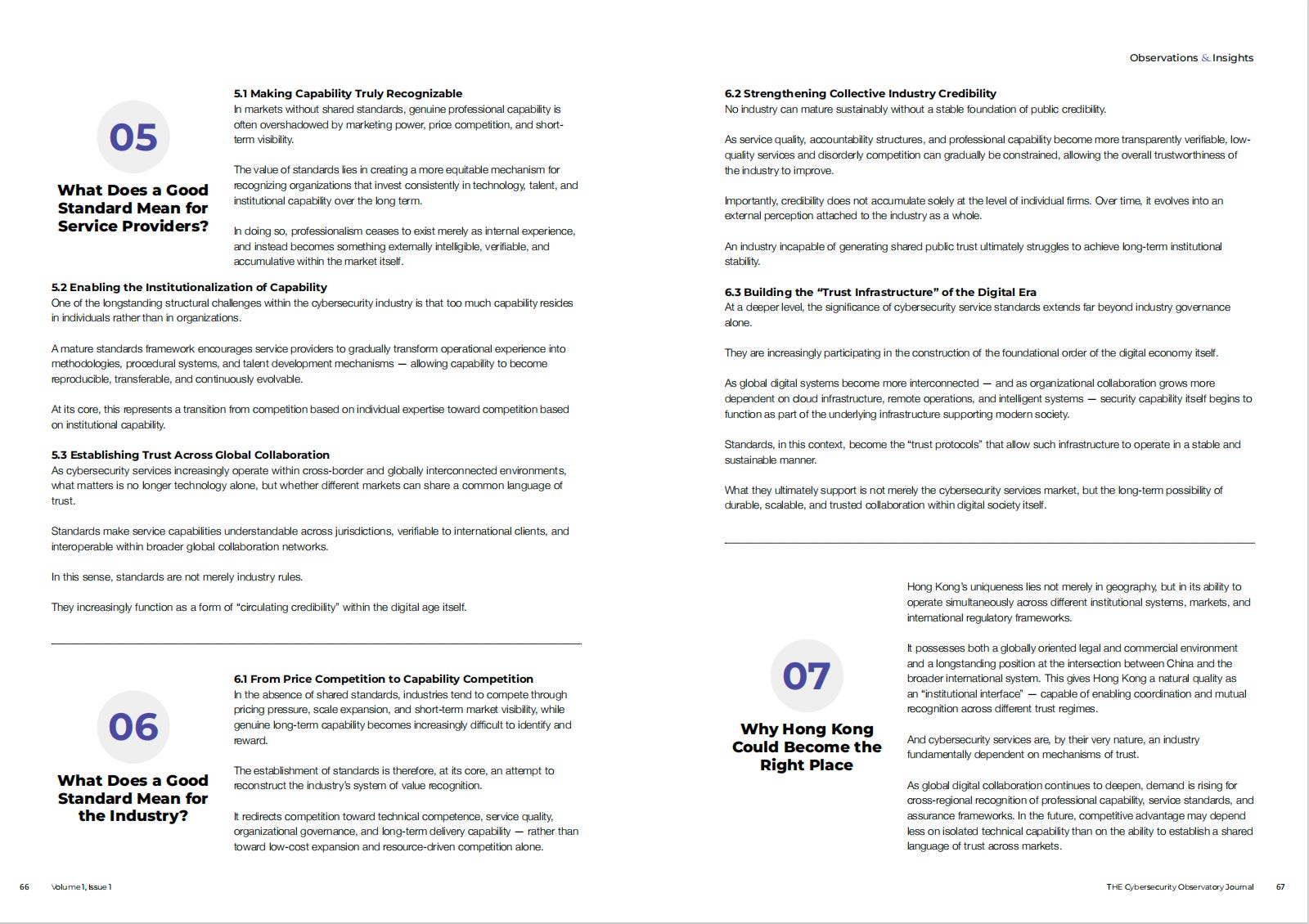
In markets without shared standards, genuine professional capability is often overshadowed by marketing power, price competition, and short-term visibility.
The value of standards lies in creating a more equitable mechanism for recognizing organizations that invest consistently in technology, talent, and institutional capability over the long term.
In doing so, professionalism ceases to exist merely as internal experience, and instead becomes something externally intelligible, verifiable, and accumulative within the market itself.
One of the longstanding structural challenges within the cybersecurity industry is that too much capability resides in individuals rather than in organizations.
A mature standards framework encourages service providers to gradually transform operational experience into methodologies, procedural systems, and talent development mechanisms — allowing capability to become reproducible, transferable, and continuously evolvable.
At its core, this represents a transition from competition based on individual expertise toward competition based on institutional capability.
As cybersecurity services increasingly operate within cross-border and globally interconnected environments, what matters is no longer technology alone, but whether different markets can share a common language of trust.
Standards make service capabilities understandable across jurisdictions, verifiable to international clients, and interoperable within broader global collaboration networks.
In this sense, standards are not merely industry rules.
They increasingly function as a form of “circulating credibility” within the digital age itself.
In the absence of shared standards, industries tend to compete through pricing pressure, scale expansion, and short-term market visibility, while genuine long-term capability becomes increasingly difficult to identify and reward.
The establishment of standards is therefore, at its core, an attempt to reconstruct the industry’s system of value recognition.
It redirects competition toward technical competence, service quality, organizational governance, and long-term delivery capability — rather than toward low-cost expansion and resource-driven competition alone.
No industry can mature sustainably without a stable foundation of public credibility.
As service quality, accountability structures, and professional capability become more transparently verifiable, low-quality services and disorderly competition can gradually be constrained, allowing the overall trustworthiness of the industry to improve.
Importantly, credibility does not accumulate solely at the level of individual firms. Over time, it evolves into an external perception attached to the industry as a whole.
An industry incapable of generating shared public trust ultimately struggles to achieve long-term institutional stability.
At a deeper level, the significance of cybersecurity service standards extends far beyond industry governance alone.
They are increasingly participating in the construction of the foundational order of the digital economy itself.
As global digital systems become more interconnected — and as organizational collaboration grows more dependent on cloud infrastructure, remote operations, and intelligent systems — security capability itself begins to function as part of the underlying infrastructure supporting modern society.
Standards, in this context, become the “trust protocols” that allow such infrastructure to operate in a stable and sustainable manner.
What they ultimately support is not merely the cybersecurity services market, but the long-term possibility of durable, scalable, and trusted collaboration within digital society itself.
Hong Kong’s uniqueness lies not merely in geography, but in its ability to operate simultaneously across different institutional systems, markets, and international regulatory frameworks.
It possesses both a globally oriented legal and commercial environment and a longstanding position at the intersection between China and the broader international system. This gives Hong Kong a natural quality as an “institutional interface” — capable of enabling coordination and mutual recognition across different trust regimes.
And cybersecurity services are, by their very nature, an industry fundamentally dependent on mechanisms of trust.
As global digital collaboration continues to deepen, demand is rising for cross-regional recognition of professional capability, service standards, and assurance frameworks. In the future, competitive advantage may depend less on isolated technical capability than on the ability to establish a shared language of trust across markets.
Within this context, Hong Kong has the potential to become a critical platform for cybersecurity capability coordination in Asia.
Whether for Chinese companies expanding globally or international firms entering the Chinese market, the most durable form of connection is rarely commercial access alone. More often, it is the existence of standards that can be jointly recognized across different systems and markets.
Because standards, at their core, are never merely technical specifications.
They are coordination mechanisms designed to reduce institutional friction, cultural asymmetry, and the cost of trust itself.
The future of cybersecurity may no longer be defined merely by competition in technical capability.
As digital society continues to evolve, the more decisive question will be who can consistently produce trustworthiness — not only demonstrating security capability itself, but enabling that capability to be understood, validated, and recognized across organizations, markets, and jurisdictions.
From this perspective, the value of standards extends far beyond technical specification.
Standards function as a shared language for complex digital societies, enabling stable cooperation across different systems of governance, markets, and institutions. And the deeper significance of standards alliances lies in their ability to construct long-term, adaptive, and continuously renewable mechanisms of trust.
Because in the digital age, the scarcest resource may not ultimately be technology itself.
But credibility.
Want to explore the full analysis?
Download THECOI JOURNAL to read the complete article and discover more insights.
Get the full issue of THECOI JOURNAL here: https://www.the-coi.org/journal
Contact THE COI
info@the-coi.org
www.linkedin.com/company/thecoi/

Comments
Nothing yet. Say the first thing.
Sign in to join the conversation.