
Security professionals consistently lose budget conversations not because the risks are wrong, but because the argument is framed in the wrong language.
When you walk into a leadership meeting and ask for funding for endpoint detection and response, or threat intelligence tooling, or a new SIEM implementation, you are describing a technical capability.
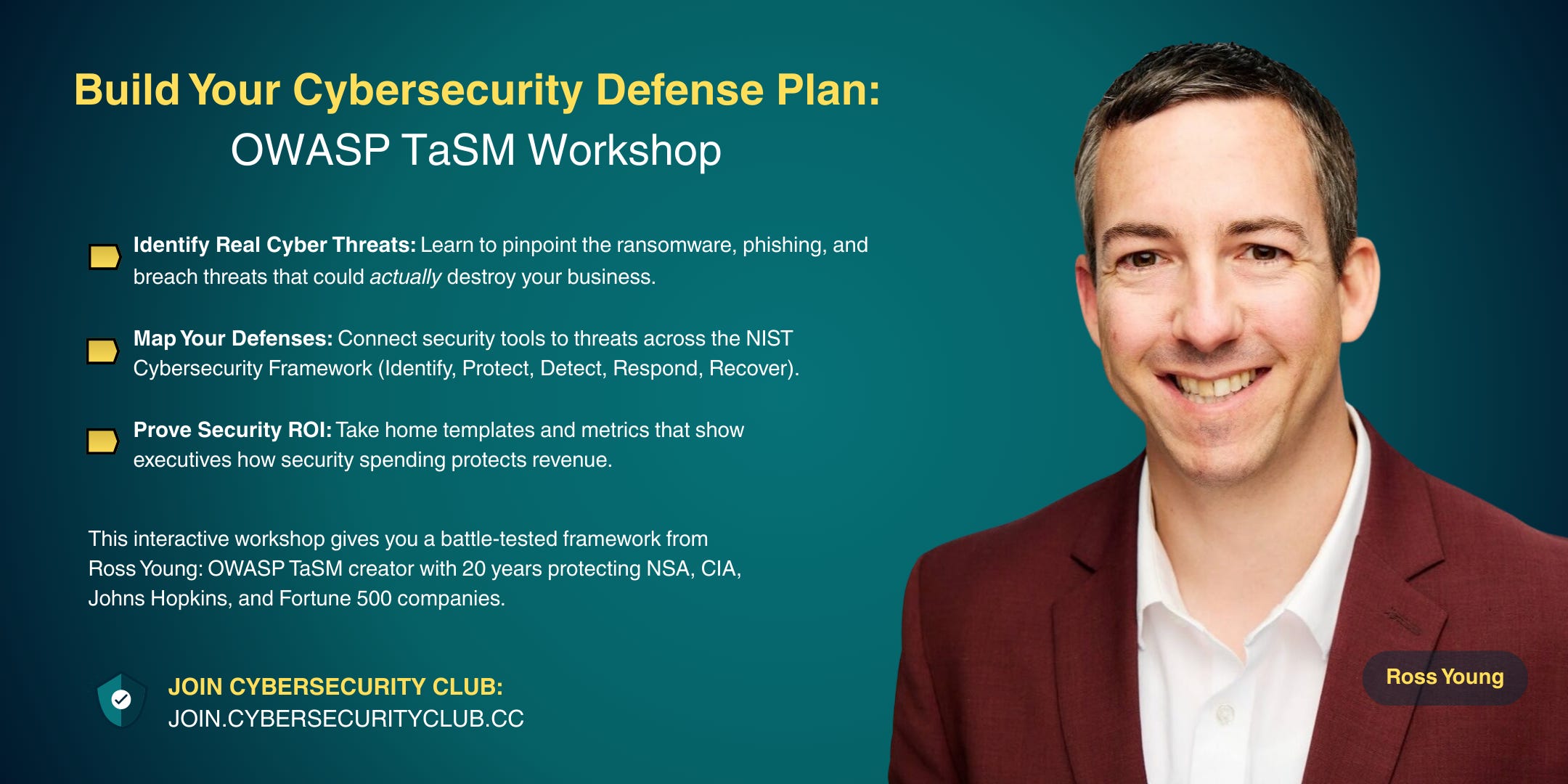
In this live virtual session, you will leave with the tools to translate your security program into language executives act on, including an AI threat matrix and executive scorecards ready for your next budget conversation.
Date: Tuesday, March 31, 2026
Time: 12:30 PM PST
Location: Virtual (Zoom link provided upon registration)
Price: $20 (FREE for Cybersecurity Club readers / followers / members!)
👉 Get a FREE Ticket (usually $20):
https://www.eventbrite.com/e/1981916887763/?discount=CybersecurityClub
Executives are not evaluating technical capabilities when they allocate budget. They are evaluating business risk, and if your request cannot be understood in those terms, it will be deprioritized against other spending that can.
This is not a knowledge problem. Most security professionals understand the threats they are trying to address far better than the executives they are presenting to.
The gap is a communication gap, and it has real consequences for security programs. Teams that cannot translate technical risk into business impact end up underfunded, underrepresented at the leadership level, and perpetually reactive because they never secured the resources to get ahead of the threats they could see coming.
Business leaders make spending decisions based on a clear set of concerns: protecting revenue, maintaining operational continuity, managing regulatory exposure, and preserving customer trust. Every dollar they approve has to connect to one of those outcomes, at least implicitly, or it looks like overhead.
When a security team asks for budget based on a compliance requirement or a technical gap, they are often right that the investment is necessary.
The problem is that “we need this to stay compliant” and “we need this to close a coverage gap” do not carry the same weight as “without this control, a ransomware incident could take our order management system offline for days and cost us an estimated $4 million in lost revenue and recovery time.”
The second version requires more work to build. It requires you to understand the business well enough to quantify what a breach or disruption actually costs, and it requires you to connect specific controls to specific risks in a way that is coherent to a non-technical audience.
Most security teams are not structured or trained to do this, which is why the budget conversation stays hard even for teams that are doing strong technical work.
The Threat and Safeguard Matrix, known as TaSM, is an open-source framework developed by Ross Young, a former CIA and NSA officer who has since served as CISO at Caterpillar Financial and Divisional CISO at Capital One.
Ross built TaSM after observing the same communication failure across radically different environments, from classified government operations to billion-dollar financial services institutions.
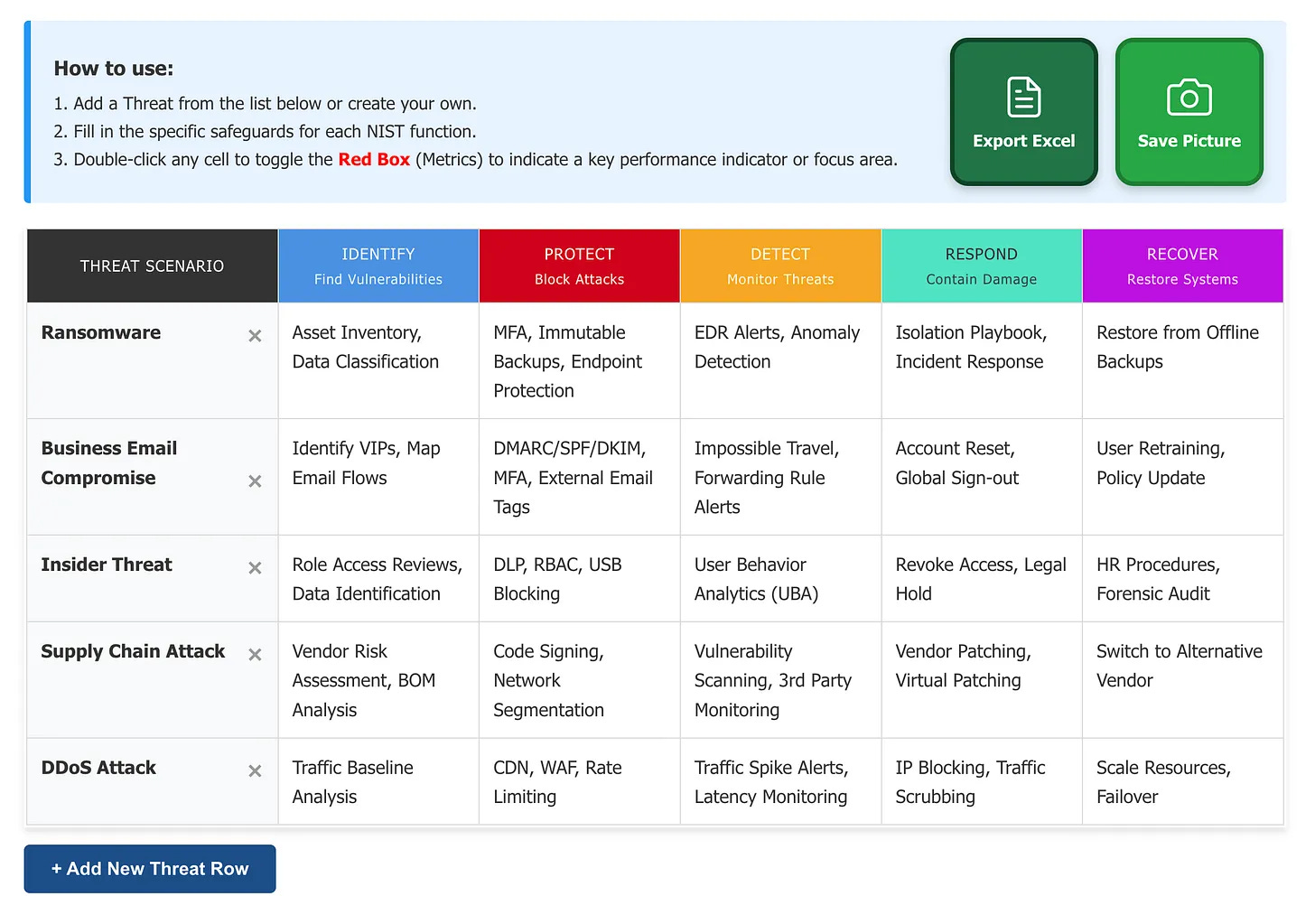
The framework gives security teams a structured way to map their defenses directly to the business outcomes those defenses protect.
Rather than presenting a list of tools and controls, you present a matrix that shows leadership exactly which threats your program addresses, which business functions those threats put at risk, and how your current investments reduce that exposure. The format is designed to be readable by someone with no security background, because the goal is not to impress the audience with the complexity of your program. The goal is to make the decision to fund it obvious.
This approach changes what gets measured and reported as well. Instead of presenting metrics like patch coverage rates or mean time to detect, which require context most executives do not have, you present scorecards that show trend lines against business-relevant goals, with clear status indicators and timelines that leadership can interpret without a translation layer.
Security teams that speak the language of business risk do not just win more budget. They earn a seat at the table where strategic decisions get made. When leadership understands that security posture directly affects the company’s ability to operate, grow, and manage liability, security stops being treated as a support function and starts being treated as a business function.
That shift in positioning has career implications as well. Security professionals who can move between technical depth and executive communication are the ones who advance into CISO roles, because the CISO job is fundamentally about influencing decisions made by people who do not share your technical background. The earlier you build that skill, the faster you develop the profile that leads to senior leadership opportunities.
On March 31 at 12:30 PM PST, Ross Young is leading a live virtual workshop where participants work through TaSM hands-on.
The session covers how to build an AI threat matrix, how to map your defenses across the NIST Cybersecurity Framework, and how to construct executive scorecards that present your security posture in terms leadership can act on.
Participants leave with templates and frameworks they can apply immediately.
✅ Cyber Inventory Template: Google Sheets template with common security technologies
✅ Interactive TaSM Tool: Web-based tool to build and visualize your matrix
✅ Workshop Exercise: Completed AI threat matrix via collaborative Miro board
✅ Metrics Dashboard Examples: Real scorecards showing vulnerability management, patching compliance, phishing metrics, disaster recovery testing
✅ Threat Modeling Integration: How to use TaSM with STRIDE-LM for application security reviews
✅ Budget Justification Framework: Connect spending to material threats and business outcomes
The workshop is free for Cybersecurity Club members, or $20 for non-members.
👉 Get a FREE Ticket (usually $20):
https://www.eventbrite.com/e/1981916887763/?discount=CybersecurityClub
🛡️ Not a Cybersecurity Club member yet? Join here! (It’s FREE)
No posts
Comments
Nothing yet. Say the first thing.
Sign in to join the conversation.