
At several commencement ceremonies this spring, graduates did something unusual. They booed when speakers praised artificial intelligence.
That reaction is easy to dismiss as youthful frustration or anti-technology sentiment. It would also be a mistake. Students are not simply rejecting AI. Many are reacting to a message that feels disconnected from the labor market they are about to enter. After years of being warned not to use AI because it might violate academic integrity rules, they are now being told from the graduation stage that AI will reshape their careers and they need to embrace it.
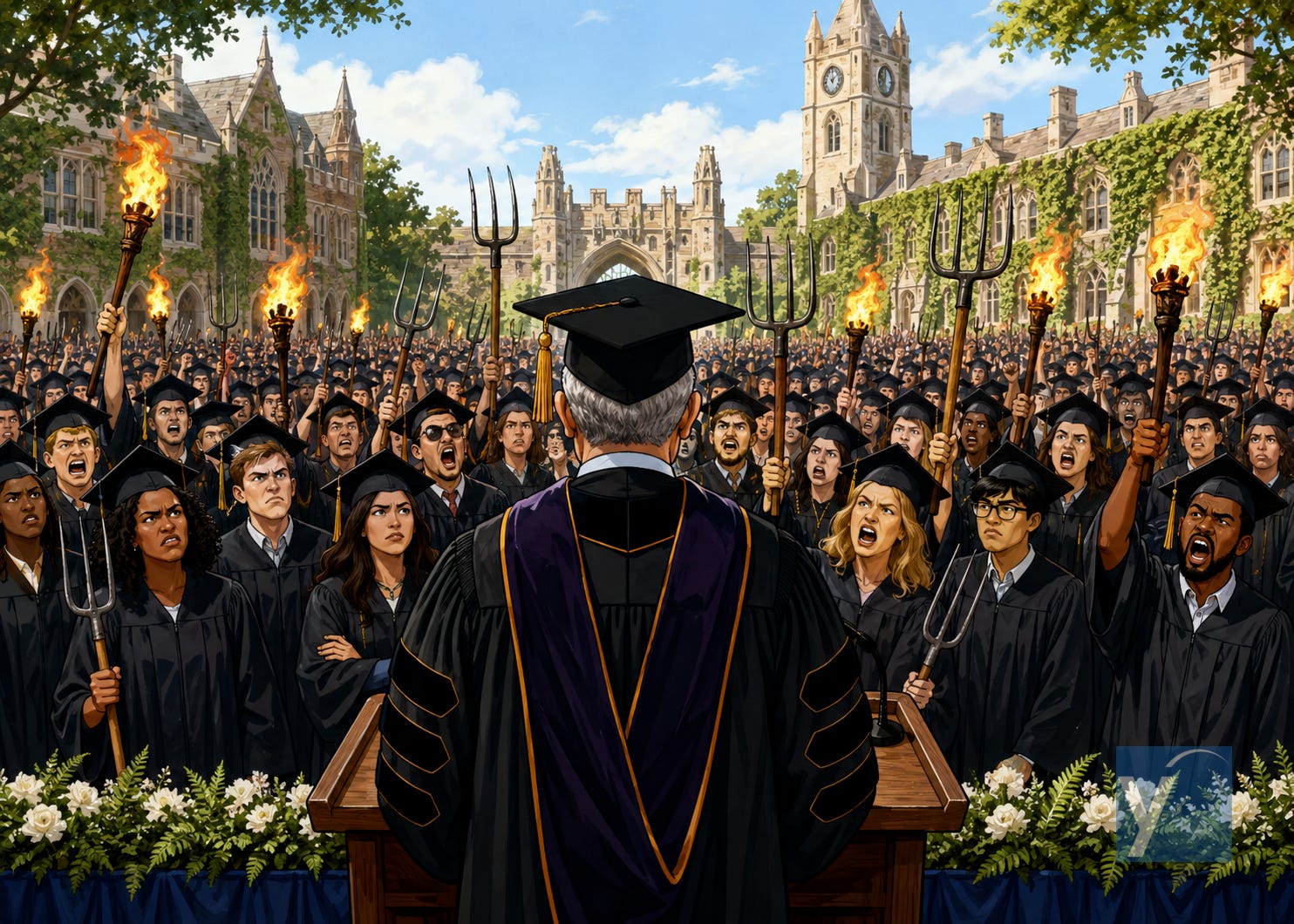
That is not a technology problem. It is a credibility problem.
Former Google CEO Eric Schmidt was reportedly booed at the University of Arizona after discussing AI during commencement remarks. By contrast, Apple co-founder Steve Wozniak drew applause at Grand Valley State University when he told graduates they already had “AI,” meaning “actual intelligence.” The difference matters. Wozniak centered the graduates before centering the technology. That message landed better because it recognized something students already understand: human judgment, creativity, and adaptability still matter.
But students are also reading the room. The early-career job market is becoming more complicated. A 2025 Stanford Digital Economy Lab paper found that workers ages 22 to 25 in AI-exposed occupations experienced relative employment declines, while more experienced workers in the same occupations remained more stable. The study also found that the employment effects were concentrated in occupations where AI appears more likely to automate work than augment it.
That is the first-rung problem.
For decades, entry-level workers learned by doing the basic work: drafting, summarizing, researching, organizing, documenting, checking, and preparing. Those tasks were not always glamorous, but they taught people how a profession worked. If AI now handles more of that work, the path from degree to competence becomes less obvious.
This does not mean the college graduate is obsolete. That conclusion is too broad and too easy to dismiss. The National Association of Colleges and Employers reports that employers expect to hire 5.6% more new college graduates from the Class of 2026, while demand for AI skills in entry-level jobs has nearly tripled since fall 2025.
That combination should get every college leader’s attention. Employers still want graduates. But they increasingly want graduates who can work in environments where AI is already part of the workflow.
Some schools are moving in that direction. Ohio State University says all undergraduates will develop foundational generative AI skills through its required General Education Launch Seminar and related workshops. The University of Florida has built an “AI Across the Curriculum” approach that includes AI literacy across majors, not only technical programs. Arizona State University has provided no-cost ChatGPT Edu access to students, faculty, researchers, and staff. The California State University system has also launched a systemwide AI initiative intended to provide AI tools and training across its campuses.
College-bound students and families should pay attention to those differences. The best question is no longer only, “What is the school’s ranking?” It is also, “How is this school preparing students for work that is being reshaped by AI?”
Prestige still matters in some fields. But it is not a substitute for readiness. A famous name on a diploma may open a door, but it does not automatically teach a graduate how to verify AI outputs, protect sensitive information, communicate clearly, improve a workflow, or explain the reasoning behind a decision.
That is where colleges need to be more honest about their product. The product is not the course catalog. It is not the credit hour. It is not even the diploma. The product is the graduate.
By 2027, a stronger graduate should leave college able to use AI tools responsibly, ask better questions, check outputs, work in teams, solve messy problems, and show evidence of practical work. That does not require every student to become a technologist. It does require every school to stop treating AI only as a cheating issue and start treating it as a career-readiness issue.
This is also where the conversation should become more hopeful. Not gaining AI literacy skills in college is not an all-is-lost scenario. A graduate does not need another full semester, another degree, or a technical bootcamp to learn the foundations of using AI responsibly in their field.
The starting point is more practical than that: learn how to ask better questions, check outputs, protect sensitive information, and use AI to improve the work already in front of you. For a teacher, that may mean lesson planning. For a small business employee, it may mean writing clearer customer messages. For an analyst, it may mean organizing information faster. For a skilled tradesperson, it may mean documenting work, estimating materials, or communicating with clients more clearly.
Human + AI: Working Better Together
AI literacy is becoming part of basic career readiness, but it is still teachable, accessible, and practical. The first rung of the career ladder may be changing, but it has not disappeared. The better question is whether we are preparing people to step onto it with judgment, confidence, and the ability to keep learning.
Can we do better for the Class of 2027?
We should. And we do not need to wait for another commencement season to begin.
No posts
Comments
Nothing yet. Say the first thing.
Sign in to join the conversation.