

On June 8, the UCI published its annual round of cyclo-cross rule amendments that take effect July 1, 2026 (this coming season), and a second, published-in-advance set of amendments taking effect July 1, 2027. Read together, they amount to one of the larger reg dumps we’ve encountered since the pandemic, and although there are some substantive changes worth mentioning, nothing here—at least for 2026-27—is groundbreaking or even earth-shattering.
The 2026 changes affect race-day operations and address long-standing issues in the junior rankings. However, the 2027 changes complete the decoupling of junior women from the elite women’s field. The rule changes also finally allow for a mandatory 50-minute elite women’s race that organizers can no longer truncate by folding in the aforementioned juniors. That is a fantastic change. And one that should be implemented this season rather than waiting until next season.
But I’m getting ahead of myself.
Let’s take the new regs in order.
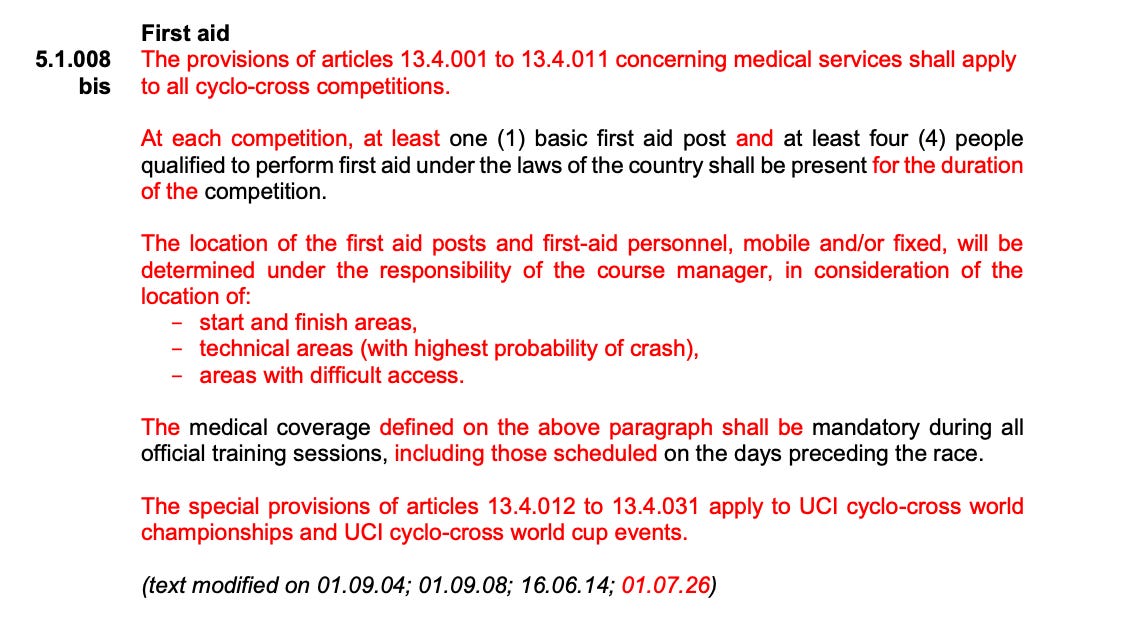
The revised first aid article (5.1.008 bis) aligns with the UCI’s general medical rules. The old rule required at least one ambulance and at least one doctor at every event. Both requirements are gone.
In their place, every competition must have at least one basic first aid post and at least four people qualified to perform first aid under local law, present for the duration of the competition. Crucially, the placement of posts and personnel is now the course manager’s explicit responsibility, planned around three priorities: the start/finish areas, the technical sections where crashes are most likely to occur, and the parts of the course that are hardest to reach.
Coverage also runs longer. Medical personnel must now be on site during all official training sessions, including those on the days before the race, at every competition. Previously, training-day coverage was only required at Worlds, World Cups, and continental championships. The heavier medical provisions (articles 13.4.012–031) still apply on top of this at the World Championships and the World Cups.
For North American UCI races, this is a big deal. In many U.S. races, the cost of having an on-site ambulance for the entire event is one of the biggest budget items. Being able to hire more EMTs to cover more ground is a strong trade-off, especially at a race like DCCX, where the area’s largest trauma center abuts the course.
Four trained EMTs positioned around the course with an off-road vehicle do a lot more for rider safety than an ambulance parked at the finish line. The change also acknowledges that injuries frequently occur during pre-ride and training sessions, when riders test lines at speed on tracks they are still learning. For smaller class 1 and class 2 organizers, as opposed to World Cups and Worlds, the net cost may actually drop with no doctor or ambulance day rate to pay. Some may argue that removing the physician requirement is a step backward for worst-case scenarios at races far from a hospital, but my experience is that many of the doctors filling the race-physician role have no emergency room or trauma experience. It’s a box organizers are required to check for the UCI, which means many a racer’s physician-spouse, no matter the specialty, has filled the role of race doctor. Trained EMTs who handle medical emergencies daily are a better option.
The obstacle article (5.1.024) gets its most prescriptive rewrite in years, prompted — per the UCI’s own explanation — by organizers experimenting with two planks of different heights. The Cyclo-cross Commission believes that such shenanigans are unsafe and technically unsound.
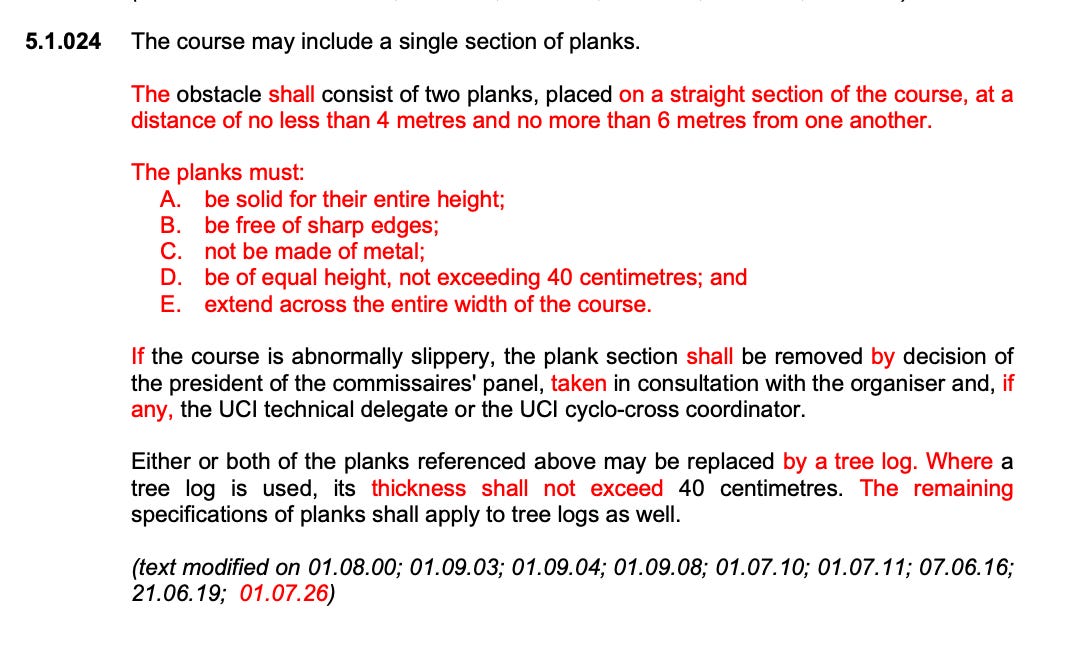
The new specification still requires a single-plank section consisting of two planks on a straight section of the course, spaced 4 to 6 meters apart. The planks must be solid for their entire height, free of sharp edges, not made of metal, of equal height not exceeding 40 cm, and extend across the full width of the course. Tree logs may still substitute for either or both planks, capped at a thickness of 40 cm, with all other plank specifications applying.
I’ve never encountered planks of significantly different heights appearing at a UCI race, but someone obviously tried it, which meant the UCI had to outlaw it. I look forward to the meter-stick-wielding rule sticklers demanding a plank be reset because it’s not the exact height of its counterpart.
If the course is abnormally slippery, the plank section shall be removed by decision of the commissaires’ president, in consultation with the organizer and, where present, the UCI technical delegate or cyclo-cross coordinator.
The mandatory removal rule is going to lead to some fantastic debates. “Abnormally slippery” is left entirely to the judgment of the official on site, which guarantees wildly differing decisions from race to race. It also butts heads with one of the best parts of cyclocross: determining risk versus reward. If conditions in the plank area are slippery, making riding the planks dicey, get off and run. That is a core tenet of cyclocross. If you can’t complete a maneuver 100 percent of the time during a race, don’t do it. Dismount and run. Slippery conditions are why toe-spikes were invented. Let’s not remove sections unless they’re truly unsafe, and those sections aren’t always going to include planks. This is a rule looking for a problem.
Article 5.1.042 now codifies that riders are called to the grid one by one in the established start order, and that the made-for-TV separate presentation of the top eight riders is permitted only at World Championships and World Cup events, “unless expressly authorised by the UCI” elsewhere.
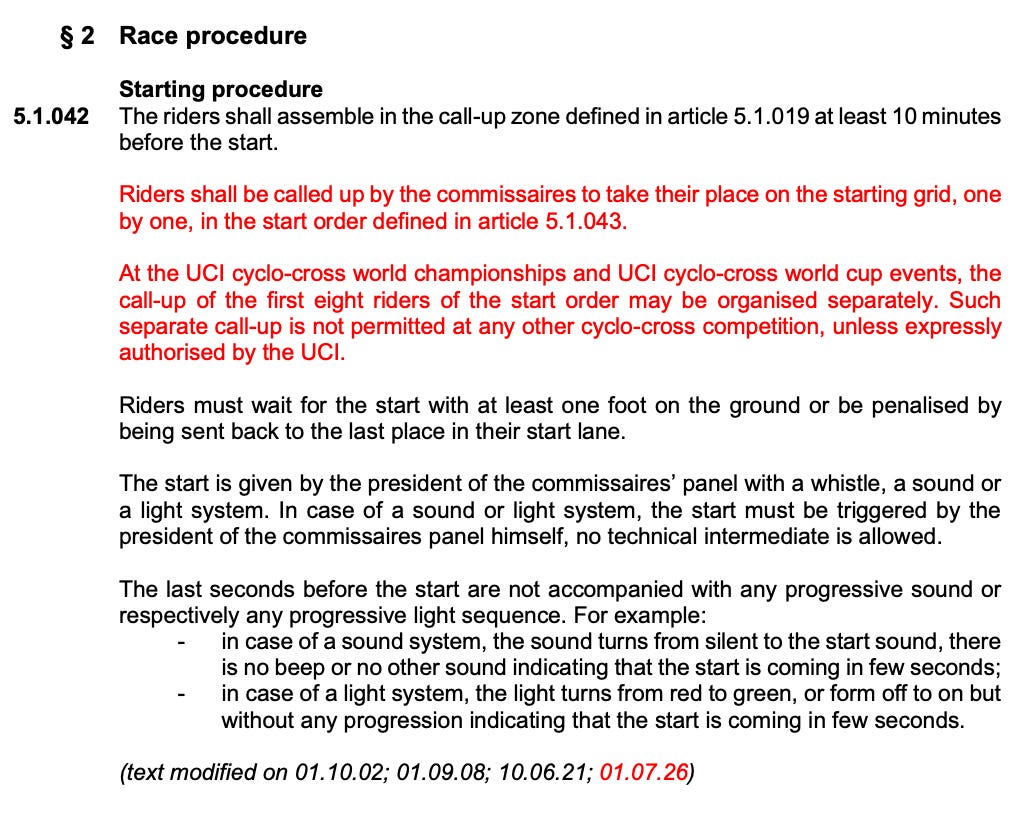
The UCI’s stated rationale is to avoid “undesirable impact on sporting aspects.” In other words, extended presentations leave the rest of the field standing still in the cold while the front row is celebrated, and inconsistent procedures among organizers create uneven starts. Read between the lines, and this also gatekeeps a premium broadcast asset for the UCI’s own properties, i.e., the World Cup.
I know the USCX tried this last season or the year before. I’m fine with not having it. Let’s get the races started and build excitement with action rather than pretense.
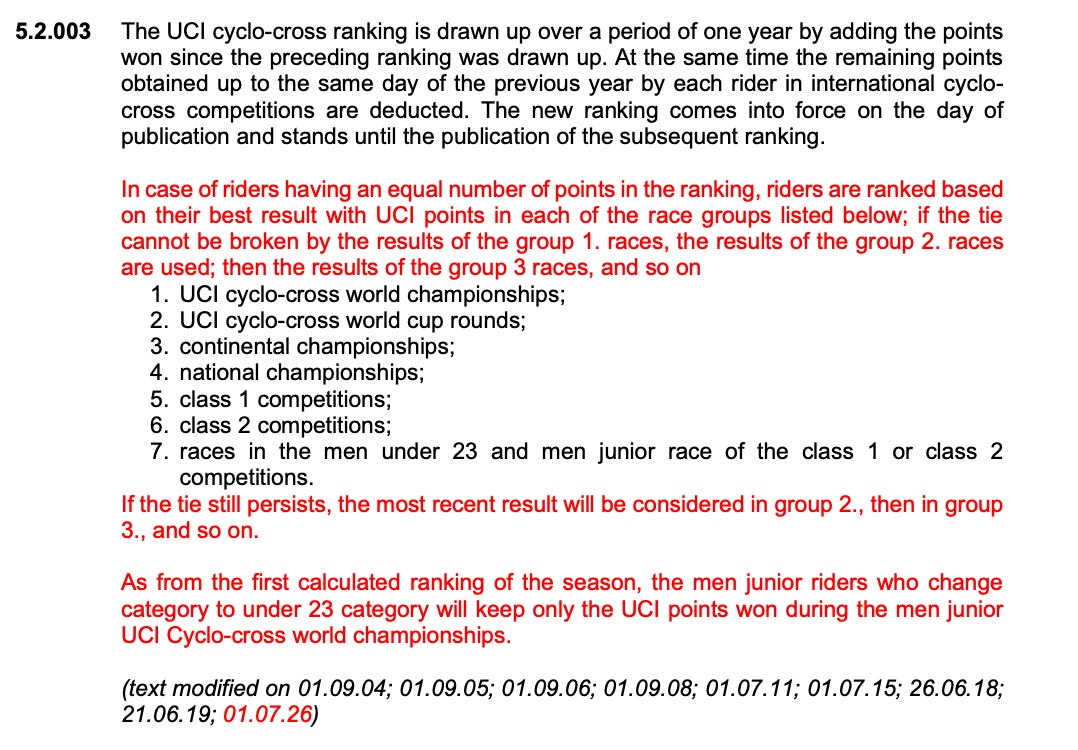
Article 5.2.003 previously split the UCI cyclo-cross ranking into two systems: a rolling 12-month ranking for everyone else, and a separate Junior Men’s ranking that tallied points from September 1 to the end of February, then reset to zero.
The UCI’s memo names two victims of that design: the 18-year-old, whose entire first junior season evaporated the moment his second one began; and the 19-year-old, whose junior points never transferred to the elite/U23 ranking.
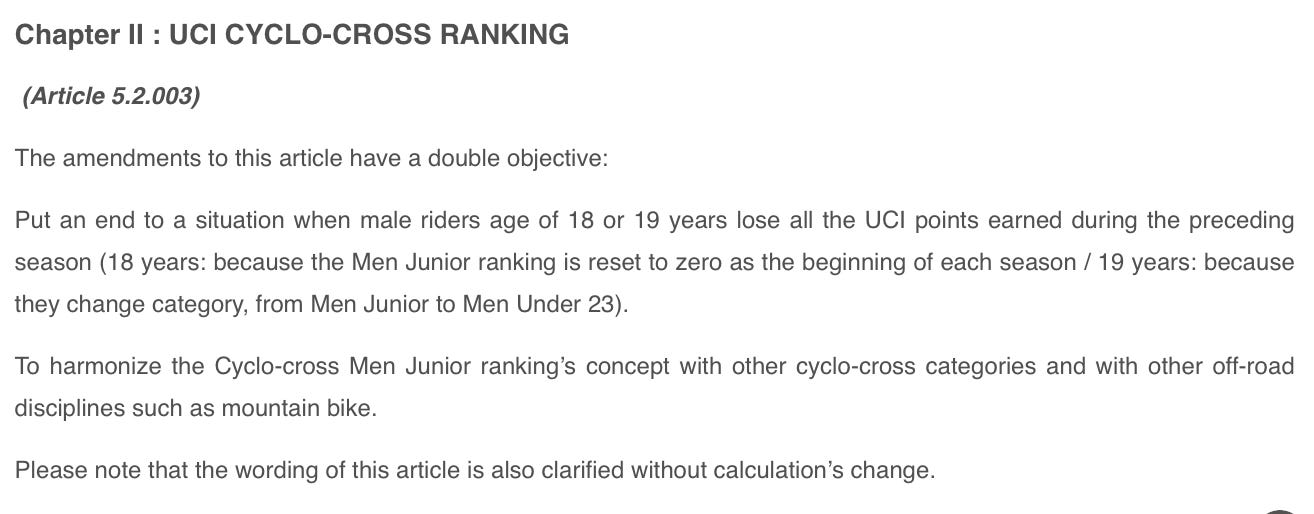
Each gets its own fix. For the 18-year-old, the separate junior ranking is shuttered, and juniors now use the same rolling one-year methodology as everyone else. Points won are added, and each result falls away individually once it’s twelve months old.
For the 19-year-old: a one-time opportunity to carry over points going into the next season (as if Worlds wasn’t already pressure-filled). When the first ranking of the new season is calculated, a rider who has moved up to U23 keeps only the points he won at the Junior World Championships. Everything else from his junior career is stripped. It’s better than zero, but it concentrates enormous stakes in a single race: Junior Worlds awards 200 points for the win (the same as an elite World Cup victory), 150 for second, 120 for third. Medal at Worlds and you’ll earn a respectable grid position as a first-year U23. Suffer a flat tire or mechanical on that day, and you start from scratch like it’s 2025.
The tie-break system is also rebuilt. Instead of “most recent points-scoring result,” ties are now broken by comparing riders’ best results across a hierarchy of events: (1) World Championships, (2) World Cup, (3) continental championships, (4) national championships, (5) class 1, (6) class 2, (7) U23/junior races within class events—working down the list, with recency as the final separator.
The capped results rules for juniors (best 6 class 1/2 results, best 5 World Cup results) remain intact, so the rolling junior ranking theoretically discourages over-racing. The new tie-break rewards quality of results over scheduling skill.
The race incidents table (5.6.004) adds a middle tier of sanction that cyclo-cross has lacked. Non-compliant accessories — such as glasses, socks, shoe covers, rain jackets, sleeves — or unauthorized modifications to accessories and clothing now draw at Worlds, World Cup, class 1/2, and continental championships, a CHF 200 fine plus either 20 UCI ranking points or relegation of one place. For other competitions, infractions carry a CHF 50 fine and either 5 points or one-place relegation. The same structure applies to non-compliant bicycle accessories.
Core violations are unchanged: showing up at the start with a non-compliant bike, clothing, or helmet still means a refused start, and the serious offenses still carry disqualification.
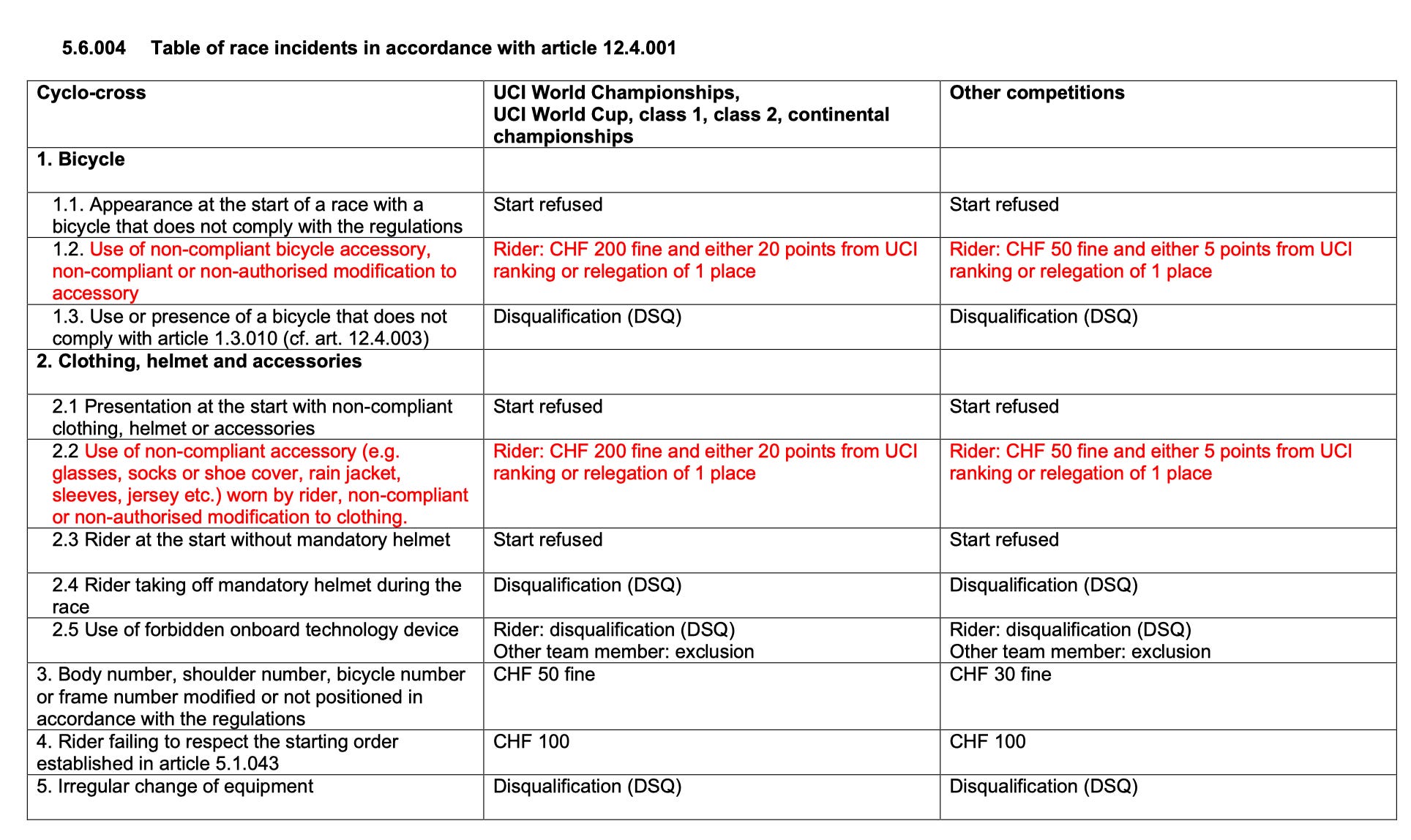
Until now, commissaires facing a sock-height or rain-jacket infraction had a binary choice. They could look the other way or impose a sanction wildly disproportionate to the offense. With a more reasonable penalty structure in place, officials may increase enforcement. Riders should carefully audit their accessory drawers before October to avoid too-high aero socks costing them 200 francs or 20 points.
The second memorandum, published a full year ahead so organizers bidding for the 2027–28 calendar (bids open October 15, 2026) can plan, completes the Women Junior development plan that the UCI Management Committee adopted back in June 2024. The end state, in the UCI’s own words: Women Juniors race only in dedicated races, mandatory at class 1 and class 2 competitions, with their own UCI ranking, no longer ranked with Women Elite.
The redlined articles show this cuts deeper than the summary suggests.
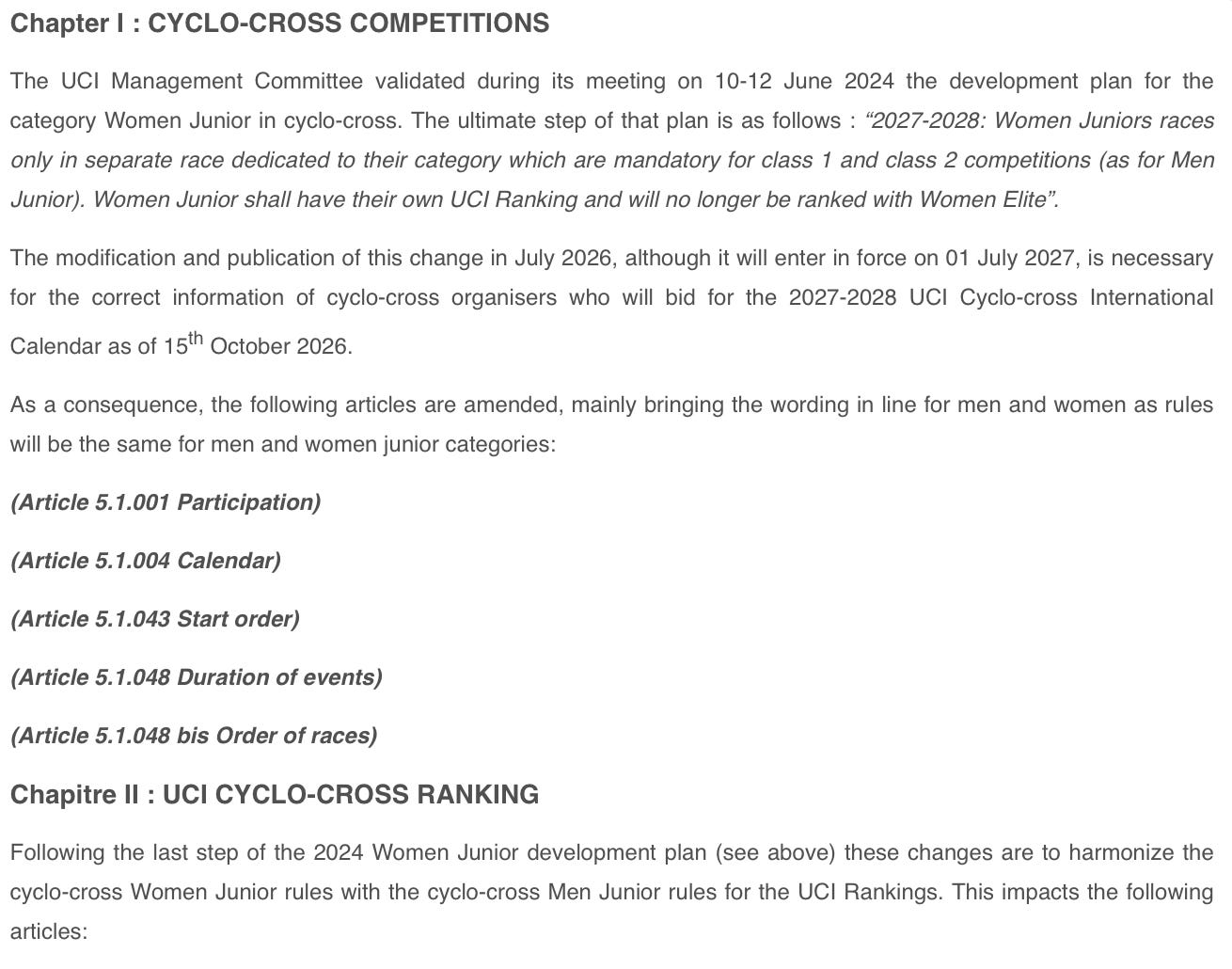
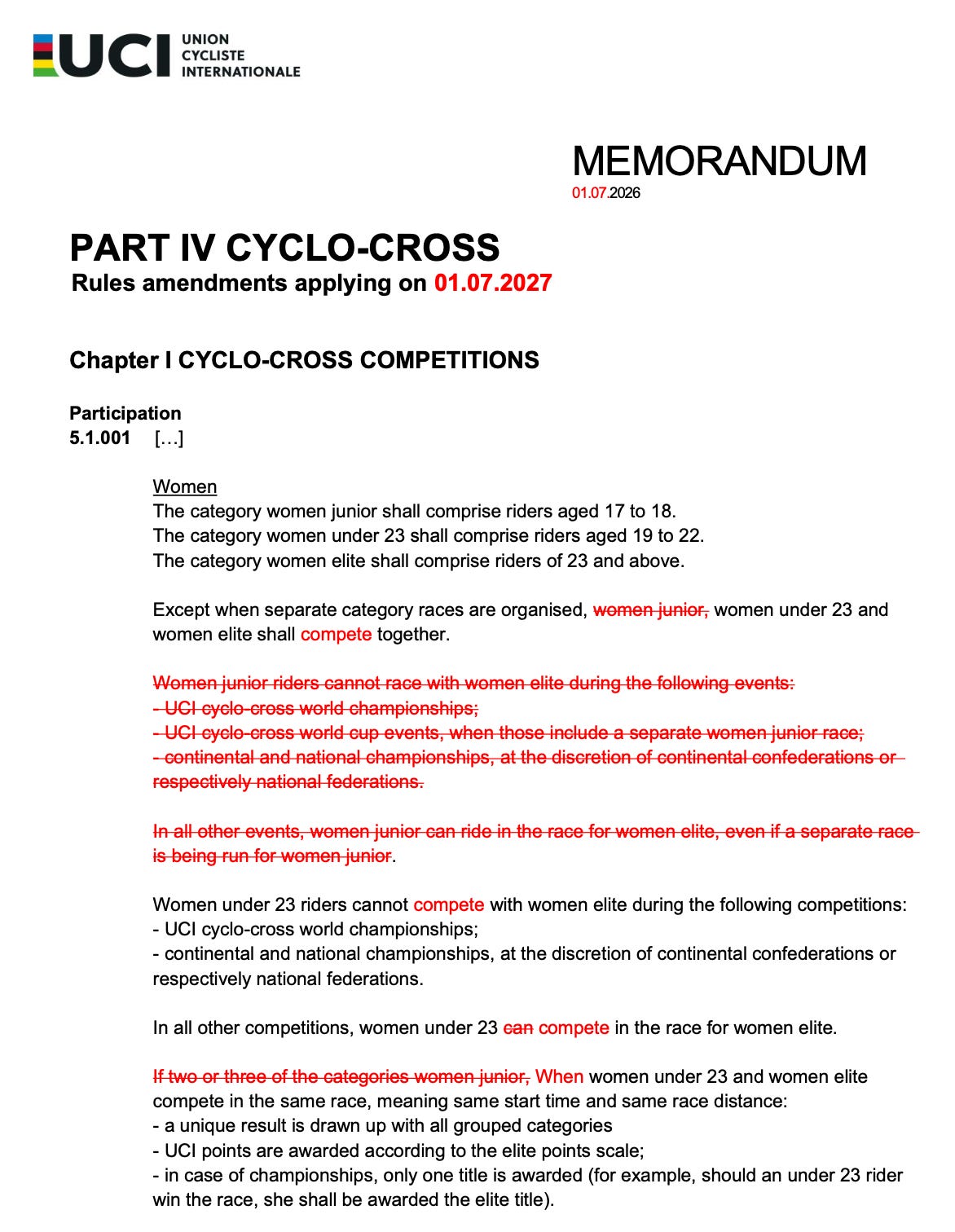
The new regulation (5.1.001) doesn’t just establish separate junior races — it deletes the entire framework under which women juniors could ride elite races at all, including the catch-all clause that allowed it “in all other events.” From July 2027, there is no circumstance in which a 17- or 18-year-old woman lines up in an elite women’s race. The combined-field provisions survive only for women under-23 riders racing with elites.
This is the structural parity the men’s side has had for years, and for the broad base of junior women, it’s huge. Junior women now get a guaranteed race of their own at every class 1 and class 2 event, against their peers, with their own ranking and visibility, instead of an anonymous spot at the back of a 40-rider professional field. There may be a generational talent who comes along that can hang with the elite fields as a junior. Although the rules are pretty clear about not letting anyone race up, we’ve seen riders petition in the past to race up, so that is still a test case in search of a subject.
The calendar article (5.1.004) upgrades the women junior race from “can be organised” to “shall be organised”: every class 1 and class 2 competition must now stage a men junior race, a women junior race, a women elite race, and a men elite race. Derogations for the junior races remain available only for events not held on a weekend. The race-order article (5.1.048 bis) adds a touch of flexibility — either junior race may run first — before the familiar sequence of men U23 (when held), women elite, men elite, with the elite races protected as stand-alone events.
Junior women getting their own race at every event, not just where organizers feel like it, is a substantive and meaningful change. Some organizers in Europe will argue that a fourth mandatory race is an unreasonable operational and financial burden, with more open-course hours, more officials, and more medical coverage, all within a small window of daylight. This will also mean that, unless the UCI changes the daily schedule, the junior men will now have races starting early in the morning.
The updated race duration table is another upgrade for the 2027–28 season (5.1.048). The current rule lists 45 minutes for races “where women elite and women junior race together” and 50 minutes for women elite races “without women junior.” Since junior women race within the elite field at most events outside the top tier, the 45-minute race has been the de facto standard across much of the calendar.
Both qualifiers are relegated to a historical note. From 2027–28, junior men race 40 minutes, junior women also race 40 minutes, women under-23 race 45 minutes, men under-23 race 50 minutes, elite women race 50 minutes, and elite men race an hour.
This is a positive change because organizers can no longer shortchange the women by tacking on a junior field they didn’t ask for. But it dodges the larger question: why can’t the elite women race 60 minutes? And what happens to women after their junior years that they can no longer race the same duration as the men? I can see racing different distances; that makes complete sense, since men generally race at higher speeds. But duration? It’s absurd. Sixty minutes for men and women is the only right answer (along with 50 minutes for men and women U23s.) Let’s just keep it as simple and fair as possible: All Juniors 40 minutes, All U23s 50 minutes, All Elites 60 minutes.
Article 5.2.001 establishes four rankings: a joint men elite/U23 ranking, a joint women elite/U23 ranking, a junior men ranking, and a new junior women ranking. The points-category table (5.2.004) deletes the old junior women special case and folds junior women class 1/2 races into the same category as the men’s. And article 5.2.006 goes gender-neutral: all junior riders, men and women, count only their best 6 class 1/2 results and best 5 World Cup results. This capped-results model aims to discourage junior over-racing and reward quality over volume.
The one notable change in 5.2.003 is “men junior” becoming just “junior.” From 2027–28, junior women aging into U23 will, like the men, keep only their Junior World Championships points. This is the part where junior women lose out a bit under the new system. Today’s junior women can earn elite points because they have no other choice but to race in the elite field on most weekends. A strong junior woman is currently entering her first U23 year with 12 months of elite points. From 2027–28, that entire base is stripped at the season’s first ranking, replaced by whatever she earned in one race at Junior Worlds. The men never had elite-scale points to lose; the women do.
Because starting positions flow from ranking, the top junior women in the 2027–28 transition class will grid worse in their first U23 season than their predecessors did. The start-order article (5.1.043) is cleaned up to match: women junior races simply drop out of the special-case list — with a ranking of their own, they grid like any other category — while women’s U23 races are explicitly part of the elite women’s ranking.
One question the memos don’t answer: what happens to points already sitting on the joint women’s ranking when the split arrives? A second-year junior in 2027–28 will have scored elite points the season before. Whether any of that carries over into the new junior women’s ranking, or she starts at zero, is something the UCI will presumably have to clarify before October.
This season’s changes are mostly about operations: medical coverage, planks, call-ups, rankings, and accessory enforcement. The 2027 package is more consequential. It finally gives junior women a protected calendar and ranking structure, and it forces organizers to yield back the elite women’s allotted time. All things that could happen this year.
Comments
Nothing yet. Say the first thing.
Sign in to join the conversation.