
Our latest research shows: kitchen-table populism wins. What does ‘Affordability’ mean to working-class voters? Blue-collar voters are (still) winnable for the Left so longs as professionals can start to develop some respect across the diploma divide. And a “Mom Populist” education agenda.
Plus, Trump is losing independent voters.
Below you’ll find a range of news and views that concern working-class politics today. Many are written by research associates and friends of the Center for Working-Class Politics.
Erica Etelson, president of the Rural Urban Bridge Initiative (RUBI), shares a byline with with CWCP director Jared Abbott in The Nation. They summarize the latest RUBI-CWCP joint-survey:
In June, our respective organizations, the Rural Urban Bridge Initiative (RUBI) and the Center for Working-Class Politics, surveyed 6,100 people, more than a thousand of them rural, about their reactions to political messaging. We asked them to compare two GOP opposition messages and 13 different kinds of messages either written by us or frequently heard on the campaign trail or in content by groups such as Indivisible, Showing Up for Racial Justice, and the Movement Voter Project. We have now compiled our findings in a new study, “Kitchen Table Messaging for the Populist Era.”
The results are clear. We found that people said they were substantially more likely to vote for Democrats who deploy populist economic messaging than for Democrats with messaging that criticizes Trump, warns about fascism and oligarchy, or exposes elites’ divide-and-conquer playbook. (Divide-and-conquer rhetoric scapegoats marginalized groups so that working people blame them—rather than elites—for their hard times.) The preference for kitchen-table populism held true with our respondents across the board and with key subgroups, including rural voters.
And Erica and I are in the Guardian writing on the same new survey. We highlight the fact that the much-lauded “Race-Class Narrative” fails with working-class voters:
The weakest variant of the divide-and-conquer narrative is the one that tells voters they’ve been tricked into blaming scapegoats. These “race-class narrative” appeals, so popular in progressives circles, finished at the bottom of the field. Why? Because telling people they’ve been duped comes off more like a condescending sermon than an invitation. Unlike kitchen-table populist messages that meet voters where they’re at, the race-class narrative strays from voters’ concrete economic woes to expound a more abstract theory of political gamesmanship. These messages trailed our top kitchen-table populist pitches with every group, including non-white voters and Democrats.
The Financial Times covers related research:
But, Abbott and Williams say, there’s an important wrinkle here: “While economic issues are a high priority for college-educated liberals, they focus chiefly on costs. Working-class people do, too, but they also focus on the other side of the ‘affordability’ equation: jobs, wages, and working conditions.
In other words, economic considerations are inseparable from questions of power and the sense of agency. Abbott and Williams’ two principal prescriptions for successful left-of-centre politics follow from this: (1) “Consistently embrace a populism that decries a rigged economy where hard work fails to yield a stable middle-class life”; (2) “Rigorously avoid reinforcing right populism’s narrative that liberal college grads look down on Americans without college degrees.
Doing the second, it seems to me, is as much about personnel as it is about policy. In other words, it might make a difference if the Democrats started recruiting candidates who aren’t products of the professional managerial class. Maybe it’s time they started looking in the labour movement for political talent like they used to decades ago?
Incidentally, that’s exactly what we argue they should be doing.
Carson Kindred makes the case for recognizing the class divide on the Left in order to bridge it:
While both liberal college grads and working people prioritize economic issues like affordability and social security, college-educated voters place substantially more importance on culture and climate issues — many of which have become the main talking points of the establishment left.
For example, liberal college grads prioritize resisting authoritarianism by 33 points more than the working class, protecting LGBTQ+ rights by 21 points more, and protecting abortion access by 19 points more.
Instead of seeking to bridge this gap between working-class and college-educated Americans, many liberal leaders have chosen to take this division for granted, directing their attention towards securing the support of educated voters, and considering the working class as unreachable.
Jared Abbott and Joan Williams in Bloomberg:
Dig deeper into the consensus around “affordable basics” and you find an important divergence. College grads’ key economic priorities all concern prices, whereas top working-class priorities also include raising wages, creating jobs and boosting economic opportunity. This reflects a K-shaped economy where the affordability crisis reflects not just high prices but low wages. “Nothing is affordable if you don’t have a good job,” observed Jason Walsh, executive director of the BlueGreen Alliance.
Increasing wages, we found, is a top 10 priority for Latino and White working-class respondents. It was also in the top 10 priorities for all Black voters, whether or not they have a bachelor’s degree. In other words, to reward a constituency Democrats need to retain (Black voters) and another they need to attract (working-class White and Latino voters), Democrats must focus not just on prices, but also on wages. This often gets lost in vague language of “affordability.”
Here’s CWCP’s own Ned Rust summarizing some of our latest research:
Working-class respondents favored securing the border by 28.3 points, lowering the crime rate by 21.8 points, and adding more police by 19.3 points.
On the other side, issues that college grads prioritize more than the working class, there are four issues with a wide spread. The college set prefers: LGBTQ+ rights by 32 points, immigration by 32 points, climate by 29 points, and abortion rights by 26 points.
These are called “wedge issues,” given their tactical utility to strategists on the Right. It’s not that these issues don’t matter — not even a slim majority of working-class voters wishes to persecute minorities, force women to have unwanted children, or further disrupt the climate. But they are simply not seen as immediate as the threats that come from not paying your rent, car payments, daycare, and medical bills — existential issues that those on the college track don’t experience so often or acutely.
Jennifer Berkshire has a long read on what Democrats might do to fix our education system. She interviewed a few of us here at CWCP:
Democrats’ deep faith in college as the vehicle for economic mobility has hampered the party’s ability to communicate with working-class voters. It has also distorted the party’s view of what constitutes a desirable candidate. “Democrats used to have this tradition of looking for candidates in union halls,” argued Guastella. “Now they want big fundraisers. If you went to an Ivy League school, you know someone who works on Wall Street or in Silicon Valley. That’s not true for blue-collar candidates.”
Among the center’s first major research projects was a survey called “Trump’s Kryptonite,” in which it tested the success of various kinds of candidates in running on economically populist messages. The candidates who fared best at attracting working-class voters held blue-collar jobs or worked in professions like nursing, in which they were “bossed,” said co-founder Jared Abbott. The hypothetical candidate who held the most appeal to these voters turned out to be a female middle school teacher. Corporate execs and lawyers fared the worst. “When you consider that just 2 to 3 percent of Congress comes from the working class despite having a majority in the population, there’s clearly a moral and ethical imperative to have more representation,” said Abbott.
Ultimately, Berkshire argues, Dems need to ditch the message that everyone ought to go to college and instead focus on making public education, including higher ed, affordable and high quality.
John Halpin at Free Agent Politics reports that Trump is losing support among independent voters:
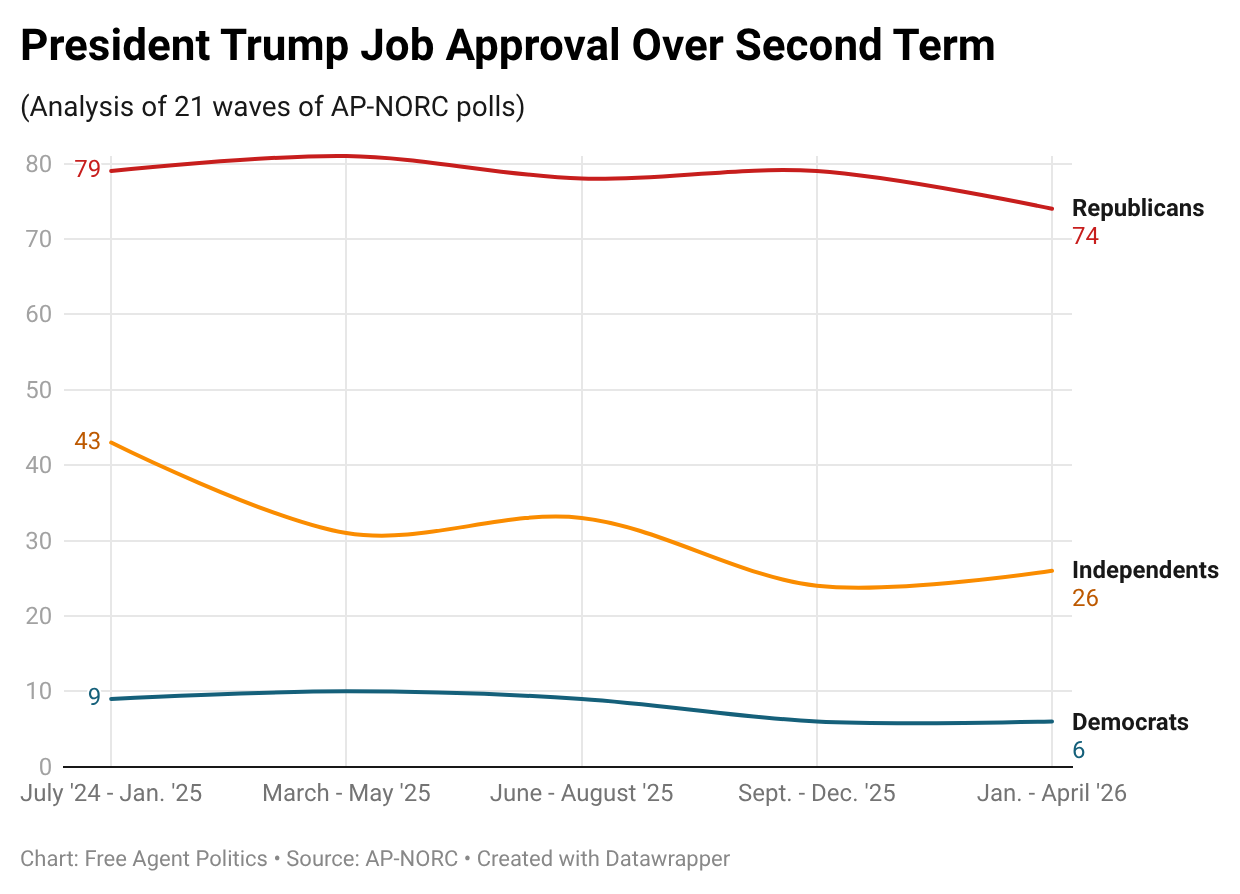
AP-NORC analyzed nearly 5000 “strict independents” (those who do not identify with or lean to one party or the other) from 21 different survey waves to examine how Trump has performed from the election period into April of this year. As seen in the chart below, highlighting his standing in five different waves, support for Trump among independents has declined 17 points,1 from 43 percent during the pre-presidency period to 26 percent by the end of April 2026. In contrast, support among fellow Republicans has dropped marginally while already low support among Democrats has remained stable.
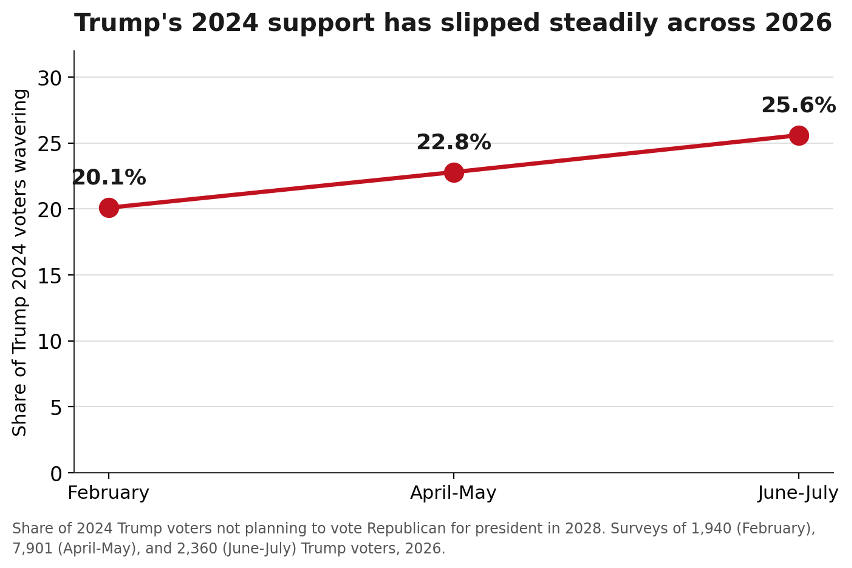
From a different angle, CWCP confirms the trend:
No posts
Comments
Nothing yet. Say the first thing.
Sign in to join the conversation.