
The 1%, but not who you think. Alissa Ellman, rust-belt populist for Congress. Donald Trump’s working-class coalition is crumbling. Friendship is becoming a luxury product. And the USW urges: elect more workers.
Plus, Angie Nixon pulls off a big win in Florida with a surprisingly working-class base.
Below you’ll find a range of news and views that concern working-class politics today. Many are written by research associates and friends of the Center for Working-Class Politics.
You may have read that only 2% of Congress comes from the working class. That number comes from research done by Professor Nicholas Carnes, of Duke University.
He and his colleague, Noam Lupu, have a new report out. Their latest research expands the scope to look at state legislatures and the findings are even worse:
By our count, about half of all Americans in the labor force have working-class jobs. However, people who last had working-class jobs when they got into politics make up only about 1% of the average state legislature, regardless of their party affiliation. The same goes for Congress.
And the U.S. isn’t alone. Starting in 2016, we partnered with a team of researchers to collect data on 97 of the 103 democracies with more than 300,000 citizens. Like the U.S., the average global democracy draws just 2% of the members of its national legislature from people who last had working-class jobs.
The new report, “How to Elect More Working-Class Americans” is worth reading in full. In it, they argue against something we have seen more and more as progressives wrack up wins in deep-blue districts:
Many reformers—especially those in political parties and interest groups—will be tempted to classify favored candidates from white-collar professions as “working class,” essentially tinkering with the definition of the term to match a favored candidate’s current occupation. Reformers must resist the temptation to shoot first and then draw the target where their arrow has landed. Changing the definition of working class is no substitute for changing the system.
That’s exactly right. Carnes and Lupu go on to advocate for recruiting more working-class candidates and outline a number of institutional policies that could help make their entry into political life a little easier.
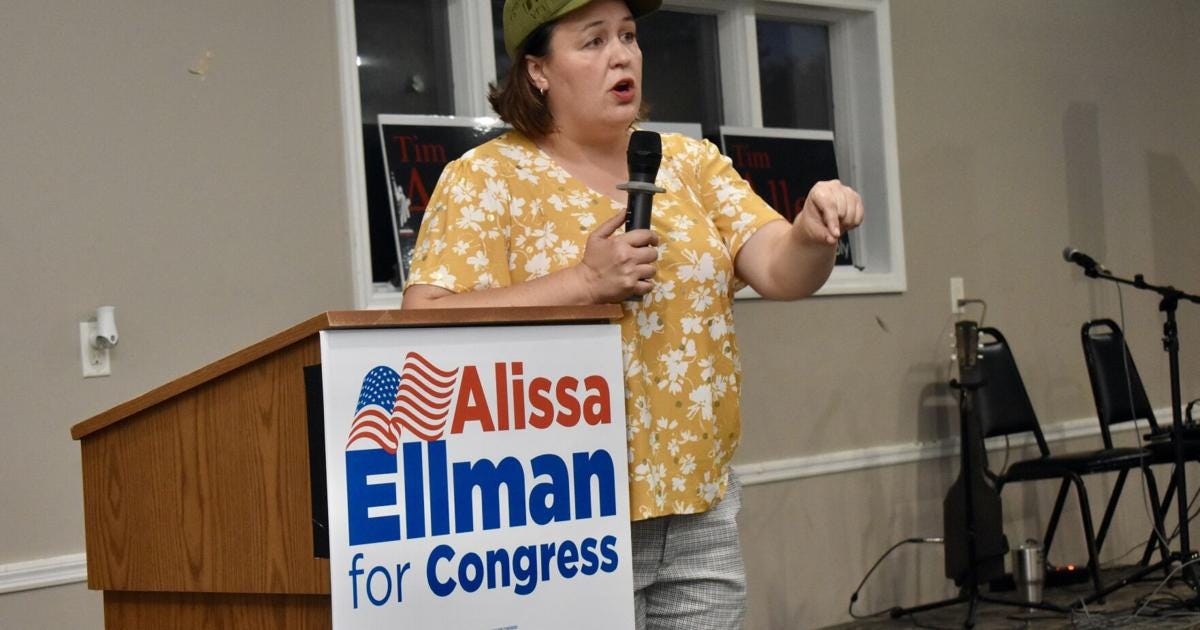
Ellman is the Democratic nominee in New York’s rural 24th Congressional District. A daughter of a working-class family she joined the Army as a teenager, worked for the VA, was fired under Trump, and is now running for Congress.
She’s sounding a lot of populist notes on the campaign trail, complete with some novel ideas:
“You’re talking about blue-collar working-class men who get up at four in the morning, go outside when it’s four feet of snow on the ground, shovel their driveway, go work outside all day throwing drywall up or pouring roads, hurting their hands, their backs, their knees. I think it makes them people we should really be focused on taking care of in this country. They are the backbone of society. I mean, you like flushing your toilet. You like turning on a light switch.
“They’re sick of their real-life work being less valued than, say, intellectual work. We should be moving that Social Security age down for those people. Do you think your body’s going to last till 65 when you’re picking up 350 pounds of drywall every day for 15 years?”
This is a direct a populist pitch to blue-collar men. We’ll see if it works in her +11 Republican district.
Hanna Horvath has a great primer on why prices have gotten out of control, the answer isn’t just “inflation.”
At this point, the problem goes beyond things simply becoming more expensive. I increasingly have no idea how much any of this is supposed to cost.
Inflation alone doesn’t really explain the experience of being a consumer right now, which increasingly involves paying more for something that is smaller, worse, harder to buy, harder to return, attached to three separate fees, priced differently depending on where you look and possibly being recommended to you by a person who does not actually exist.
Horvath provides a compelling, and rage-inducing, account of the steady destruction of the consumer market at the hands of “surveillance pricing,” “shrinkflation,” “skimpflation” and more. Of course, private equity is a big part of the story.
Horvath provides a good run down on the supply-side corruption but there is also a wage story to be told. Right now the top 20% of earners account for about 57% of all consumer spending. Consumer spending accounts for something like 70% of the American economy. High-earners have all the power.
One way of thinking about this is that we’ve traded an economy where consumption was widely spread among the vast majority of wage earners, for a society where the capital owners increasingly hawk their wares only to the top quintile of earners.
Feels a bit Weimar doesn’t it.
Meanwhile, Jared Abbott and Joan Williams have been tracking a steady slide in Trump support:
Republicans heralded Donald Trump’s 2024 victory as the birth of a new majority: a multiracial, working-class coalition powered by newfound support among black and Latino voters, particularly men, who had finally abandoned the Democrats over inflation, the cost of living, and immigration. While that conclusion may have been warranted in November 2024, it is not anymore. Indeed, over the course of 2026, Trump’s new coalition has been coming apart at the seams.
Over the first half of this year, we surveyed Trump’s 2024 voters three times: 1,940 in February, with extra interviews among working-class black and Latino voters, nearly eight thousand in April and May, and 2,360 in a national survey in late June and early July. We found that the share of 2024 Trump voters who are not committed to voting Republican in 2028, what we call “Trump waverers,” has risen appreciably over the course of the year.
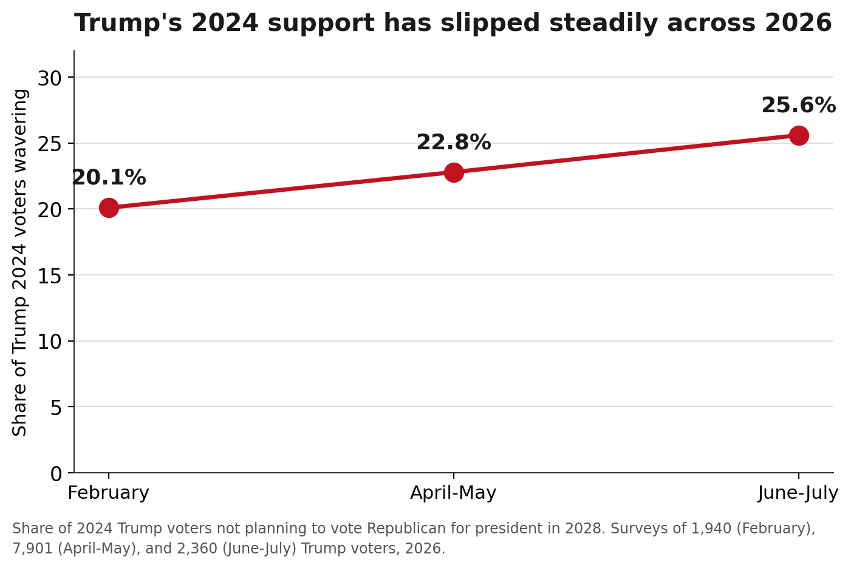
And as predicted, the “waverers” are concentrated among lower-income voters. Though the defections have spread to the white-collar set, with middle and upper income voters starting to question their loyalty.
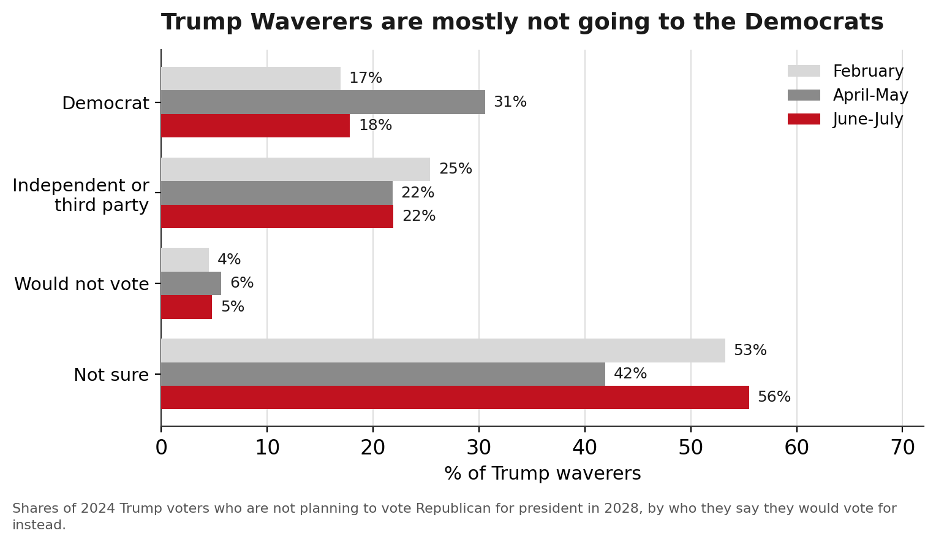
Still, as Abbott and Williams warn, the “waverers” may be leaving Trump behind but where they end up is still an open question:
In our K-shaped economy those who make their money on assets, and not wages, have seen their lives improve relative to their wage-earning counterparts in all sorts of ways. One particularly depressing social example is friendship:
If isolation really is a societywide crisis, we need societywide solutions — and an understanding of who has been left out most acutely from what friendship promises.
In pursuit of that aim, the researchers Sam Pressler, a fellow at the University of Virginia’s Karsh Institute of Democracy, and Soren Duggan, a communications strategist and Army veteran with a background in human intelligence collection, produced a report this spring titled “Nobody to Call,” based on a series of 30 in-depth, qualitative interviews with men ranging from their mid-20s to their mid-40s without college degrees. They hoped to add texture to the conversation on loneliness by seeking out those who they believe are struggling the most. We’ve all experienced social atrophy, Mr. Pressler told me, but for men without degrees the bottom has fallen out.
College completion rates have risen over the decades for both men and women, but a growing proportion of those who aren’t graduating are men. As of 2021, men made up around 43 percent of four-year-college enrollees, down from approximately 57 percent in 1970. “As the college degree has increasingly become the great sorting function in American life,” Pressler and Duggan write, “men without degrees have increasingly found themselves sorted out.” We tend to talk about the loneliness crisis in terms of gender, but class, as derived from educational status, is the factor too touchy — or too invisible — to acknowledge.
The quotes from young men in that report are brutal. To make matters worse so much of the discussion about working-class men in the media ends up reproducing vicious caricatures, often in the service of flattering professional-class liberals’s sense of moral righteousness.
The social rot goes deep and no genuinely progressive social policy can be won in an enviornment of total social devastation.
Roxanne Brown, international president of the United Steelworkers (USW), cites CWCP in her plea for electing more workers:
Union workers advocate more strongly for working people, both while campaigning and after election to public office, than non-union peers, according to a study released in March by Jacobin, the Center for Working Class Politics and Arizona State University’s Center for Work and Democracy.
Union members also use their leadership skills to build bridges in the government arena. They convert their experience in the trenches into credibility in the halls of power. And they win voters’ trust in ways that drive turnout at the polls, the researchers concluded.
As Ryan decided in running for the Indiana legislature, there’s only one way to ensure working people get the government we deserve.
We have to build it with our own hands.
Well put, and we are proud to have helped. To ensure that Brown and other union leaders continue to get CWCP insights that make a difference, please consider upgrading your subscription to this newsletter.
Angie Nixon, a self-described democratic socialist, won big in her bid to become the Democratic nominee for the Senate in Florida. That’s not news in itself given the success of progressives in Democratic primaries around the country, the real news is that she cleaned up with working-class voters:
Nixon, however, distinguished her victory from the slate of democratic socialists who have scored upset victories in Democratic primaries nationwide. While she ran on progressive policies such as universal child care and Medicare-for-all, she said she did not agree with the DSA on all issues and believed her campaign, not a national organization, allowed her to build a coalition that looked different from other democratic-socialist wins.
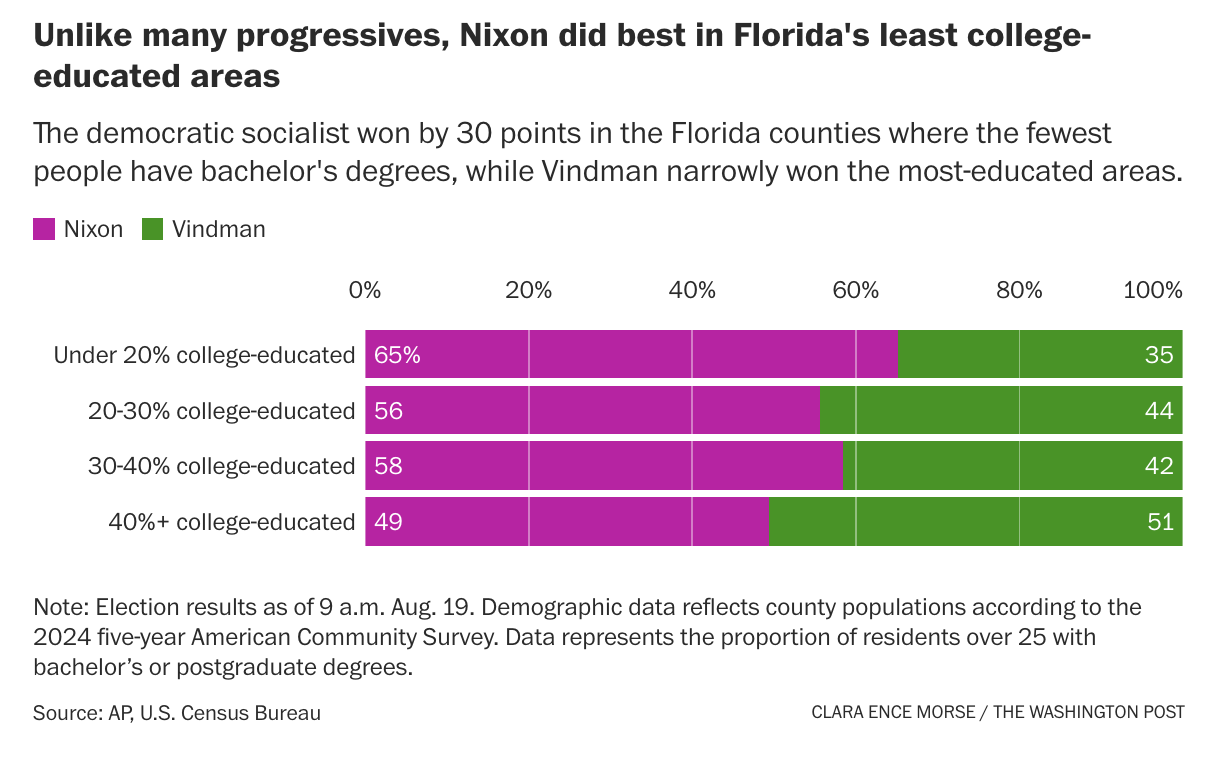
Not surprisingly, Nixon made it a point to reject the policy of defunding the police and spent a lot of her campaign translating progressive policy language into a more plainspoken populism.
Yet, even with her political smarts, and more favorable coalition, Nixon faces an immensely tough general election in red Florida.
No posts
Comments
Nothing yet. Say the first thing.
Sign in to join the conversation.