
Troy Jackson rallies union allies in Maine. A Democratic candidate causes a headache for Dan Osborn in Nebraska. And Anton Jäger on the Hyperpolitics of the elite.
But first, two new CWCP-affiliated reports
Below you’ll find a range of news and views that concern working-class politics today. Many are written by research associates and friends of the Center for Working-Class Politics.
How Democratic congressional candidates’ messaging shifted across three election cycles, and what it meant electorally.
Our regular CWCP candidates report is out today. The report analyzes the class background and political appeals of over 600 candidates who ran in the 2024 election cycle. Plus, this year’s edition compares appeals over the last three major election cycles.
Understanding the Massive Divide Between Working Class and College Educated Voters, and How to Bridge it
Jared Abbott and Joan Williams also have a new report out on the class divide on the Left and what might be done about it. Published this week, the analysis provides a thorough portrait of the various class-based attitude gaps that have become major obstacles for progressive politics.
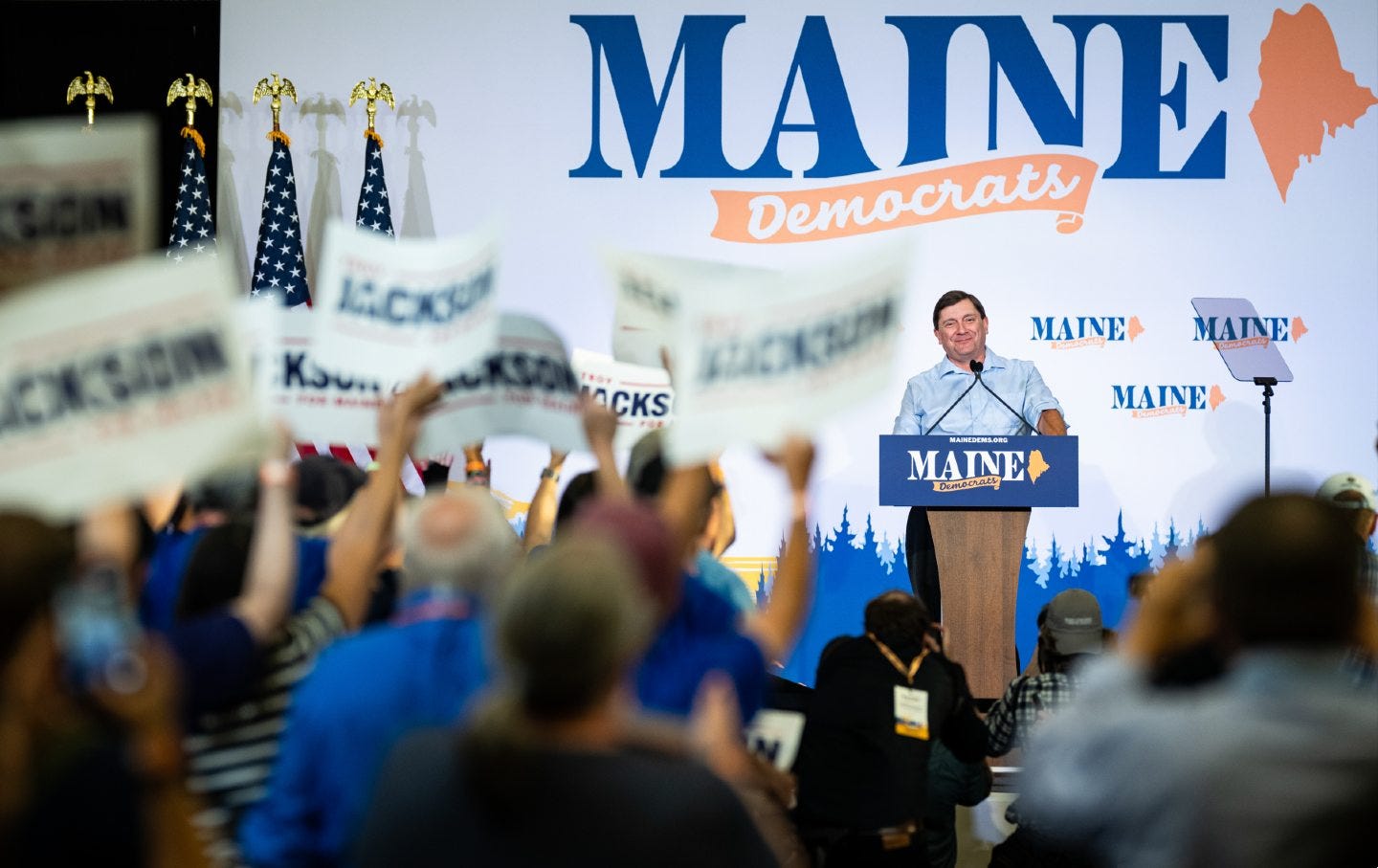
The Nation Magazine has a good write up on Troy Jackson’s campaign. Jackson is a labor-bred, labor-backed candidate, the kind we think has a strong chance of winning back crucial working-class votes:
As delegates to the Maine Democratic Party’s special Senate nominating convention on Saturday morning filed into a convention center in the former “lumber capital of the world,” a box truck sponsored by Teamsters Local 340 pulled up to the curb. It was flying “Troy Jackson for Senate” flags from the hood, and the trucker inside pumped his fist to egg on the attendees. Inside, a handful of union officials compared notes on fifth-generation logger and former state Senate president Troy Jackson’s improbable ascent from second runner-up in the primary for governor to emergency Senate nominee. Jake Teitelbaum—treasurer of the Maine Service Employees Association, a union that represents state employees—explained it to me: “Maybe some of the other candidates could mobilize money quickly, but Troy had the connection to labor. And we mobilize people.”
That last point is important. We’ve long advocated for more working-class candidates, but we’ve also argued that those candidates ought to come out of the union movement. Jackson’s campaign offers a good demonstration why. While much of civil society has been ground into dust or otherwise dissolved through digital substitutes—and while the Democratic Party’s own organization has atrophied into nothing more than a few terabytes worth of pathetic, whimpering emails and texts begging you for cash— the labor movement is still here. Unions still have the capacity, and resources, to mobilize and communicate with working-class voters in a way almost no other organizations can. Thats a huge asset, one that working-class union candidates can wield.
In a surprising move, William Forbes is suing the Democratic Party to run a candidate in the upcoming general election. Forbes, who lost his primary bid, claims that if a nominated candidate drops out, the party has to replace them:
“Nebraska law does not permit a candidate — or, more fundamentally, her political party — to abuse and distort the electoral process by running in a primary election with the deliberate purpose of exiting the race before the general election to strategically divert votes to a rival,” part of the lawsuit reads. “Nebraska law is clear: when a nominee withdraws between the primary and general elections, their political party has an obligation to replace them.”
Osborn, an independent, has greatly benefitted from the Democratic Party standing down in this election. If Forbes succeeds, it could threaten future Osborn-style candidates, those populist independents in deep-red areas where no Democrat stands a chance. And Forbes isn’t alone. In Montana, where the Democrats have also sat out the election in the hopes that an independent candidate might snatch the seat away from the GOP, the same fight is playing out.
Anton Jäger, who was recently profiled in The Guardian, has a sharp essay at New Left Review regarding our Hyperpolitical age:
The globalization of wealth, while politics remained residually national, introduced comparable intra-elite contradictions in other countries. Though France and Germany fought much harder to protect their ‘national champions’ in high-end engineering (the last British carmaker was sold off long ago), their banks nonetheless found American subprime mortgages more enticing. In the US, the state–capital nexus was less dependent on kith and kin, being robustly institutionalized in the lobbying industry that channelled corporate inducements to appropriate Congressional Committee members. But here, too, the onset of ruthless mergers and acquisitions, asset-stripping and outsourcing, helped to weaken links between enterprise and place.
Yes, in the good years of globalization the GDP growth machine did go brrrr, but the built environment and social world all suffered as a result. It makes sense, then, that in an effort to restore some sense of social and political stability the working-class all over the world has rallied behind those who criticize globalism and promise to renew place-based industry.
Still, we may find ourselves trapped. Globalism has resulted in obscene levels of inequality that have immensely empowered the rich and radically increased their influence over democracy, making any challenge to their economic theories much more difficult. Worse, neoliberalism has destroyed the associational and organizational capacity of the popular classes. We’ve all been digitally individualized and live in an almost incomprehensibly fractured social world. As such, forming coherent, durable, democratic coalitions has become nearly impossible and political leaders, of the Right or Left, routinely fail to command popular legitimacy for more than a half-second after the polls close.
No posts
Comments
Nothing yet. Say the first thing.
Sign in to join the conversation.