
To quote Jerry Seinfeld… “The soup counts!”
So, under my recent YouTube post about the upcoming Mark Solms podcast, a commenter reasonably raised everyone’s favorite biological objection to brain-bound minds: the butterfly.
That is, if consciousness and/or memory is brain based, then how does that explain the humble self effacing (literally) caterpillar who turns entirely to soup, yet the adult remembers its larval life? If the hardware scrambled beyond recognition, then what the heck is doing the remembering?
I did some searching and found that this folklore is present basically everywhere in pop sci. For instance:
The New York Almanack tells readers the caterpillar “releases enzymes which dissolve its body. All of it.” Closer inspection shows the article walks itself back a paragraph later.
Scientific American’s explainer softens its own “dissolve all of its tissues” two sentences after writing it. But guess which sentence gets excerpted.
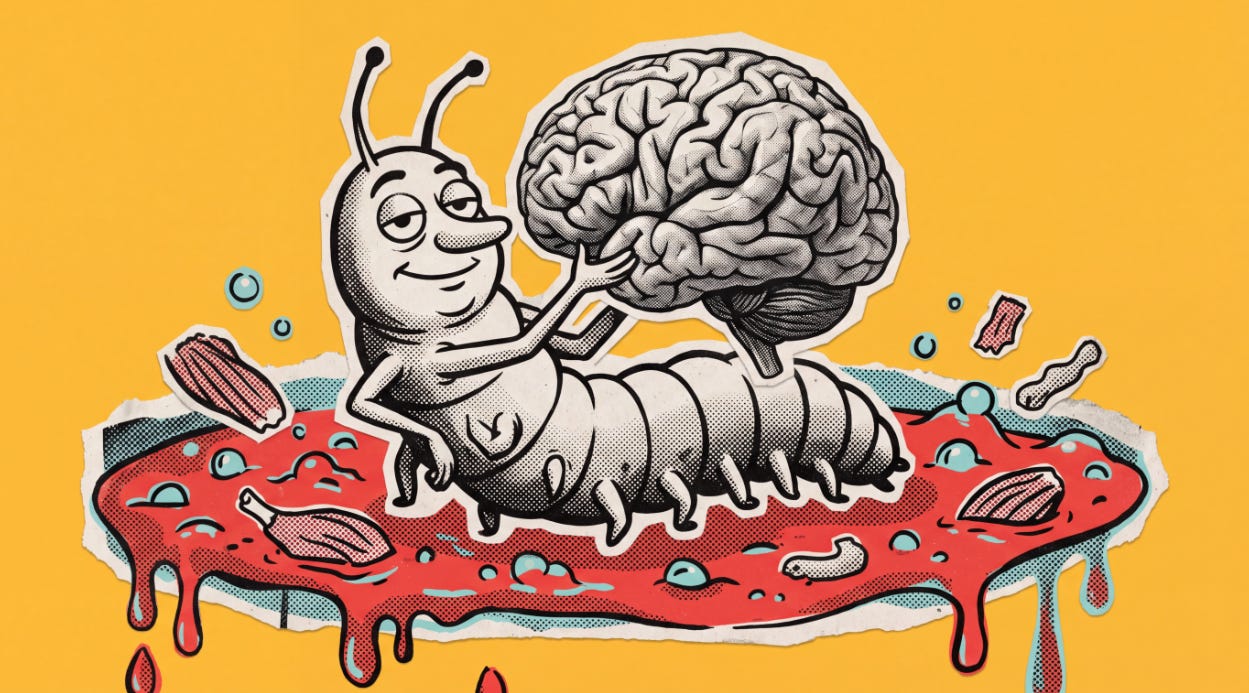
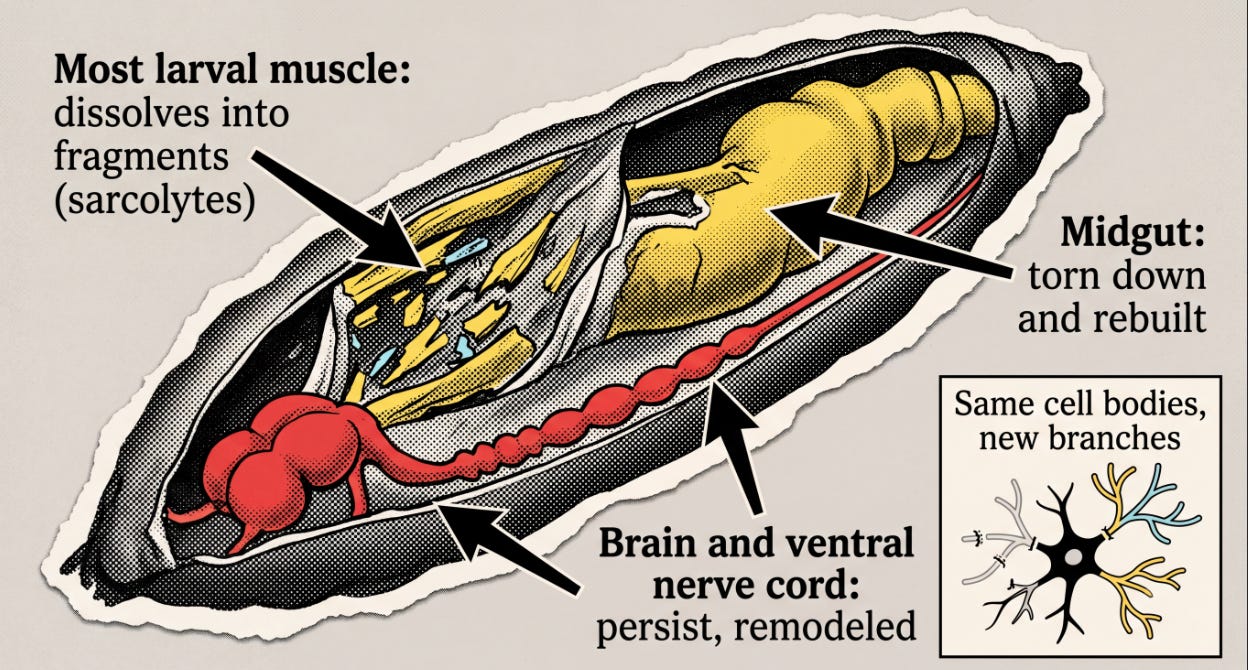
Let’s think about this soupness. Most larval muscle destroys itself on cue and breaks into drifting fragments the literature apparently calls sarcolytes. (Yes, I also had to look that up)
Much of the digestive tract of the caterpillar goes with it, and the freed molecules feed the adult butterfly. It would be nice if we, mere mortals, could substitute liquefying our gut with liposuction, but the gods aren’t so kind.
But notice that I focused on the digestive tract. I didn’t say “all of it” because not all of the caterpillar becomes soup-like.
You may also hear a juicier version: the caterpillar’s immune system attacks the would-be butterfly cells and kills them until it’s overwhelmed. But no such battle appears in the developmental literature! Much of the adult grows from imaginal discs, cell pockets set aside back in the embryo. Immune cells do show up, but as the cleanup crew for tissue already dismantling itself on hormonal orders.
This isn’t the Walking Dead. The brain was never on the menu. Most larval neurons persist, the fly anatomy finds, and the mushroom-body cells (the insect’s smell-learning hub) prune their larval branches and regrow adult ones from the same cell bodies. The organ sits there throughout, bathed in the broth that used to be muscle. Sounds somehow hot actually.
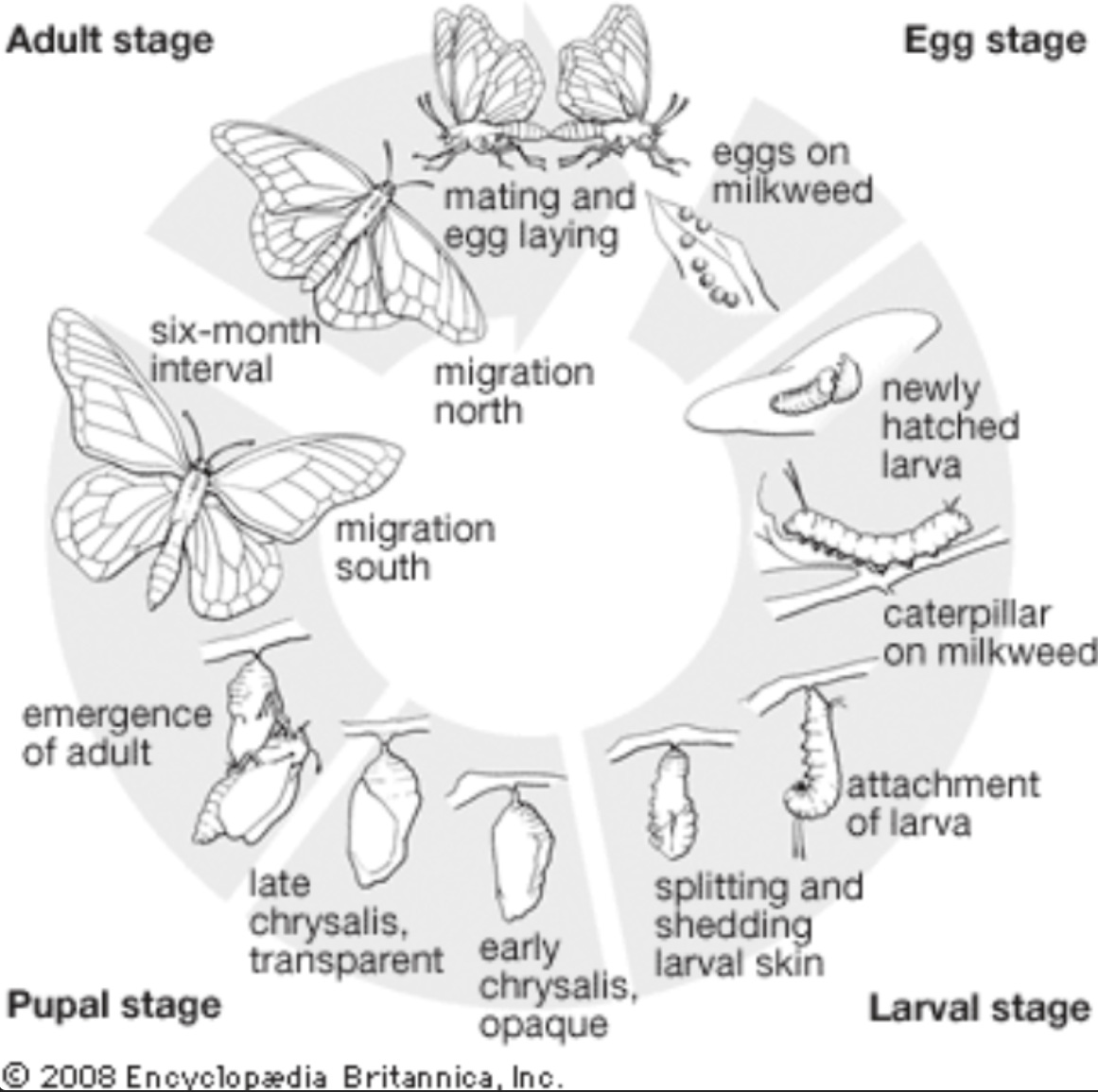
The wiring is another matter. A few years ago, James Truman’s team mapped the fly’s larval memory circuits through the pupal stage (the one where it’s a shelly thing) and found none of those connections on the far side.
The cells stay while the talk between them is rebuilt. Whatever carries a crossing memory (synapses off the map, or cargo inside the persisting cells?) is an open debate, as far as I know.
Three biologists at Georgetown (Douglas Blackiston, Elena Silva Casey, and Martha Weiss) trained hornworm caterpillars to avoid a smell by pairing it with electric shock. Hornworms become moths, not butterflies, but the rebuild is pretty much the same. Afterward, the moths still avoided the smell.
The obvious objection is that the smell just clung to the shell and the moth sniffed leftovers like how your clothes smell when you come from your parents place. No. Scrubbing the shell didn’t wash the memory out, and perfuming untrained pupae didn’t plant a memory.
If you train a caterpillar too young, the moth doesn’t remember anything. However, if you train it in its last caterpillar stage, the moth remembers. Why? Well, apparently the early memory sits in a brain part the rebuild tears down, while the late one sits in a part that survives.
Weiss puts the myth as follows: “the larva essentially turns to soup and its components are entirely rebuilt as a butterfly.” Michael Levin retells the experiment on TOE.
Thanks for reading! This post is public so feel free to share it.
Whatever it is that carries the memory through the soup, it seems to only be carried because the brain is carried. Remembering, then, has something to do with neurons, and nothing here supports a free-floating mind.
Note. I’m not saying free-floating minds are impossible. I’m saying that the soup argument (is that what we’re calling it?) is not one that supports Descartes.
The “total‑soup → memories are a non‑physical” chronicle is a tall tale. Much of the caterpillar indeed becomes soup, but certain neural structures actually persist through the metamorphosis. Thus, rather than this goopy transformation to a butterfly serving as evidence toward some form of soup‑like consciousness or non‑neural consciousness, it actually serves as evidence that consciousness has something to do with neurons, or at least that memories have something to do with neurons.
Btw, what does the pupa feel in there, exactly? Do they feel anything? I’m saving that for Mark Solms, who thinks consciousness starts deeper than the cortex: raw feeling from the brainstem… Stay tuned for that.
Thank you for reading. So, what do you think about the ideas in this post? Leave a comment / share if you like.
—Curt Jaimungal
PS: Consider becoming a paying member on this Substack. This is how I earn a living, as I’m directly reader-supported. Moreover, you’ll get a slew of exclusive content such as early access to full podcasts. If you like the free content, you’ll love the members-only content.
PPS: I read The Economist and find their coverage of science, AI, and global affairs genuinely excellent. If you’d like to try it, my link gets you a huge discount. They don’t partner with just any podcast. In fact, I believe TOE is the only podcast they consistently partner with, thus you get a special 35% discount not offered anywhere else.
PPPS: If there’s something you want me to ask Solms (about brainstems or about dissolved caterpillars), say so in the comments.
Comments
Nothing yet. Say the first thing.
Sign in to join the conversation.