
From chatbots to autonomous digital workers — inside the $5 trillion bet that AI agents will finally make large language models profitable, and what it means for every industry on earth.
Something quietly extraordinary happened in February 2026. Anthropic announced a legal AI agent — not a chatbot, not a copilot, but a genuine autonomous system capable of handling legal research, contract review, and regulatory analysis with minimal human oversight. Within days, SaaS stocks went into freefall. Billions of dollars in market capitalization evaporated from companies that had spent decades building software for tasks an AI agent could now handle in minutes. It was the kind of moment that separates the before from the after — the instant the market collectively realized that artificial intelligence was no longer about generating text or images, but about doing work.
If you have been following the AI narrative over the past three years, you may feel a certain fatigue with breathless predictions. We have heard about ChatGPT “changing everything,” watched companies slap “AI-powered” labels onto products that were little more than glorified autocomplete, and endured an endless cycle of hype, backlash, and recalibration. But here is why this moment is different: for the first time, there is a credible path from technological capability to measurable economic value. And the stakes are staggering — an estimated $5 trillion in infrastructure investment between now and 2030, all betting on a single question: can AI agents generate enough value to justify the most ambitious capital deployment in human history?
This piece is my attempt to map the terrain. We are going to travel from the foundational economics of large language models to the bleeding edge of multi-agent orchestration, from the server farms consuming gigawatts of power to the boardrooms where enterprise adoption decisions are being made right now. Along the way, I will introduce you to the concepts, the players, and the numbers you need to understand what is happening — and what comes next.
Pour yourself something strong. This is going to be a long one.
To understand where we are, we need to understand how we got here. When OpenAI released ChatGPT in November 2022, most people — including many in the technology industry — saw it as an impressive novelty. A parlor trick. Something that could write passable college essays and mediocre poetry but hardly constituted a threat to the way business was conducted. The dominant view was that generative AI was interesting but fundamentally limited: it could produce text, but it could not do anything.
That assessment was correct, for about eighteen months.
What happened next was not a single breakthrough but a convergence of advances that, taken together, transformed what AI systems were capable of. Three developments in particular deserve attention because they form the technical foundation of the agentic revolution we are now witnessing.
The first was retrieval-augmented generation, or RAG. This technique allows AI models to pull information from external databases, company documents, and live data sources before formulating a response. It sounds simple, but its implications are profound: RAG transformed AI from a system that could only work with what it had memorized during training into one that could access and reason over current, organization-specific information. Suddenly, an AI could answer questions about your company’s contracts, your customer data, your regulatory environment — not just generic knowledge scraped from the internet.
The second was the emergence of reasoning models. In contrast to earlier language models that essentially pattern-matched their way to answers, reasoning models like OpenAI’s o1 series, DeepSeek, and Anthropic’s Claude think through problems systematically. They decompose complex questions into steps, evaluate multiple approaches, and arrive at answers through a process that more closely resembles human problem-solving than statistical prediction. The difference is not subtle. Reasoning models use up to eight times more computational tokens per prompt than their predecessors, but they produce dramatically more reliable and nuanced outputs.
The third development — and the one that ties everything together — was the concept of agentic workflows. Instead of waiting passively for human prompts, AI agents can now plan sequences of actions, execute them autonomously, monitor their own progress, identify errors, and adjust their strategy without human intervention. They operate through what researchers call “think-act-observe” loops: the agent thinks about what to do, takes an action, observes the result, and iterates until the task is complete.
Put RAG, reasoning, and agentic workflows together and you get something qualitatively different from what existed two years ago. You get a system that can be pointed at a complex, multi-step business process — say, analyzing a portfolio of vendor contracts, identifying risk clauses, flagging deviations from company policy, and generating a summary report with recommended redlines — and execute it from start to finish. Not perfectly. Not every time. But well enough, and improving fast enough, that the trajectory is unmistakable.
Key Insight: Agentic AI is not a single technology. It is a convergence of retrieval-augmented generation, reasoning models, and autonomous workflow orchestration that, together, enable AI systems to do work — not just generate text.
It helps to think about the journey from generative AI to fully autonomous agents as a progression through six distinct phases. We are currently somewhere between phases two and three, which means the most transformative capabilities are still ahead of us.
Phase 1: RAG & Fine-Tuning. AI retrieves data from external sources to ground responses in real, current information. Reduces hallucinations and makes models enterprise-relevant.
Phase 2: Reasoning Models. Models that think step-by-step through chain-of-thought processes. They evaluate, decompose, and solve problems rather than just predicting the next token. Over 50% of token generation now comes from reasoning models.
Phase 3: Agentic IT Automation. AI transforms rigid, rule-based IT workflows into adaptive, goal-oriented systems that learn, adapt, and make real-time decisions.
Phase 4: Multi-Agent Systems. Multiple autonomous AI agents collaborate within shared environments to solve large-scale problems through coordination and sometimes competition.
Phase 5: Agentic DevOps. The evolution of software delivery from manual processes to autonomous, AI-driven operations across the entire development lifecycle.
Phase 6: Agentic RAG. Autonomous AI agents that plan, iterate, and use tools to find information across multiple data sources, self-correcting along the way. The most sophisticated form of agent intelligence.
What makes this progression so consequential for investors and business leaders is that each phase does not replace the previous one — it builds on it. A Phase 4 multi-agent system still uses RAG and reasoning under the hood. The capabilities are cumulative, and the value compounds as the stack deepens.
Here is a number that should stop you in your tracks: between 2025 and 2030, an estimated $5 trillion will be poured into data centers specifically designed to handle AI processing workloads. To put that in context, the total GDP of Germany — the world’s third-largest economy — is roughly $4.5 trillion. We are talking about an infrastructure investment larger than the economic output of an entire G7 nation, concentrated in a single technology sector, over just five years.
And that is just the AI-specific spend. Total data center expenditure, including traditional workloads, is projected to reach $6.5 trillion over the same period — covering everything from land and buildings to GPU servers, memory, networking, cooling systems, and power distribution.
The companies writing the biggest checks are the ones you would expect. The top five US hyperscalers — Alphabet, Amazon, Meta, Microsoft, and Oracle — spent a combined $244 billion on AI-related capital expenditure in 2024 alone. That figure is expected to nearly double to $404 billion in 2025 and then leap to an estimated $720 billion in 2026.
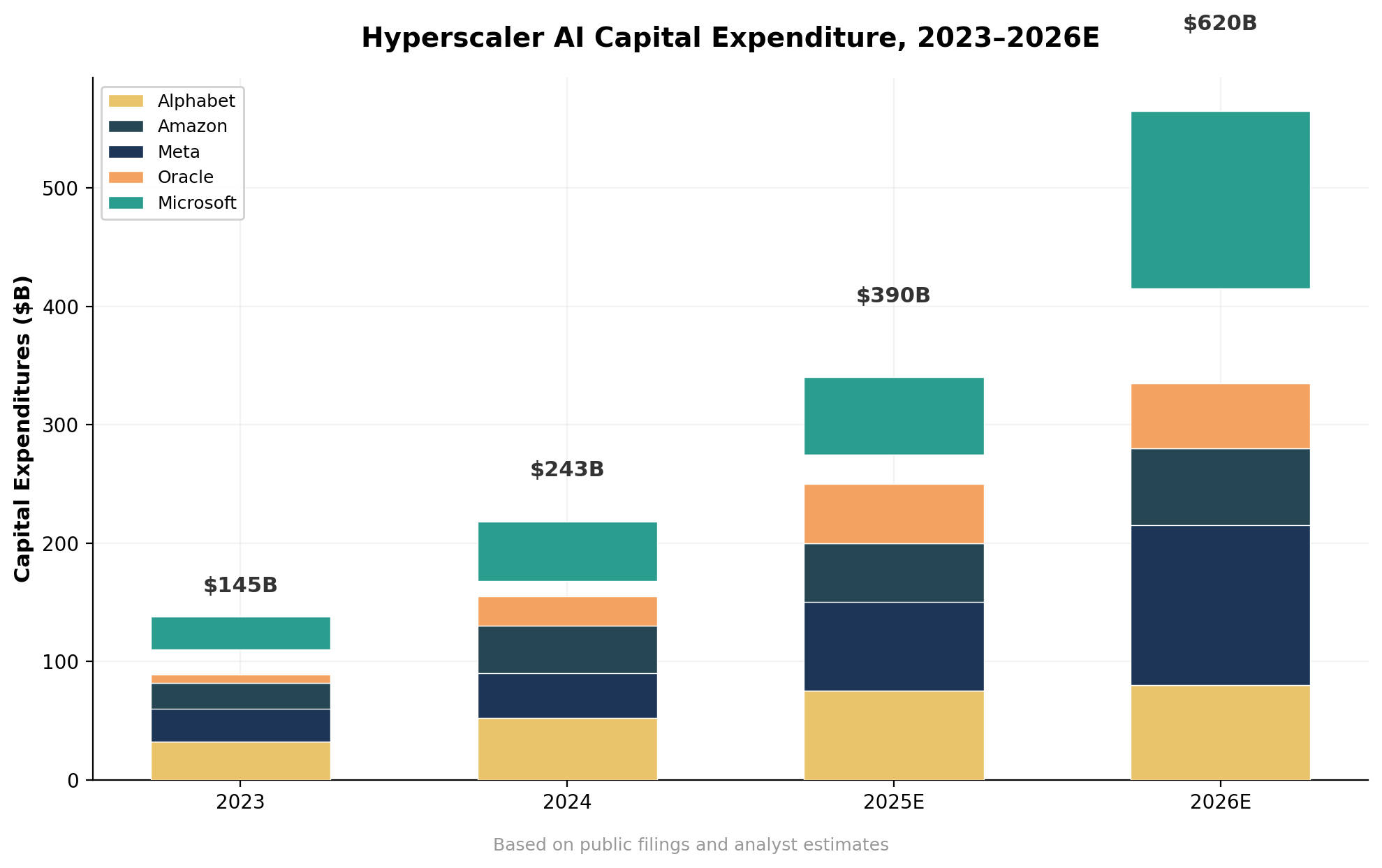
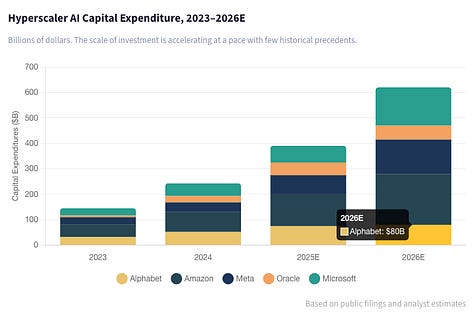
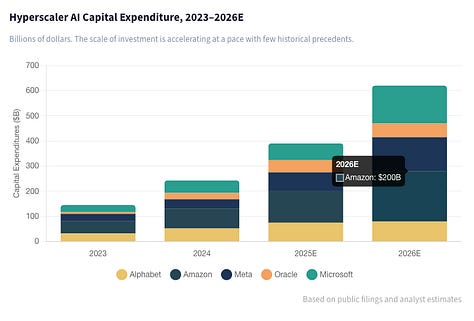
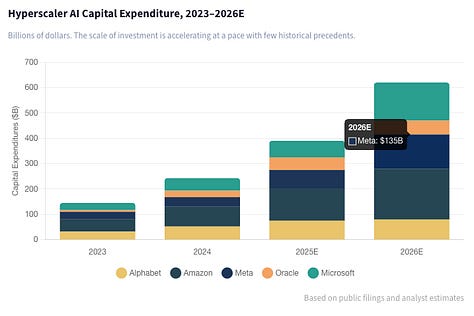
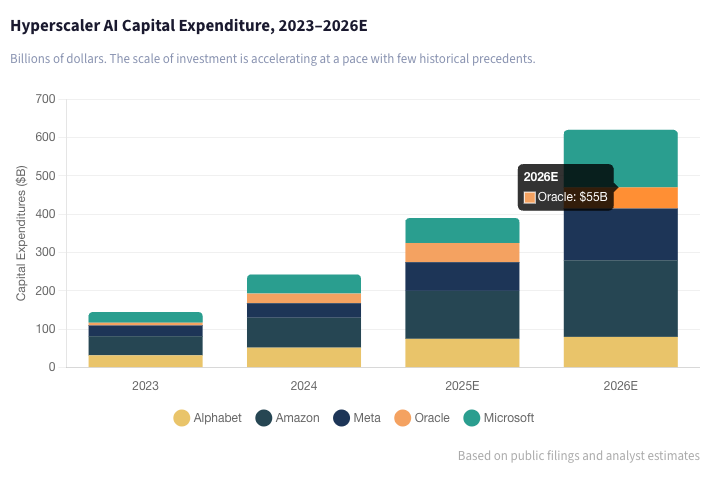
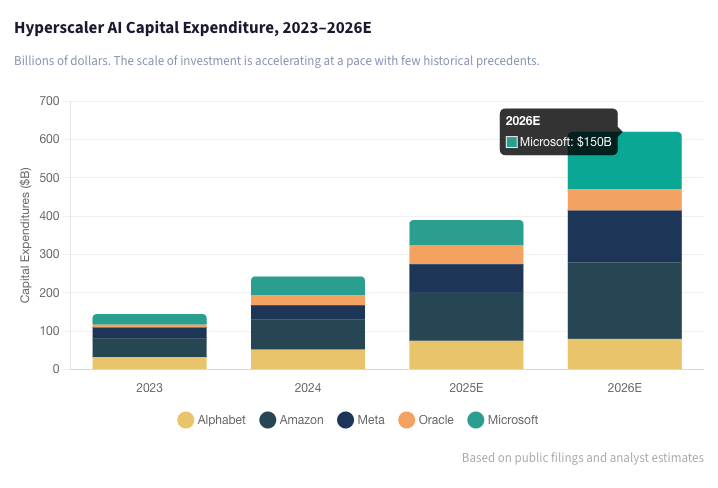
Let those numbers settle for a moment. In three years, annual AI infrastructure spending by just five companies will have nearly tripled. This is not speculative venture capital chasing the next TikTok. This is the deepest-pocketed companies on earth making an irreversible commitment to a technology they believe will fundamentally restructure how business is done.
The key numbers at a glance:
Metric Figure Projected AI data center capex, 2025–2030 $5 trillion New AI data center capacity needed by 2030 156 gigawatts Estimated hyperscaler AI capex in 2026 alone $720 billion
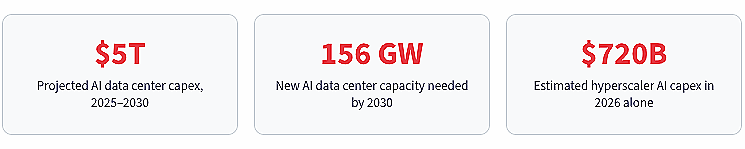
To appreciate the physical scale of what is being built, consider that the estimated demand for new AI data center capacity will reach 156 gigawatts between 2025 and 2030. As a rough rule of thumb, one gigawatt of data center capacity employs approximately one million GPUs. We are talking about a physical infrastructure expansion of truly unprecedented magnitude.
This is not simply a matter of building more server rooms. AI-capable data centers require fundamentally different engineering: liquid cooling systems to manage the heat output of GPU clusters, massive power distribution networks, networking architectures optimized for the parallel processing demands of AI inference, and proximity to reliable energy sources. Some of the largest planned facilities will consume as much electricity as small cities.
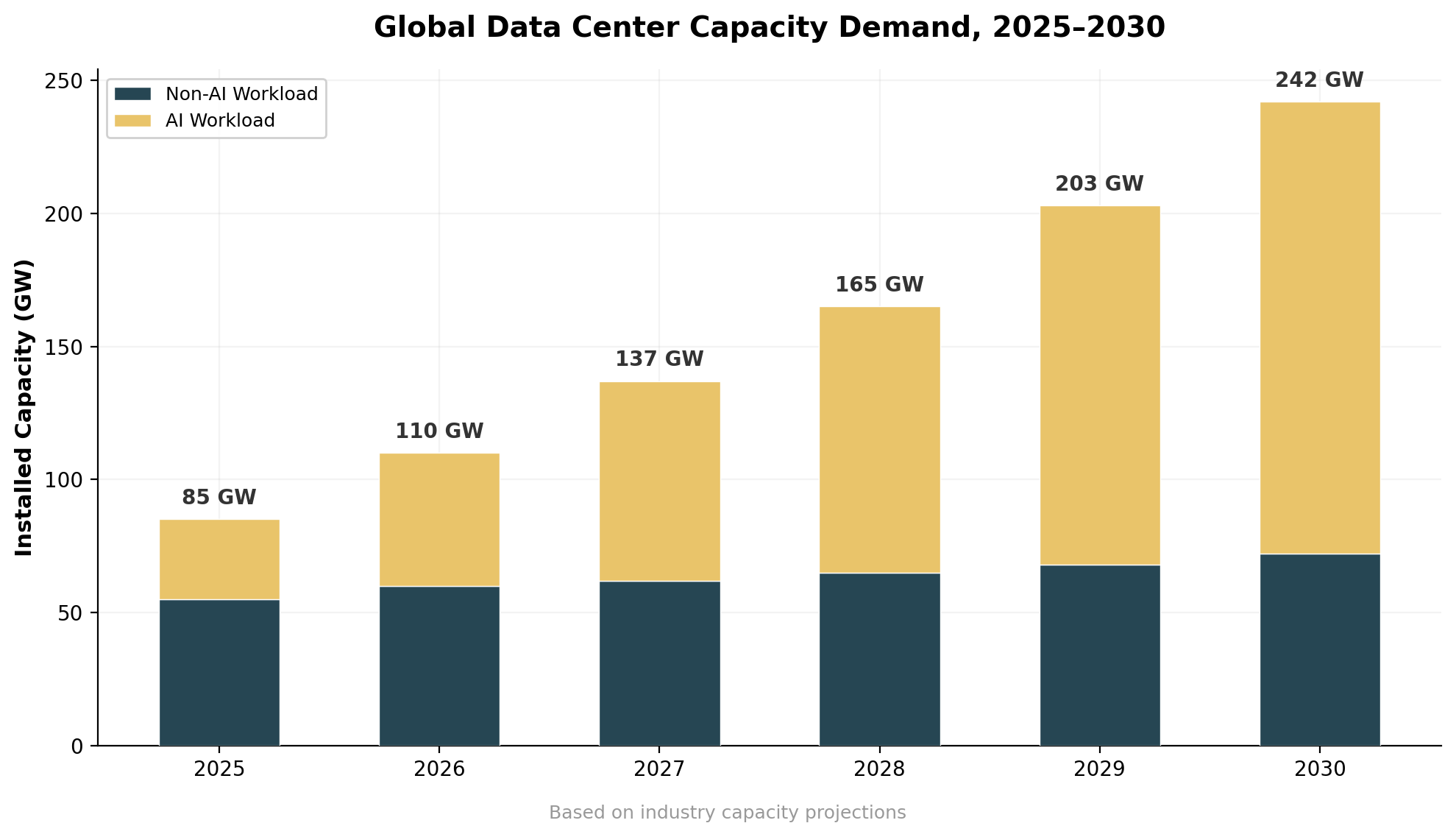
The energy implications alone are staggering. As frontier AI models grow more complex and user prompts grow longer, the energy required per inference increases. This creates a compounding demand curve that is already straining power grids in regions with high concentrations of data centers. Virginia’s “Data Center Alley,” for instance, already consumes more electricity than some US states, and the planned expansion will push those demands significantly higher.
Whenever I see investment at this scale flowing into a technology that has not yet proven its economic case, my mind turns to historical analogies. And there are three that feel particularly relevant to where we are with AI right now.
The Metaverse Scenario. The most bearish possibility: AI turns out to be far less useful than investors anticipate. The technology fails to deliver transformative value at scale, enterprise adoption stalls, and the trillions invested in infrastructure become the most expensive white elephant in history. Think of Meta’s $46 billion bet on virtual reality, or the metaverse mania of 2021–2022 — enormous capital deployment chasing a future that consumers and businesses simply did not want. In this scenario, we are looking at one of the largest misallocations of capital ever recorded.
The Railroads Scenario. The historically likely middle ground: AI does become a genuinely transformative technology, but many of the companies pouring money into it during the build phase go bust. Just as the 1800s railroad boom created the transportation infrastructure that powered American economic growth for a century — while simultaneously bankrupting the majority of railroad companies — the AI infrastructure being built today may prove enormously valuable to society even as many of its builders fail to capture that value. This was also the story of the dot-com era: the internet changed everything, but Pets.com and Webvan did not survive to see it.
The Airlines Scenario. The most nuanced outcome: AI becomes highly valuable, but fierce competition among major providers results in a race to the bottom on pricing that keeps profits permanently thin. The airline industry is the classic example — air travel became one of the most valuable services in modern life, yet the industry’s cumulative profits over its entire history have been almost negligible. If every major tech company can offer competitive AI services, margins may never reach levels that justify the infrastructure investment.
Unless AI generates significant value, debates about who shares the spoils become largely irrelevant. The fundamental question is not who wins the AI race, but whether the race is worth running at the price being paid.
My own assessment, for what it is worth from someone who spends his days evaluating startups and technology investments, is that we are most likely heading for some version of the railroads scenario. The technology is real and transformative — I am increasingly convinced of that. But the current investment cycle has the hallmarks of overshoot: too much money chasing too few proven use cases, too many circular investments between companies funding each other, and too little scrutiny of whether the revenue models can actually work.
Which brings us to the question at the heart of this entire edifice: can large language models actually make money?
If you want to understand the economics of artificial intelligence — the real economics, not the hand-wavy narratives about “changing the world” — you need to understand tokens. Everything in the LLM business model flows from this fundamental unit.
A token is essentially a chunk of text that a language model processes. It might be a word, part of a word, or even a single character. When you type a question into ChatGPT or Claude, your question gets broken into tokens. When the model generates a response, it produces tokens one at a time. Think of tokens as the atomic unit of AI computation — they are to large language models what kilowatt-hours are to the electricity industry.
The business model, at its simplest, works like this: LLM providers charge for the computational resources required to process tokens. You pay for input tokens (your prompt) and output tokens (the AI’s response). Prices are typically quoted per million tokens, and they have been falling rapidly — from around $20 per million tokens to as low as $0.50 per million tokens in the past 18 months.
That sounds like wonderful progress. But here is the catch that most casual observers miss: despite falling per-token prices, the total cost of using AI is staying flat or actually increasing. There are two reasons for this.
First, the context window — the amount of text a model can “remember” at any one time — keeps expanding. Larger context windows mean more tokens per interaction. Second, and more importantly, reasoning models consume dramatically more tokens than their predecessors. When a reasoning model “thinks through” a problem, it is generating enormous volumes of internal tokens as part of its step-by-step process. The result is what industry analysts are calling a token explosion.
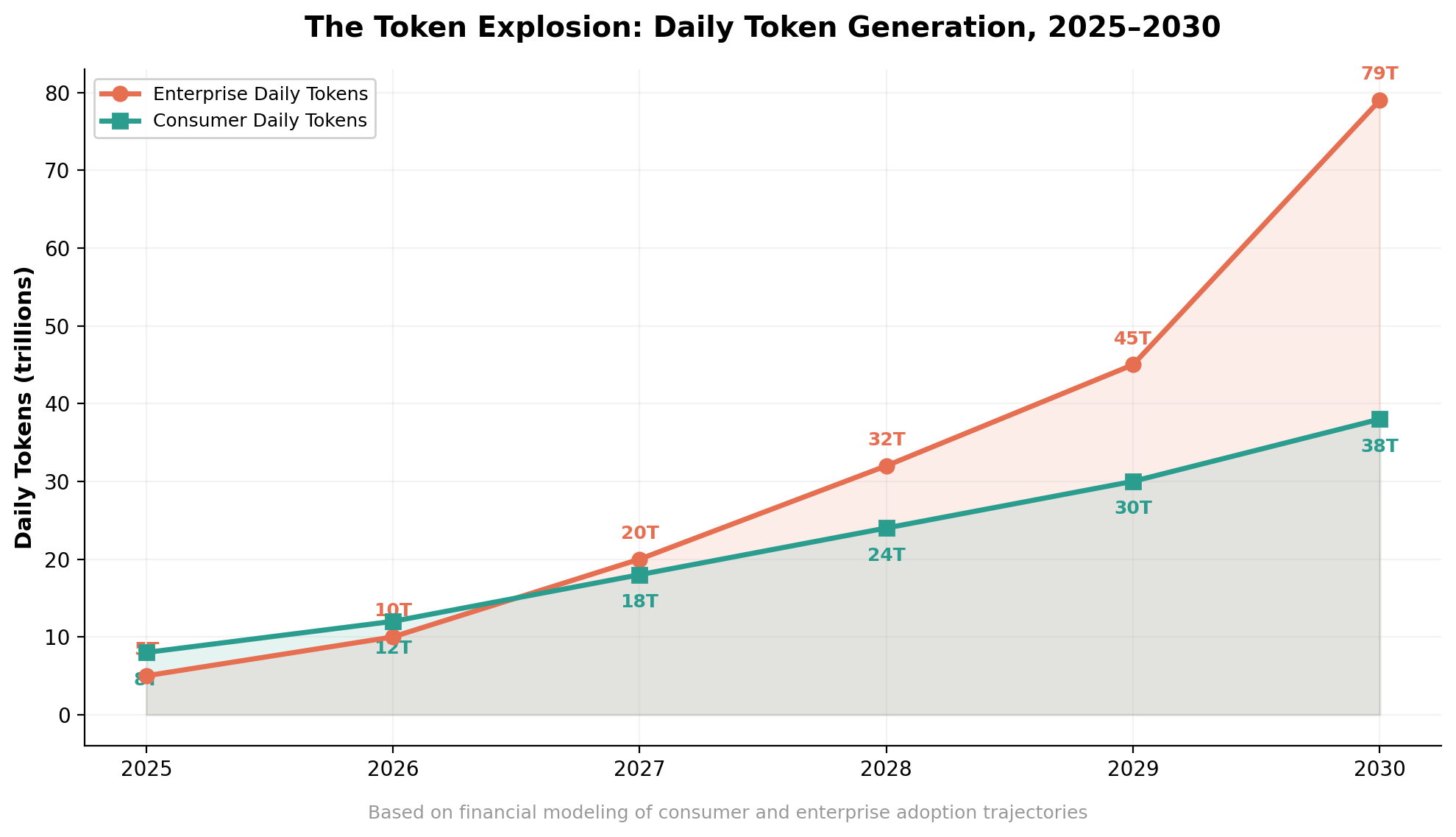
Consider this data point: in October 2025, Google disclosed that it was processing 1.3 quadrillion tokens per month — that is 1,300 trillion tokens, an eightfold increase from February of the same year. And reasoning models, which now account for over 50% of token generation, use up to eight times more tokens per prompt than standard models. The math is startling: we are generating exponentially more tokens while the per-token price falls linearly. Volume growth is outpacing price decreases.
This brings us to the central tension of the LLM business. For these models to be viable businesses — not just impressive technology — they need to achieve net positive margins on inferencing. That means the revenue they generate from selling access to their models must exceed the combined costs of data center operations, GPU leasing, energy consumption, equipment depreciation, and ongoing model development.
Right now, that math does not work for most providers. The cost structure of running large language models is brutally demanding. Data center operating expenses include facilities management, GPU leasing, fire prevention, and cooling systems. Energy costs are soaring as models grow more complex. And the electronic equipment — servers, networking gear, GPUs — depreciates on roughly a six-year cycle, meaning providers face a constant treadmill of capital replacement.
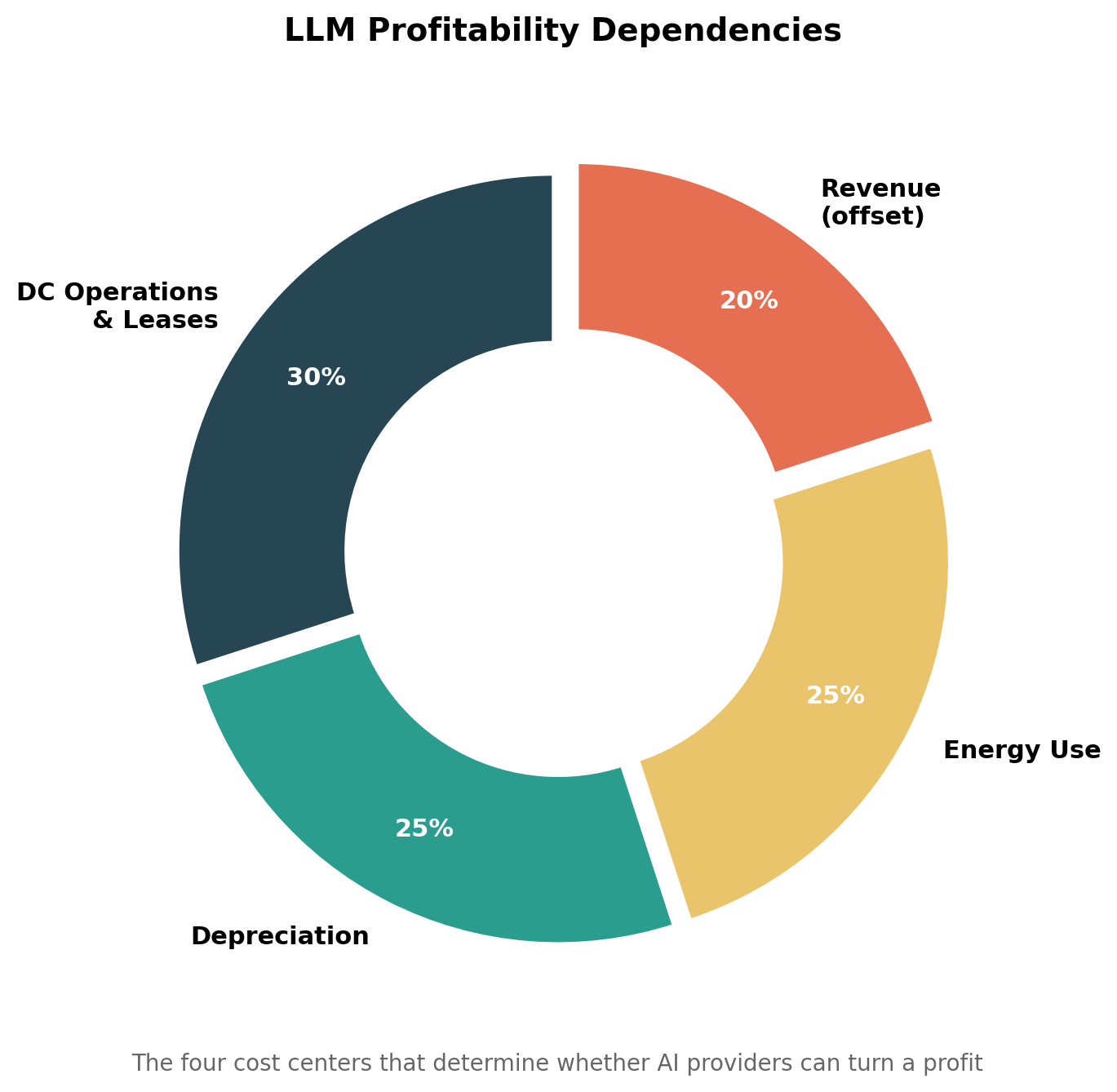
LLM vendors are responding by pursuing multiple revenue streams. Subscription services (think ChatGPT Plus or Claude Pro) offer transparency and predictable revenue. Pay-per-use API access aligns costs with actual value delivered. Custom enterprise solutions command premium pricing but are expensive to deploy. And strategic partnerships — like Microsoft’s integration of OpenAI’s models into Azure, or Google’s deployment of Gemini through Cloud Platform — improve economics by embedding LLMs into existing enterprise relationships.
But here is what keeps me up at night as an investor: the path to profitability runs directly through enterprise adoption of agentic AI. Consumer subscriptions alone will not generate enough revenue to justify the infrastructure investment. The big money — enterprise contracts averaging $450–500 per month compared to consumer plans at $20–200 — depends on businesses deploying AI agents at scale across their operations. And that adoption is still in its early stages.
The agentic AI ecosystem is not a single market — it is an interconnected web of companies spanning hardware, infrastructure, software, and applications. Understanding who sits where in this value chain is essential for anyone trying to make sense of the investment landscape or identify which companies are best positioned to benefit.
Let me walk you through the key layers:
Reasoning Models — The cognitive engines: Anthropic, OpenAI, Meta, Google, IBM, Perplexity, and DeepSeek are building the foundational models that power agent intelligence.
Code Generation — AI writing software: Microsoft (GitHub Copilot), Anthropic (Claude Code), Amazon, and Google lead in tools that let agents write, test, and deploy code.
RAG & Data Retrieval — The knowledge layer: companies like Pinecone, Elastic, Oracle, and Perplexity build the tools that let agents access external data sources accurately.
Multi-Agent Orchestration — The coordination layer: Microsoft, Google, ServiceNow, UiPath, CrewAI, and IBM are building frameworks for multiple agents to work together.
Agentic Workflows — Enterprise automation: ServiceNow, Salesforce, Oracle, Automation Anywhere, and LangChain turn agents into end-to-end business process executors.
DevOps Tools — Self-managing software: Amazon, Oracle, Microsoft, Adept AI, Zapier, and Vercel build the tools for AI-driven software development and deployment.
Cloud & Neocloud Providers — The infrastructure backbone: CoreWeave, Nebius, Lambda, Nscale, Crusoe, and DigitalOcean provide specialized GPU compute for AI workloads.
Hardware & Semiconductors — The physical foundation: NVIDIA, TSMC, Samsung, AMD, Broadcom, SK Hynix, Micron, and ASML build the chips, memory, and equipment that make it all possible.
Not all AI agents are created equal. The industry is rapidly developing a maturity framework that ranges from simple rule-based automation (Level 0) to sophisticated multi-agent systems that collaborate across organizational boundaries (Level 4). Understanding these levels is critical for enterprises evaluating where to start their agentic AI journey.
Level Capability Example Use Case Level 0: Repetitive Tasks Rule-based automation for information retrieval Simple FAQ chatbots Level 1: Information Retrieval Agents assist by retrieving data and recommending actions Knowledge base search for support ticket resolution Level 2: Simple Orchestration Agents autonomously orchestrate tasks in a single domain Scheduling meetings and automating follow-up emails Level 3: Complex Orchestration Agents orchestrate workflows across multiple domains with harmonized data Managing sales pipelines using CRM, service tickets, and financial data Level 4: Multi-Agent Orchestration Agents from different vendors collaborate across domains in real-time Processing orders, managing inventory, routing feedback across departments
Most enterprises today are somewhere between Level 0 and Level 2. The enormous promise — and the enormous investment thesis — rests on the expectation that they will rapidly progress to Levels 3 and 4 over the next two to three years. That progression is not guaranteed, but the drivers pushing adoption forward are powerful: AI-first strategies gaining board-level support, growing pressure to cut costs and boost productivity, increasingly sophisticated customer expectations, and the maturation of open-source models that can be customized for specific industries.
There is a pattern in the current AI investment landscape that deserves scrutiny, and I want to flag it because I think it is underappreciated by most observers.
As investment levels have increased, so has the number of interlinked and circular investments across the tech sector. Consider this example: NVIDIA has provided funding to neocloud providers like Nscale and Nebius. Those companies, in turn, use that funding to purchase chips from — you guessed it — NVIDIA. Microsoft invests $13 billion in OpenAI, then integrates OpenAI’s models into Azure, generating revenue that flows partially back toward OpenAI. Oracle commits $300 billion to AI data center expansion while simultaneously investing $30 billion in OpenAI.
This is not inherently nefarious, but it does create a situation where revenue and investment figures can be somewhat self-reinforcing. If Company A invests in Company B, and Company B uses that money to buy products from Company A, the resulting revenue growth may look more organic than it actually is. With echoes of the dot-com bubble of the late 1990s, this web of cross-investments raises the risk of cascading losses if AI fails to meet its current expectations.
Investor Caution: The AI ecosystem is characterized by a web of circular investments: hardware makers fund cloud providers who buy hardware from the same makers. While not inherently problematic, this pattern can mask organic demand and amplify risk if adoption disappoints.
Let us get to the question that matters most for anyone with capital at risk: what kind of return on investment can we expect from all this spending?
To answer this, I want to walk through two scenarios that model the relationship between enterprise adoption of agentic AI and the resulting financial returns for the LLM infrastructure ecosystem.
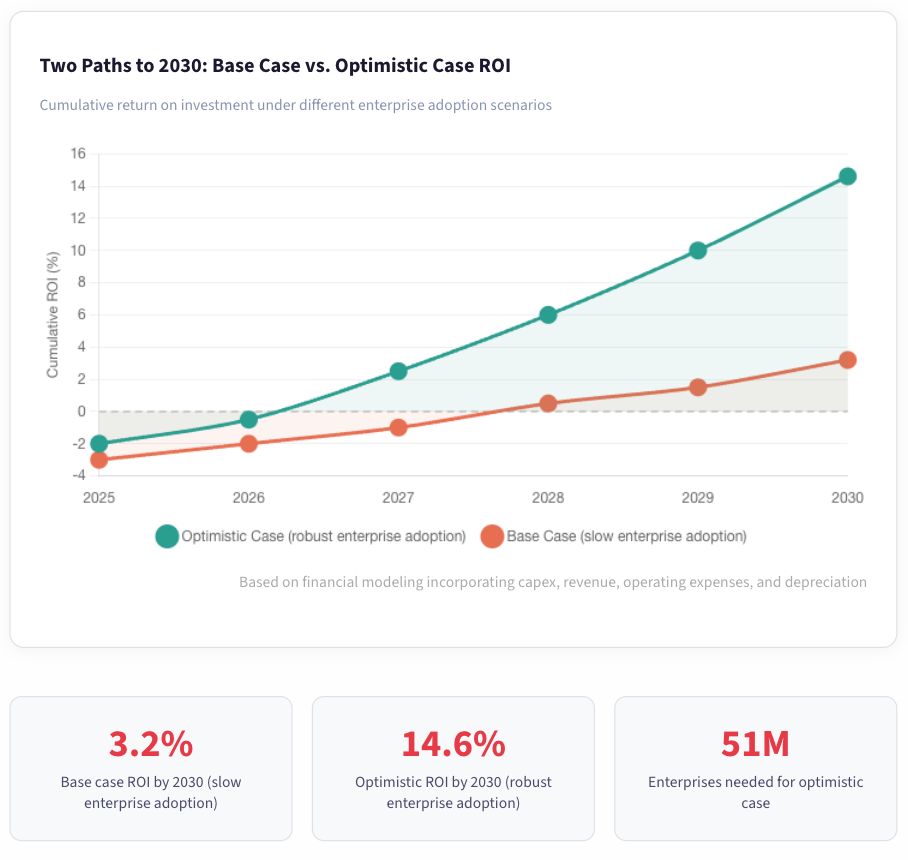
The Base Case assumes strong consumer adoption of LLM services but relatively slow enterprise uptake. By 2030, this scenario projects 112 million paying consumers and 23 million enterprises using LLMs, generating 45 trillion enterprise tokens and 34 trillion consumer tokens per day. Under these assumptions, total cumulative capex reaches $5 trillion, total gigawatt capacity hits 96 GW, and the cumulative ROI by 2030 is approximately 3.2%.
Three point two percent. On a $5 trillion investment. That is, to put it mildly, not a number that makes infrastructure investors jump for joy. For context, a US Treasury bond currently yields more than that with essentially zero risk.
The Optimistic Case assumes robust adoption from both consumers and enterprises. By 2030: 251 million paying consumers, 51 million enterprises, 122 trillion enterprise tokens per day, 43 trillion consumer tokens per day, total capacity of 176 GW. Under these more bullish assumptions, the cumulative ROI reaches approximately 14.6% — a much more attractive number, and one that begins to justify the scale of investment
.
The two scenarios at a glance:
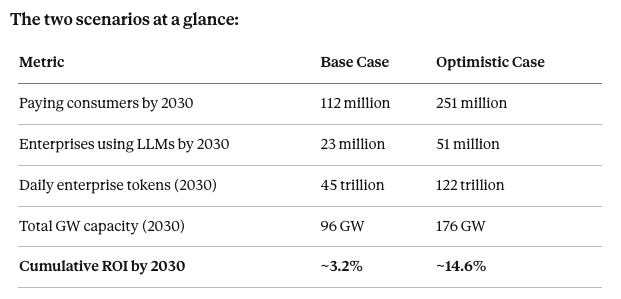
The gap between these two scenarios is enormous, and it hinges almost entirely on one variable: how quickly and how deeply enterprises adopt agentic AI. Consumer adoption is important but insufficient. The financial viability of the entire LLM industry depends on enterprises deploying AI agents at scale across their operations — and generating enough enterprise prompts (at higher revenue per user) to make the infrastructure investment worthwhile.
This is where the rubber meets the road. The sectors showing the strongest early adoption of agentic AI include financial services, professional services (consulting, legal, accounting), manufacturing, healthcare, telecoms, and transportation. These industries share common characteristics: they have high volumes of structured and semi-structured data, repetitive knowledge-intensive processes, clear cost-reduction incentives, and regulatory requirements that benefit from automated compliance monitoring.
The drivers pushing enterprises toward agentic AI are converging from multiple directions. Companies are increasingly adopting AI-first strategies at the board level. Customers expect more human-like service experiences and personalized interactions. The promise of substantial productivity gains — Goldman Sachs estimates a 15% gross uplift to US productivity from full AI adoption — is too significant to ignore. And the growing availability of open-source small language models that can be fine-tuned for specific domains is lowering the barrier to entry.
But there are real obstacles too. Enterprise AI deployments are still moving from proof-of-concept to production at a pace that many find frustrating. Integration with legacy systems remains difficult. Concerns about data privacy, hallucinations, and regulatory compliance create friction. And the skills gap — the shortage of people who understand both the technology and the business processes it is meant to automate — is arguably the biggest bottleneck of all.
Financial modeling suggests it will take two to three years for automated agentic workflows to become a significant share of overall inference workloads. That timeline matters enormously for the investment thesis. The infrastructure is being built now, the returns depend on enterprise adoption later, and the gap between those two events is the period of maximum financial risk.
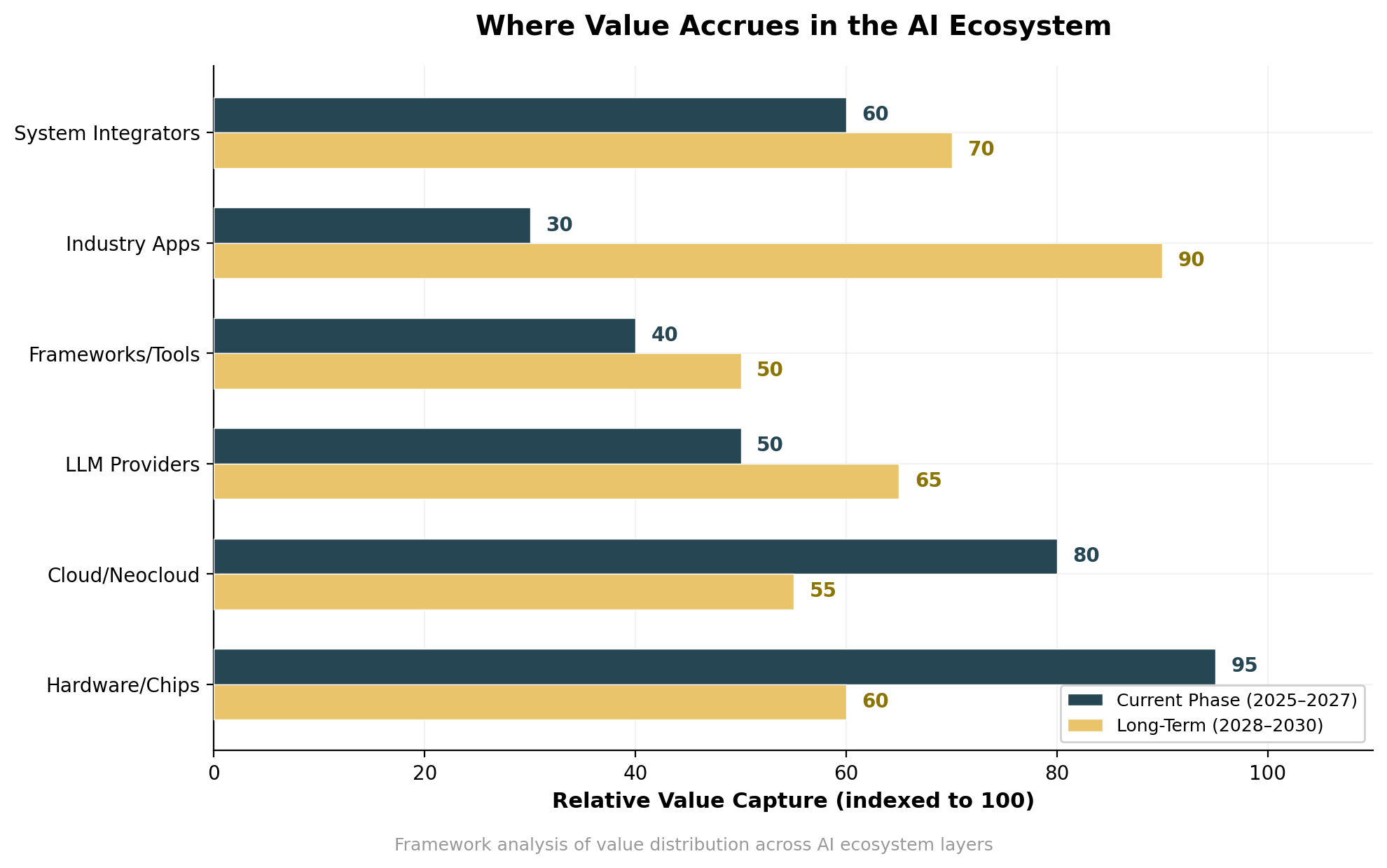
In the first phase of any major technological shift, the companies that benefit most are not the ones using the technology — they are the ones supplying the picks and shovels. The California Gold Rush made more money for Levi Strauss than for most miners. The internet boom enriched Cisco’s shareholders before it enriched Amazon’s.
The AI investment cycle is following the same pattern. Right now, the clearest winners are the companies that supply the underlying data center infrastructure: chip companies (NVIDIA, AMD, Broadcom, TSMC), memory makers (SK Hynix, Micron, Samsung), networking and data center facilities providers (Vertiv, Schneider Electric), and semiconductor equipment manufacturers (ASML). These companies have pricing power, order backlogs stretching years into the future, and revenue that flows regardless of which AI model or application ultimately wins in the market.
The second tier of winners includes the neocloud providers — companies like CoreWeave, Lambda, Nebius, Crusoe, and Nscale that offer specialized GPU compute optimized for AI workloads. These companies have emerged to fill a gap: the traditional hyperscalers (AWS, Azure, Google Cloud) cannot build capacity fast enough to meet demand, and their general-purpose infrastructure is not always optimally configured for the specific requirements of AI inference. Neocloud providers are growing explosively, though they carry meaningful financial risk given their dependence on continued AI investment momentum.
The third and most interesting tier is industry-specific application providers — companies building agentic AI solutions for particular verticals. Think Talkdesk and Counterpart in customer service, Agentech in insurance, Shopsense in retail, and the growing ecosystem of companies bringing AI agents to healthcare, legal, and financial services. These companies have a potential advantage that the horizontal platform providers do not: deep domain expertise and existing customer relationships that create switching costs and competitive moats.
Perhaps the most consequential implication of agentic AI is what it means for the software-as-a-service industry. SaaS has been the dominant business model in enterprise software for more than a decade — and agentic AI threatens to disrupt it in ways that even the most forward-looking SaaS executives are only beginning to grapple with.
The logic is brutal in its simplicity. Much of what SaaS companies charge for — managing workflows, organizing data, automating routine processes, providing user interfaces for business operations — is precisely the kind of work that AI agents are becoming capable of performing. If an AI agent can manage your sales pipeline, generate your invoices, draft your contracts, and handle your customer service tickets, the question becomes: why are you paying $50 per user per month for software that requires humans to operate?
This is not theoretical. The freefall in SaaS stocks following Anthropic’s legal AI agent announcement in February 2026 was the market’s way of repricing this risk in real time. Companies like ServiceNow, Salesforce, and Oracle are responding by integrating agentic AI into their own platforms, but the fundamental question remains: does the future belong to AI-native companies that build agents from scratch, or to incumbent software companies that bolt AI onto existing products?
My instinct, informed by years of evaluating startups and their competitive positioning, is that we will see a pattern similar to what happened with mobile. The companies that tried to retrofit desktop applications for mobile devices mostly failed. The companies that built mobile-native experiences from the ground up mostly succeeded. I expect something similar to play out with agentic AI: the winners will be companies that design around agent capabilities from day one, not companies that add agents as a feature to existing software.
Financial services is the industry where agentic AI is moving fastest, and for good reason. The sector is built on exactly the kind of work agents excel at: processing vast quantities of structured data, performing repetitive analytical tasks, maintaining regulatory compliance, and making decisions based on complex but well-defined rule sets.
Banks are deploying agents for credit risk assessment, fraud detection, regulatory reporting, and customer onboarding. Asset managers are using them for portfolio analysis, market research synthesis, and compliance monitoring. Insurance companies are automating claims processing, underwriting, and policy administration. In each case, the agent is not replacing human judgment at the strategic level — it is eliminating the hours of manual data gathering, formatting, and preliminary analysis that consume the majority of knowledge workers’ time.
The financial impact is substantial. Early adopters report 40–60% reductions in time spent on routine compliance tasks, 30% improvements in customer onboarding speed, and measurable reductions in error rates across document-intensive processes. These are not projections from vendor marketing materials — they are results from production deployments at major financial institutions.
Healthcare presents both the most compelling opportunity and the most significant challenges for agentic AI. The potential value is enormous: AI agents capable of synthesizing patient records, assisting with diagnostic reasoning, managing care coordination, processing insurance claims, and monitoring patient outcomes could transform an industry that is drowning in administrative burden.
The challenge is that healthcare operates under uniquely stringent requirements for accuracy, privacy, and accountability. A hallucination in a customer service chatbot is an inconvenience; a hallucination in a diagnostic support system could be life-threatening. This means healthcare will likely adopt agentic AI more cautiously than other sectors — but the institutions that get it right will have an extraordinary competitive advantage.
Law firms, consulting firms, and accounting practices are in the crosshairs of agentic AI in a way that few of their senior partners fully appreciate. These businesses sell human expertise by the hour, and a technology that can perform significant portions of that expertise at a fraction of the cost represents an existential threat to their business model — or an incredible opportunity, depending on how they respond.
The legal AI agent from Anthropic that rattled markets in February was just the beginning. We are seeing agents that can perform contract analysis, due diligence, regulatory research, and even initial drafts of legal documents at a quality level that, while not replacing senior attorneys, dramatically reduces the need for the junior associates who have traditionally done this work. The implications for law firm economics — where associate labor is the primary profit driver — are profound.
Manufacturing is where agentic AI intersects with another transformative trend: robotics. AI agents managing production scheduling, supply chain coordination, quality control, and predictive maintenance are being integrated with robotic systems on factory floors to create increasingly autonomous manufacturing environments.
The convergence matters because manufacturing has always been one of the sectors most receptive to automation — but traditional automation was rigid and rule-based, requiring extensive programming for each specific task. Agentic AI introduces adaptability: agents that can adjust production schedules in response to supply chain disruptions, reroute quality inspections based on real-time defect patterns, and coordinate across systems without human intervention.
Two industries that do not get enough attention in the agentic AI conversation are telecommunications and transportation. Both are infrastructure-heavy, operationally complex, and sitting on massive datasets that are woefully underutilized — which makes them ripe for agent-driven transformation.
In telecoms, AI agents are being deployed for network optimization, predictive maintenance, customer churn prediction, and automated service provisioning. A telecom network generates petabytes of data about signal quality, usage patterns, equipment performance, and customer behavior. Historically, only a fraction of this data has been analyzed, and even less has been acted upon in real time. Agentic AI changes this equation: agents can continuously monitor network performance, predict equipment failures before they happen, automatically reroute traffic during outages, and personalize service offerings based on individual usage patterns — all without human intervention.
Transportation is following a similar trajectory. Beyond the headline-grabbing autonomous vehicle story, agentic AI is quietly transforming logistics, fleet management, route optimization, and supply chain coordination. Companies managing fleets of thousands of vehicles are deploying agents that dynamically adjust routes based on real-time traffic data, weather conditions, delivery windows, and fuel costs. The efficiency gains are measurable and immediate: early deployments are reporting 8–15% reductions in fuel costs and 12–20% improvements in on-time delivery rates.
What makes both of these industries particularly interesting from an investment perspective is that they have clear, quantifiable ROI metrics. Unlike some AI use cases where the value is soft or difficult to measure, telecom network optimization and logistics efficiency translate directly to the bottom line. This makes them likely to be among the faster adopters of agentic AI at scale, which in turn feeds the enterprise adoption numbers that the broader industry needs.
For those of us in the venture capital world, the agentic AI landscape presents a fascinating and somewhat paradoxical investment opportunity. On one hand, the foundational model layer is increasingly dominated by a small number of well-capitalized players — OpenAI, Anthropic, Google, Meta — making it nearly impossible for startups to compete at the base model level. On the other hand, the application layer is wide open, and this is where I believe the most interesting startup opportunities exist.
The pattern I am seeing in deal flow is consistent: the most compelling agentic AI startups are not trying to build better language models. They are building domain-specific agent systems that combine foundational models with deep industry expertise, proprietary data, and workflow integration. A startup building AI agents for insurance claims processing does not need to train its own LLM. It needs to understand the nuances of claims adjudication, integrate with existing insurance platforms, handle regulatory requirements, and deliver measurable cost savings — all while using commercially available models as the cognitive engine.
In 2024, $1.8 billion was raised across 69 agentic AI deals, showcasing a surge in investor confidence. I expect that number to grow substantially in 2025 and 2026, with the lion’s share going to vertical-specific agent companies rather than horizontal platform plays. The playbook is becoming clear: pick a large, complex, process-heavy industry, understand its workflows intimately, and build agents that automate the most painful and expensive parts of those workflows. The companies that execute on this thesis will be the next generation of enterprise software giants.
I have been cautious throughout this piece about drawing too many parallels to the dot-com bubble, because the comparison can be facile and misleading. The internet really did change everything, and the companies that emerged from the wreckage — Amazon, Google, eBay — became some of the most valuable enterprises in history. The same may well prove true for AI.
But there are structural similarities that demand attention. The circular investment patterns we discussed earlier bear an uncomfortable resemblance to the mutual fund/IPO feedback loops of the late 1990s. The infrastructure spending is being committed before the revenue models are proven. And the market is pricing many AI-related companies as though the optimistic adoption scenario is already a certainty, leaving little margin of safety if reality falls short.
The specific risk I worry about most is what happens if enterprise adoption disappoints. If companies fail to create meaningful value from AI, demand for compute power could fall short of expectations. That would mean the tech sector fails to generate a reasonable return on its investment, risking a financial market correction that could impact the broader economy. This is not alarmism — it is the logical consequence of $5 trillion in concentrated investment failing to produce sufficient returns.
For all the progress in reasoning models and RAG, AI systems still hallucinate — they generate confident, plausible-sounding information that is simply wrong. In consumer applications, this is a manageable nuisance. In enterprise applications where AI agents are making autonomous decisions about financial transactions, legal documents, medical records, or manufacturing processes, it is a potentially catastrophic risk.
The industry is making progress on this front. RAG reduces hallucinations by grounding model outputs in real data. Reasoning models produce fewer factual errors because they work through problems step by step. And agentic frameworks typically include human-in-the-loop checkpoints for high-stakes decisions. But the problem is not solved, and it remains the single biggest obstacle to the trust that enterprises need before deploying agents at scale.
There is no gentle way to say this: the energy demands of AI are enormous and growing. The data center expansion required to support agentic AI at scale will consume quantities of electricity that have genuine environmental implications. Every token processed requires energy. Every reasoning chain generates heat. Every multi-agent workflow running across thousands of enterprise deployments simultaneously represents a non-trivial draw on the power grid.
The industry is investing heavily in energy efficiency, renewable power sourcing, and cooling technology innovations. But the fundamental physics have not changed: more computation requires more energy, and the trajectory of AI usage is exponentially upward. This is a tension that will intensify over the next several years and may ultimately constrain the pace of AI adoption in ways that are not yet priced into market expectations.
If there is one timeframe that matters more than any other in the AI landscape, it is the next 12 to 18 months. This is the period during which several critical questions will begin to resolve themselves:
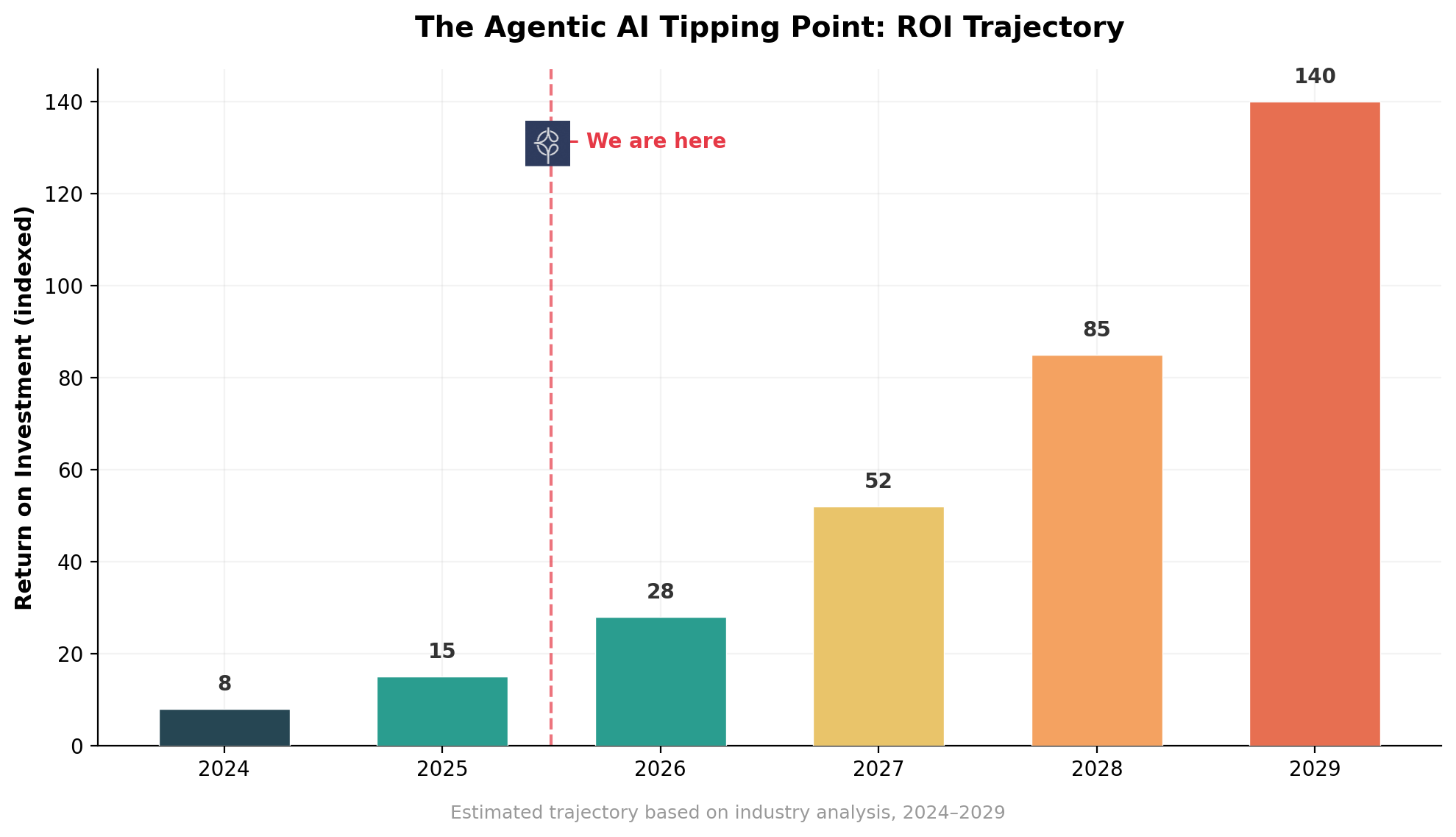
Will enterprise adoption accelerate beyond proof-of-concept? The technology is ready for production deployment in many use cases, but organizational inertia, integration challenges, and skills gaps could slow the pace. The difference between the base case (3.2% ROI) and the optimistic case (14.6% ROI) is essentially a question of how many enterprises move from experimentation to commitment during this window.
Will cost efficiencies outpace token consumption growth? Per-token costs are falling, but total token consumption is rising faster. If this dynamic persists, the cost of AI for enterprises could actually increase even as the underlying technology becomes cheaper — a paradox that could dampen adoption.
Will multi-agent systems prove their value? The current wave of single-agent deployments is generating positive results. But the really transformative use cases — and the really large enterprise contracts — depend on multi-agent systems that can orchestrate complex workflows across departments and data domains. This capability is still maturing, and its performance in production will be a major signal for the industry.
Will the circular investment bubble self-correct? As more scrutiny falls on the interlinked investment patterns in the AI ecosystem, we may see a period of rationalization where weaker players lose funding and the market concentrates around companies with genuine technological differentiation and sustainable business models.
As someone who evaluates technology investments daily, here is what I am paying closest attention to over the coming months:
Enterprise deployment metrics. Forget the product announcements and partnership press releases. The number that matters is how many enterprises are moving from pilot to production with agentic AI, and what revenue per enterprise account looks like. If enterprise ARPU stabilizes in the $450–500/month range with growing adoption, the optimistic thesis holds. If it stalls, the base case becomes more likely.
Token economics. The ratio between per-token cost reductions and per-user token consumption growth is the single most important financial metric in the LLM business. If cost efficiencies win, margins improve and the business model works. If consumption wins, margins compress and the industry has a problem.
Neocloud provider financial health. Companies like CoreWeave, Lambda, and Nebius are the canaries in the coal mine. They are highly leveraged to AI infrastructure demand and have limited diversification. If they start showing financial strain, it is an early warning signal for the broader ecosystem.
SaaS stock recovery (or lack thereof). The February 2026 selloff was driven by fear. If SaaS companies demonstrate that they can successfully integrate agentic AI into their platforms and defend their customer relationships, the stocks will recover. If they cannot, the selloff was just the beginning of a much larger repricing.
After spending weeks immersed in the data, the models, the technological trajectories, and the financial analysis, here is where I land:
Agentic AI is real, transformative, and inevitable. The convergence of RAG, reasoning models, and autonomous workflow orchestration has created a fundamentally new category of technology — one that can deliver genuine, measurable economic value across virtually every industry. This is not a metaverse-style hype cycle. The technology works, and its capabilities are improving rapidly.
The investment cycle is running ahead of the adoption curve. The $5 trillion in infrastructure spending is being committed based on optimistic assumptions about enterprise adoption that have not yet been validated at scale. There will be a correction — perhaps not a crash, but a period of recalibration as the market adjusts to the reality that enterprise AI deployment takes longer, costs more, and encounters more friction than the current narrative suggests.
The winners in the short term are the infrastructure providers. Hardware companies, neocloud providers, and the consultancies helping enterprises navigate AI adoption will benefit first. The winners in the long term will be the companies that build AI-native applications for specific industries — the companies that understand both the technology and the business processes deeply enough to deliver measurable ROI.
The biggest risk is not that AI fails. It is that AI succeeds but the profits flow to the wrong places. If the airlines scenario plays out — AI becomes enormously valuable to society but the competitive dynamics prevent any individual company from capturing that value — we could see a situation where the technology transforms the economy while the companies that built it struggle to generate returns.
I started Curious Compass because I believe we are living through one of the most fascinating periods of technological and economic change in human history, and I wanted a space to think through it seriously; with data, with nuance, with the kind of depth that social media and cable news cannot provide.
The agentic AI revolution is a perfect case study of why that depth matters. The surface-level narrative — “AI will change everything!” — is useless for making actual decisions. The reality is a complex, interconnected story about infrastructure economics, enterprise adoption dynamics, business model viability, and the interplay between technological capability and organizational readiness. It is a story with genuine potential for transformative value and genuine risk of spectacular disappointment.
As I sit here in early 2026, watching the biggest capital deployment in technology history unfold in real time, I find myself thinking about the railroad magnates of the 1850s. They too were building infrastructure for a future they could sense but not fully see. Many of them went bankrupt. But the infrastructure they built changed the world. The trains did run. The goods were delivered. The economy was transformed.
I believe the AI agents will run too. The question is whether the investors who are building the tracks will be around to see it.
What gives me confidence in the long-term thesis, despite the near-term risks, is the breadth of the value creation opportunity. Unlike previous technology cycles that primarily benefited a narrow slice of the economy, agentic AI has the potential to transform virtually every knowledge-intensive industry simultaneously. When you have a technology that can meaningfully improve productivity in healthcare, legal services, financial services, manufacturing, logistics, telecoms, and education — all at the same time — the aggregate economic impact is almost certainly large enough to justify significant investment, even if the individual returns are distributed unevenly across the value chain.
The investors and entrepreneurs who will navigate this transition most successfully are the ones who resist the temptation to think about AI in abstract, grandiose terms and instead focus relentlessly on specific, measurable value creation. Not “AI will transform healthcare” but “this agent reduces clinical documentation time by 40%, saving the average hospital $3.2 million annually.” Not “agentic AI will revolutionize finance” but “this multi-agent system processes 10,000 loan applications per day with 95% accuracy, replacing a workflow that previously required 200 analysts.” The technology is sophisticated, but the business case should be simple enough to write on a napkin.
For those of you who are building in this space, operating in industries being disrupted by it, or investing capital alongside it, the next 18 months will be among the most consequential of your careers. The infrastructure is being laid. The technology is maturing. The enterprise buyers are paying attention. What remains is execution; the hard, unglamorous work of integrating AI agents into real business processes, proving their value with real metrics, and scaling what works.
It is going to be a wild ride. And I, for one, am glad to have a front-row seat.
— Bernardt
If this analysis sparked your curiosity, there is more where it came from. Curious Compass publishes deep dives on AI, venture capital, and the technologies reshaping our world. Join 13,000+ readers who want to understand not just what is happening — but why it matters.
Disclaimer: This analysis represents the author’s personal views and does not constitute investment advice. Always conduct your own research before making investment decisions.
Comments
Nothing yet. Say the first thing.
Sign in to join the conversation.