
Life immediately after college was a rude awakening for me, as I’m sure it is for many. A certain kind of older adult relishes the humbling of young people as they enter the working world. Because, after all, misery loves company. Young people like to think they have all the answers — then they grow up and see that everything is harder, more expensive, and takes more time than expected.
Additionally, the responsibilities of adulthood are often mind-numbingly dull and repetitive. Paying bills, doing taxes, traffic, constant car and house repairs, annoying co-workers, etc. You get used to it.
But there was one aspect I was truly unprepared for, and indeed have never fully gotten used to: enshittification. This is a term originally used to describe software/internet platforms and the way they are intentionally/inevitably degraded over time, but in a typical western capitalist culture it can really be applied to all modern businesses and products.
My first conscious awareness of enshittification involved restaurants — especially those I went to for a quick lunch near my old workplace. The pattern would happen as follows:
New lunch place opens, does brisk business for tasty food and good prices.
Time passes, excitement cools.
Gradually, changes are made. Fewer (or less experienced) staff on duty. The place seems less clean. Costs rise. Or the real death knell: cheaper but lower quality ingredients. (Oh lord, deliver me from pale, mealy tomatoes and wilty lettuce.)
Business is sold, dies, or carries on with low-level inertia.
Many reasons for this pattern. A lot of it comes down to cost-benefit analysis, where the business has to adjust because they’re making less money or due to diminishing interest by the owners, managers, and staff.
But I also think American society is set up in such a way as to make this decline nearly inevitable. Either a company is a big success and starts looking for ways to squeeze more cash out of the situation, or they’re failing and they simply must look for ways to save more cash.
This is even more blatant in the case of publicly traded companies, who have a legal mandate to do everything in their power to increase profit constantly. That’s some heavy pressure, and inevitably leads to a prioritization of cash over quality, profit over people. Layoffs, cheaper and less durable materials, production shortcuts, etc.
Through most of my life I’ve begrudgingly accepted this as a reality of living in America, and adjusted my own behavior accordingly. With my tiny voice and modest wallet, I’ve tried to support companies that are doing good, quality work even if their prices did reflect somewhat of a premium.
But I recently had a consumer experience that I can’t shake, and feels important to share.
First, some personal history.
I was always a little bigger than other kids in my class. For years, there were whispers that I must be one of those kids who got held back because I stuck out like a sore thumb from my size. I’d been getting suspicious glances while trick-or-treating ever since late elementary school.
Then, by the beginning of eighth grade, I hit six feet tall and nearly 180 lbs. I was a shy, weird kid — so standing out that much was nerve racking. On top of that, it felt impossible to find age-appropriate clothing.
My family didn’t have a lot of money, and as a result my single mother had raised us with a strong focus on quality and durability in the products we bought. She didn’t care whether my clothes were “cool,” just that they fit and lasted.
That’s how I got to know Eddie Bauer. For those who are unfamiliar with EB, they’re an outdoor clothing and recreation brand that started back in 1920 in the Pacific Northwest. When my mom first handed me an Eddie Bauer catalog, I maintained a sour face through each turn of the page. The models were all gray, older men. The colors were muted. I was around 11 or 12 years old, and completely mortified at the prospect of dressing like a fisherman or mountaineer.
Still, it was the beginning of the 90s and flannels were catching on — of which EB had plenty. But most importantly, they had tall sizes. Despite my initial reticence, I gave them a chance. EB quickly became the most abundant clothing brand in my wardrobe.
Now, let’s jump ahead 30 years. Without a doubt, Eddie Bauer is the clothing company with which I have spent the most time and money. There’s not even a close second. I am a devotee of their Guide shorts and pants, which are incredibly flexible, durable, and light, while still looking professional — perfect for an active career like mine.
In my 30+ years of patronage, I’ve noticed a gradual decline in quality at Eddie Bauer. In fact, most of what I eventually had to throw away from there were items that were technically newer. All my oldest stuff still holds up pretty well. My favorite jacket is a simple EB canvas work jacket I got when I was still a teenager.
As I said, I’d accepted the basic reality of American brand life. I’m sufficiently cynical to just deal with it when I see these declines, because it’s always happened this way and likely always will. But I couldn’t abide by the terrible drop in quality in one of my recent purchases.
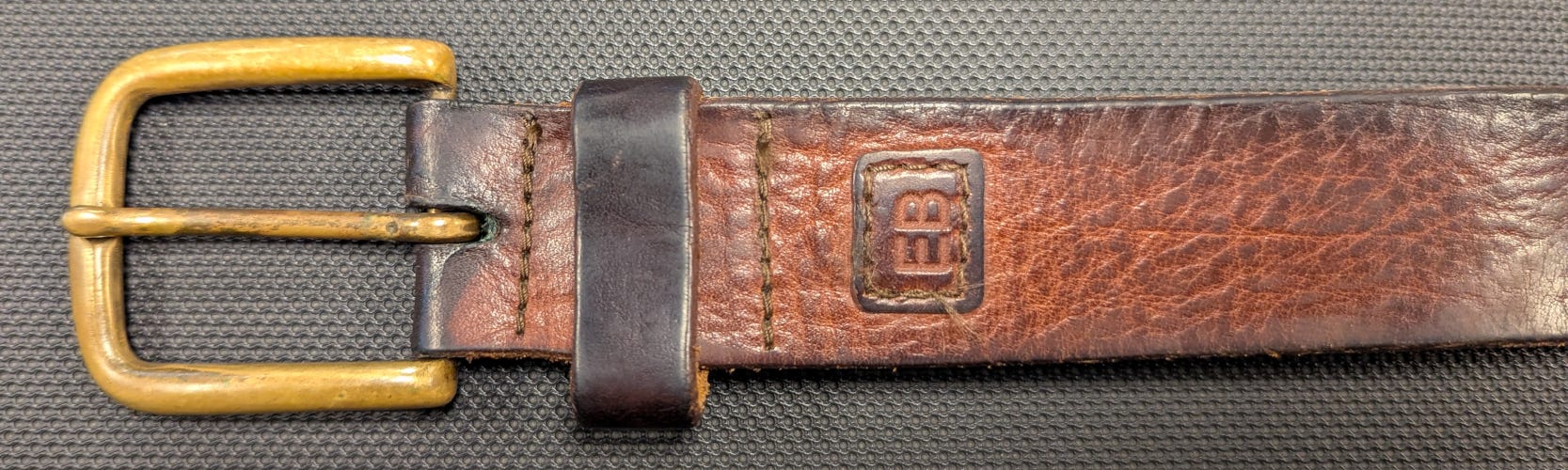
When I was in college, I bought a basic brown Eddie Bauer leather belt. I have worn that belt 5-6 days a week for over 20 years. It was durable, reliable, and looked good. But earlier this year, leather started coming apart near the buckle. I was so devastated that my reaction could only be described as “mourning.”
Though my enthusiasm for EB had waned a little in the past few years, they’re still where I went for a replacement. I ordered their current model of the same everyday belt. And I haven’t been the same since.
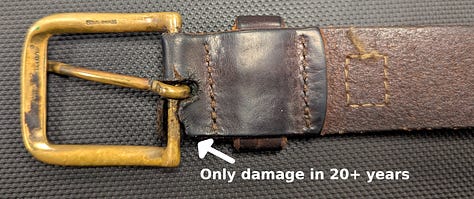
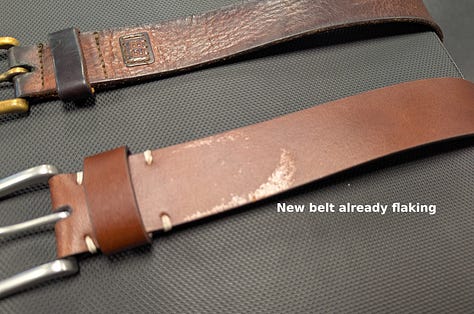
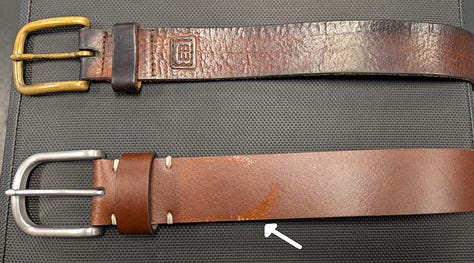
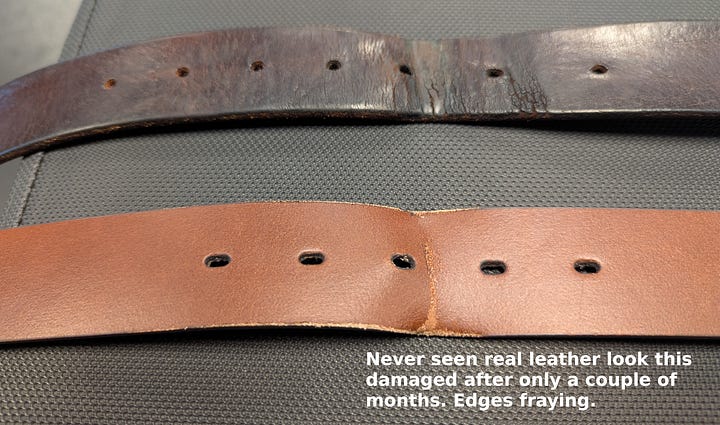
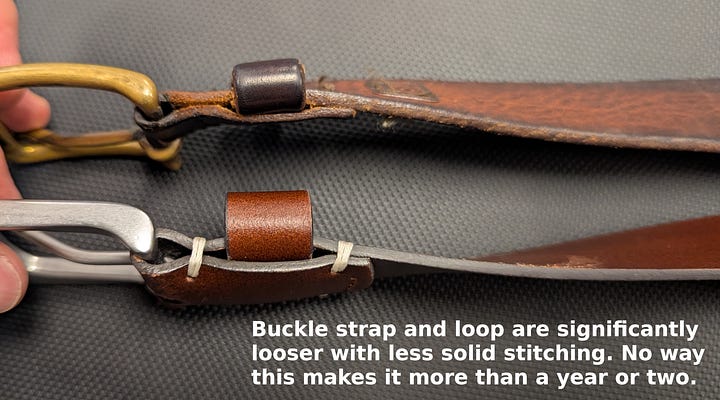
Check out the pictures and video for more detailed comparison. But suffice to say, these belts come from two entirely different kinds of companies with significantly different values, even if they were both sold under the same name.
After only a few months of use, the thin, plastic-feeling, sorry excuse for a belt that I received this year can’t even hold a candle to the 20+ year-old-belt, even in its current state of needing replacing. But since I haven’t had the time (or inclination, or enthusiasm) for seeking out another belt, I’ve been wearing this god-awful strip of clearly fake or at least offensively low quality leather to hold my pants up in the meantime.
It wasn’t just that I’d grown attached to my old belt; it was the fact that a belt is so simple in design that it serves as a potent bellwether. For all the minor quality dips I’d experienced with EB, I could trust that the basics were well handled… until now.
The first company that ever earned my total trust and loyalty as a young man and through most of my life is clearly nearing death. Maybe some version of them will continue for years to come, but it’s not the same anymore.
This probably all seems a little dramatic considering it’s “just a belt.” But bear with me here — I’m in my mid-forties now so I’m reflecting a lot. It’s about way more than a belt, for me. It’s about a decline in American quality and pride of workmanship as a whole, where even the brands that were once fiercely devoted to quality are turning into pipelines full of disposable garbage.
The phrase that keeps scrolling through my head non-stop these days is: Who’s it all for?
Really though, what are we building all this for? What are we spending all our time creating?
Flaccid, factory-churned out sandwiches. Shitty belts and fast fashion. Tools and appliances that fall apart in half the time they used to. Tech money and talent focusing on systems that are primarily used to supplant our creative and cognitive capabilities, used mainly to plagiarize other texts and create deepfake pornography.
It’s all just for money, instead of creating a cohesive society full of quality human experiences.
Even worse these days is the phenomenon of venture capital/private equity groups buying up businesses and ideas and absolutely cannibalizing them. An alarming acceleration of the already-obnoxious arc of capitalism. (Check out the stories behind the decline of Toys R Us and Red Lobster if you’re curious.)
None of what I’m saying is particularly new or different. I just wanted to add my voice to the chorus of lamentations about where we’re headed and what we’re focused on. I think it’s important to keep raising this point, if only so that one or two people along the way might be drawn to a focus on quality and community over profit.
Smarter people than I are studying, writing about, and fighting for a better economic and social system. I’ll leave it to them to address that bigger fight. For my part, I’m trying to personally live a life focused more on quality, community, and positive experience. And I want to encourage as many people as possible to do the same.
Start with you. If you have created what has been a quality product that you want to dumb down just for the sake of a few more pennies, you are part of the problem. If any of your hopes involve the deliberate, knowing suffering of others with no examination or empathy, you yourself are a broken person and could do better. If your goals are a continuous calibration to make more money while reducing quality, you don't deserve a cent of it.
I deeply resent the idea that, in order to succeed, one must engage in trickery, deception, and erosion of quality and good will.
Yes, I know that we live in a system where we have to make money — and that’s fine! But I reject the notion that the only way to do that is through a slow-burn bait-and-switch. You can do something that’s high quality and then work to maintain that quality even in the face of external pressures.
True, it’s harder. And it’s probably also true that you won’t make quite as much money, nor make it as quickly, as you would if you abandoned any semblance of values. But ask yourself: What is it that you want and expect out of the world? What do you hope for?
Do you really want a world of cynical people with houses stuffed to the gills with shitty products? Or do you want to be a bright spot producing something valuable, lasting, and good?
Do you really want to win the race to the bottom?
Totally aside from the devastation these qualities bring to the greater world, they're also just boring. It's the same old bullshit, over and over again. It’s easy to make a lot of money with slave labor, union busting, shitty pay, poor working conditions, cheap materials, and unethical business practices. It’s much harder to do things well, with a consideration to quality and your fellow humans.
My parents divorced and my father left the family when I was 4 or 5 years old. From what little I remember, and from the stories told to me by family and friends, he had a lot of qualities that I found repulsive or otherwise dishonorable. But unfortunately I didn’t have a lot of strong male influences in my life, so my path of figuring out how to be a man was very confusing.
Without consciously thinking it, I settled into a “reverse role model” way of addressing this problem (and many others in my life). Instead of modeling myself after a particular person, I constructed a philosophy around being NOT like certain people. And truthfully, it’s been a great way to live my life.
This leaves room for creativity and autonomy in my approach. Instead of trying to replicate someone else’s success through direct copying, I simply try to avoid making the same mistakes that they did. As long as I avoid those pitfalls, I can approach everything else in the way that feels right and true for me.
I’ve worked for multiple other gym owners who had stratospheric success and strong community for a short time, only to crash and burn as they pushed too hard, too fast. They often lost sight of what made their gyms great, which was a particular quality of the coaching and programming, and a friendly, honest, direct openness that fostered the community. Instead they would focus on bigger space, more coaches and classes and equipment, and a constant influx of new people tied down by restrictive membership contracts. This often created high churn.
Nowadays, I own a modest little gym with my wife called Chapel Hill Movement Gym — Chill Movement for short. Our space is pretty small. We are very careful about hiring new coaches, making sure they’re of the caliber and mindset that we want for our particular style. Class sizes are never above 12 athletes. And (despite the protestations of my gym biz coaches) we don’t do contracts for memberships. We want to create a high-quality, flexible experience for our members.
We make enough money to pay our bills and save a little. It’s not a money machine. It’s not big and glamorous. Are we changing the world? Probably not in any sort of widely noticeable way. But we’re helping a handful of people live better, happier, stronger lives free of pain. We’ve got a small but loyal following.
We’ve been open for seven years, we’re not in debt, we have a lot of autonomy with our own schedules, and we still love what we do. To me, that’s a better kind of success. And it’s what I want to see more of in the wider world.
No posts
Comments
Nothing yet. Say the first thing.
Sign in to join the conversation.