
This article is for people who are experiencing full-body failure.
People with long COVID.
People with fibromyalgia.
People with chronic fatigue or various other slow grinding syndromes.
People whose bodies are not responding to targeted treatments.
Or people who are trying to support anyone experiencing the above.
And frankly, unless everything else has failed you, you won’t want to do this.
It’s too complicated.
It’s too hard.
It takes too long.
But if you’ve already spent years going down rabbit holes with no success, this gives you something else:
A chance.
When the body is not recovering, it’s very tempting to assume we just haven’t found the right treatment yet. Facebook somehow snoops on our phone conversations and targets advertisements to us selling the next miracle cure.
But, if the system that heals the body has dropped below the level where it can function, none of them are going to help.
You can throw targeted treatments at a body indefinitely —
but if the underlying system cannot respond, nothing will work.
So the question becomes:
How do you rebuild the system that heals?
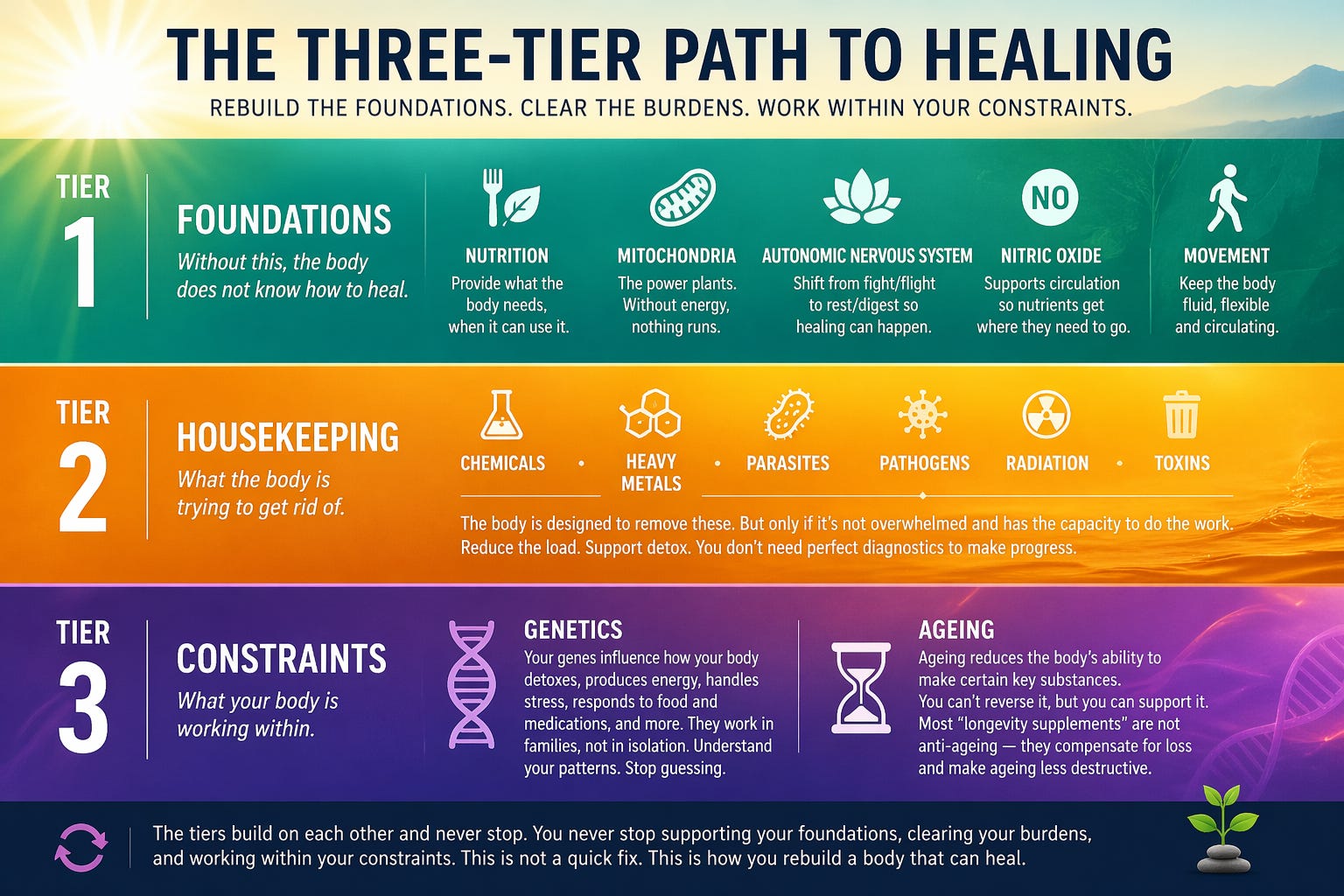
I’ve broken this into three tiers:
Tier 1 – Foundations
Tier 2 – Housekeeping
Tier 3 – Constraints
These are not separate processes.
They interact continuously.
But you do have to start somewhere, because you can’t fix everything at once.
There seems to be a threshold. If these functions drop below that threshold, the body struggles to spontaneously recover.
And this is where many people with long COVID and similar conditions are stuck —
below the threshold where the system can rescue itself.
Not because they’re doing nothing, but because the system itself is not strong enough to rescue them.
There are five elements to this.
It actually doesn’t matter how good your nutrition is if your body can’t use it.
But it does matter if the nutrition isn’t there at all.
Because if it’s not there, you are guaranteed to be below standard.
So the aim is not perfection.
The aim is to keep nutrition available, so that when the body can use it, it has something to work with.
The mitochondria are responsible for producing ATP — the body’s usable energy.
If they’re not functioning properly, you don’t have a reserve.
This is what sits behind post exertional malaise. It’s not just that you’re tired.
The system doesn’t have reserve energy and can’t quickly restore energy reserves.
The battery doesn’t hold charge.
This is the system that decides what your body is prioritising.
If you are in sympathetic mode — fight or flight — the body is focused on survival. Real or imagined doesn’t matter. The body treats it the same. And when it’s in that mode, it is not allocating resources to healing.
Parasympathetic mode is where the body says, “we’re safe enough,” and starts to repair.
You can’t force the body to heal.
But you can create conditions where it learns to spend enough time in parasympathetic mode for healing to occur.
This involves a significant behavioural change and takes time, lots of it.
Nitric oxide supports circulation.
Without it, nutrients don’t reach the tissues in sufficient volume.
Production declines with age, so many people need support.
If blood stream delivery fails, healing fails.
This is not gym-based exercise.
This is movement that keeps the body:
Fluid
Flexible
Circulating
If the body is not moving, things stagnate.
Muscles tighten, fascia stiffens, circulation reduces, lymph flow slows.
The aim is not performance.
The aim is to keep the system alive and moving, at whatever level the body can tolerate.
If these five are not sufficiently effective, you will not get well.
So this becomes a lifestyle shift.
You identify your weak points.
You work on them.
You integrate them.
Not as a strict regime — because that backfires —
but gradually, until they become normal.
What the body is trying to get rid of
This includes everything the body identifies as harmful:
Chemicals
Heavy metals
Parasites
Pathogens
Radiation
Toxins of all kinds
Miscellaneous growths
And, in many cases, post-viral material such as spike protein might be significant.
The body is designed to remove these.
But it can only do this if:
It is not overwhelmed
It has the capacity (Tier 1) to do so
This is where things break down. (Some are speculating that COVID attacks the mitochondria and the autonomic nervous system, thus damaging the very systems our bodies needs for recovery from COVID.)
Because we don’t have good, affordable, accessible diagnostics for most of this, and the science is all very recent, we often do not know what is poisoning or burdening our systems.
And even when we can test — the results are not always meaningful.
For example:
You can test for spike protein.
But not everyone with spike protein has symptoms.
So the test doesn’t resolve the question.
Cancer also sits in this layer.
Cells go rogue, and the body must deal with them.
It is still a problem of removal and regulation.
So Tier 2 becomes:
Supporting the body’s ability to clear what it does not want.
Even when you cannot perfectly identify it.
What your body is working within.
This tier is about limits.
Not limitations in a negative sense — but the conditions your body is operating under, whether you like them or not.
There are two main parts:
Genetics
Ageing
Your genes define what your body is capable of — and where it struggles.
They influence:
Detox capacity
Energy production
Nervous system behaviour
Circulation
Food tolerance
Medication response
Genes don’t operate in isolation.
They work in families, interacting as a system.
For example:
Variations in the family of genes that includes the MTHFR gene, can reduce detox capacity
Variations in genes governing the acetylcholine-related systems can affect the body’s electrical signalling
Once you understand your genetic patterns, you can stop guessing.
You start to see:
Why certain things work for you and not others
Why some interventions backfire
Where your system needs extra support
And that feeds directly back into Tier 1 and Tier 2.
But it is not simple. The field is not well advanced scientifically at this stage, and there is a lot to learn. I personally have only just made a start with two systems, the methylation system and the acetylcholine system, which is where my major genetic limitations are.
You can’t change your genetics but you can live with them effectively. It is clear that my current health decline is at least in part caused by these two systems failing. That means my quest is two fold:
how do I get these systems to run cleaner, smoother, and closer to their natural capacity?
how do I compensate where the system cannot produce enough of something, or cannot do it efficiently enough. This is less about optimisation and more about bridging a gap.
The hope is that once I support these two systems in a meaningful way, with proper nutrition and exercise, my Tier 1 core systems will start to recover, and my innate immune system will resume managing Tier 2 housekeeping.
Ageing is not optional.
And it is not fully reversible, no matter what is being sold.
What ageing does is gradually reduce the body’s ability to manufacture and regulate key substances.
For example:
The capacity to manufacture nitric oxide declines with age
Mitochondrial efficiency declines
Repair processes slow down
You cannot completely reverse this.
But you can compensate for it.
And this is where many so-called “longevity supplements” actually sit.
At their core, most of them are not extending life in some dramatic way.
They are:
Supporting functions that naturally decline with age.
For example:
NAD⁺ (via NMN / NR)
The body’s NAD⁺ levels decline with age → affects energy production, repair, cellular signalling.CoQ10
Endogenous production declines with age → impacts mitochondrial energy output.Collagen
Production declines steadily → affects skin, joints, connective tissue.Melatonin
Production drops with age → affects sleep, circadian rhythm, antioxidant activity.Glutathione
The body makes it from multiple ingredients including NAC, but levels tend to decline → affects detox and oxidative stress handling.
Rather than thinking in terms of “anti-ageing,” a more accurate frame is:
making ageing less destructive.
You are not working with a perfect body.
You are working with:
A specific genetic pattern
A body that is ageing
The goal is not to eliminate those constraints.
The goal is to work intelligently within them.
Tier 3 doesn’t sit above the other tiers.
It shapes them.
Your genetics influence how you approach nutrition, detox, and movement
Your age influences how much support your system now needs
So Tier 3 feeds back into:
Tier 1 (how you build your foundations)
Tier 2 (how you manage load and clearance)
What I’ve laid out here is not a treatment, and it’s not a quick fix. It’s a way of looking at why the body stops recovering, and what has to be in place for it to recover again. There are three layers to that. The foundational systems that give the body the capacity to heal. The housekeeping layer that deals with everything the body is trying to remove or manage. And the constraints — genetics and ageing — that determine how well those two layers can function in your particular case. If the foundations aren’t strong enough, nothing lands. If the load is too high, the system is overwhelmed. And if you ignore the constraints, you end up applying the wrong solutions. So instead of chasing one more targeted fix, the job becomes rebuilding the conditions under which health can be restored at all.
If you think others may benefit from my articles and insights
please spread the message by sharing, re-stacking and subscribing.
I would prefer PayPal donation to subscription. It your prefer subscription please be aware that I am not promising delivery of anything, and will not refund subscriptions if you find yourself unable to access my stack in the event you are asked by Substack to verify your identity and refuse to do so.
If you would like to help me keep going despite my battle with serious ill health…
…a PayPal donation will be gratefully received. I have a healing path that might even work - each day I get more optimistic that old systems that had shut down are booting back up again, but it does not come cheaply.
Comments
Nothing yet. Say the first thing.
Sign in to join the conversation.