
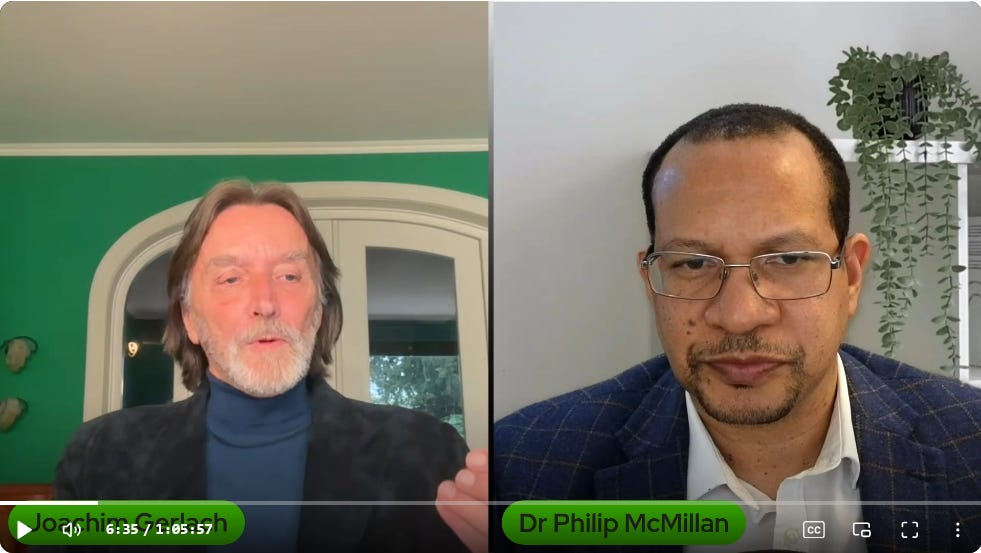
In this interview, Dr Philip McMillan speaks with medical researcher Joachim Gerlach about the current state of understanding of COVID and long COVID, with a particular focus on the role of the spike protein. The conversation centres on whether persistent spike protein may be driving ongoing symptoms, how it interacts with the body at a biochemical level, and what this might mean for treatment approaches going forward.
The core idea running through the discussion is that long COVID may not be about an ongoing infection in the traditional sense, but about ongoing biological disruption — particularly involving the spike protein. Rather than a virus actively replicating, the emphasis is on residual effects that continue to interfere with normal function.
A major theme is that spike protein is not inert. It appears capable of interacting with multiple systems in the body — including blood vessels, immune signalling, and cellular function — in ways that may explain the wide and often shifting symptom patterns seen in long COVID. This includes effects on circulation and clotting, which are proposed as key drivers of fatigue, pain, and organ-level dysfunction.
The conversation also highlights the idea that the body may struggle to clear spike protein effectively in some individuals. Instead of being rapidly removed, it may persist or recirculate, contributing to chronic symptoms. This persistence is presented as one possible explanation for why some people recover quickly while others remain unwell for extended periods.
Another important point is that long COVID appears to involve multiple overlapping mechanisms rather than a single cause. These include immune dysregulation, vascular impairment, and cellular stress. The implication is that no single treatment approach is likely to be sufficient — the condition may require addressing several systems at once.
There is also discussion of emerging treatment approaches that focus on removing or neutralising circulating factors (including spike protein) and restoring normal physiological function. These approaches are still evolving, but they reflect a shift away from treating long COVID as a standard viral illness and towards treating it as a complex, systemic condition.
A strong undercurrent in the conversation is the concern that COVID is being treated as a concluded event, when in reality it remains both circulating and biologically active. The acute phase may have passed in public perception, but the downstream consequences — particularly long COVID and related dysfunction — are ongoing and insufficiently addressed. The danger lies in assuming that absence of urgency means absence of problem.
The discussion challenges the idea that the issue is straightforward immune suppression. Instead, it points toward immune dysregulation — a system that is at times overactive, at times ineffective, and poorly coordinated. This helps explain why some individuals experience persistent inflammation, reactivation of latent infections, or unusual responses to otherwise routine exposures. Effectively you cannot just simply stimulate the immune system if it is already chaotically over-active.
The implications extend beyond individual cases of long COVID. There is a suggestion that the post-2020 landscape may involve a wider pattern of altered health responses — including increased susceptibility to certain infections, changes in disease presentation, and a general shift in how the body responds to stressors. In this framing, long COVID is not an isolated condition but part of a larger change in baseline health dynamics. More people appear to be getting sick with a wider range of ailments.
The direction this points to is a move away from the idea of long COVID as a simple post-viral state, and toward a model of persistent biological disruption that requires active intervention. Future work is likely to focus on identifying exactly what remains in the body — whether spike protein, inflammatory signals, or other factors — and developing ways to clear or neutralise them.
At the same time, there is a growing recognition that recovery may depend not just on removing these factors, but on restoring the body’s underlying systems — circulation, immune balance, and cellular energy. This suggests that effective protocols will need to combine targeted interventions with broader support for the body’s ability to recover.
In short, the conversation points toward a future where long COVID is treated less as a mystery illness and more as a multi-system dysfunction that can be understood, measured, and gradually reversed — but not with a single, one-size-fits-all solution.
If you think others may benefit from my articles and insights
please spread the message by sharing, re-stacking and subscribing.
I would prefer PayPal donation to subscription. It your prefer subscription please be aware that I am not promising delivery of anything, and will not refund subscriptions if you find yourself unable to access my stack in the event you are asked by Substack to verify your identity and refuse to do so.
If you would like to help me keep going despite my battle with serious ill health…
…a PayPal donation will be gratefully received. I have a healing path that might even work - each day I get more optimistic that old systems that had shut down are booting back up again, but it does not come cheaply.
Comments
Nothing yet. Say the first thing.
Sign in to join the conversation.