
N279K
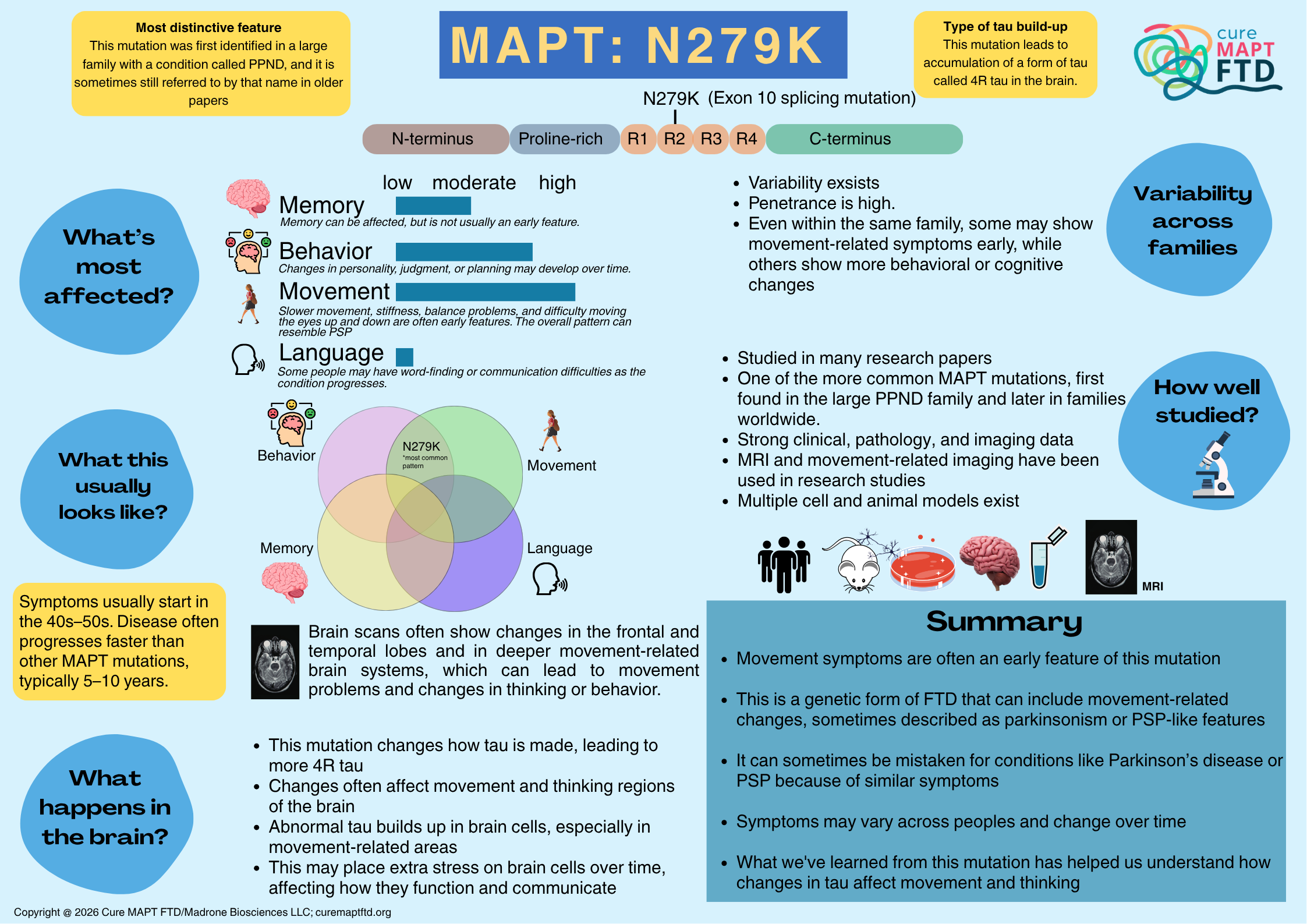
N279K is a change in the MAPT gene that disrupts how tau is built. Normally, the cell decides how much of each form of tau to make by including or skipping a specific section of the gene called exon 10 — this section contains the instructions for a key part of tau that helps it bind to and stabilize the internal scaffolding of nerve cells. N279K interferes with this decision, causing exon 10 to be included more often than it should, shifting the balance toward a form of tau called 4R.
In many families, the symptoms noticed first are related to movement — slowness, stiffness, balance difficulties, and trouble moving the eyes up and down. The overall pattern can resemble PSP or Parkinson’s disease, and N279K is sometimes mistaken for these conditions early on. Changes in behavior and thinking often follow. Symptoms typically begin in the 40s–50s, and the disease often progresses faster than with some other MAPT changes, usually over 5–10 years.
Penetrance is high, and variability across families exists; even relatives carrying the same change can differ, with some showing movement-led symptoms early and others showing more behavioral or cognitive changes.
In the brain, the excess 4R tau builds up into aggregates, particularly in the frontal and temporal lobes and in deeper movement-related regions. Tau PET imaging has shown that the amount and pattern of tau build-up can vary considerably across carriers, even within the same family.
N279K is one of the better-studied MAPT changes, first recognized in a large family with a condition called PPND (pallido-ponto-nigral degeneration) and later in families worldwide. It has strong clinical, imaging, and pathology data, as well as many model systems — including cell and animal models — available to researchers.
Selected references:
Wszolek ZK, et al. (1992). Annals of Neurology 32:312–320. — The original description of the large PPND family later found to carry N279K. https://pubmed.ncbi.nlm.nih.gov/1416801/
Clark LN, et al. (1998). PNAS 95:13103–13107. — Identifies N279K as the cause of disease in the PPND family. https://pubmed.ncbi.nlm.nih.gov/9789047/
Slowinski J, et al. (2007). Neuropathology 27:73–80. — Detailed neuropathology of N279K carriers, describing the 4R tau pattern. https://pubmed.ncbi.nlm.nih.gov/17319286/
Ikeda A, et al. (2019). Movement Disorders 34:568–574. — Tau PET imaging study documenting variability in brain tau build-up across N279K carriers. https://pubmed.ncbi.nlm.nih.gov/30773680/
Alzforum. MAPT N279K — continuously updated overview of clinical features, pathology, and research models. https://www.alzforum.org/mutations/mapt-n279k
No posts
Comments
Nothing yet. Say the first thing.
Sign in to join the conversation.