
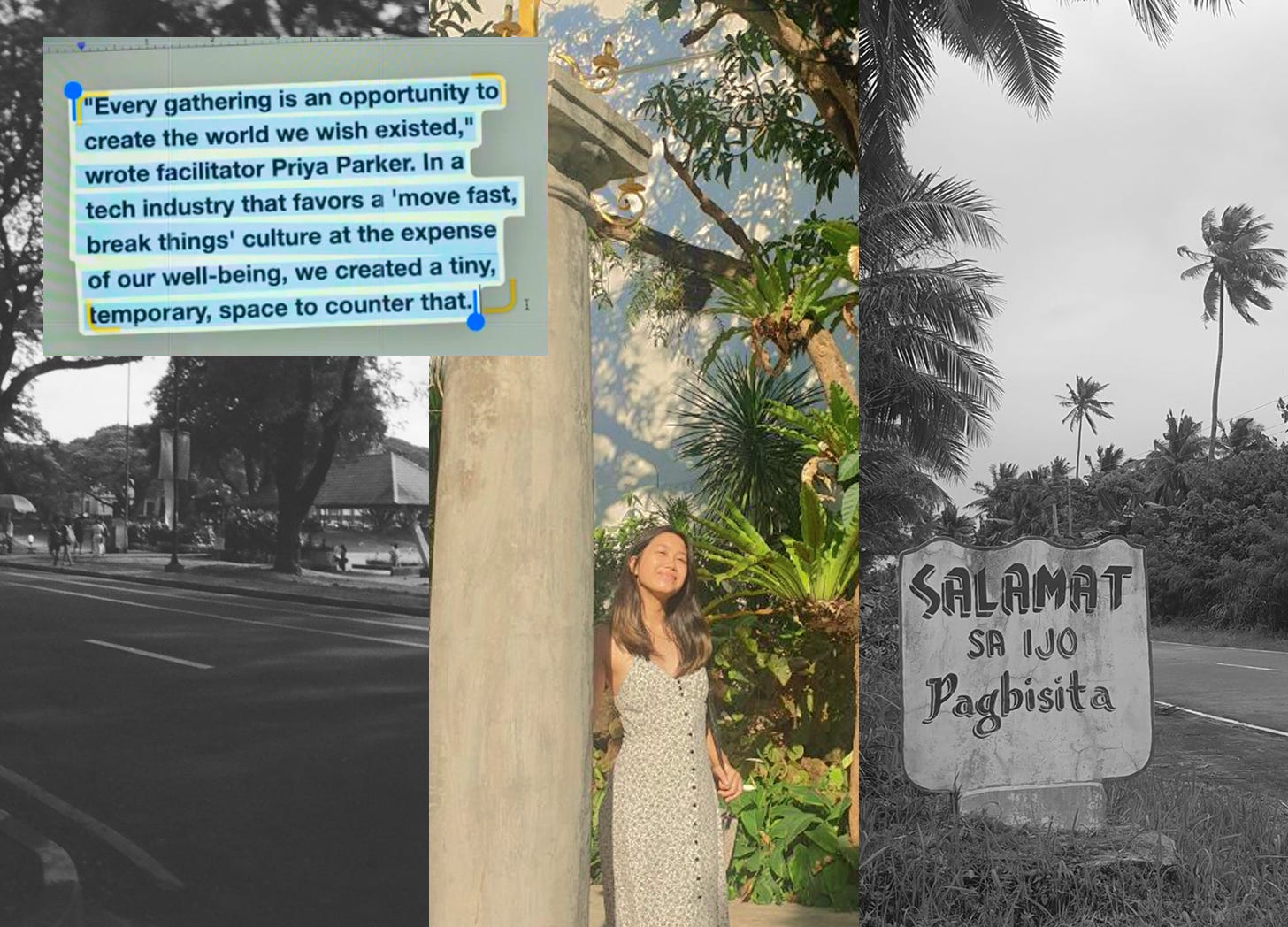
For this issue, I sat down with my friend Nikki Datlangin, who lives a “double life” of sorts: a psychology major working in tech. This is part of my series of interviewing friends with a unique practice. A lot of the folks I know do such cool things, but they barely write any of it down! Without further ado:
Q: In 2-3 sentences, how would you introduce yourself and your practice to a stranger?
I'm a psych student-turned-designer working to reclaim technology from its extractive histories into a tool for collective care.
I run Studio Bisita alongside Rachel Chak, where we co-create websites amplifying the work of Filipinos actively supporting their communities on ground. I also design at Dapat Studio, where I'm learning to weave my research skills into design for social impact.
Q: Tech and psych seem like very different things. How are you able to reconcile them in your practice?
I think that disconnect stems from seeing tech and psych as opposites: one cold and calculating, the other warm and human.
But I've always thought that the two work alongside each other, for better or for worse. The same principles that help us care for each other are also being used to build entire infrastructures that exploit, misinform, and polarize us. That’s not an accident—that’s by design.
I'm interested in using what I’ve learned about well-being to create more intentionally. The values that make a good care provider—respect, compassion, collaboration—can also guide how we design for audiences and work with clients. I love this quote from Becky Chambers:
“We have logic and emotion, and they serve different purposes. They’re both important. Emotion does not taint logic, and logic does not cut you off to the ability to feel things.”
In my coursework, I focused heavily on the psychosocial impacts of tech, and I’ve been privileged to be able to carry that lens into my work with Dapat and Bisita. A lot of what we do is grounded in understanding people’s contexts, stories, and needs. Tech can be reimagined as a tool for care, and there’s so much we can learn from psych and indigenous knowledge to make that possible.
I also hope to slowly build a facilitation practice. I hosted a tiny gathering last year at Couch Club Kapitolyo on cultivating a more mindful relationship with tech, and we’ve been dreaming up more community events and workshops at Studio Bisita since then!
Q: What media/readings/experiences factor into your practice? What are your sources of inspiration?
Developh: My entry point into tech, where I learned not just hard skills, but hard truths about digital labor and its offline consequences. I owe so much of my growth to this community and the friendships I formed there.
Seeing more of the Philippines: Manila imperialism runs deep. Working on the websites of Lokal Lab and For the Future, and on the zine Galing Mindanao, has been a huge part of my unlearning process. These projects are love letters to our archipelagic heritage.
Sikolohiyang Pilipino: Studying psych at UP taught me that recentering indigenous perspectives is essential to challenging the paradigms that dominate both mental health and tech. So excited to see researchers like Kar Abola drawing on SP concepts to understand how we can proactively use design for the betterment of Filipinos.
Soft, cozy corners of the web: I’m inspired by the practices of Kening Zhu, Patricia Mou, Annika Hansteen-Izora, Neema Githere, Chia Amisola, and Spencer Chang.
Frank Chimero: Specifically, The Good Room and The Shape of Design.
Q: What advice do you have for people who want to pursue a similar practice as yours?
There can a lot of pressure to focus on craft as a young designer, but relationship-building is part and parcel of this work too.
There are people and spaces out there that share your fascinations. Find them, take root in them, allow them to change you. Craft isn't developed in a silo, and it's a lot more fun having friends with you along the way.
Nikki can be reached via Instagram.
I’ve got a lot more interviews lined up; can’t wait to share them with you. See you in the next issue! 🍃
Comments
Nothing yet. Say the first thing.
Sign in to join the conversation.