
Knock knock, are you still checking your feed every minute, or did you finally get bored?
Here’s the spoiler: it’s very likely an AI created the content you’re consuming right now or just did. Like the incredibly real looking avatars trying to sell you something, the stylish tennis court on the ocean, or modified news videos of current events, whatever social-bubble you are in. They all do not exist and are not human made. But we keep watching them.
I call it the post-attention economy (Or maybe someone else already did). Artificial Intelligence just ate the industry built in the last decade. The industry that provided us with a lot of information. So much that we are running out of time and losing our ability to concentrate.
The good news: there’s now a chance to go back to concentration, full creativity, focus, love and peace, and embrace that shift in a productive way.
Can we?
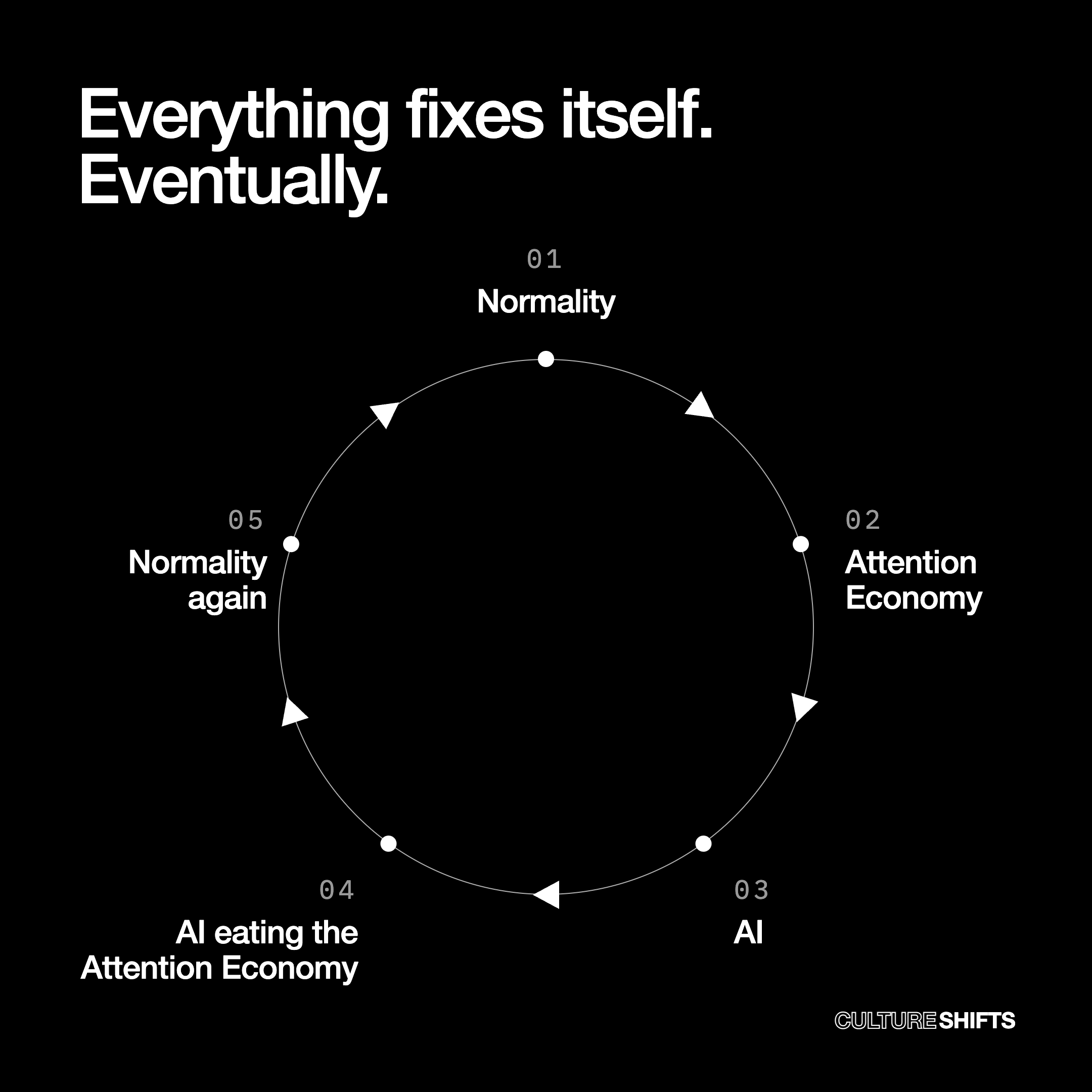
The graphic that you’ve just seen is basically my argument in one shape. Obviously without guarantee, but a scenario that I’m positive about.
For years, I – and I think most of us – have given away our attention without ever asking ourselves what it’s actually worth. That was the whole business model: an auction I didn’t know I was in. And trust me, I know exactly when I want to be part of one. You know, social media, feeds, also TV and radio but in a soft way. Every feed, every autoplay, every notification, every DM or whatever existed to sell a few seconds of my focus onward to whoever was bidding for it. And the ones bidding for it made a loooooot of money, but that’s another story.
Two kinds of people built the content economy from my point of view. Some had genuine expertise and used video, writing or music to show it online and make their skills more visible. Maybe because they either didn’t sell enough concert tickets or they needed new distribution models for their art, services, food, designs and so on. And then there were the others that had absolutely no skills and used the same tools to sell an image, a lifestyle, a product, a bubble in the end. (Fashion influencers I’m sorry but it’s you here).
Now we are in that fantastic and at the same time absolutely destructive situation where AI automates both. It writes the news, cuts the reel, composes the track, creates the poster, produces the podcast, does everything faster and cheaper than any human ever could.
That’s exactly what every clear-thinking person on the internet can now see, but we just keep scrolling. But hey, what we’re seeing might simply no longer have been created by a creative person, so why bother watching it at all? People trust less of what shows up while they consume media. (I wrote about it in an earlier piece)
Now we arrive at the turning point: Increasingly, the contest for attention happens between machines rather than for humans. By mid-2026, American technology company Cloudflare's own network saw bots pull ahead of humans on HTML traffic. AI Bots ranking bot-written content, tuned against other bots built to detect it.
We're in the room while the negotiation happens around us. You all know that situation when someone hijacks your conversation. Of course disturbing first, but then kind of nice, isn't it? You just let it happen and log off while the bots are ranting, being politically incorrect, disrespectful etc. Like all commentary sections of every media daily since the invention of the Web 2.0.
So to be honest, my own interest in the digital has been thinning out. I love technology and loved the internet, digital media, all the perks and opportunities it opened up.
But now, when platforms are adding authenticity badges and AI-detection tools (like Substack the other week or also LinkedIn) to reassure people that a human wrote what they’re reading, we arrive at the point where we can also just not produce digital content anymore.
We’re kind of back where we have been before the attention economy but with more data centers, digital garbage, a stupidly huge amount of messed up code and economic, ecological and societal problems connected with that.
Why on earth should we now trust machine-based tools that tell us whether something was made by a human or a machine? It’s an important feature but its effect won’t last long. I’ll tell you what happens next: new, super-sophisticated systems will outsmart the AI detection systems and flag it as “human-made” again. It’s that simple. But isn’t that ridiculous?
This brings me to the point where analog media becomes way more interesting again and guarantees the human made touch: a book, a rehearsal, a movie theatre, a magazine, a play, a conversation with no algorithm deciding who speaks next or a nice film that is longer than five seconds. Or a live event, a panel discussion, a talk, something that builds real communities.
It’s sad that the tools developed for connectivity over twenty years have ultimately led to disconnection becoming a better option.
And now we’re back. And here’s the logic:
If an AI model can produce content faster and cheaper than a person, the incentive to produce it as a person weakens, and the incentive to make something that specifically requires a body in a room gets stronger. The same goes for consumption. Why even care about a piece of art, music, video or text if a person didn’t make it?
German philosopher Walter Benjamin gave this feeling a name back in 1935: Aura. It's probably been quoted a million times since, including in the first week of my media studies degree in Vienna 15 years ago. A computer has no aura and it never will. And that’s the difference.
Step outside the digital realm for a moment, and that’s exactly where aura still lives: presence itself, a space a machine can’t enter, a person who’s actually there. (Well, at least until the humanoid robots show up.)
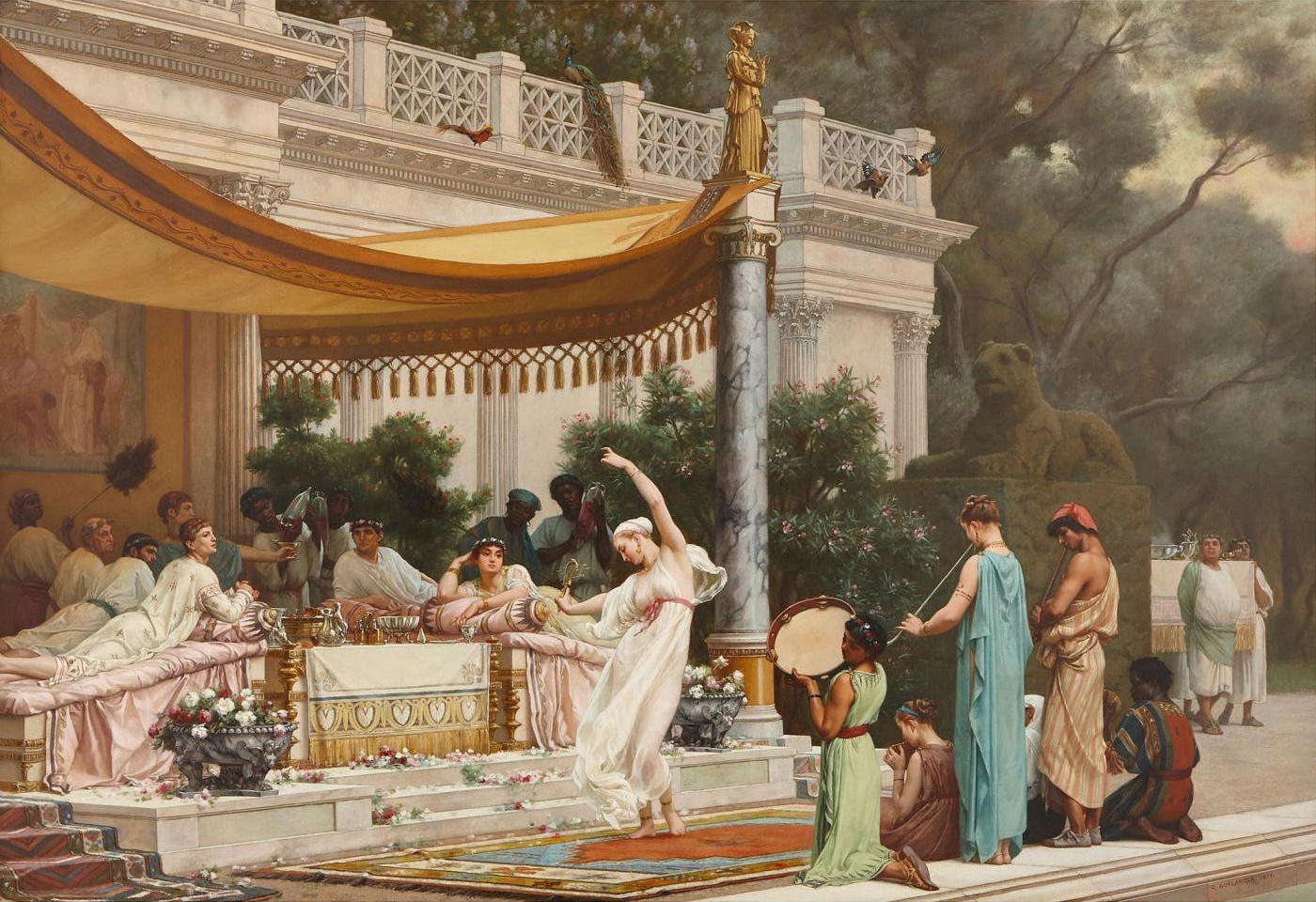
To close with something nice, exciting and contemporary: Cinema became a niche medium and it shows the same instinct taken further. Christopher Nolan shot The Odyssey entirely on IMAX cameras, a format only around forty theaters on the planet can actually project in true 70mm. People are traveling for the privilege, because a screen at home cannot reproduce what that room was built for or the neighbourhood cinema is too close to the Netflix account at home.
So, ideally all of this leads precisely there: to a return to what, based on experience, cannot or should not be automated. To a return of the non-algorithmic, the experienced, the human made. Let the robots get on with their thing, be it writing books, composing music and so on. From a creative point of view it’s all irrelevant.
We can get back to focusing on what really matters: what and who deserves our full attention, and what we produce that has real added value and aura.
So, what are you doing with your time in the new normal? I'm working on talk salons in Milan this autumn, in-person conversations on the question of what it means to be human today. (more tba.)
Enjoy the summer.
*Moritz
No posts
Comments
Nothing yet. Say the first thing.
Sign in to join the conversation.