
(before you proceed, I must warn you that this essay contains spoilers for the film) When I saw the trailer for
Will Gluck’s new rom-com takes place in an America where premarital sex is illegal for 364 and a half days of the year (yes, this is the “sex purge” movie, in case you’ve heard chatter to that effect). For twelve hours, once a year, the mandate is lifted and single people are free to fuck. Naturally, the country has turned this brief window of bodily autonomy into a national holiday. There are parties and advertisements, lube brands hand out free samples on the street, and every store is completely sold out of condoms. On paper, it has all the makings of a sex-positive political satire: take America’s historically weird, puritanical relationship with sex, push it to its most ridiculous conclusion and make a romcom out of it.

Except the longer you think about the premise, the less funny it becomes. For any of this to work, we first have to accept something pretty damn sinister: the government has decided that it has the authority to tell people when they can and cannot have sex (not too inconceivable in this political scenario, if you ask me). And much more importantly, all the citizens seem to have been lulled into submission too. There is little to no resistance, and the one day of the year that should serve as the greatest reminder of their government-imposed shackles instead turns into a celebration that seems bigger than New Year’s Eve.
One Night Only wants the stakes of an authoritarian dystopia without really wanting to talk about authoritarianism. It borrows surveillance, incarceration, sexual repression and state control of the body as the machinery for a romantic comedy, then asks us not to look too closely at how any of that machinery works. If you’re going to borrow the stakes of bodily oppression, though, you inherit the responsibility of understanding what you’re satirizing.
In her review of the film for RogerEbert.com, Marya E. Gates writes, “Good satire is rooted in the understanding and interrogation of systems, of the root causes of its satirical target.” She later distills her criticism into an even simpler diagnosis: “Political satire cannot stand up if it doesn’t have a spine.” 1
The problem with One Night Only isn’t that bodily oppression is too serious to joke about. Political oppression is exactly the kind of thing satire has historically been good at talking about. We have seen this done, and done WELL, several times. Dr. Strangelove makes nuclear annihilation ridiculous by following Cold War logic until the people supposedly protecting humanity are calmly engineering its destruction. The Death of Stalin turns authoritarian bureaucracy into farce, where officials are so terrified of making the wrong move that even responding to a dying dictator becomes a political calculation. The Handmaid’s Tale, though not a comedy, operates through a similar exaggeration: it takes existing ideas about reproductive control, religious fundamentalism and prescribed gender roles and removes the comforting distance between rhetoric and consequence.
In each case, exaggeration makes the flaws in a logic we have normalized impossible to ignore. One Night Only is clearly reaching toward purity culture, abstinence, “traditional values” and state control of the body, but it rarely follows those ideas far enough to reveal much about them.
There is plenty of evidence that the citizens of this world dislike the mandate. Throughout the film, we see posters and graffiti in the background that are anti-mandate. In one scene, crowds at a party chant “fuck the mandate,” an act that initially reads as rebellion until you remember that they are doing it on the one night of the year when the mandate has been lifted. They are protesting at precisely the moment when their protest costs them nothing. For twelve hours they can fuck, party in the streets and shout anti-government slogans before returning the next morning to the exact same system.
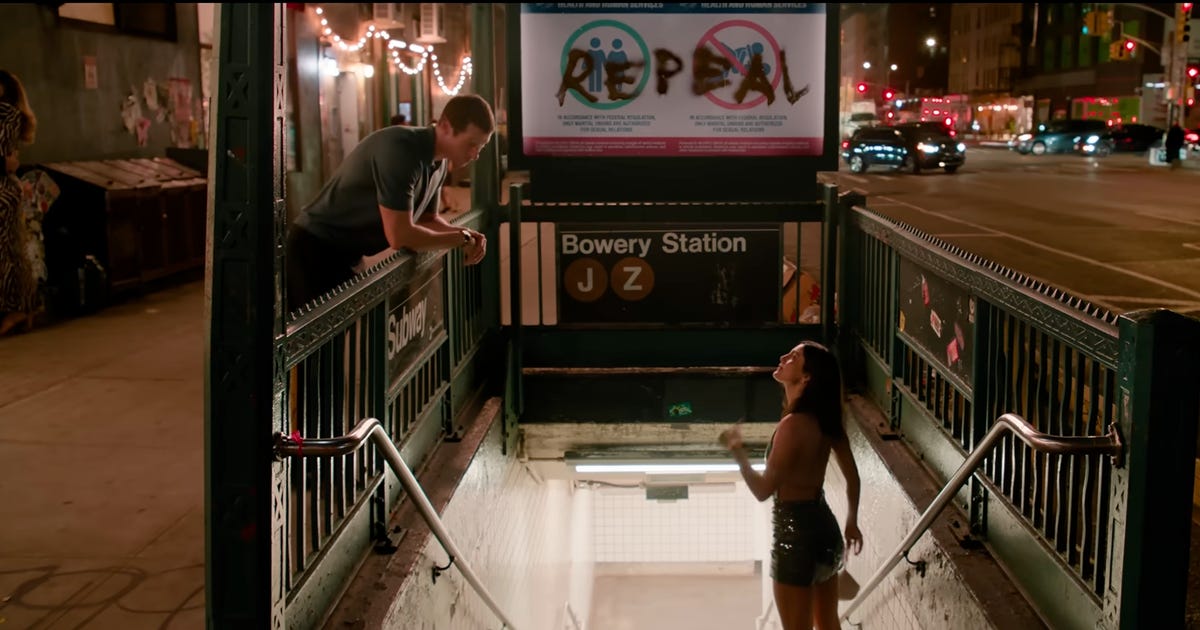
The government doesn’t need its citizens to like the mandate, it only needs them to accept its legitimacy. One Night gives people an opportunity to perform their dissatisfaction without ever threatening the system itself. “Fuck the mandate” becomes less of a rallying cry and more the chorus in the song of the annual festivities.
And naturally, those festivities have sponsors.
Lube brands hand out freebies in the streets while condoms are subject to surge pricing, at one point reaching $200 (cash only) at a bodega. Sexual repression has become economically productive. The state restricts bodily autonomy and capitalism monetizes its temporary restoration. One Night Only mostly uses commercialization as texture instead of investigating its effects. The sentiment it leaves me with is: oppression gets merch! Yay!!
The $200 condom is particularly interesting because condoms aren’t merely in high demand on One Night—they are required by law. Sex is legal for twelve hours, but unprotected sex remains illegal. The government hasn’t actually stopped regulating sex for the night, it has simply changed the terms under which sex is permitted. They really said you can have sex for 12 hours (terms and conditions apply). Great.
The surge-pricing gag becomes a window for comedy in the movie, with Allie and Owen actually stealing the mannequin holding the locked box containing the $200 condom from the aforementioned bodega. Clearly, people are willing to go to great lengths to get laid on this One Night. But the more you sit and think about it, the surge-pricing gag goes from funny to bizarre to despicable. The government legally requires a product and then permits that product to become prohibitively expensive during the only hours citizens are allowed to have sex. What looks like a joke about supply and demand is also a neat little illustration of how nominally universal freedoms become stratified by money. You are free to have legal sex, provided you can afford the thing that makes it legal.

The condom requirement also tells us something about what this supposedly universal law thinks sex actually is. By making condom use the legal condition for sex, the mandate imagines “sex” primarily through the mechanics of penile penetration. A rule supposedly governing everyone has been written around one particular sexual configuration.
The movie isn’t merely heteronormative in the vague sense that its central romance happens to be straight. The law that is the premise of the entire film itself appears to be heteronormative. Its definition of permissible sexuality is built around heterosexual penetrative intercourse. Queer sexuality doesn’t merely complicate the rules—it exposes that the rules were never written with it in mind.
For a movie borrowing the language and imagery of authoritarian sexual politics, that is an enormous blind spot. Governments that police sexuality have historically cared very much about defining which sex, relationships, genders and families count as legitimate. Queerness isn’t a side question to a premise about state-regulated sexuality. It is one of the first things that the premise should force you to confront.
But the implications don’t stop at sex and sexuality, because the moment a government defines legitimate sex, it inevitably begins defining something else: legitimate reproduction. If only married people are allowed to have unprotected sex, then only married people are realistically permitted to reproduce. Children out of wedlock don’t simply fall outside a cultural norm, they fall outside the legal framework the state has created. The mandate is therefore prescribing a very particular vision of kinship, one in which sex, reproduction, marriage and the nuclear family are deliberately collapsed into one another.
Once reproduction becomes part of the law, another omission becomes impossible to ignore. The movie acknowledges pregnancy when it needs a rule governing condoms, but barely follows that concern into reproductive autonomy. What happens after the condom fails is apparently outside the scope of a government otherwise interested enough in sexual behavior to monitor its citizens’ dopamine levels.
This is where my initial, admittedly facetious question about whether the movie hates women starts to feel a little less facetious. The premise can only remain this breezy if you don’t think too hard about who bears the consequences of the reproductive system it has created. Pregnancy matters enough to justify another layer of government control, but the person who might actually become pregnant—and what control she retains over her body afterward—barely seems to factor into the equation.
In America in 2026, government control of reproductive autonomy hardly belongs to speculative fiction. Abortion access already changes across state borders, while legislation governing trans healthcare continues to make questions about who controls a person’s body materially consequential. One Night Only asks us to laugh at the absurd extreme of a government inserting itself into people’s sexual lives without doing much with the uncomfortable fact that its exaggeration has very recognizable roots.
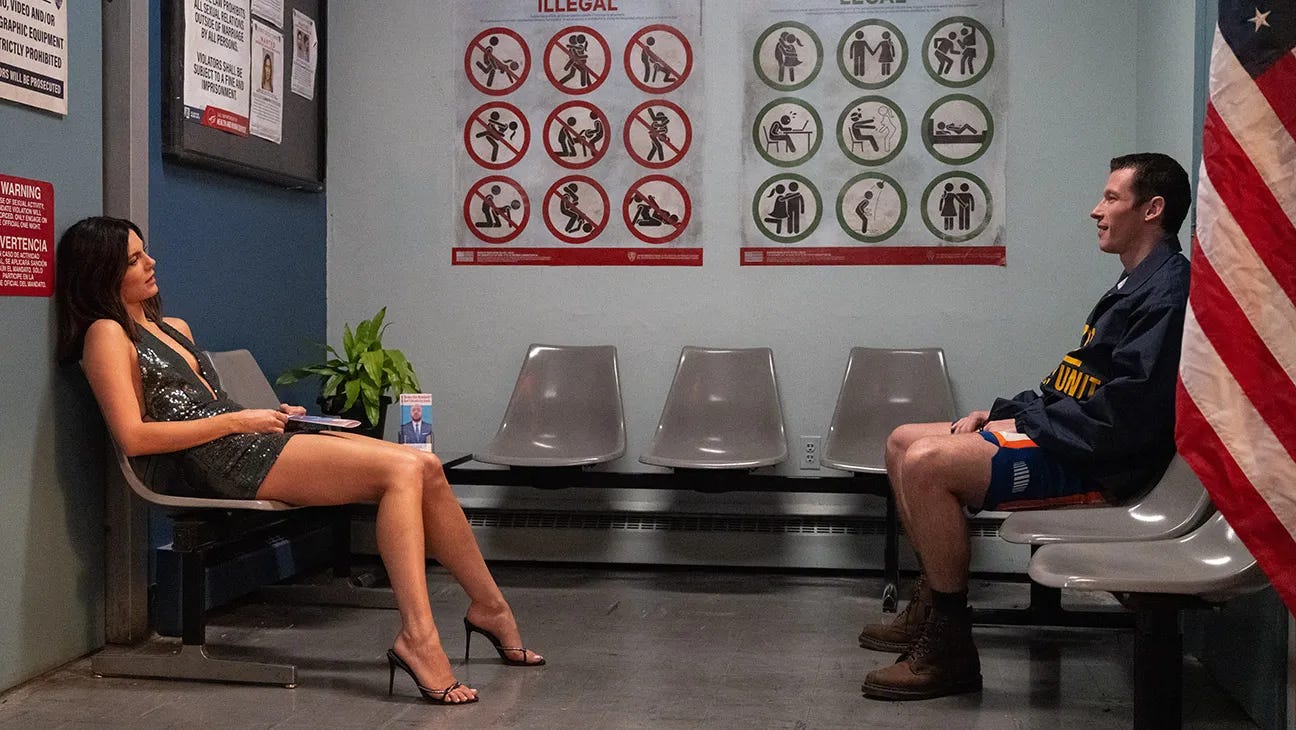
A key component to the logistical feasibility of this absurd premise is surveillance. The government enforces the mandate through biosensors capable of detecting hormonal changes, including dopamine increases associated with sexual encounters. The trackers are red for unmarried citizens and green for married ones. During the twelve-hour window, everyone’s trackers turn green (yay freedom!!!!). It is an astonishingly invasive idea disguised as a cute piece of world-building: the state has access to biological information from inside its citizens’ bodies in order to determine whether they are having illegal sex.
Dystopian fiction has used bodily surveillance precisely because of how uniquely violating it is. The trackers in The Hunger Games don’t simply tell the Capitol where the tributes are; they make clear that even their bodies exist within the Capitol’s technological control. Divergent similarly uses injections, simulations and tracking technology to dramatize a government that can penetrate the supposed privacy of a person’s body and mind. The violation is the point.
One Night Only, meanwhile, lets you pick your design.
The film has aestheticized the absence of choice by offering a smaller, meaningless one. You cannot choose whether the state monitors your biological activity, but you can choose whether the device doing it looks like a bat or a heart or a car or potentially anything else. The movie doesn’t go into the menu of options you get, but the protagonists do have a “meaningful” conversation about why they each chose their respective emblems. Personalization makes surveillance feel participatory without actually providing autonomy.
Allie chose a lighthouse for her biosensor design. It becomes a small expression of her personality, something she tells Owen about herself and something he remembers. Eventually the motif becomes part of the film’s climactic romantic gesture when they find each other again at a red lighthouse. An object that exists because the government monitors Allie’s body becomes an accessory, then a character detail, then romantic iconography. The surveillance apparatus becomes part of the love story.
And this is all before you even start asking whether the science makes any sense. I think the film is relying on the hope that since this is a romcom, people won’t think too deeply about it. If we go off the logic of the biosensors, the definition of sex would be anything that raises dopamine levels, which for some people is a jelly-filled donut and for others (me) is Taylor Swift dropping new music.

But perhaps the most effective enforcement mechanism in the film isn’t the biosensor at all.
There is one moment that inadvertently reveals just how successful the system has become. We learn that a character has been arrested after breaking the mandate fourteen times, establishing that people really are incarcerated for consensual sex. But Allie’s reaction isn’t horror at the punishment. It’s shock and judgment at the number of offenses. Fourteen times?
It’s a small reaction, but perhaps a very politically revealing moment in the movie. Allie doesn’t merely understand the mandate as something the government enforces. She has absorbed the morality behind it. The person repeatedly exercising bodily autonomy strikes her as more aberrant than the state imprisoning him for doing so. The law has successfully become a social norm.
That makes the film’s ending feel less like a contradiction than a culmination. After spending the movie racing toward their one legal opportunity to have sex, Allie and Owen finally find each other and choose to wait. Within the language of a conventional rom-com, the gesture is supposed to distinguish their connection from the frenzy around them. Everyone else wants sex but they have found something more meaningful.
For a movie whose premise cosplays as extremely sex-positive, that is a remarkably traditional romantic conclusion.

One Night Only repeatedly positions sex and romance as opposing impulses. Casual sex belongs to the chaos of One Night while romantic love is elevated above it. Allie and Owen prove the depth of their connection by declining the very thing everyone else is pursuing. The problem isn’t that choosing not to have sex is inherently conservative—choosing when and whether to have sex is obviously part of bodily autonomy. The problem is what that choice is asked to signify. Abstinence becomes evidence that their relationship is more meaningful.
That isn’t sex positivity so much as a familiar hierarchy wearing sex-positive clothes. A sex-positive worldview doesn’t require sex to be meaningful, meaningless, romantic or casual—its entire point is that consenting adults get to determine that meaning for themselves. Sex can be part of romance without diminishing it, and romance doesn’t become more profound simply because sex has been withheld.
Which makes the ending almost comically aligned with the ideology the movie has supposedly spent its runtime satirizing. The state has spent years telling these people that waiting to have sex is morally preferable, and the film ultimately uses waiting as the romantic gesture that distinguishes its protagonists from everyone else.
Maybe the mandate worked a little too well.
There is an incredible political satire somewhere inside One Night Only. I’m just not convinced the movie knows it made one. For all its attempts to mock the absurdity of state-controlled sex, the film never quite questions the premise its entire world has accepted: that bodily autonomy is something the government can give and take away in the first place. Twelve hours of sanctioned sex isn’t freedom, it’s permission—and perhaps the movie’s greatest failure is that it seems just as willing as its characters to confuse the two.
https://www.rogerebert.com/reviews/one-night-only-monica-barbaro-callum-turner-film-review-2026
No posts
Comments
Nothing yet. Say the first thing.
Sign in to join the conversation.