
In the early months of my philosophy degree, in some intro Classics course, I read Plato’s The Symposium for the first time. In it, the character, Aristophanes, describes the “myth of halves;” a fable that argues that humans were split into two by Zeus (that dude was really just doing anything), and were compelled to search for our other half our entire lives. Love, as Plato saw it then, was at its core, a pursuit and desire of the whole. That, if you loved anything, you had to love all of it. Little did I know that almost twenty years later, at 37 years old, this seminal Philosophy 102 text would re-enter my consciousness as a foundation for how I see and think about motherhood.
Little did I know that almost twenty years later, I would see an interesting book on an upcoming release list on Instagram, reach out to the publisher to ask for a review copy, and have said book completely and absolutely change my life.
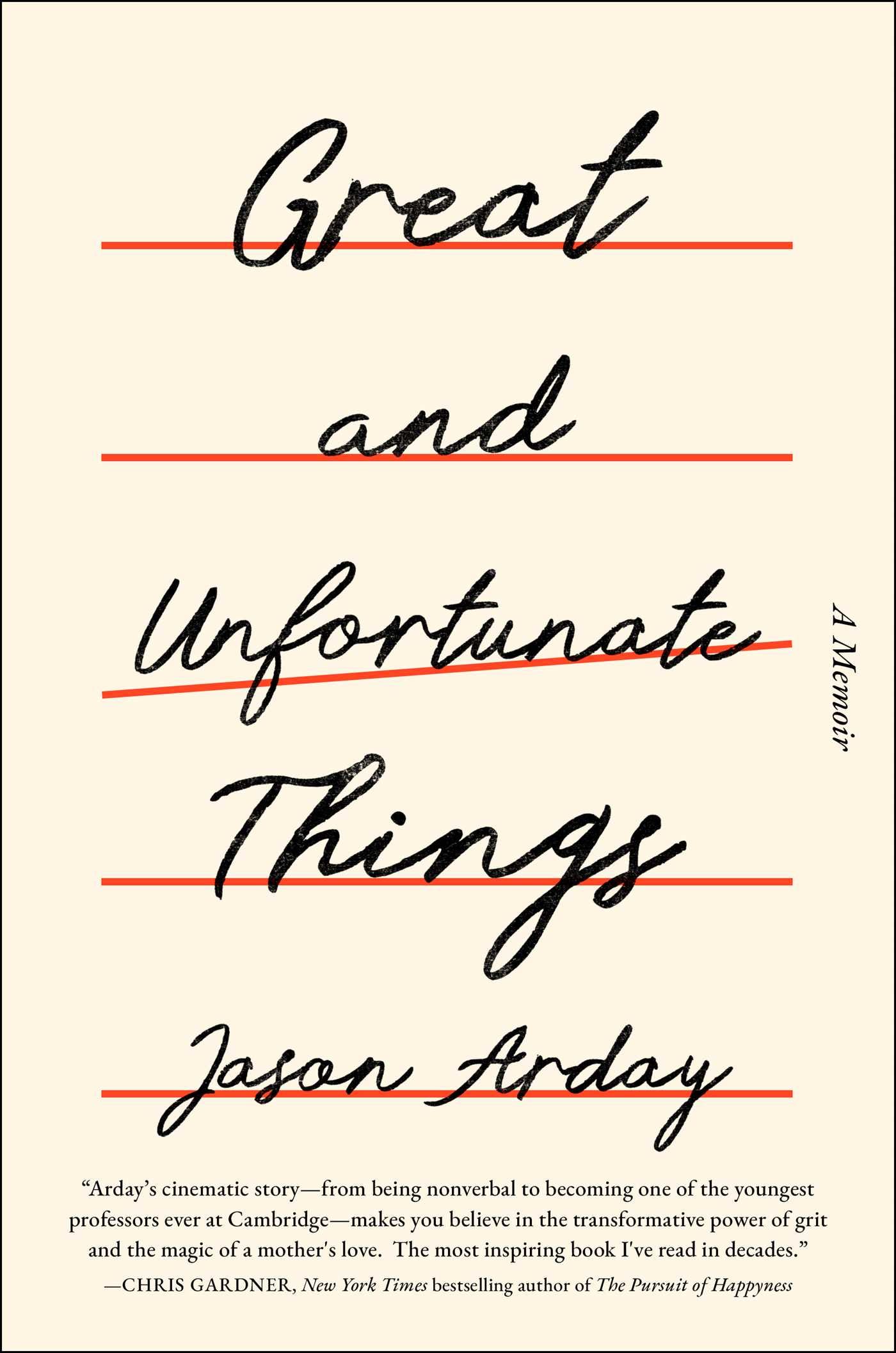
Great and Unfortunate Things by Jason Arday (from 37 Ink, a Simon & Schuster imprint) is Arday’s debut memoir. Jason, the second of three boys of his immigrant, Ghanaian parents, grew up in the council estates of South London. His mom, Gifty, affectionately referred to as Giff (including by Jason), was a stay-at-home mom for most of his childhood and adolescence, raising three children with very little support. His dad, the primary income earner, worked grueling hours to just barely keep the family afloat month to month, year to year. Diagnosed with autism and global development delay at the age of three (this would mark the second autism diagnosis for the family, with Jason’s older brother being the first), Jason wouldn’t say his first word (two actually: “Good morning.”) until he was 11 years old. He wouldn’t read or write until he was 18. And then at 37 years old, he became the youngest Black professor in Cambridge University’s history.
Pretty freaking incredible.
An astounding story, by all definitions, and one, I would argue, where those previously mentioned highlights are probably the least interesting parts of it. Great and Unfortunate Things is, ultimately, a story about love. It is a story about the rivers of possibility that are carved out of the mountainous strength and courage of a mother. It is the story of refusal; refusal to accept the permanence of insult and injury, and the cruel and untrue limitations of a diagnosis that has been (and still is) so clouded by stigma and misinformation. It is the story of language and worldmaking as a practice of discipline, devotion, and care, in both the metaphysical and literal. It is the story of Jason’s mother, Giff, a woman who fought a system - a whole world - designed to render and keep children like her son invisible. “I don’t accept that,” an oft-repeated phrase of Giff’s became a battlecry; a creed that let everyone around her know that your limited belief in her son was not (and would never be) the truth of her son.
When you become a parent of a child with special needs, your map changes. Or, more aptly, I should say, it disappears. You are thrust into a new and entirely different terrain of parenthood where everything you naively thought you knew about parenting before (and it was already so little, wasn’t it?) is gone. You find yourself now writing an exam you haven’t studied for, in a language you don’t speak, in a school you have never attended. The stakes rise staggeringly overnight. Your days are now filled with shifting milestones and expectations (until you learn to get rid of them entirely), and you become a searcher. You find yourself scanning, scavenging, searching for things you never thought you’d have to deal with or need. Things like speech, OT, and feeding therapists, swim classes that can accommodate your child, dirty looks from strangers while your child is having a meltdown, advice on how to navigate IEP meetings, someone who understands, a sign that your child understands what you’re saying, a minute alone to cry in the bathroom, their newest safe food so you can stock up…
A crystal ball that will tell you that they’re going to be okay.
In general, I think, all motherhood is like this. We oscillate between heart-shattering joy and ache and fatigue and pride and rage. But when you finally get that diagnosis, your world - which has already tilted on its axis - inverts once again. Your foundation, already cracked open from the earthquake of matrescence, transforms, this time into a waterbed, and you have to figure out a way to stay standing on its roiling waves.
And I know that, by some strange miracle, with every slip, with every tumble, with every fall, you do find a way to stand back up. The ground underneath you turns and rolls, but your legs get stronger, your core reacts a little faster each time, and you’re able to stay up a little longer.
I know that with every defeat, comes a win. With every misfortune, there is something great and joyful that awaits us, as long as we keep love in the room with us. Unwavering, unflinching, unencumbered love. I know this because Arday’s memoir, so perfectly titled, shows us that with every blow, there’s an unimaginable comeback.
And I know this because my own son has autism.
I have never publicly shared this fact until now. I haven’t shared it for many reasons, chief among them being that I feel an overwhelming need to protect him. I also have a strong, almost repulsive reaction to pity. From early on, I knew, just like Giff did, that our story - and more importantly, my son - was not to be pitied. I didn’t want to hear the choruses of “Oh no, I’m so sorry!” or “Gosh, I could never handle that.” Those empty, banal phrases filled me with rage because the universal fact of all motherhood is that you are compelled to handle all the things you previously thought untenable. Trust me when I say that I am no more prepared or studied for this task than any one else. This was simply the proverbial deck that we were handed when we chose to have a child and it propels me forward every single day. It is the single most powerful charge over my life. One that I consider holy. I have been tasked to usher, nurture, teach, guide, and protect this beautiful little boy in (and from) a world that was never designed for people like him. Most days, I want to scream that it’s the world that doesn’t fit my son, not the other way around. But I am forced to remember that my rage is far more potent as love.
Plato taught me, almost twenty years ago, that if you love something, you must - you really, really must - love all of it. And there is nothing in this universe that I have felt this more completely with than my son. I look at him and see and know love. I love every hair on his head, I love his fingers that reach for mine. I love the way he puts his forehead to mine right before he kisses me. I love the way he whispers that he wants a snack. I love that whispers for snacks are miracles in our house. I tell my son I love him with a near fervent obsession. Every task completed, every word uttered, every meltdown, every Ms. Rachel episode, every song sung, every new skill, every step forward, every three steps back, every smile, every giggle, every point, every followed instruction, every ignored instruction is a chance to remind him that he is urgently, beautifully, unconditionally, and perfectly loved. If I could go back to that Philosophy 102 class today, I’d probably argue that Aristophanes didn’t get it quite right. I have absolutely been searching for my son my entire life, but he isn’t my other half, so much as he is his own whole. And his is the only whole that perfectly overlaps with mine. I was made for him and I thank God and the universe and whatever deity you pray to that somehow this perfect child found his way to me.
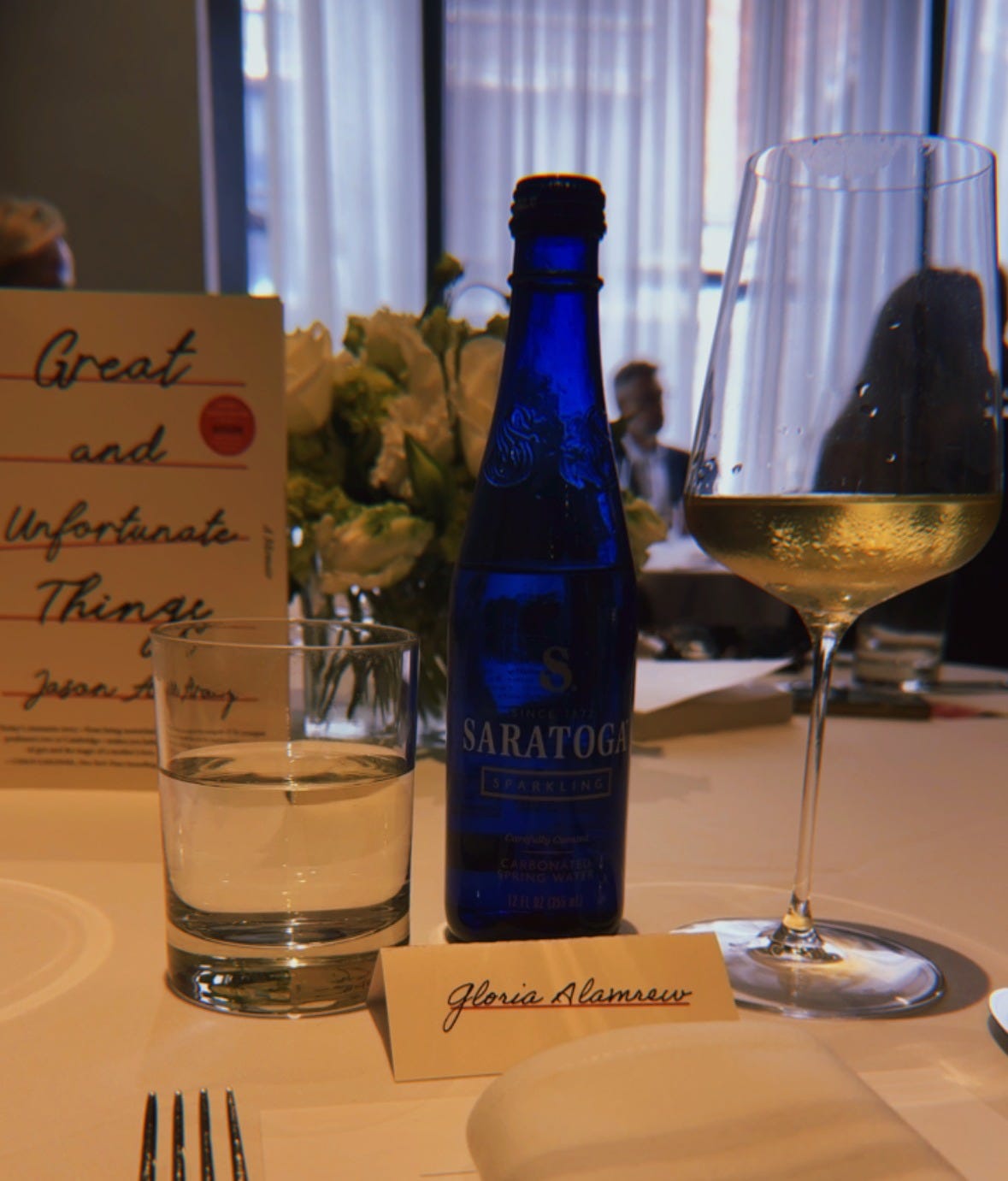
Earlier this week, I had the honour of attending a private media event with Jason, hosted by the publisher (thank you again to Cat and Katharine for the galley and the invite!). Over wine and a delicious four-course meal, the intimate room filled with journalists/writers, and publishing and book industry professionals listened raptly as Jason graciously answered every single one of our questions, each answer coming with a poignant quote from one of his parents. One of particular note was his dad telling Jason and his brothers as children that the greatest compliment someone can give you is saying that you’re the furthest thing from what you actually are. The quote immediately resonated and gnawed at some secret, interior place of knowing inside of me.
I know that so often people see what we have to be, not what we actually feel internally or have gone through to become this way. People see (and judge) the choices we make without ever knowing the impossible options we had to choose from. For Jason, he writes often in the book about the concept of “losing to win,” a reminder that every single accomplishment of his that gets celebrated publicly today has come at far too great costs privately. His health has suffered, his personal relationships have suffered. In the memoir, he writes about experiencing “autistic burnout” during the early days of the pandemic, a sudden-onset of severe, crippling depression, that left him bed-bound and literally unable to speak. No matter the incredible strides we make, there is always a pound of flesh to be paid.
At the luncheon, Jason kept reiterating that he is a “very ordinary, normal person.” And I think that’s the point. People have called me brave when I talk about my motherhood journey countless times. Courageous, even. They’ll remark that they don’t know how I do it all. And the truth is, I don’t know either. I am deeply afraid. Almost all the time. I am impatient to a fault (a personal fact that I find myself laughing at often these days). I am not naive about the truth of our world, and its inability to care for the lives of Black, autistic children. But, like Giff, I do not accept that this is how things have been and therefore, must always be. I do not accept that it’s only children like my son who have to do all the intense, spirit-bending work to fit into the constraints of a neurotypical world. I do not accept that a diagnosis is a definition. I do not accept that.
Instead, what I do know is that the love for my child surpasses all fear. It allows me to get back up on my waterbed foundation and learn to surf, no matter how tired my legs are, because I know that at the very least, I’m a little stronger than I was yesterday. Giff, described by Jason as “mousy-voiced” and small in stature, was an inventor. Where doors shut in her face, she turned to windows. Everything - and I mean, everything - became an access point for learning. She used music, television shows, and movies to impart practical and moral lessons to Jason and his brothers. She carefully observed which skills and interests emerged naturally and breathed life into them. Where doctors, therapists, and teachers focused solely on lack and deficits, she shone light on the skills that were already present, and found ways to fill in the gaps. Where there were none, Giff made pathways for her children. And Jason, an inimitable person, walked down each one with honesty and integrity. Great and Unfortunate Things is no fairytale. It is not a love letter, fantasy ode to the benefits of “hard work.” It is a reminder that pain and heartbreak are inevitable. Life will absolutely weather you down to the bone sometimes. But it will also replenish and restore. Sometimes in the same day. But love as the desire and pursuit of the whole is the one true changemaker. I see it in action every single day when I look at my son. Love does not and cannot change the facts of your life, it only asks for the acceptance of them. It invites you through the door to face every great and unfortunate thing that waits for us, promising only another opportunity to try again.
Great and Unfortunate Things by Jason Arday is slated for release on August 11, 2026 by 37 Ink.
No posts
Comments
Nothing yet. Say the first thing.
Sign in to join the conversation.