
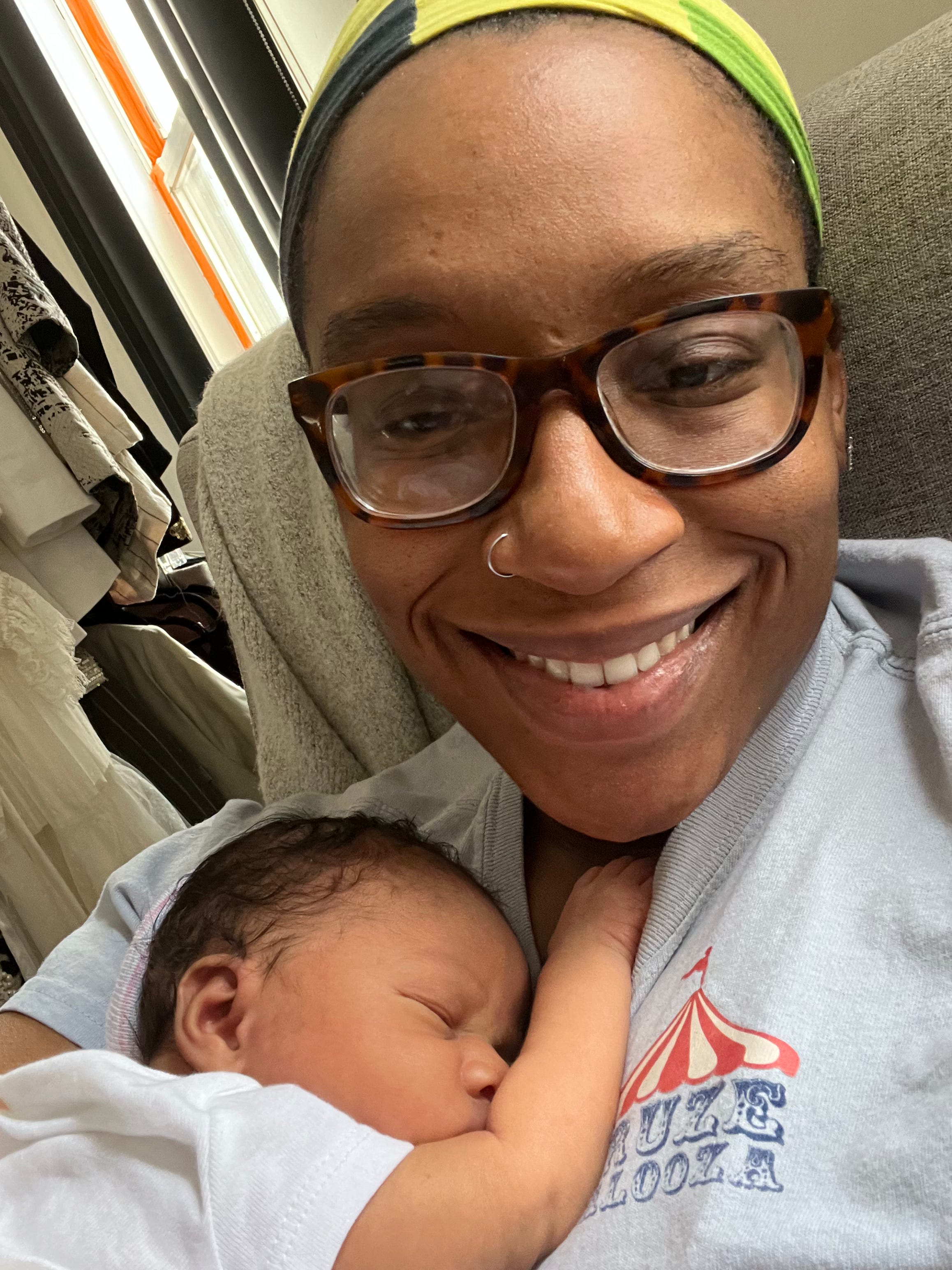
Me in the early postpartum days, smiling in the picture, but definitely running on exhaustion behind the scenes.
I want to tell you something a little embarrassing.
I spent 16 years caring for the most vulnerable infants in existence before I had my own baby. I had opinions. Strong ones. About sleep. About holding. About what parents should and shouldn’t do.
And then I came home with my son.
Here’s what the AHEAD Method™ and my own son corrected for me.
I grew up hearing this. A lot of us did, it’s deeply cultural, and I’m not here to shame anyone who still believes it. But developmentally and clinically, it doesn’t hold up. Newborns are not capable of manipulation. They are not testing you. They are regulating through contact. Holding is biology, not indulgence.
Before I became a mom, I thought I believed in sleep training. It’s easy to have opinions about things you’ve never actually experienced. The moment I was in it holding my son, reading his cues, watching him communicate the only way he knew how I knew it wasn’t for me. What I did instead was work ahead of his needs so the nights ran smoother without either of us having to cry it out. That’s a different approach entirely.
It did not. I stared at my son the entire first night in complete disbelief that I had a newborn. On the car ride home I thought there are no leads. No telemetry. No ICU. It’s just me and my instincts. So I did what I knew: feed, change diaper, wash hands. That was my framework. And it was enough.
My milk came in the moment I walked through the door and I panicked. I called a friend and colleague who is lactation certified and she talked me through it. And then I spent weeks triple feeding ;nursing my son, pumping immediately after, then offering him what I pumped; what we do in the NICU with some premature babies. All I needed to do was feed on demand. My clinician hat was nowhere to be found. I was just a new mom trying to figure it out.
I started on day one. Not a schedule, a rhythm. Feed, change, the same morning sequence in the bathroom, the same pre-sleep environment. Predictability from the beginning. By the time the six-week mark came around, we were already running smoothly because the foundation had been laid for weeks.
Crying is language. Once you learn to read it , really read it, you stop panicking and start responding. A hungry cry sounds different from an overtired cry. Overstimulated looks different from under-stimulated. This is learnable. And it changes everything about the newborn stage.
Sometimes. But more often, the signs come early and quietly before the cry, before the escalation. A yawn. A gaze that goes slightly unfocused. A slowing of movement. If you learn to catch those signals early, you’re responding before you ever reach crisis mode. That’s the whole premise of the AHEAD Method™.
The goal in the newborn stage is regulation, safety, and trust. Sleep evolves naturally when those three things are in place. Chasing “sleeping through the night” in week two sets you up for frustration. Building the foundation gets you there on a timeline that actually sticks.
These are not opposites. A consistent rhythm IS responsive parenting. When your baby knows what’s coming , when the environment is predictable, they spend less energy in distress and more energy developing. Rhythm and responsiveness work together.
Knowledge and confidence are not the same thing at 3am with a crying baby. What closes that gap is a framework, something that tells you what to do with the information you already have, in real time, when your brain is running on no sleep. That’s what Newborn Sleep Without Tears gives you.
Every one of those ten things shaped the framework I built. If any of them landed for you, the full system is inside the workshop.
Because your baby doesn’t need a perfect routine. They need a regulated parent with a plan.
With care,
Kelly-Ann MSN, APRN, CPNP
| Pediatric Nurse Practitioner | 16 Years in Pediatrics | 9 Years, Infant Cardiac ICU | Founder, CubConvos | Creator, AHEAD Method™
No posts
Comments
Nothing yet. Say the first thing.
Sign in to join the conversation.