
Hello Cuba on Record readers! I’m back from a bit of vacation by the sea, where I was graced with the opportunity to experience the eclipse from a small boat with my family. I hope that you’re having some special moments in your summer too, and some time to do some nothing.
Thanks to all of you who continue to support my work. And cheers to the people who who subscribed even while I was on break, and propelled Cuba on Record into the Top Ten of Substacks in Spain, and onto that “rising” music Substacks list. I appreciate it so very much.
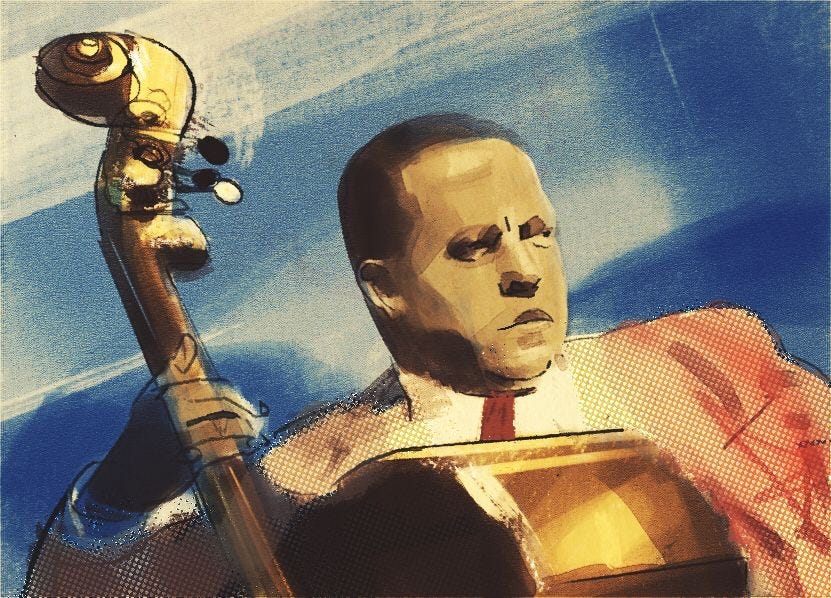
This week, while I’m getting back to work and sweating here in Barcelona, I’ll be sending out a few stories from my archive: An interview with Rosalia, pre global fame; a humble tribute to rock journalist Dave Marsh via Question Mark and the Mysterians, and first up, a profile of the mambo innovator and Latin jazz pioneer Israel López: Cachao. I’ve pulled that story of an unforgettable lunch with the influential bassist out again in response to a request from a reader, Verónica, whose Substack is called To Get to The Mango Tree.
This article was originally published in 2004, four years before Cachao’s death, in The Miami Herald’s cultural magazine Street Weekly, where I was a staff writer. We went to one of Cachao’s favorite restaurants, where I’m sure that as usual I ordered black beans with a side of tostones. I had pegged Cachao for a quiet man, but, as I discovered, among those who knew him he was a legendary raconteur, and at times a hilarious one. Here’s the story:
Israel Lopez -- the legendary ‘’Cachao’‘ -- will soon turn 86, and he likes to talk about the good old days, what he refers to as ‘’the romantic era,’‘ when music was played by orchestras, not computers, and strangers greeted each other on the street. Installed at a corner table at La Casita Restaurant on SW Eighth Street, his cane leaning on a nearby wall, the master of acoustic bass and composer famously known for devising the mambo with his older brother, Orestes, ignores the menu for an hour to talk about his new album and reprise some of his favorite anecdotes.
These all take place in the Havana of his youth, where every night promised yet another revolution in music, and where he can boast of having performed with 200 orchestras in all, playing danzón, waltz, tango, and even, once, while wearing a Mexican hat. Bringing to life the musical Camelot that was the Havana of the first half of the 20th century, Cachao describes the city in which so much innovative and enduring music was conjured as a mystical place populated by Americans, Chinese, Spaniards, Arabs, Jews, and the strong African men,``shiny black, with blue eyes and teeth so white they looked pink, who lived to be 115 years old.’‘
Comments
Nothing yet. Say the first thing.
Sign in to join the conversation.