
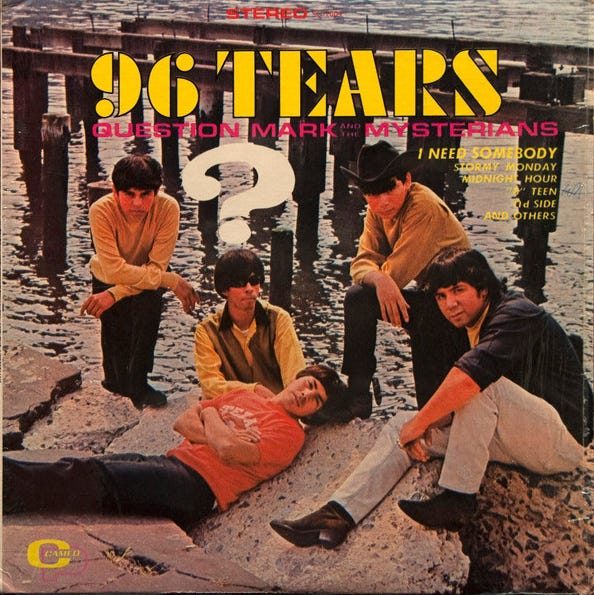
Note to readers: Before reading this story, I suggest that you listen to “96 Tears” (again) and watch The Question Mark and The Mysterians perform in this video below.
I never met Dave Marsh, but as a music journalist who came of age in the United States over the last half century, I had read articles and books that he wrote (most recently Louie Louie: The History and Mythology of the World's Most Famous Rock 'N' Roll Song,) and more often heard his name. Then I unexpectedly had the chance to interview him in 2021.
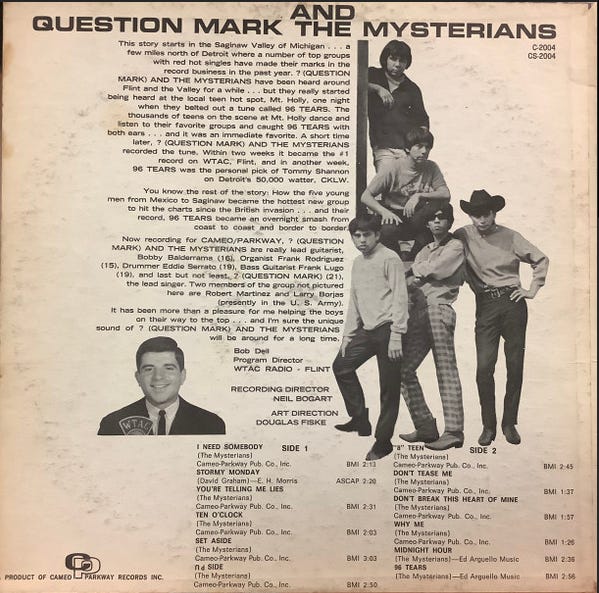
When he died two weeks ago, on August 14, at age 76, so many musicians and writers came out to honor him, sharing memories about his influential and even life-changing criticism and of his steadfast opinions of bands he disliked, and also of those he championed. One of those latter bands was Question Mark and The Mysterians, a group of Mexican-American teenagers from Michigan who suddenly found themselves appearing on American Bandstand and sharing concert stages with Roy Orbison and The Beach Boys when the 1966 recording of their song “96 Tears” became an international hit. It reached number one in the U.S. on the Billboard chart.
The members of the group were rapidly introduced to the disillusions of the recording industry and their opportunities just as quickly faded away. They disbanded after some of their members were drafted and went off to Vietnam, and in the case of frontman Question Mark (also spelled ?), traveled to other destinations of the mind.
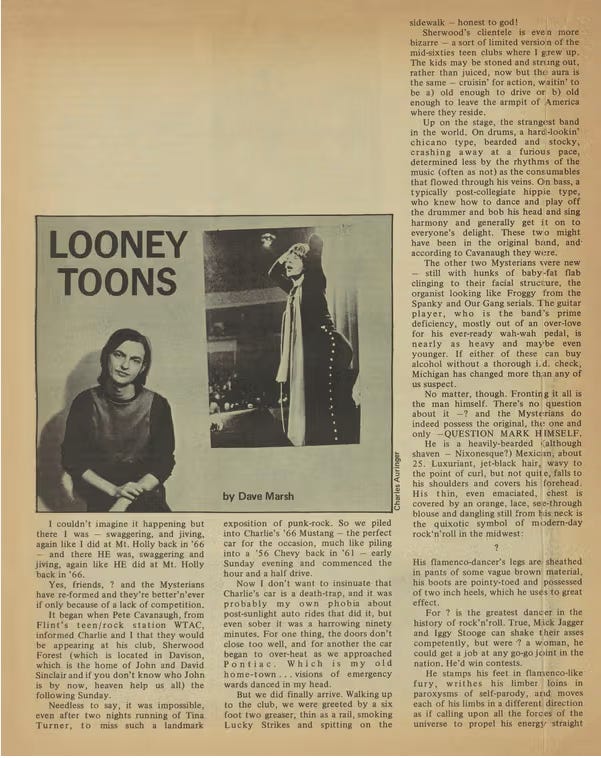
It was Dave Marsh who would ensure their legendary status in rock history far beyond the hit parade. Marsh had seen them perform during their brief heyday in the Sixties, and he had not forgotten it. As he now famously wrote in his column in a 1971 issue of Creem magazine, he was worn out after two nights of Tina Turner concerts, but still raced to see a reunion concert of Question Mark and the Mysterians that Spring. It was at a benefit for Creem at Sherwood Forest, a storied outdoor rock venue at an amusement park built on farmland near Davison, Michigan. Marsh would fatefully describe The Mysterians’ 30-minute set as a "landmark exposition of punk rock."
According to Marsh, as you can read below, that phrase did not attract much attention at first. But the music media, and social media, would later pick up on reports that Question Mark and The Mysterians, that group formed by the adolescent sons of Mexican migrant workers, was actually the first-ever punk band, or, more precisely, the first band described that way in print.
So that’s why I, with the generous help of someone who knew someone who knew someone, called Dave Marsh. And it had been a long time since I was that nervous about making a phone call. I was on deadline, writing a script for an episode of a podcast about the Latinos contribution to punk music. The idea was to get a couple of soundbites of Dave explaining why he had used the term punk rock to describe The Mysterians. Which he did:
“Because I was tired of people calling me a punk. A fucking punk,” he said, and started laughing, literally infectiously. I started laughing too. “It’s 100% of the reason.”
The rest of what he told me and the time he gave me to explain it was not so expected. My recorder was not working great, but I had to try and get clean tape, and I sat on the line in silence while he talked passionately about The Mysterians, and also about the influence of Latino music on rock and roll. Listening to him was a privilege. Read what he said below.
I had not thought that when I spoke to him on the phone about it more than 50 years later that Marsh would still pinpoint seeing a concert of Question Mark and the Mysterians, this band of marginal kids who hit a nerve in the 1960s and were quickly used and spit out by the record industry, as something that was, for him, “transforming.”
“Rock and roll was a monolith at that point I think, at least in terms of what it had to offer.” he said. “And they sort of cracked open the walls and said, well you could do this too. You can open some eyes wide. And they did.”
The parents of the members of The Mysterians were migrant workers who had settled into jobs at the General Motors factory . The story, as told to me by Mysterians’ guitarist Robert Lee “Bobby” Balderrama, whose father was able to buy a farm outside of Bay City on his factory wages, was a very American story. Or what used to be a very American story. Bobby was only 12 years old when he co-founded the band.
“I saw the clothes they were wearing and I knew those clothes because my father worked on the railroad, my grandfather worked on the railroad, and I had relatives all over central Michigan that were in farming,” Marsh said, recalling seeing the band for the first time. “I knew who those people were, I could tell by the way they dressed and the way they talked.”
“His flamenco-dancer’s legs are sheathed in pants of some vague brown material, his boots are pointy-toed and possessed of two-inch heels, which he uses to great effect. For ? is the greatest dancer in the history of rock’n’roll. True, Mick Jagger and Iggy Stooge can shake their asses competently, but were ? a woman, he could get a job at any go-go joint in the nation. He’d win contests.” Dave Marsh, in his review of the Question Mark and the Mysterians concert. Dave Marsh writing in Creem, May 1971
“You could open some eyes wide, and they did. And through the bits of contact that I had with them afterwards, I don’t think they knew exactly what they were doing, but The Beatles didn’t know exactly what they were doing for Christ’s sake. They understood that they had a grip on people in a deeper way then they had imagined having. I think. And then from the listeners’ point of view of what they were delivering was a package that was primed to confuse us with. And from that springs many things.
I don’t know if the MC5 would agree with me about this, I don’t know that Iggy would even agree with me about this, but I would say that those two bands are examples of what happened when that thing got cut loose with full power. That wasn’t what they were trying for it was just what they were. So for me it was transforming.
I don’t think I could have imagined it, because it was bigger than anything else I had ever experienced. The Beatles, but the Beatles weren’t real in that way…That was all a different kind of magic.
This was the magic of reality, and therefore it was possibility for many other people, many of them musicians but not exclusive to musicians.
…I’ve never seen any reason that this was wrong. Because it happened. There’s no other explanation for it.
I was that fanatic. Everyone [at Creem] was a fanatic, but [Question Mark and The Mysterians] was my particular fanaticism. I think everybody picked it up to some degree because the record really was that good and it really was 100% having that effect. And partly because it was a great gig.
Slowly people began to adopt [the phrase punk rock] from time to time if they had read that edition of Creem or if they had it read to them or it tumbled across their desk or their living room or something. That’s what I remember. I don’t think there was any upsurge in sales of the magazines or anything else. I don’t think there was any structure to it or anything else. Because the only people who were pushing this thing were the people at Creem, and there weren’t very many of us. And only one of us was pushing very hard. And not all of us even then were pushing in the same direction.
This is the purest example I can think of, and I don’t care if it isn’t black and white, of how that process works in real life in popular culture, and there’s never been a better one since, or before either.
That’s what happened, and it happened. And it happened at a degree several times smaller than it sounds like when you put it on paper. But that’s the nature of putting things on paper, and that’s not any falsification of what happened, or a slighting a of “96 Tears.”
The other thing is, and you have to admit this, that there is something in American popular culture that expresses itself in rock and roll…One of the more prominent ones is the influence of Latino music.
And that was very real. And people have written about that and I don’t think that they take “96 Tears” into consideration that much which is too bad, but that’s part of what it was, too. Because the walls were coming a tumbling down. Even if Joshua was late to the party. The situation demanded a response, and the response demanded a tool that could signify and express, not the new order of things, not anything like that, I’m not a Fascist, but the new possibility, the new dreams, the new hope. And that was damn sure happening. And it’s not outside of The Beatles and not inside of The Beatles. That was its own thing that touches on those things. And it touches on them in a productive way.
And it forces people to think about certain things that they don’t want to think about which is always helpful, in a broad sense. That’s just what I think. But I don’t think its just what i think.
I don’t think it was that alien. The separation that was enforced in those days and any means of racial segregation and cultural segregation, that was a different matter, but even then, it doesn’t have to make a great sea change I don’t think to get there. But I think it takes a certain kind of power that has to come from the audience as much or more than it does as the people who made the music.
“I didn’t know what punk was. Punk was something I said one day, and then a bunch of other people decided it was a movement or a style or something.” Dave Marsh
The people who were making the music were making the most exciting music that they understood how to make, and they were doing a damn good job too if you ask me.
It’s kids who are sort of, some of them [were] embracing it because it sort of nulls out whats left of the square parts of popular music after the rock-n-roll British invasion. And some of it’s a new feeling. I don’t see where else that could have come from except for that chicano influence.
That was really coming from, if you think about it, and you really study the popular records, in that period of time in the Southwestern part of the United States. that was there. I think one of the things that happened was, and I know it happened to me, was that there was a heritage there that I had never been exposed to.
So that’s what I’ve thought about for 40 or 50 years. I don’t want to start a war over whether I’m was right or not.
[“96 Tears”] was the new plus the old, plus the possible. That’s what it is. It’s alive. And it’s not supposed to be alive. It’s supposed to be dead. And I can see some DJ or radio programmer or writer or band standing there stamping on the damn record and saying ‘what do I have to do to kill you?’ And “96 Tears” just looks up and them and laughs.
And where I get that kind of image, that’s what I learned from Iggy. And Iggy’s records laid that out very clearly. Well not very clearly to everybody. But if you know how to appreciate them, it has a path that can lead in that direction. And that’s disruptive.
I didn’t know what punk was. Punk was something I said one day, and then a bunch of other people decided it was a movement or a style or something. I can’t tell you that because that’s something that was made by other people. That wasn’t made by me. And I don’t think it was made by Question Mark and the Mysterians either.
I mean it was something that was a handle. And we needed a handle. I’m not ashamed of what became of it or anything, but I would say that the notion that everybody who was involved in that process saw it as a fine occasion to be silly and sneer, that I’ve always resented.
Thinking they were better than “96 Tears.” That grave I spit on.”
Dave Marsh, as told to Judy Cantor-Navas.
*There have been many tributes to Dave Marsh on Substack, and many from writers who did know him, for example HERE and HERE and HERE. Alex Williams wrote his obituary in the NY Times, HERE.
*For the story of Question Mark and The Mysterians and how they made “96 Tears” (originally called “69 Tears,” because the adolescent band members found that name hilarious), and its aftermath, listen to Episode One of the podcast Punk in Translation. You can find it on Audible, or if you are not subscribed to Audible, get it through Amazon.
*I also recommend reading the Michigan Legends Rock and Roll Hall of Fame blog by Gary Johnson (Dr. J) for an authoritative and entertaining profile of Question Mark and The Mysterians with all the details of their story. It’s HERE.
Further reading and listening:
Los Saicos: Peru's Punk Primal Scream. An Interview With Erwin Flores
·
May 5
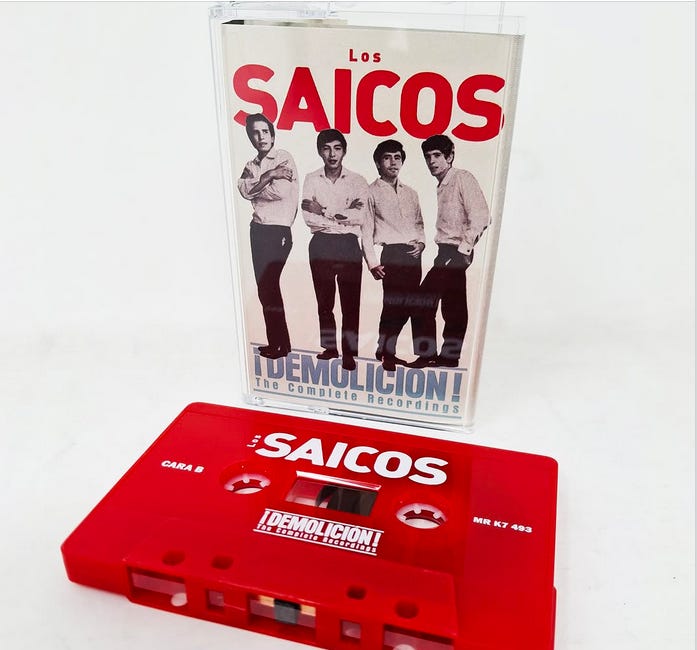
The complete recordings of the Peruvian band Los Saicos is now out on cassette. Madrid’s Munster Records has also re-released CD and vinyl versions of the 12 original singles of the group that has been called the original punk rockers, recorded during their short-lived run in 1965 and 1966, years when they were mobbed by fans on the streets of Lima.
Celia Cruz is a Rock & Roll Hall of Fame Inductee
·
Apr 19
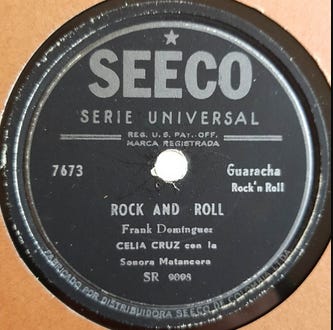
Celia Cruz is a 2026 Rock & Roll Hall of Fame Inductee. In the “Early Influence” category. That makes more sense than you might think. And it’s not just because the Fania All Stars, the New York City group she performed with in the 1970s, were undeniably rock stars of their place and time.
Round Trip: Cha-Cha-Chá and Rock-and-Roll
·
Apr 20
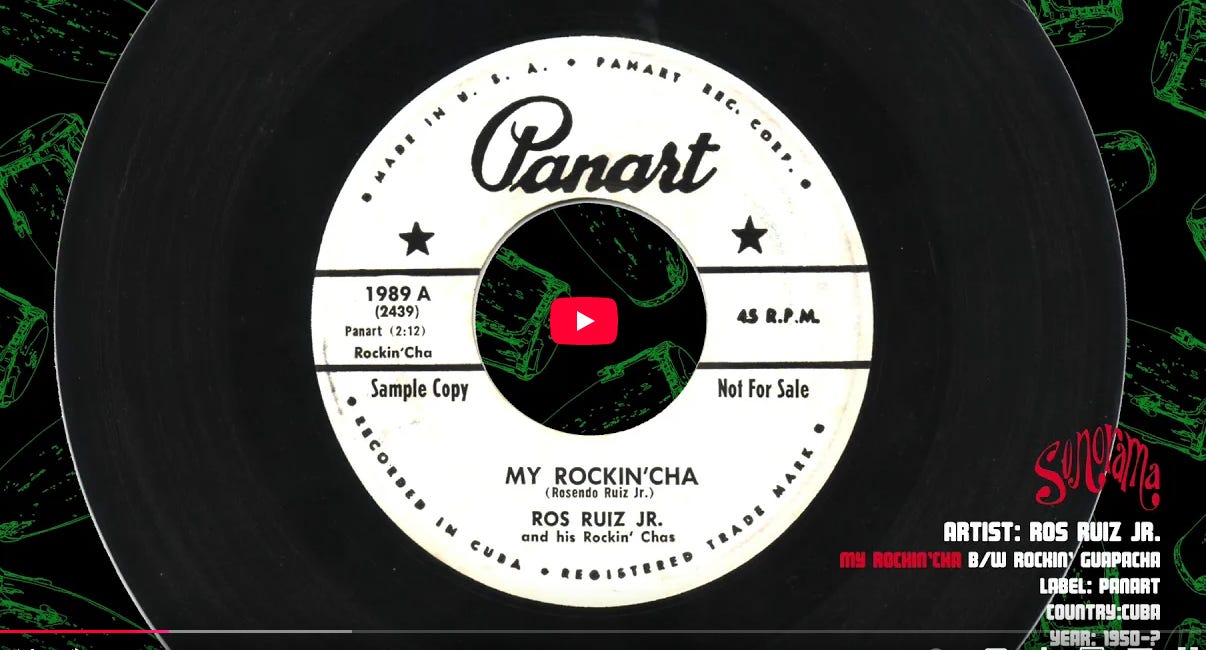
The sound of the cha-cha-chá invaded the United States in 1953, after the first single featuring the catchy rhythm, Enrique Jorrín’s “La Engañadora,” was recorded in Panart’s studio. Soon rock-and-roll infiltrated Cuban radio on songs by Elvis Presely and Bill Haley. The effect that the two modern sounds had on each other came fast.
Comments
Nothing yet. Say the first thing.
Sign in to join the conversation.