
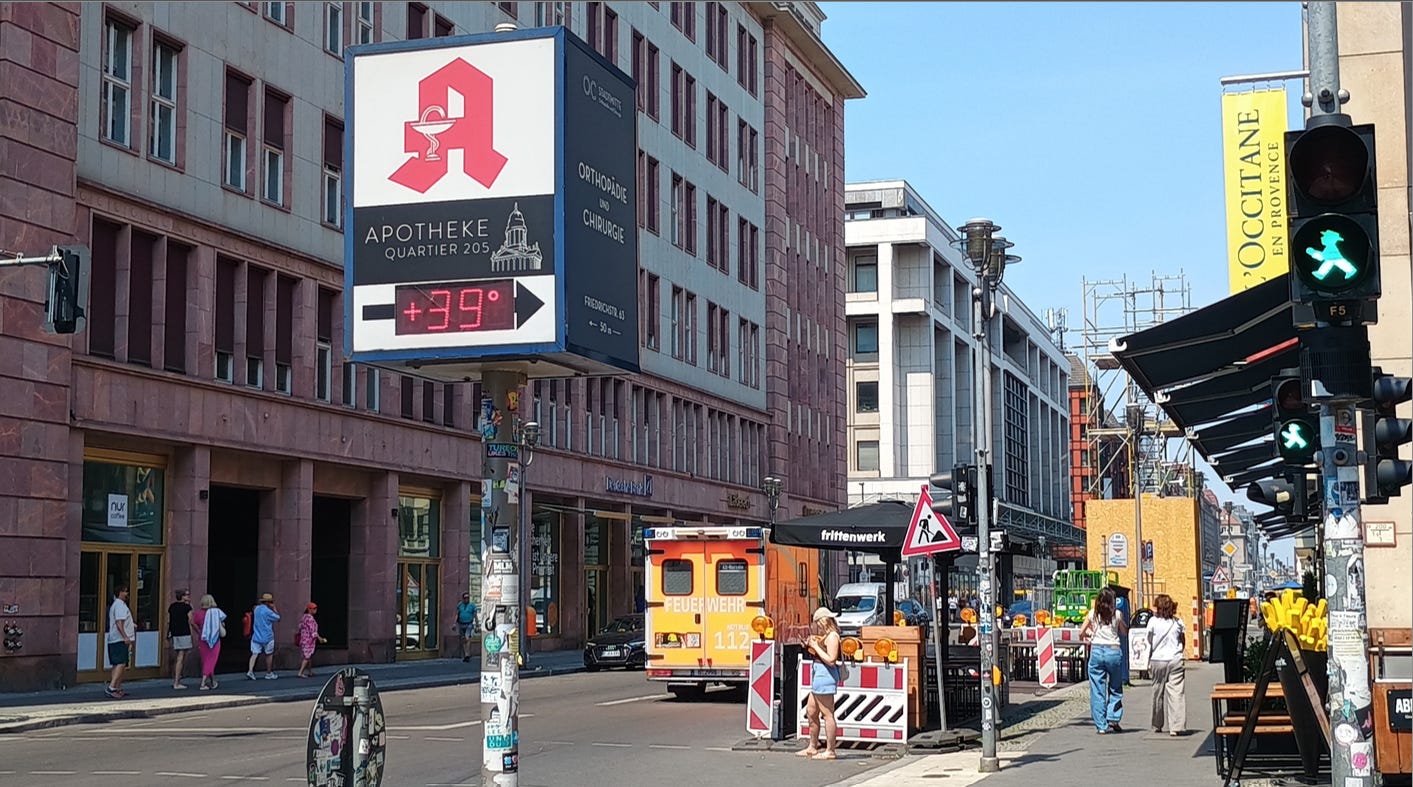
The impact of climate change on human societies became horrifyingly evident this week in a way that dry temperature statistics cannot convey.
A heatwave left more than 10,000 people dead across Europe. Ugandan families are facing starvation as crops fail. Saltwater creeps into farmland in The Gambia as sea levels rise and drought-induced evaporation increases soil salinity. Indigenous communities in the Amazon risk losing not only forests, but languages, traditions, and generations of knowledge tied to them.
Amid these sobering realities, hope continues to emerge. Engineers are building technologies that pull carbon from the air. Scientists are uncovering how forests naturally defend our climate. Every breakthrough reminds us that solutions exist, but the runway for these breakthroughs to take off is shortening.
This edition explores both sides of today’s climate story: the remarkable ingenuity that could shape a more resilient future, and the growing human consequences that make acting on those solutions more urgent than ever.
Thanks for reading Climate Tech Venture Review! This post is public so feel free to share it.
“Supported by grants from Toyota, the University of Illinois’s Campus Research Board, and its Grainger College of Engineering, this research represents a pioneering step towards scalable electrochemical direct air capture. It opens avenues for novel materials and process engineering to tackle the persistent legacy of atmospheric carbon that conventional emission reductions alone cannot resolve.” (Bioengineer.org)
“Climate projections indicate that the Amazon region will experience rising temperatures and more frequent heat extremes in the coming decades. The new findings suggest that this could alter how trees allocate carbon, i.e., the amount and type of compounds they release into the atmosphere. Since these emissions influence atmospheric reactivity, aerosol formation, cloud development and carbon cycling, even minor changes in emission patterns could affect climate processes on regional and potentially global scales.” (Phys.org)
See also: The Forests Are Burning—and so is Our Climate Buffer
During the extreme weather, natural forests proved more resilient in the short term. They suffered less damage from the drought and heat wave, with more than 70% of areas analyzed showing that natural forests were better able to withstand the conditions. Planted forests, by contrast, are often made up of fewer species and trees of similar ages. This simpler structure can make them more vulnerable to extreme conditions because they respond to stress in the same way. (Phys.org)
“By focusing on plants used by humans, the researchers were able to combine the effects of species loss with language extinction in the Amazon. When a plant species goes extinct, its Indigenous name, uses and benefits are lost as well, along with knowledge of its role in the rainforest ecosystem. As a result, the valuable body of knowledge about the world’s richest flora, which also helps shape cultural identity, is gradually disappearing.” (Phys.org)
“As the area gets hotter and drier, Santa Cruz could see median household water bills nearly double to as much as $120 a month from $64 by 2050, according to new research published in Nature Sustainability on Wednesday.” (Bloomberg)
“It is by now fairly well-known that datacentres use huge amounts of energy and water. Datacentres in Australia are expected to triple our consumption of both by 2030. At a time when our best answer to the climate crisis is to electrify as fast as possible using renewable energy and storage, allowing these energy vampires to strain grids could slow the transition to net zero emissions – and add to energy costs for everyday consumers.” (The Guardian)
See also: AI’s Hidden Water Footprint
There is a new El Niño out there and it was officially declared already on June 11 by NOAA. This is both unusually early in the year and very soon since the last El Niño in 2023-24. Another remarkable thing is the seasonal forecasts, which for a couple of months have indicated that it may well be at strengths by the end of the year that we have not seen before. All these three aspects combined seem to make this El Niño different to the previous ones. (RealClimate)
“Figures released by EuroMOMO, a mortality monitoring network backed by the European Centre for Disease Prevention and Control (ECDC) and the World Health Organization (WHO), showed 10,650 excess deaths were recorded during the week of June 22 to June 28, when the heatwave peaked across France, Spain, Britain and several other countries.Of these, more than 9,000 deaths were among people aged 65 and above, highlighting the severe impact of extreme heat on older populations.“ (The Times of India)
“Experts warn the region’s recurring shortages are caused by climate change, poor rainfall, deforestation, overgrazing and crop pests. Together, they leave communities increasingly vulnerable to hunger. Prime Minister Robinah Nabbanja says thousands of families have been left without food as the dry spell has destroyed crops, and her office is to seek cabinet approval on Monday to buy more supplies for affected areas. The government says it has started distributing emergency food aid.” (BBC News)
“The little nation of Gambia is on the front lines of a global struggle with salt, as a combination of climate change and human activities push ocean waters further inland, threatening ecosystems, aquifers and agriculture. Most of the salt intrusion is taking place along coastlines and deltas, where rising sea levels send saline water flooding ashore, seeping underground and changing the chemistry of nearby land. Droughts increase salinity too, since there is less rainfall to dilute the salt or flush it out. Both phenomena are expected to worsen with global warming.” (Inside Climate News)
“The death toll from last week’s devastating wildfire in Spain’s southern province of Almeria reached 13 after a 93-year-old British woman died from burns on Sunday, with 10 people still missing as of Monday, according to authorities. Visiting Almeria on Monday, Prime Minister Pedro Sanchez called to reinforce fire prevention in the country. But the impact of the summer scorchers could be more grim. Scientists monitoring so-called excess deaths said there were thousands more fatalities recorded than normal during a heatwave that swept through Europe and Britain at the end of June.” (Reuters)
See also: California Wildfires Are A Wake-Up Call For Climate Change Adaptation and Climate Change is no Longer Redrawing the Future--It’s Redrawing the Present
Thanks for reading Climate Tech Venture Review! This post is public so feel free to share it.
No posts
Comments
Nothing yet. Say the first thing.
Sign in to join the conversation.