
Three apps. A confused AI, a wrongful ban, a bad afternoon. None of them came from a brainstorm. Each came from a moment I could have discarded and chose to study. But first, a casual reminder that this month’s event is happening this weekend. It’ll begin with a fireside chat to kick things off, this month with Joel Telling, the 3D Printing Nerd (who has been vibe coding up a storm).
A few weeks ago Gemini misread something I asked and started spitting out words from no language on Earth. Fluent, confident, and completely invented. The sane move was to fix my prompt and keep going.
I read the gibberish instead and thought: what if that’s the product?
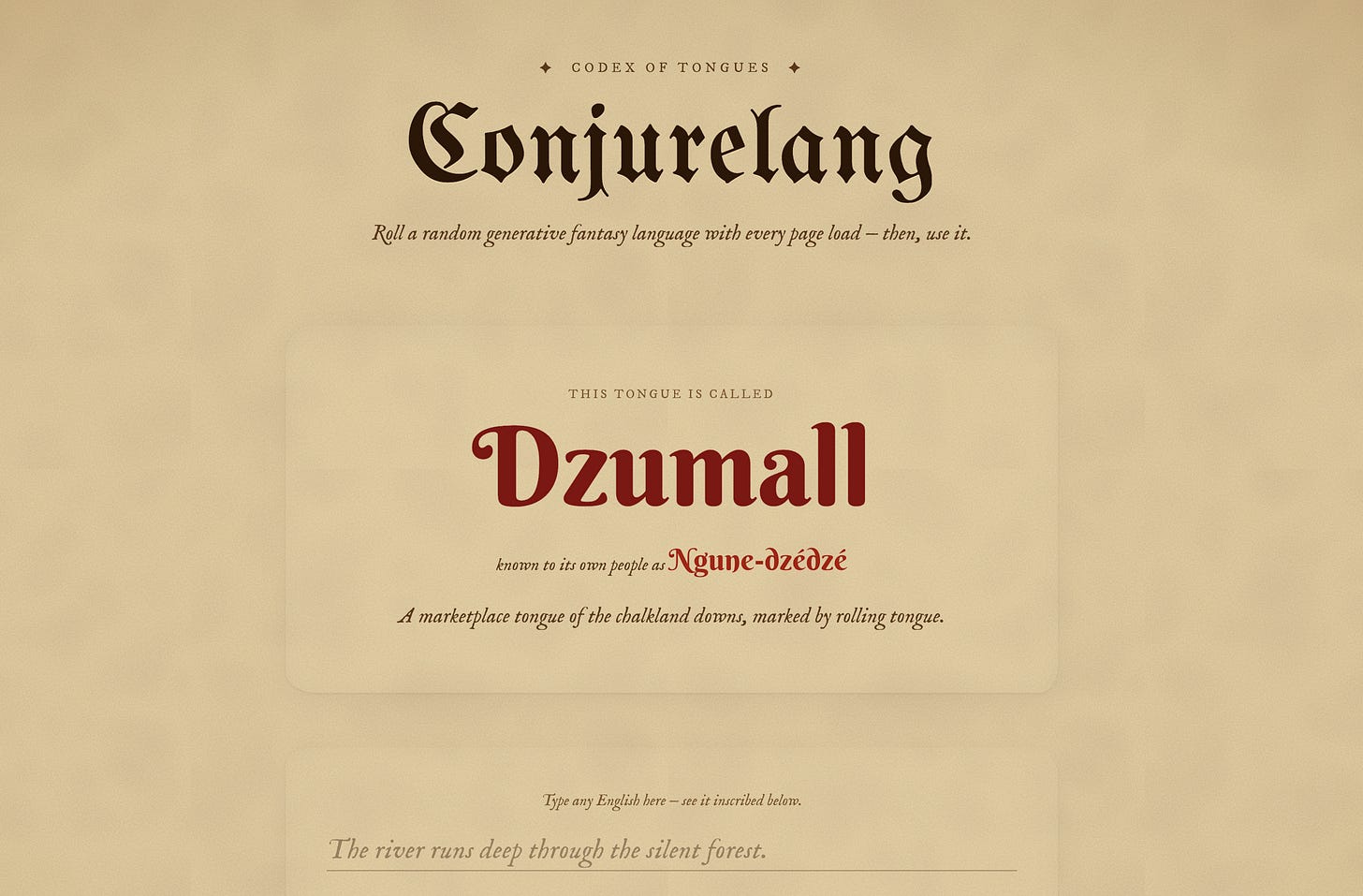
That question became Conjurelang, which invents whole fantasy languages with real phonology, grammar, and a 2,500-word lexicon you can type English into and watch render live. It’s a free alternative to Vulgar, which charges for the orthography I give away. The app exists because a machine fumbled a request in a way I decided to take seriously.
I keep doing this, and almost nobody treats it as a skill you can learn. So let me make the case that it is one.
Broken things come at you all day. A tool misfires. A platform locks you out. An export lands at the wrong size. A search for something simple returns ten pages of garbage. Most people feel the irritation, fix it or route around it, and forget the whole thing by lunch.
That irritation is data. It’s a product brief someone already wrote and stapled to your forehead, and you keep throwing it away because you were trained your whole life to clean up the mess rather than study it.
When Gemini babbled, the babble was a working demo of something I’d never seen pulled off well. Live, fluent, invented language, generating in real time. The hardest part of the app already existed. My only job was to quit treating it as an error and start treating it as a spec.
I’m not handing you a poster about embracing failure. I don’t care about failure in the abstract, and the people who turn it into wall art mostly haven’t shipped anything. The useful version is narrower. The broken thing in front of you is often a prototype of something nobody thought to ask for, and the whole game is catching it in the half-second before you reflexively fix it and erase the evidence.
Think about how much friction runs through your hands in a day. Each snag is a tiny research interview the universe is running on your behalf, free of charge, with you as the test subject. You felt exactly where it hurt. You know what you wanted to happen instead. That’s better grounded than most of the user research companies pay for, and you delete it daily because getting past the friction felt like the point.
Conjurelang came from a machine’s mistake. The next one came from a human one, aimed at me.
Facebook suspended my personal account. No reason given, no human to reach, the same wall every locked-out person slams into. Support loops that loop. Canned replies that never read the actual problem. The slow understanding that there is no door and no one behind it. I got the account back eventually, through a Washington State Attorney General action, which most people don’t know is even an option.
Somewhere in the middle of that I stopped writing “how do I get my account back” and started writing “why is this impossible for everyone, and what would help.” Those are different notes. The first one you solve once and forget. The second one you can build for. It became Signal Flare, which helps people stuck in exactly that loop after a hijack, ban, or lockout. It walks you through organizing what happened, setting realistic expectations for recovery, and preparing the documentation you need to escalate past the bots.
I almost missed it. For the first stretch I treated my lockout as my private emergency, something to resolve and bury. The switch from victim to builder flipped the moment I asked whether the thing happening to me was happening to other people too. It nearly always is. Your worst afternoon is somebody else’s Tuesday, every Tuesday, and being the person who can build means you get to turn yours into their way out.
I went to grab a header image for my LinkedIn profile. Trivial task. I searched for a free tool to crop and resize an image to the dimensions LinkedIn wants, and every option was miserable. Cluttered, slow, half of them demanding an account, none of them willing to let me drop an image and get the right size back out. I sat there getting annoyed, and the annoyance did its trick and flipped into the only question that matters: is this a brief?
It is. The reason my header was a pain to size is the reason every free image resizer is awful, which means the tool I built out of that afternoon was never really about me. It’s about a problem a lot of people hit over and over that nobody bothered to solve cleanly. I didn’t invent the need or run a survey. I lived the need in real time while irritated, and the irritation handed me the spec. One image in, every platform’s correct size out, no account, no upload anxiety. That became Profile Studio, which shipped today. The bad afternoon did the product work. I’m the guy who wrote it down.
You can do this. It’s a practice, not a knack you’re born with, and it’s more learnable than most of what goes into building.
Keep a friction log. When something breaks or annoys you for the second time, write one line about it before you fix it or move on. Don’t rate it. Don’t ask whether it’s a good idea yet. Capture the friction while it’s hot, because the friction log only works if the entry comes before the fix. Once you’ve solved the problem, your brain files it under done and the idea evaporates. Most entries die in the log and that’s fine. You’re not collecting ideas, you’re building the reflex of catching the signal instead of trashing it.
When a tool does something strange, screenshot it before you correct it. The strange output is the demo. Gemini’s gibberish was the entire concept of Conjurelang sitting on my screen, and a reflexive re-prompt would have deleted it before I knew it was there. The fix erases the evidence, so grab the evidence first.
Watch for the second time it happens. One bad experience might be you having an off day. The same snag twice means the friction is built into how the thing works, which means everyone who touches it hits the same wall. The repeat is your confirmation that the brief is real and has a crowd behind it.
Then ask the one question: is the broken thing the product? The answer is often no, and you move on having spent ten seconds. But you have to ask every time, because asking costs nothing and not asking costs you the thing that showed up for free while everyone else walked past it. Ten seconds against an app that wouldn’t exist otherwise is the best trade in building.
The shift underneath all of this took me years. Most people treat friction as an interruption to the real work. I’ve trained myself to treat it as the real work, because the annoyance has been a more reliable source of things worth building than planning, market research, or my own taste, and my taste is wrong about my best ideas more than it’s right. (More on that in this issue’s companion CPU newsletter, where I cut the Conjurelang feature I loved most.)
Conjurelang invents complete fantasy languages, sound system and grammar and a 2,500-word vocabulary. Type plain English, watch it render. A free alternative to Vulgar, no signup, no limits.
Signal Flare helps you out of the support loop after a hijack, ban, or lockout. Organize what happened, set expectations, prepare the docs to escalate.
Driftopolis is a procedural 3D city visualizer and ambient screensaver, a generative skyline that never sleeps.
Typhoria is a 3D kinetic type generator with 40 modes, from sphere to helix to vortex, with image and video export. A free Space Type alternative.
Page Turner reads ePub and PDF books as real 3D books with Euler Elastica page-turn physics, and lets you dial the paper stiffness and fonts. A free alternative to DearFlip and FlipBuilder.
Wooly Willy rebuilds the 1955 magnetic drawing toy in your browser with real iron-filing physics. Upload any face, draw the hair and beard, save and share.
Profile Studio crops and resizes a profile picture or header for LinkedIn, Instagram, X, Facebook, YouTube, TikTok, Bluesky, Threads, and Pinterest, with batch download. The one I built this week out of pure annoyance.
Pre-register now. It starts at noon and will go to 3pm on-site in Seattle.
New to vibe coding? Start here: ctrlaltcreate.live/what-is-vibe-coding.html
Presented by Every, who may follow up with you after the event
Bring a friend, all ages welcome, bring your kids if they’ve got an imagination
Join the Discord between events: discord.gg/XRBTM8sAMX
Can’t make it in person? Register anyway and join us online for the chat
Google published an official AI optimization guide in May, and the headline finding embarrassed a lot of people who sell GEO as its own discipline. From Google’s side, it mostly isn’t one. Most generative-engine-optimization tactics do nothing for Google’s AI Overviews and AI Mode. I went back through my own SEO instructions and cut the tactics Google flatly debunked, including a scoring framework and a word-count target I’d been treating as gospel. Read it from the source rather than from a consultant. Here’s Google’s AI optimization guide. When the platform tells you what it wants, believe it over the people selling you a workaround. Feed that into your AI tool and have it help you build a skill you can rely upon for future builds.
The other one is a habit rather than a download, a skill I had to build because I kept getting burned by my own tools. When you direct AI to build things, the failure mode is speed. The AI gives you a fast, confident, wrong answer, you ship it, you catch it a turn later, and now you’re three rounds deep on what should have taken one.
The fix I landed on is a “pre-flight gate” skill that runs before any work starts: (1) Read the actual source file before editing it, never the summary in your head. (2) Pull facts like icon paths and pixel dimensions from a real source, never type them from memory. (3) Confirm the file actually saved where the other person can reach it before calling it done. (4) And post one visible line at the top saying what you read, so the person you’re working with can see you did the homework instead of trusting that you did.
You can build your own version(s) in less than an hour. The whole point is that consulting the ground truth feels slower and is faster, every single time.
A handful of open-source and local-first projects in the same spirit as the arcade, made by people who looked at an expensive tool and gave away the free version:
OpenReel edits video in your browser with AI subtitles, color grading, and 3D transforms. An open-source CapCut alternative, MIT licensed, nothing uploaded.
Modly turns a photo into a 3D model with AI running on your own GPU, then exports STL for printing. No cloud, no account.
OpenVox is local text-to-speech for Mac with voice cloning and audiobook generation across 600+ languages, for a one-time price instead of a subscription.
Tolaria is a local-first Markdown second brain with Git built in. Your notes stay as plain files you can always walk away with.
Lev is an AI co-founder that takes you from a rough idea to go-to-market plans, prospect lists, and product specs on an infinite canvas.
Audiblez turns ePub books into audiobooks with neural text-to-speech.
I notice the people who send me “you should build X” almost never build X themselves, and the gap isn’t skill anymore. It’s permission. They’re waiting to be sure the idea is good before they start, which is exactly backwards, because you find out if it’s good by building the ugly first version. Conjurelang’s first version was embarrassing. Ship the embarrassing one.
What broke for you this week, got fixed, and got forgotten? That’s the one I’d go dig back up.
Yours Digitally,
Comments
Nothing yet. Say the first thing.
Sign in to join the conversation.