
This Saturday I’m doing a fireside chat with Heather Jackson, CEO of Prom.dev, before we all build for a couple hours. You have to pre-register please.
Now, let me give you the TL;DR version of this entire editorial:
Don’t wait.
So now that I’ve given you the whole point of this newsletter, I suppose I have to spend the rest of it explaining what I mean?
Saturday afternoon my feed was raccoons. All of it, every third post, fan art of a little critter named Jimothy who’d been spotted in Ballard with what looks like short-spine syndrome, which bunches the vertebrae until the poor thing appears to have been folded in half by somebody who then forgot to unfold him. It started when Kiana Hall filmed him and asked the internet “what am I looking at”, followed by a balcony security cam clip on Reddit, and from there the thing went fully feral. Millions of views. An entire subreddit that will not stop. Tattoos, of a raccoon, on human skin, permanently. The Mariners put him in the Salmon Run. Somebody built him out of Lego. Somebody else painted him, auctioned the painting, and Amazon matched the winning bid to send the money to a food bank, which is a sentence I’d like you to sit with for a second.
My first idea was a tracker. Log every sighting, every meme, every new drawing as it lands, a sort of Jimothy dashboard. I got maybe an hour in before I killed it, because it wasn’t fun, and because what I’d built was a spreadsheet wearing a little raccoon hat. Nobody’s day gets better because of another dashboard.
What people wanted (what *I* wanted, if I’m being straight with you) was to be the raccoon for five minutes. The internet had already handed him a character arc: reluctant celebrity, hunted by people with phones, freezing in place and hoping the nice lady with the iPhone loses interest. He’s Frogger with anxiety. So I made that.
One short prompt got me something playable. Then I spent about a day pushing pixels around until it stopped being embarrassing, and by Sunday night there were four missions, all of them lifted from his actual life: raid the trash cans, cross the street to the park, sneak past the paparazzi, climb the tree to the den. Monday morning GeekWire wrote me up in a dedicated article. This week, I’m talking to KNKX about it on the radio. About a raccoon game. That I made over a weekend.
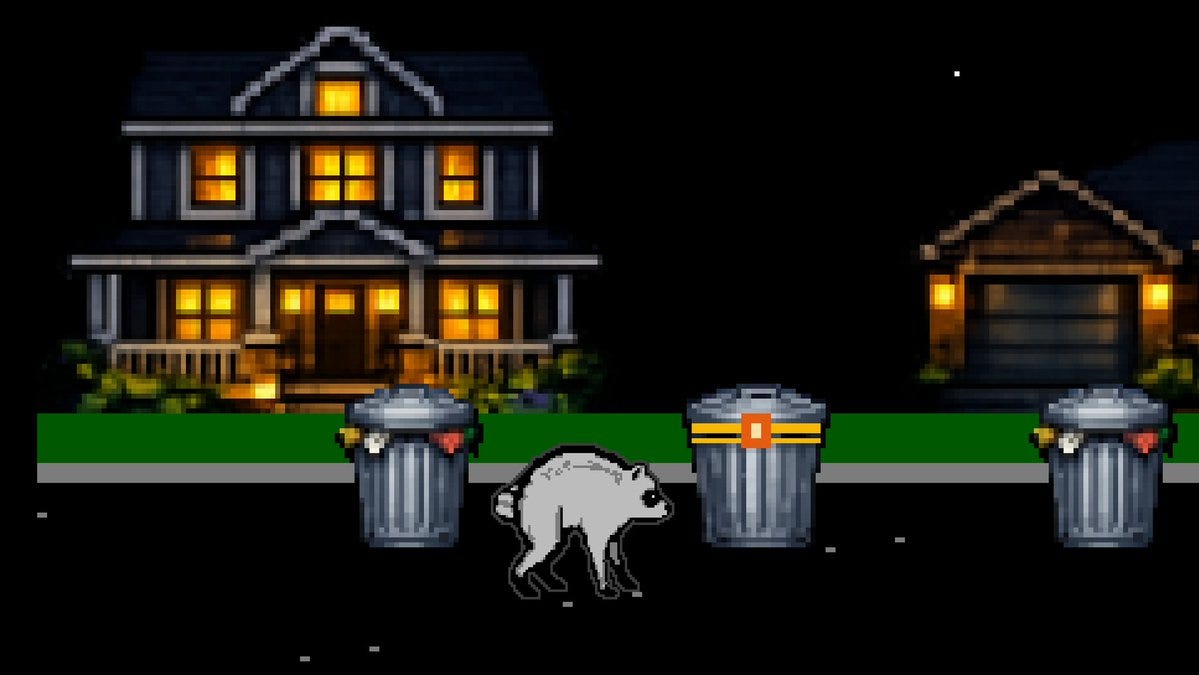
Fun weekend! But that’s not why I’m writing you.
I’ve been doing this since 1996, and for almost all of that time there was a joke everybody in tech media understood without anyone having to say it out loud: the internet moves in days, studios move in quarters, and never the twain shall meet. Some property would go hot. A publisher would notice about three weeks late. Then came the licensing, the greenlight, the staffing, the eighteen months of production, and finally a tie-in game would belly-flop into a world that had long since stopped caring. Everybody could see it happening. Nobody could fix it, because the pipeline was the pipeline and no amount of wanting made it shorter.
That gap is gone. Not narrower. Gone.
I’m not going to pretend I closed it through skill. The entire chain of specialists it used to take (an artist, a programmer, somebody for sound, somebody for QA, somebody to get the thing out the door) now fits inside one guy with a chat window who cannot write code, has never written code, and is not going to start now. That’s the whole trick. There isn’t a second trick.
And that’s exactly where I think most of the coverage about this stuff goes sideways, because “look how fast AI builds things” is not the story. It’s barely a fact worth reporting anymore. Everybody reading this has the same access I do. If speed were the differentiator your feed would be wall-to-wall wonderful little tie-in games for every passing moment, and instead your feed is mostly garbage, which brings me to the part I want to talk about.
Give a man a hammer and he can build you a cabinet with hand-cut dovetails, or he can nail two boards together sideways and tell you it’s a shelf. Nobody blames the hammer. Nobody writes think-pieces about the hammer crisis in American woodworking. We understand, in every other domain humans have ever worked in, that the tool sets the ceiling and the person sets the floor.
AI didn’t invent low effort. It made low effort faster, which feels like the same thing and isn’t.
So what separated this from the other forty raccoon games nobody made? Four things, and AI only handled one of them.
Speed, sure. Idea Saturday, playable Sunday, because the moment does not care about your calendar and will not hold the door.
Focus is where it gets less glamorous. I had something like fifty mission ideas and shipped four. Four! The other forty-six were fine. Some were better than fine at 3am, which is precisely the hour when your judgment files for divorce. Trash cans, streets, paparazzi, and the climb survived because each one maps onto something the real animal does, and everything that didn’t map got cut no matter how clever it felt while I was typing it.
Polish is the part nobody puts in the highlight reel and the part that ate ninety percent of the clock. The prompt got me a skeleton in maybe ten percent of the total time. The rest was a Sunday spent zoomed into a sprite sheet at 400%, hunting one wrong pixel like it owed me money, faking a walk cycle out of a single standing pose because that’s all the art I had, rebuilding the climb level’s physics from scratch after the first version cheerfully dropped Jimothy through the floor in an infinite loop, getting the freeze mechanic to hide you outright rather than slow down a meter (which is what it did at first, and it felt terrible, and I couldn’t have told you why for about an hour). None of that is fun to describe. All of it is the difference between a thing people share and a thing people close.
And then there’s the one I’d call wisdom if that didn’t sound so pleased with itself. Knowing the moment was worth building for at all. Knowing an NES frame would let his weird little body be the joke, where a slick modern mobile look would have sanded that right off. Knowing “dodge the paparazzi” lands as a mission because it is, unfortunately, his Tuesday.
Take any one of those away and you get something worse. AI hands you the first one on a plate and cannot hand you the other three, and it’s never going to, and I don’t think that’s a limitation so much as it’s the whole job description of the person in the chair.
Here’s my favorite part, because it’s the clearest evidence the tool wasn’t doing the thinking.
Getting Jimothy’s face right took longer than building the game.
I went to Gemini, to Grok, to ChatGPT, looking for reference art. Only ChatGPT went and researched who this raccoon is. The other two kept confidently handing me a perfectly normal, healthy-spined, structurally sound raccoon, which is a technically correct answer to “draw a raccoon” and a completely useless answer to the one I asked, since the entire reason ten million people care about this particular animal is that he doesn’t look like that.
Somewhere in hour six I posted a bit that got more traction than the game did for a while:
“AI can do anything!” “Anything?” “Okay, make this image with a transparent background.” “...” “...” “Well, almost anything.”
Every builder reading this nodded. The gap between “AI generates art” and “AI generates the exact art you need, in the format you need, without you hand-fixing it” is enormous and stays invisible until you’re the sucker standing in it. I ended up exporting the sheet at true 1:1, marking it up by hand, sending it back, decoding my own corrections into pixel data. Three hundred seventy-eight edits later we had a viable Jimothy. Then I caught one more in a screenshot, a single pixel where a 4x4 color block hit a perfect 8-to-8 tie and the decoder had to guess, and guessed wrong. One pixel. On his eye. Naturally.
I also ran a small bake-off on the game build itself, OpenAI’s GPT 5.6 against Anthropic’s Claude Fable 5. Both gave me something playable on the first pass; Fable was ahead by a good margin. Partway through, Anthropic auto-nerfed me down to Opus, presumably because a classifier somewhere decided a man building a game around a biological entity was up to something. (I was up to something. It was a raccoon.) In hindsight I should have thrown Moonshot’s new Kimi at it too, since it’s been getting real attention for exactly this kind of work, and I didn’t, and that’s on me.
None of which is a complaint. It’s the texture of the work right now: models differ, guardrails fire when they feel like it, and you route around both instead of standing there waiting for conditions to be perfect. They won’t be.
Before a single mission got built I went and read up on the actual animal, the actual condition, and the actual guidance about what people should do when a wild raccoon becomes a tourist attraction. That reading is where the mechanics came from. Freezing in place when you’re spotted isn’t a game design idea I had, it’s a thing he does. Climbing to somewhere high and safe to wait people out isn’t a level I invented, it’s Tuesday.
It’s also why the game says what it says on the way in:
“This game is as close as any of us should ever get to him. If you find yourself in his neighborhood: don’t go looking for him, don’t feed him, don’t try to touch him, and don’t crowd him for a photo.”
That’s maybe twenty minutes of reading, total. It’s also the difference between a character wearing Jimothy’s face and a thing people trust enough to hand to their kid. Skip it and everybody can tell, even when they can’t articulate what’s off.
If you’re sitting on an idea right now, here’s what I’d ask before you open a chat window, none of which is about prompting.
Is the moment still warm, or are you building for the version of it you noticed three weeks ago? Be honest. Moments cool fast and they don’t send a notification.
What would survive if you only had one evening? That list is your real product. The rest is stuff you think is cool, which isn’t the same thing and never has been.
What’s the part that makes somebody stop scrolling, and is it the part you’re excited to build or the part you’re avoiding? It’s usually the part you’re avoiding. That’s not a coincidence.
Who is this for, specifically, ideally by name? “Everyone” is not an audience. “Everyone” has never once been an audience.
Notice that a good editor would ask a writer all four of those about a pitch, and a good producer would ask a band the same about a set list. AI changed who’s allowed in the room. It didn’t change what the good answers sound like.
It’s never been easier to make something. It’s also never been harder to get one living human being to look at it.
Capability used to be the wall. Could you build it at all, on budget, before the money ran out. That wall came down, and what’s behind it turns out to be a much less fun wall, because attention doesn’t scale the way tooling does. More tools every month, same twenty-four hours in everybody’s day, same finite patience.
Marketing, stripped of the jargon, is showing up in the moment somebody’s ready for you. Jimothy shipped the same week Kiana Hall’s video and a Reddit balcony cam turned a Ballard raccoon into a regional folk hero, and because it shipped that week, Kurt Schlosser wrote it up at GeekWire and a public radio station called. Same game, same care, three weeks later, after everybody else has done their tribute and moved on? Portfolio piece. Nobody sees it. GeekWire covered a pre-rejection-letter generator I built out of pure job-search spite for the same reason, which is that it existed during the week people were feeling that exact thing.
So don’t wait for permission, because there’s nobody left to ask. You don’t need a green light, a budget, a co-founder, or a better laptop than the one you’ve got.
But (and my geeky friends, this is the whole ballgame) don’t confuse how fast you can go with being done. Getting a working build in five minutes doesn’t mean you’re finished in five minutes. The person who ships something forgettable on Sunday and the person who ships something that gets picked up on Monday are running identical tools. The difference is entirely what happened after the prompt stopped being useful, which is the exact moment most people stop.
Take your time. Sweat the stupid details nobody will consciously notice. Put your actual personality in it, because that’s the one input the model can’t fake and the one thing that makes a person forward it to a friend.
People are already asking for a real ROM to run on handheld hardware, which I didn’t see coming. Controller support is in there already. The browser turned out to be a far better platform for this than I gave it credit for, which is its own small lesson about assuming you know what your tools can’t do.
Anyway. That feed of raccoon art is still scrolling. There’s something in yours right now, too.
Don’t wait.
What: ctrl+alt+create live, the monthly hybrid vibe-coding workshop
When: Saturday, July 25, noon PT
Where: Foundations, 1605 Boylston Ave, Seattle, or streamed on YouTube and Twitch
Guest: Heather Jackson, CEO of Prom.dev, fireside chat before the build sprint
Cost: Free.
Bring: A charged laptop and whatever you’ve been sitting on
Register: Right now on Luma
Jimothy: did you miss the link before lol
Night Curtains: aurora borealis screensaver driven by real KP storm data
Retrowave Road: endless synthwave highway with a generative 80s soundtrack
Harmonia: circle of fifths that plays real four-part voice leading
Mandala Muse: kaleidoscope drawing studio, free alternative to Silk and Weavesilk
Live Wire: generative circuit-board screensaver and live wallpaper
Stained Glass: window generator with a real light and caustics engine
Tesselchet: 52 tileable Truchet, girih, and weave families, exports SVG and STL
CCAT Prep: practice trainer I built while prepping for my own interview
Astrostorm: Asteroids with power-ups, boss waves, and astronaut rescues
Paper Glider: paper airplane game, a tribute to Glider PRO
Glass Towers: 3D stacking balance game, free alternative to Stacktris
Living Aquarium: freshwater tank that aquascapes and cycles on its own
Reef Dive: pixel-art reef where every fish grows from a procedural genome
Pixel Rehab: pixel art fixer, free alternative to Pixel Snapper
Slack Man: Pac-Man in a Slack workspace, dodge Distractions, grab coffee
Brickmark: turns any word into a brick-style logo wordmark
Windchimes: wind chime instrument with 55 musical scales and breeze physics
BrickSaver: 3D brick screensaver you can capture as PNG, MP4, or GIF
Brick ASMR: infinite bin of physics bricks with real rummaging sound
Antique Typewriter: 3D typewriter with working typebars and key jams, free OverType alternative
Easy Invoices: invoice generator, no client limit, no watermark, no signup
Retrotube Television: 57 CRT, VHS, PAL and Super 8 emulations
Screencast Recorder: record, zoom, blur, caption, cut. Free Loom alternative.
ayghri’s i-have-adhd is a small MIT-licensed instruction set for shaping AI output when your attention is a scarce resource. It targets a real problem: the answer buried under four paragraphs of throat-clearing, the thread lost halfway through a long session, the estimate that says “some work” instead of a number. I built my own version with one change I’d argue for whether or not you have an attention problem, which is that it compresses packaging and never content. Brevity is a virtue right up until it starts eating the idea.
Moonshot’s Kimi. I keep hearing good things for exactly the kind of asset-and-code grind I described above, I didn’t get to it in time for the raccoon, and it’s first up next round. Yeah, I know it’s out of China… but…
None of this is about raccoons. These are the things from the rest of the month’s work that I keep turning over:
Pixel Rehab has a “rescue” mode meant to reconstruct damaged pixel art, and a plain dumb pixelate mode. I finally measured them against each other on the same sources. The clever one was getting about 20% of cells right. The dumb one was getting 51%. It had been shipping that way, losing to its own simpler sibling, and I had no idea, because it looked like it was doing something sophisticated. I now think a nontrivial amount of software everywhere is quietly worse than the naive version nobody bothered to compare it against.
I was fixing an image converter and found a “strip metadata” toggle that was wired to nothing at all. It moved, it lit up, it did nothing whatsoever. I put it there. I have no memory of deciding not to finish it. How many switches have you flipped in your life that were connected to nothing on the other end?
Microsoft open-sourced the original Comic Chat this month, thirty years after it shipped, complete with Jim Woodring’s character art. Software from 1996 got a second life because somebody at a company that has no commercial reason to care went and did the paperwork. There’s a whole category of thing we lost forever because nobody made that call, and no way to know what was in it.
I built a settings panel into one of my own apps and then, weeks later, went looking for that panel twice and couldn’t find it. In an app I designed. If the person who put the thing there can’t locate it, the answer is never a better label.
Spent a chunk of an afternoon tuning the acceleration curve on a racing game that felt like it was driving itself, before discovering there was no throttle in the code at all. Nothing to tune. I’d been adjusting the feel of a system that did not exist, and it kept sort of seeming to work, which is the part that unsettles me.
Yours Digitally,
Comments
Nothing yet. Say the first thing.
Sign in to join the conversation.