

The durable advantage in the AI race is cadence, not capacity: not the megawatts a site commands but the rate at which those megawatts convert to compute.
A frontier datacenter is closer to a living thing than a capital asset. The building lasts; the chips flow through it. The financial numbers that look like insolvency are the design.
Depreciating the majority of capex on a twelve-month cycle is deliberate accelerated consumption. In a metabolic systems sense, think of it as feed to grow the beast of intelligence.
The spending never pays back in return on capital. That is the price of a race its participants call existential, and their government now says the same in court. The distillation cycle means methods leak to China in months. The hardware refresh cycle does not leak at all. The rest of Western strategy is protection for that cycle.
The near-frontier silicon the cycle will discard by the millions of units each year in an efficient system is recycled either through redployment or harvested for its materials. And the intelligence the cycle produces is already aimed back at the cycle producing it.
If you want to win the AI race in a time of limited materiality supply, you churn hardware within that materiality to produce the maximum intelligence.
Cadence is the unique and durable advantage that cannot be stolen, only forfeited. In this existential race, the one metric that matters is watts-to-intelligence, maximising the critical foresight produced per unit of raw energy. This requires a form of industrial neuroplasticity, where the data centre, conceptually closer to an organism than a fixed capital asset, must physically replace its own functional ‘neurons’ on a looped annual cycle.
By metabolising a new generation of compute every twelve months, we achieve an organisational habit geopolitical rivals can’t copy. Algorithms leak, methods distil, and researchers change jobs, but nobody can carry off a place in the fab queue.
This cadence is a pure energy arbitrage, converting fixed grid capacity into intelligence, creating a self-accelerating, closed loop where the resulting insight is immediately aimed back at the process, shortening the next round of creation, and hurtling toward an escape velocity that redefines global power.
Five claims that support the argument ;
A frontier AI (DC) Data Centre is better conceptually modelled as an organism than as a capital asset: the building, power, cooling, and network persist, while the chips flow through it, the newest generation in one door, the last one out to lesser work. It’s the only path to adaptation when a transformer from Siemens or Hitachi might take 5-6 years from order to delivery.
A chip’s economic life runs five years or more; its frontier timeline or depreciation is calculated differently; the period in which it can train leading models runs about one year, and the race is run on frontier time.
You can see the NVDA and AMD product release cycles align to this rhythm.
Burry time is 3-4 years, economic life is maybe 5-6 years, and frontier time is maybe 12 months. These chips are passed like parcels through different metabolisms as they age, non-linear depreciation. Burry time is of course important but relevant to the secondary inference market.
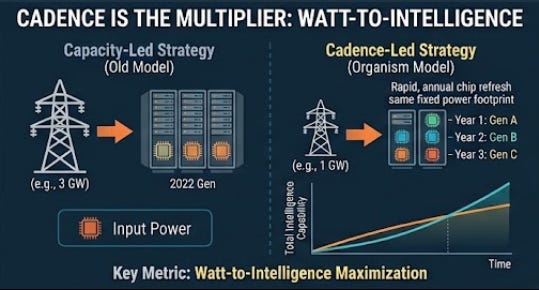
At fixed grid power, every gain in performance-per-watt converts directly into capability, so a site’s position is its capacity multiplied by its conversion rate: watts-to-intelligence.
Every leader grows capacity as fast as grids allow, but you play the cards you’re dealt; the durable difference between them is the rate at which fixed megawatts become current-generation compute.
In an energy- and materials-constrained world, that conversion rate is the quantity to maximise.
For NVIDIA. The generations run Hopper, Blackwell, Rubin, with Rubin Ultra due in 2027 and Feynman in 2028, one new generation every year. Each step is large. Blackwell delivered roughly 15 times the inference throughput of Hopper. Rubin, shipping now, produces ten times the inference throughput per watt of Blackwell and cuts the cost per token to one tenth.
Put plainly: a rack that replaced its Blackwell chips with Rubin chips this year makes ten times the tokens from the same electricity, one year later.
For AMD. The generations run MI300X (2023), MI325X, MI355X (2025), MI455X (this week), MI500 (2027). The claimed steps are larger still.
The MI355X delivered up to 35 times the inference performance of the MI300X. The new MI455X delivers up to 34 times the token throughput of the MI355X, at up to 18 times lower cost per token. And AMD says the MI500 will reach 1,000 times the AI performance of the 2023 chip, a thousandfold gain in four years.
The point to ponder here is that 95% of these performance gains haven’t reached us yet. Yet we have headlines telling us it’s all over because Kimi can do some very narrow tasks in AI benchmarking adequately.
Watts-to-intelligence need to be maximised in an energy- and capital-constrained world. IQ is a very imperfect way to rate AI, but for now, in 2026, it’s say 130-200; it will be in the 1000s by 2028. What we have seen so far is only a small part of what is to come.
I point this out to bring attention to where we are; a current open-weight model is 3 trillion parameters, in 3-4 years it is likely to be 100 trillion, yet we have folk resolving winners and losers already .
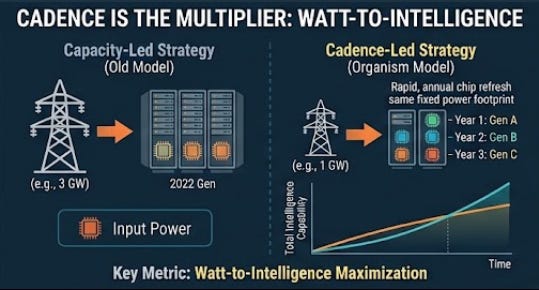
Burry’s thesis in its own terms: useful lives were stretched to five and six years while frontier replacement compressed toward one, so reported earnings overstate economics and the capex cannot be recovered on any disclosed revenue trajectory. The math is right: frontier-capable value decays within about a year, and on frontier time the schedules understate the loss.
Burry prices a metabolism as a building, and a survival race as a payback problem. My suggestion is we are in an existential cycle that is not a capital survival era. This isn’t dot.com; it’s the era of machine intelligence, not digital banner home pages.
The books survive because a depreciation schedule prices the whole earning ladder, not the top rung. Chips leave the frontier after a year and earn for years below it, training to inference to internal workloads, and so far inference demand has absorbed every retiring cohort.
They are fluidware, not hardware; shape matters when depreciating. My suspicion goes further: if the Limits to Growth hold us tighter, all things will have to last longer.
The frontier spend was never meant to clear at return on capital. The marginal buyers are sovereign participants maximising frontier capability in a race they call existential, and the state now says so in court: the Justice Department told a federal judge in June 2026 that the model trained at Memphis is one of only four frontier systems capable of supporting national-security applications.
That is litigation support for one operator, not appropriations for a sector, but it fixes the reference class: wartime production, not corporate capex. Cisco in 2000 was never a condition of national survival.
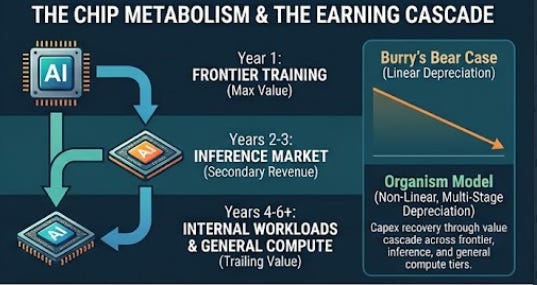
Capability at the frontier compounds as hardware refresh multiplies algorithmic improvement, and the race’s strategic character is the asymmetry between the terms: the second leaks by nature; the first can be sealed.
Methods leaked through papers while the labs still published. Since publishing stopped, around 2023, what travels is capability rather than recipe: open weights, distillation, researchers changing jobs, and it travels both ways: Western software advances reach China in months, and DeepSeek’s training innovations travelled west as fast. China, constrained on hardware, compounds the software term with total focus, on domestic accelerators one to two process generations behind, a slower metabolism, not a stopped one. F5 dates the gap.
Nobody can copy a place in the fab queue, carry off packaging capacity, or steal the habit of standing up a new generation every twelve months. None of the three is held as a stock: allocation is recontested every generation, packaging re-queued, the habit proved again or forfeited, so each is kept only while the cycle keeps turning. The sealed terms reduce to one the speed of the cycle.
The West’s one durable edge is that speed. Everything else in the strategy is protection for it. Jensen will always put someone at Elon at the head of the queue.
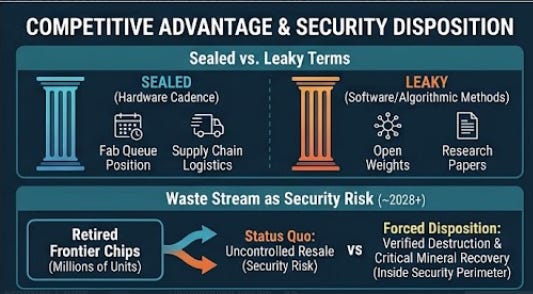
Every metabolism excretes (shits). The AI industry excretes near-frontier computing capability by the millions of units. Barely a year old, re-deployed or sold at scrap prices, these discarded chips hand incentives to scavenge them. That’s a description of a system that’s planned, not yet fully built.
For years, the West shipped this e-waste to China. No longer does that make sense.
Today, active recycling pipelines strip critical metals from old hardware to forge the new. The DoW and DoE are actively encouraging this pathway.
Currently, a cascading secondary market absorbs this silicon chip runoff.
Demand for inference eats every aged cohort in succession. Yet each new generation runs larger and burns hotter. When material shortages inevitably stall new data centre construction, aggressive recycling could become the industry’s only adaptation. Eventually, the volume of discarded chips outpaces market absorption; facilities will face three choices: resale outside the security perimeter (unlikely), repurposing to lower-inference DC, or recycling.
This is not a description of current practice; it’s a forecast with a logistics deadline that unfolds from the NVDA/ AMD release cadence. Their cadence forces everything that happens downstream. If you put stuff on one end of a system (with a delay ), it comes out the other.
Intelligence has been, until now, almost entirely biological. The metabolism that now produces it is fed from outside: megawatts for calories, silicon for neural tissue, water and cooling against the heat of its cognition, fibre and racking to lower the resistance that power and information meet. The alchemy of turning metal into intelligence.
The product is aimed back at the process. Models tune the kernels their successors will train with, refine the training recipes, and search the architecture space the next silicon is drawn from. The mechanism is on the record, not inferred: SpaceX’s sixty-billion-dollar purchase of Cursor bought the loop’s input pipeline, millions of developer interactions feeding the models that automate the next round of optimisation, a price that reads as conversion capacity rather than tooling.
Each completed cycle raises frontier capability; the higher capability shortens the next. A process that raises its own rate is what every other domain calls a takeoff. Escape velocity.
The industry has inverted its own unit of account and neglected to say so. The chip was the capital asset and the building its container; the design now runs the other way, the building is the durable good, the chip the consumable.
Product architecture announced it before any speech. NVIDIA and AMD have moved their architectures to an annual rhythm: Blackwell now, Rubin in full production since June 1, 2026, Rubin Ultra and Feynman behind it at one-year spacing, with the mid-cycle Ultra steps advancing memory and fibre interconnect inside each architecture. It then designed the Rubin racks as drop-in replacements for the Blackwell infrastructure already on data centre floors. A rack engineered for annual replacement inside an existing shell is the organism-made hardware. It’s the commonsense architectural reaction to restricted energy.
The rhythm dominates size at the margin because of the energy math. A frontier site’s binding constraint is not (just)capital or land; it is grid connection: the interconnection queue fixes a site’s megawatts years in advance, and no payment moves the date. The one workaround is generating behind the meter, which is what the turbines and batteries at xAI’s Colossus 2 are for.
Each generation delivers a multiple of the computation per watt, so refreshing at constant power converts directly into capability; not refreshing converts the same megawatts into a museum.
It follows that a smaller site on a faster cycle overtakes a larger one on a slower cycle. It’s Ferrari vs Ford leapfrogging.
At the factor-of-two gains F1 forecasts, a one-gigawatt annual site passes a three-gigawatt quadrennial site by its second refresh. The refresh is an energy arbitrage: intelligence per megawatt, compounding yearly.
None of this makes capacity irrelevant. The leaders add gigawatts as fast as grids and turbines allow; the organism grows as well as cycles. Cadence decides among rivals who can all raise capital, because megawatts and wafer allocation are queued years out and money alone does not move the queues. Though we know these traditional build directions are constrained, so it is unsurprising.
The organism model also predicts where the strategy gets hard, and the roadmap confirms it on schedule. Rubin Ultra-class racks arrive in 2027 at roughly five times today’s power density, demanding a different electrical spine and a different cooling plant; in that generation, the shell itself becomes the consumable and must be rebuilt around the new cells. The metabolism moults, and if the density curve holds, it moults every second refresh. Construction speed therefore becomes a core capability rather than a logistics detail, which is why xAI, which stood up a two-hundred-thousand-GPU site on Memphis industrial land in months, holds an advantage unrelated to balance-sheet size.
The strongest version of the AI bear case begins with a fact: accelerators are the majority of a frontier site’s capital cost. If the frontier fleet turns over annually, the five-to-six-year useful lives on the hyperscalers’ books look like fiction, reported earnings are inflated by understated depreciation, and the industry is spending capital at a pace no plausible revenue stream repays.
Michael Burry made this argument through late 2025, calling the extension of GPU depreciation schedules the accounting scandal of the cycle. He is right that a chip at the frontier loses most of its strategic value within a year.
His thesis misunderstands: economic life and frontier life are measured on different clocks. Chips from 2020 were still earning inference revenue in their sixth year, not stationary but migrating off the frontier after a year and working for years below it, cascading from training to inference to internal workloads. A depreciation schedule prices the whole ladder, not the top rung and has the insight that the ladder’s usage is variable.
The hyperscalers themselves split on where to draw the line: Amazon shortened useful lives in the same quarter Meta extended them. What the schedule cannot price is the top rung itself, the annual refresh, which NVIDIA sells at gross margins above seventy per cent.
At the frontier, return on capital is the wrong category because the operators are not suffering the write-down; they are running it. Depreciation at maximum speed is how the leader denies frontier position to every rival that thinks in payback periods. A rival who computes return on capital cannot stay in a race where the leader treats the majority of capex as a twelve-month consumable.
The reference class that fits is wartime production, not corporate capex: nobody computed the internal rate of return on the Manhattan Project, and nobody judged 1943 aircraft output by airframe depreciation policy. When participants call the race existential, in filings and testimony, not only on stages, the analytically serious are entitled to believe them and re-derive the economics from that premise. Races declared existential are clear at survival, not at return.
The scope of that premise showed itself in a courtroom. When environmental litigants challenged the unpermitted turbines powering Colossus 2, the Justice Department intervened on June 15, 2026, telling a federal court that the model trained there is one of only four frontier systems capable of supporting national-security applications. If we expect to see important national security infrastructure become insolvent, we may not hold the right expectation.
.That is litigation support for one company, not appropriations for a sector, and the distinction bounds the claim. For xAI, the marginal counterparty is now the state, and the historical ceiling on what a superpower pays to hold a frontier is that there is not one. For the hyperscalers, whose shareholders still expect the capex back, the defence is the cascade, and it holds exactly as long as the cascade absorbs, a condition Section IV dates. Between those poles, the schedule everyone is short functions less like corporate capex than like a defence program carried on private books, priced against a mission the state has now said, in court, it will not let fail.
Capability at the frontier compounds as the product of two terms, hardware refresh and algorithmic improvement, and the strategic character of the race comes down to one asymmetry: the first term can be anchored and the second is an ongoing race between rivals. If the US can keep the hardware race sealed against its rival China, then the result will follow. So we should be looking at how hard China tries to break that seal.
The algorithmic term leaks by nature rather than by negligence, though the channels have narrowed. The frontier labs stopped publishing their methods around 2023, so what travels now is capability more than recipe: open weights, distillation, training a cheap model against an expensive model’s outputs, and researchers changing employers.
The demonstration arrived in December 2024, when DeepSeek published a near-frontier model trained on export-grade hardware for under six million dollars by the company’s own accounting, a figure that covers the final training run and not the research, prior experiments, or infrastructure behind it. Kimi did something similar in July 2026 with its 2.8 trillion parameter model. Though in a race where a model at +100 trillion parameters is possible in 3 years, we shouldn’t become distracted by the to-and-fro of competition. Open source has many expressions in development; the idea that the West will move to a Chinese model seems unjustified at this stage.
Would it be all that surprising to find out that the Chinese and US AI models found it hard to keep secrets from each other?
The direction of the lesson survives the caveat: a large share of Western software progress reaches China months later, and the traffic is not one-way, since DeepSeek’s own training innovations travelled west just as fast.
China, constrained on the hardware term, compounds the software term with total focus. Constrained is not frozen, either: Huawei’s accelerators ramp on domestic fabrication one to two process generations behind, a slower metabolism rather than a stopped one, and the comparison that matters runs between two cycle speeds. The two metabolisms also face different binding constraints, and the asymmetry cuts both ways.
The West is power-constrained, which is what makes performance-per-watt decisive for it; China is silicon- and memory-constrained but adds generation capacity faster than any Western grid, so it compensates for weaker chips with more of them on cheaper power. Cluster-level scale buys back part of the per-chip deficit, part, not all, since interconnect overhead grows with chip count and training efficiency still favours fewer, better chips.
Three things do not leak. Fab allocation, queue position at the two or three facilities on earth that can make frontier silicon, doesn’t download, and neither does advanced packaging capacity.
The cadence itself is the organisational ability to specify, procure, install, and light up a new generation every twelve months, then do it again; that ability is not a document an adversary can exfiltrate; it lives in supply contracts, construction crews, and practised logistics. Its advantage is in physics.
These are the sealed terms, and they renew through the same mechanism: allocation is recontested every generation and packaging is re-queued every generation, so each is held only while the cycle keeps turning. In that sense the durable advantage reduces to the speed of the cycle, and the rest of the architecture reads as protection for it: the captive fab insures the cycle against allocation risk, the state backstop insures it against capital risk, and the disposition regime of the next section would insure it against the leak the cycle itself creates.
Each generation of chip moves through the organism in three stages: intake, digestion, excretion.
Intake is a queue with a broker in the middle. Labs and clouds queue for NVIDIA’s allocation; NVIDIA queues at TSMC, where wafer starts are booked years ahead. Fleet-refresh buyers go first because their demand is annual, predictable, and enormous. Committing to the cycle is what secures the supply the cycle needs.
Digestion is the twelve months at the frontier: training at full intensity inside one perimeter. The second act begins the day it ends.
Excretion. The chips leaving the frontier are one year old, near-frontier capable, millions of units. Export rules don’t lapse with age, a controlled accelerator is as restricted secondhand as new, but rules written for shipments can’t police a stream this size.
Today there is no problem. Inference demand has grown faster than the fleets retiring into it, so the secondary market absorbs every cohort. Six-year-old accelerators rent by the hour, hyperscalers resell through established channels, used prices fall on a normal curve.
Two growth rates are racing: the power draw of each exiting cohort, and the downstream capacity to absorb it. The first grows with every generation’s unit count and wattage.
When the first exceeds the second, around 2028, as Rubin displaces Blackwell, operators have three options. Resale outside the perimeter is the largest proliferation event in the history of computing. Storage keeps the same capability in a warehouse. A security logic that closes both doors leaves destruction, verified inside the fence, dressed as critical-minerals recovery. As minerals, the numbers fail by six orders of magnitude: milligrams of gallium against tens of thousands of dollars of chip. It only makes sense as denial.
No such program exists today; the claim is a forecast. The test is the used price of the exiting generation: destruction inside the perimeter starves supply and holds prices high; continued resale lets prices fall on the normal curve. Either way, measurable by end-2029.
Every past control regime had the same enforcement problem: the contraband survived, so it leaked. This one solves enforcement by consumption, the controlled object destroyed by its own lifecycle, with an ESG report as the record.
Industrial history has no precedent for a waste stream run as a security function. Biology does: organisms survived a billion years of parasites by not leaving usable tissue behind.
The mechanism is public record. The operators aim the intelligence the metabolism produces back at the metabolism. Models tune the kernels their successors will train with, and search the architecture space the next chips are drawn from. It’s an evolutionary impulse unfolding of the traditional sort.
In June 2026, days after the SpaceX-xAI listing, SpaceX bought the loop’s input pipeline outright: Cursor, for sixty billion dollars in stock, with close expected in the third quarter.
Its millions of developer interactions now feed the models that will automate the next round of optimisation. The first co-trained model shipped in July. As a coding tool, the price is high. As a watt-to-intelligence conversion capacity, turning raw engineering activity into faster cycles, it is rational and straightforward.
Each completed cycle raises frontier capability. Higher capability shortens the next: better kernels, better recipes, better silicon on a vendor release cycle. From inside, escape velocity looks less like a moment than a rhythm that keeps shortening.
The organism can be reached from outside at two points: the fab gate it depends on, and the raw materials beneath the fab that no one has secured. Those are a different essay, already written. This one stops here.
The finished picture is a permanent body of concrete and copper, silicon cells that turn over annually, and a product, frontier intelligence, that exists as a flow. Against it, a rival compounds the term that leaks because it is the term he has, on hardware that lags by rivals’ policy rather than by choice.
You can’t evaluate an AI datacenter as real estate, because the real estate is the least important thing in it, and you can’t read the depreciation schedule as a scandal, because the write-down is deliberate. It’s a recurring stock-and-flow/causal-loop systems design, a flow framework, not a first-past-the-post race.
The remaining instruments fail the same way: return on capex has no meaning when the return is denominated in frontier position, which the spenders and their government have declared beyond price, and gigawatt or GPU counts measure a compounding process at a single date. The number that matters is the cycle time, and the gap between the two metabolisms grows at the difference of their rates.
Intelligence, in this decade, belongs to whoever metabolises the inputs the fastest and most efficiently.
No posts
Comments
Nothing yet. Say the first thing.
Sign in to join the conversation.