
This is not a story about prediction; it’s a story about what has happened in the past and what it might mean today.
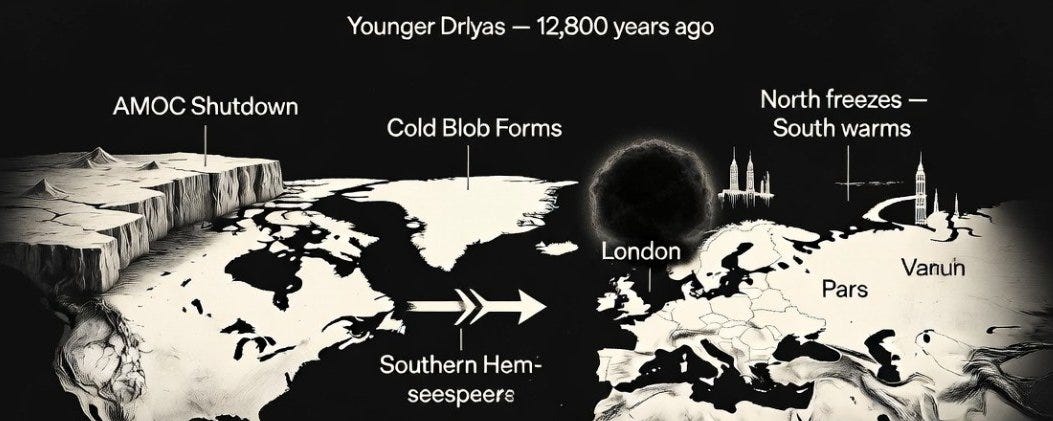
Thirteen thousand years ago, the Earth was thawing. The Ice Age was ending. Then, the climate violently reversed. The Northern Hemisphere plunged back into a deep freeze that lasted a millennium. We call this the Younger Dryas.
Melting glaciers unleashed a colossal flood of freshwater into the sea. This flood disrupted the Atlantic Meridional Overturning Circulation (AMOC), the oceanic conveyor belt that transports equatorial heat northward. When the current died, a massive “cold blob” paralysed the North Atlantic. Deprived of oceanic heat, global weather patterns shattered.
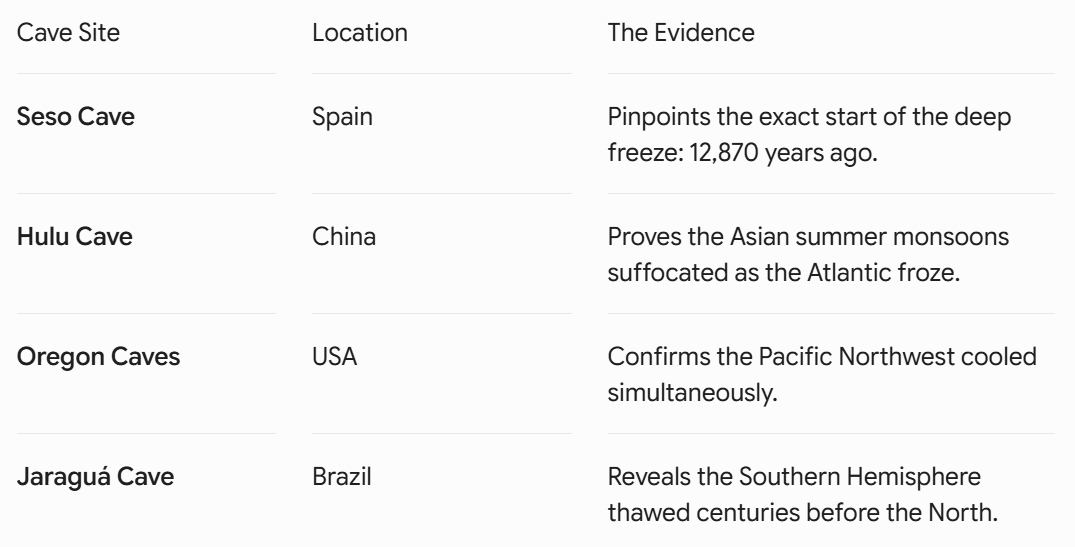
To understand the trigger, we can pinpoint its origin. Standard radiocarbon dating fails here; the stalled ocean temporarily warped atmospheric carbon levels. Scientists look to caves instead. By measuring the radioactive decay of uranium and thorium trapped in Spanish stalagmites, scientists identified the onset of the deep freeze: 12,870 years ago.
So what happened 12800 years ago?
Ice cores from Greenland and lake varves from Germany confirm the speed of the collapse. The transition didn’t take centuries. It took one to three years.
Winter winds shifted violently. Storms battered Europe. Greenland’s ambient air temperature fell 10°C within a single human lifetime.
The recovery, however, was asymmetrical. While the North Atlantic stayed frozen, ice cores prove that Antarctica and the tropical Pacific began to thaw hundreds of years before the Northern Hemisphere.
It all happened relatively quickly, which makes it interesting in itself. Our models have everything happening slowly.
The warming Earth melted ginormous ice sheets covering North America and Scandinavia. Massive prehistoric lakes swelled behind walls of ice. When those dams shattered, millions of cubic meters of freshwater blasted simultaneously into the Arctic Ocean and the Nordic seas.
Because freshwater is lighter than saltwater, it floats. It refused to sink, smothering the ocean’s deep-water convection. The Atlantic circulation choked and died.
Scientists prove this ocean shutdown by reading the mud on the seafloor:
Chemical Tracers: Radioactive isotopes (Protactinium and Thorium) in the Bermuda Rise confirm the ocean conveyor belt stalled.
“Sortable Silt”: The size of mud grains near Iceland proves that deep, fast-moving ocean currents have been physically stopped.
Carbon Signatures: With northern currents paralysed, deep, cold water from Antarctica crept northward across the equator to fill the void.
When the Northern Hemisphere froze, the heat trapped at the equator had to go somewhere. It migrated south. The oceanic bipolar seesaw is engaged.
By analysing methane bubbles trapped in ice, scientists synchronised the poles. Greenland ice froze exactly 200 years before Antarctica began to thaw. This lag represents the time it takes for ocean currents to transfer thermal shock across the planet.
To balance this extreme thermal asymmetry, the Earth violently dragged its tropical rain belts southward, suffocating the Asian monsoons and scorching the Middle East.
The freeze shattered the biosphere. Lush European forests vanished, instantly replaced by the brutal, frozen tundra flower that gave the era its name: Dryas octopetala.
In the Northern Hemisphere, the sudden elimination of nutrient-dense grasslands dropped an anvil on the Pleistocene megafauna. Mammoths, mastodons, and sabre-toothed cats faced mass extinction.
The climate whiplash forced humanity to adapt or perish. In North America, the nomadic Clovis hunting networks collapsed. In the Levant, the Natufian people, who had thrived in a wet paradise, suddenly faced unending megadrought. To avoid starvation, they stopped wandering. They planted drought-resistant wild cereals. They settled.
The Younger Dryas triggered human agriculture. Out of sheer desperation, humanity abandoned the hunt. We built the first settlements. We stockpiled the first granaries. We invented the first administrative systems. We created the ledger.
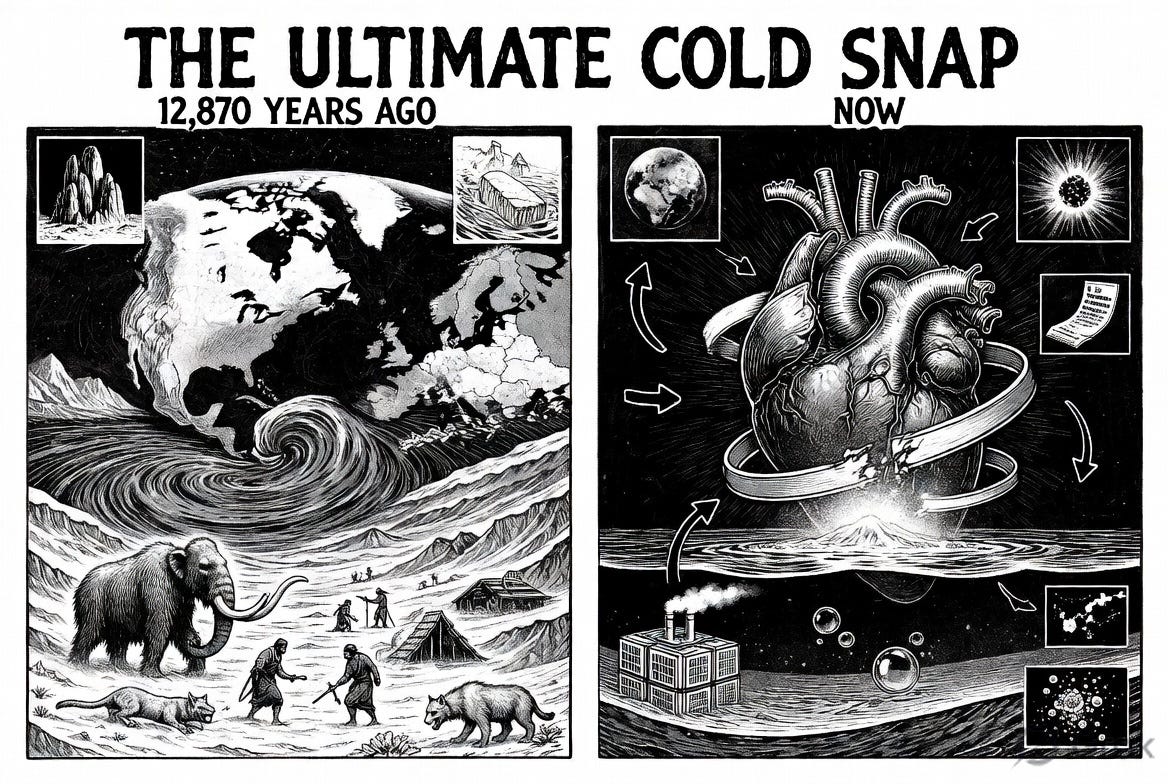
The past is a warning. Today, we are witnessing the exact preconditions that triggered the Younger Dryas. Over the last century, a distinct “cold blob” has swelled southeast of Greenland. Accelerated melting of the Greenland Ice Sheet has already weakened the AMOC by 15% since the mid-20th century. 15% is an enormous drop in that time period.
But a prehistoric ice dam is not the trigger today. Modern industrial civilisation is the geological forcing mechanism. We are executing a similar physical phase shift of an extraterrestrial impact. Whether it be by releasing CO2 or SO2, lowering albedo and cloud cover, or contributing in some other way via effluent pumped into the ocean.
An asteroid delivers a singular, catastrophic kinetic shock that vaporises rock and instantly alters atmospheric chemistry. We achieve a similar structural devastation by burning millions of years’ worth of stored solar energy and injecting the carbon directly into the sky.
Both act as the external trigger required to force a bistable climate system out of equilibrium. The asteroid is obviously imminent, and civilisation is saying it’s 200 years away.
Here lies the structural irony: the climate crash of the Younger Dryas forced humanity to invent agriculture and administration just to survive. Today, those exact survival mechanisms have mutated into a thermodynamic engine demanding near infinite material expansion.
As localised human order decays, societies construct massive, centralised external structures, global supply chains, hyperscale computational grids, and exhaustive energy extraction networks. Civilisation functions as a machine specifically engineered to consume the biosphere in order to maintain its own complexity.
A divergence governs the engine: the gap between financial ledgers and the Earth’s material solvency. Centralised economics mandate exponential growth. The physical planet provides a finite reservoir of matter and thermal buffering capacity. To satisfy the infinite demands of the ledger, the industrial apparatus must extract material and vent waste at rates that physically overwhelm the Earth.
Current climate models are optimistic. They rely on uniform averaging, smoothing out the data and assuming ocean currents will decline gradually.
But oceanic physics operates a bistable mechanical system. When freshwater flux ($F_W$) hits a critical threshold, the current collapses. Modern civilisation supplies the exact external freshwater flux required to trigger this rapid phase shift.
The origin of the forcing is biological and administrative, but the resulting climate crash will mirror a planetary impact. If the Atlantic circulation stalls again, it will devastate the marine food chain, plunge Western Europe into freezing winters, and trigger brutal heatwaves and droughts. The Younger Dryas proves the Earth’s climate does not bend slowly. Pushed too far, it snaps.
Thirteen thousand years ago, the Earth was coming out of the last Ice Age and warming up. Then everything suddenly reversed. Freshwater from melting ice sheets flooded the North Atlantic, shut down the AMOC (the giant ocean conveyor belt that carries warm water north), and created a huge “cold blob.” The Northern Hemisphere plunged back into a deep freeze that lasted more than a thousand years, while the Southern Hemisphere warmed. This is the Younger Dryas — and it is the best real-world example of what a full modern AMOC collapse would look like today.
Here is what the weather report would sound like if the AMOC stalled again right now.
Winter in the Northern Hemisphere (December to February)
The cold blob southeast of Greenland grows much larger and colder. Winter temperatures across the UK, France, Germany, Scandinavia, and eastern Canada drop 5 to 10 °C colder than today. In London and Paris, winters would feel like they belong in Siberia — long periods of freezing temperatures, heavy snow, and ice on the rivers. Oslo and Stockholm would be even harsher. In eastern Canada, Toronto and Montreal would see far more brutal cold snaps and longer-lasting snow cover. In the northeastern United States, New York and Boston would face more frequent Arctic outbreaks and nor’easter storms. The jet stream becomes wavy and stuck, so cold air from the Arctic parks over Europe and the eastern US for weeks at a time. Sea ice pushes much farther south in the Atlantic.
Summer in the Northern Hemisphere (June to August)
Even in summer, the cold blob refuses to disappear. Europe stays unusually cool and cloudy. Summers in the UK, France, and Germany feel more like a long, damp autumn, several degrees colder than today, with frequent rain and overcast skies. London, Paris, and Berlin would rarely see the hot, sunny days people expect. Changes in the jet stream can still create blocking high-pressure systems, bringing occasional heatwaves and droughts to parts of Central and Eastern Europe (such as Poland and Hungary), but the overall cooling effect from the ocean dominates across most of Western Europe. Eastern North America also stays cooler than normal in summer.
The Tropics and Monsoon Regions
The Earth’s rain belts shift southward to balance the cold in the north. The Asian monsoon weakens or fails in many places. India and Bangladesh would face severe droughts or wildly erratic rains that destroy rice and wheat crops — Delhi and Mumbai would see major water shortages and failed harvests. In China, Beijing and Shanghai would also struggle with unreliable rainfall and food supply problems. Parts of Southeast Asia and the Middle East would turn much drier, while some tropical areas swing between floods and droughts.
The Southern Hemisphere — The Relative Winners
While the north suffers, the south warms up. Antarctica and the Southern Ocean receive extra heat. Ice shelves around Antarctica (including those near the vulnerable Thwaites Glacier) melt faster from below, speeding up sea-level rise worldwide. Australia, New Zealand, Argentina, Chile, and southern Africa generally fare better than the north. Sydney in Australia and Buenos Aires in Argentina would see milder or wetter conditions compared with the chaos in Europe and North America. Cape Town in South Africa would also be relatively stable.
The Oceans and Global Ripple Effects
The stalled AMOC would devastate marine life. Fisheries in the North Atlantic collapse because the normal nutrient upwelling stops. The Amazon rainforest would see more droughts and fires. Global food supply chains would break down if key farming regions in Europe, North America, and Asia failed simultaneously.
This is not a slow, gentle change. The Younger Dryas happened really fast, in just one to three years in some places. Today we are already seeing the exact same early signs: an expanding cold blob southeast of Greenland and a 15% weakening of the AMOC since the mid-20th century, driven by accelerated melt from Greenland’s ice sheet. Our modern civilisation is supplying the freshwater and warming that could push the system over the edge.
The Ultimate Cold Snap would redraw the world map of where people can live. Some places would freeze, others would overheat or dry out, and the entire global system would be thrown out of balance — exactly as it was 12,800 years ago.
The past is not just history. It is a warning. The same physical mechanism that forced our ancestors to invent agriculture out of desperation is now being triggered again, this time by us.
When it happens is another story; 2025-2060 is the range, with some further beyond. It’s slowed by 15%, so the changeover could even be placed in the past. What we are seeing are signs and potential consequences, as well as further data that our current science overlooks, that make things look worse.
No posts
Comments
Nothing yet. Say the first thing.
Sign in to join the conversation.