
Li Zhide
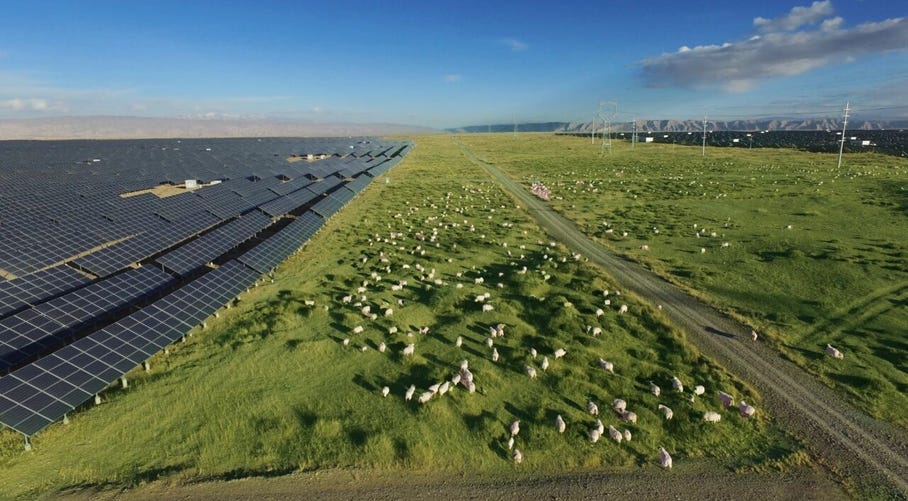
The story of Talatan is easy to tell as a “miracle of Chinese infrastructure.” Solar panels were installed across a barren stretch of high plateau. Grass slowly began to grow in what had once been desert. Then the grass grew too tall and started interfering with power generation. Sheep were brought in. They ate the weeds, reduced the cost of clearing vegetation, and at the same time created additional income for local herders. In the end, several things that had once seemed unrelated—power generation, desert control, and sheep grazing—became part of the same system. It is a remarkable story, and one worth thinking about.
What deserves closer study, however, is not the “miracle” itself, but the pattern of thought and action behind it. The most important lesson of Talatan is not that everything was known in advance. It is that knowledge with real vitality is often not designed once and for all in an office. It emerges through action, is corrected by feedback, and gradually takes shape through setbacks, surprises, and unintended consequences. On the surface, this is a story about solar power. At a deeper level, it touches on an old philosophical question: what is the relationship between knowing and doing? And when that question is enlarged from the cultivation of an individual to the workings of a country, it becomes more important still: How does a nation learn?
We should begin by bringing Talatan back from legend to fact. Talatan lies around Gonghe County in Hainan Tibetan Autonomous Prefecture, Qinghai Province, at an average elevation of nearly 3,000 meters. The area receives long hours of sunshine, suffers from severe desertification, and contains large expanses of relatively flat land. For these reasons, it came early into consideration for large-scale solar development. Publicly available information shows that megawatt-scale photovoltaic projects in the area began connecting to the grid around 2011. After 2012, Hainan Prefecture accelerated the construction of large renewable-energy bases, and the photovoltaic park continued to expand.
By 2026, according to figures released by China’s National Forestry and Grassland Administration, the Talatan photovoltaic industrial park had a planned area of 609 square kilometers, of which about 420 square kilometers had already been developed. In 2022, a photovoltaic complex in Hainan Prefecture, with an installed capacity of 8,430 megawatts, was certified by Guinness World Records as the solar power facility with the world’s largest installed capacity. But the more interesting changes were taking place on the ground. Large fields of solar panels altered the original balance of heat, moisture, and wind at the surface. Monitoring data from the park showed that, in some photovoltaic areas, near-ground wind speeds fell by about 50 percent, evaporation of soil moisture declined by roughly 30 percent, and vegetation coverage rose to around 80 percent. The shade and wind protection provided by the panels, together with water used to wash the photovoltaic modules, the artificial sowing of grass seed, and subsequent ecological restoration measures, jointly changed the local habitat.
Academic research offers a more cautious form of support than promotional accounts do. A 2024 study published in Scientific Reports, examining a large desert photovoltaic development zone in Gonghe County, found that solar development had generally positive effects on the local microclimate, the physical and chemical properties of the soil, and plant and microbial communities. At the same time, the study warned against imagining that the photovoltaic zone had therefore become an ecological paradise. Some ecological indicators remained weak, there were substantial differences from one area to another, and the long-term effects still require continued monitoring. That distinction matters. Talatan is not a fairy tale in which solar panels are installed and desert automatically turns into grassland. The real world is more complicated. The panels altered the environment, grass planting helped stabilize the sand, operations and maintenance introduced additional moisture, and management practices were repeatedly adjusted. Only through the interaction of these factors did the landscape we see today emerge.
And the new outcome created new problems. Once the grass began growing, difficulties appeared that had not existed before. Vegetation that grew too high could interfere with some photovoltaic equipment, while dried grass increased the risk of fire. A renewable-energy project had suddenly encountered a livestock-management problem. Around 2015, the park began cooperating with nearby villages, and an initial flock of roughly 600 sheep was introduced into the photovoltaic area. As the sheep grazed, the need for manual weed removal declined. Their manure returned nutrients to the soil and became part of a new ecological cycle. Some projects later adjusted the height and design of photovoltaic supports to reduce conflicts between grazing animals and power equipment. By 2026, Gonghe and Xinghai counties had developed 32 photovoltaic ecological pastures and 56 grazing sites, with roughly 20,600 “solar sheep” being raised across 18 villages.
By this point, the project had moved far beyond the original idea of “building a power station.” The first objective was electricity generation. Later, people discovered that the project could improve the local ecology. Ecological improvement produced grass, and grass then became a new management cost. Sheep helped solve the grass problem, while the sheep themselves became economic assets for local herders. Once the herders entered the system, new rules had to be created for companies, village collectives, grassland management, livestock raising, fire prevention, and ecological protection. An engineering project had become a system. The real value of Talatan lies in that transformation.
In traditional Chinese thought, Wang Yangming famously said, “Knowledge is the beginning of action; action is the completion of knowledge.” The line is often reduced to a simple lesson: once you know something, you should act on it. But Wang’s meaning was more demanding than that. What he opposed was the separation of knowing and doing into two completely distinct stages—as if one could first understand the world in full and only then begin to act. For him, genuine knowledge naturally enters into action, while “knowledge” that has never been tested in action may be little more than an idea in the mind.
Seen from this perspective, Talatan becomes especially interesting. No one sitting in a conference room more than a decade ago could have calculated everything that would later happen: how the panels would change wind speed, how they would affect soil moisture, how high the grass would grow, whether that grass would interfere with equipment, how many sheep should eventually be introduced, how the animals could coexist with photovoltaic installations, how village collectives should participate, how herders might benefit, and how overgrazing could be avoided. If action had been postponed until every one of these questions had been answered with certainty, many things would never have begun. But the opposite approach—doing things blindly, without research or restraint—would have been just as dangerous.
The real unity of knowledge and action is therefore not a matter of saying, “Just be bold and do it.” It is a cycle. Existing knowledge gives people enough confidence to begin, action produces new information that did not exist before, that information changes what people think they know, and revised knowledge then changes the next round of action. Knowledge enters action, while action produces new knowledge. Only then do knowing and doing form a complete relationship. From the standpoint of modern epistemology, this is close to the basic spirit of experimental science. The purpose of an experiment is not to prove that the researcher is always right. It is to give reality the chance to tell the researcher where he or she is wrong. The grass at Talatan was one of reality’s answers. The sheep were another.
But moving from the individual unity of knowledge and action to a national version of it requires crossing an important threshold: a country is not a person. A country does not possess a single brain, nor does it have anything resembling an individual conscience concentrated in one organ. Government consists of different departments, regions, companies, experts, local officials, and ordinary citizens. Each possesses different information, and each has different interests.
For that reason, the “national unity of knowledge and action” cannot mean that a leader reaches a conclusion and everyone below simply acts in unison. That can produce the opposite result—a separation of knowledge from action. Senior policymakers possess macro-level knowledge. Engineers possess technical knowledge. Local governments understand local conditions. Herders know when the grass grows and what sheep prefer to eat. Maintenance workers know which kinds of vegetation are most likely to obstruct equipment. Knowledge is dispersed among many people. The true cognitive capacity of a modern state is therefore not measured by how much the people at the top know. It is measured by whether knowledge scattered throughout society can be discovered, transmitted, tested, and eventually incorporated into decision-making.
This is the deeper meaning of Talatan. When the grass became too tall, the first people to notice were not policymakers in Beijing. They were people on the site. Nor did an abstract theory first reveal that sheep could clear the grass. Practice did. But if a discovery made in practice remains merely something “one herder knows” or “one power station knows,” it is still only local experience. The crucial step is turning experience into rules.
Talatan today is no longer a place where anyone who wishes can simply bring sheep into the photovoltaic park. Local authorities have gradually developed arrangements under which village economic cooperatives sign agreements with photovoltaic companies, stocking levels are determined according to the amount of available grass, the size of individual grazing sites is controlled, rotational grazing is used, traceability systems are introduced, and grazing intensity is adjusted to the carrying capacity of the grassland. This may sound less dramatic than “the first flock of sheep walking under the solar panels,” but it matters much more. An accidental discovery becomes genuine social knowledge only when it is turned into a stable institution.
This also helps explain why many countries have no shortage of intelligent people and yet continue making serious mistakes for long periods of time. National failure often does not arise because no one knows what is wrong. It arises because what is known cannot enter action, while the information generated by action cannot return to the knowledge system. Experts raise a problem, but no one listens. Local officials discover a mistake, but are afraid to report it. Grassroots units, under pressure to meet targets, report only good news. When a policy fails, no one wishes to admit it. When one case succeeds, it is copied nationwide before the reasons for its success have even been tested. The cycle between knowledge and action then breaks down. The number of documents grows, while the amount of real knowledge may actually shrink.
There is therefore a frequently overlooked measure of state capacity: Can a country learn from what it has already done? One feature of China’s reform history that has long attracted the attention of scholars inside and outside the country is the use of local experiments, comparison, feedback, and gradual expansion. The value of this process does not lie in some assumption that “local governments are always right.” It lies in allowing certain policies to operate first within a limited scope, generating information through actual results, and then deciding whether they should be expanded, modified, or stopped.
This is the kind of national philosophy Talatan can illuminate. The national unity of knowledge and action does not mean “once we know the answer, we must carry it out firmly.” It means building a system of action that is capable of continuous learning. Such a system must possess several abilities. It must be willing to act, because otherwise no new knowledge will be produced. It must allow reality to contradict earlier assumptions, because otherwise action becomes little more than a ritual for proving official documents correct. It must allow bad news from the grassroots to travel upward, because otherwise senior decision-makers will receive only a polished version of reality. And it must know when to expand a successful experiment and when to stop one, because local success does not automatically amount to a universal rule. That last point is especially important.
Talatan should not be treated as a “Chinese answer” that can simply be photocopied indefinitely. This is the most important counterargument the case itself demands. Gonghe County has its own particular combination of high altitude, intense sunlight, dryness, strong winds, soil conditions, grass species, rainfall patterns, pastoral traditions, and population density. In this setting, reducing evaporation and wind speed through photovoltaic installations may help vegetation recover. Somewhere else, the results may be different. In wetter regions, additional shade may alter plant communities in other ways. In ecologically sensitive areas, construction on a large scale may itself cause new damage. In places under extreme water stress, the water used to clean photovoltaic modules must be included in the ecological calculation. Too many sheep could degrade the grassland again. Even differences in panel height, spacing, or tracking technology can affect soil temperature, moisture, and plant composition.
So what deserves to be copied is not the rule that “sheep should always be raised beneath solar panels,” much less the idea that every desert in China should be covered in a replica of Talatan. What deserves to be copied is the method of solving problems. Understand local conditions first, then build. Monitor continuously and identify side effects. Allow adjustment. Bring different departments into the same process. Give local people a stake in the outcome. Then rewrite the rules in response to the new ecological carrying capacity. What can be reproduced from Talatan is its learning mechanism, not Talatan itself.
That distinction matters. A country with weak learning capacity tends to search for standard answers. A more mature country values methods for solving problems.
Take the argument one step further and Talatan reveals another fact that modern societies often forget: many of the most important innovations are not breakthroughs in a single technology. They come from rearranging relationships that were previously kept apart. Photovoltaic technology was not invented at Talatan. Sheep certainly were not. Nor was grass planting for desert control. What was new at Talatan was the way energy, land, water, grass, sheep, herders, companies, the power grid, and local government were connected.
A piece of land that once had only one use can now perform several functions at once: generating electricity, stabilizing sand, restoring vegetation, and supporting controlled grazing. What a power company sees as “weeds” can be feed from a herder’s point of view. If the two systems remain separate, the company pays to remove grass while the herder pays to find feed. Once the systems are connected, one side’s cost can become the other side’s resource.
This is a classic form of systems innovation. Many social problems persist not because people cannot find better individual technologies, but because every department optimizes only its own small piece of the problem. The energy department watches kilowatt-hours. Environmental agencies watch vegetation. Agricultural authorities watch livestock. Finance departments watch expenditure. Companies watch profit. Herders watch income. Each part may be locally rational while the system as a whole remains irrational. What is interesting about Talatan is that it places several accounts that used to be separate onto the same table.
Is maximizing electricity generation the only objective? No. If slightly higher construction costs reduce future spending on desert control, fire prevention, and vegetation clearing, the overall balance may be better. Is more vegetation always better? Again, no. Too much grass may obstruct equipment and increase fire risk. Do more sheep always mean more income? Not necessarily. Once grazing exceeds the carrying capacity of the land, today’s additional income becomes tomorrow’s ecological debt. Good governance does not maximize a single variable. It searches for a workable balance within a system.
This may be the most important addition that public governance makes to the traditional philosophy of the unity of knowledge and action. In an individual, the unity of knowledge and action often emphasizes courage. At the national level, what matters even more is feedback. When an individual makes a mistake, the cost may fall mainly on that person. When a government makes a large-scale policy mistake, the cost may be borne by millions of people and may persist for many years. A country therefore needs institutionalized humility even more than an individual does.
Such humility does not mean indecision or fear of acting. It simply acknowledges a basic fact: no matter how intelligent a decision-maker may be, no one can know every consequence before action begins. The true reliability of a modern state does not lie in never making mistakes. No such state exists. What matters is whether mistakes can be discovered, whether, once discovered, they can be spoken about, whether, once spoken about, they can be corrected, and whether successful corrections can be retained as institutional memory.
This is where Talatan matters. When photovoltaic development began, people were thinking primarily about energy. Then the land told them there was also ecology. As the ecology improved, the grass told them there was also maintenance. Once the sheep arrived, the herders told them there was also livelihood. Once herders entered the system, the grassland told them there was also carrying capacity. Every problem that is solved generates another problem. That does not mean the earlier decision was a failure. On the contrary, this is how a complex society normally works.
Good governance does not solve every problem once and for all. It raises society’s capacity to solve the next kind of problem while dealing with the present one.
One of the most interesting capacities China has developed over the past several decades may be precisely this ability to learn by doing. It has certainly not succeeded every time, and this idea should never be used to romanticize every policy as an “experiment.” Experiments need boundaries. They must be capable of being stopped. Failures must be recorded. People who bear the costs must have channels through which they can speak. Successes must also be independently tested rather than automatically declared “experience” simply because they fit a grand narrative. Otherwise, the word “experiment” can become a convenient cover for bad policy.
A mature national system of knowledge and action therefore requires one final condition, and it is not a romantic one: facts must be allowed to matter more than face. If Talatan were permitted to have only one official story—“we designed everything brilliantly from the beginning”—then the case would lose its most valuable meaning, because that is not what happened. No one originally designed the complete photovoltaic–grass–sheep–herder–ecological-management loop that exists today.
What deserves respect is something else: people did something, the world produced an unexpected result, and instead of simply treating that result as a nuisance to be eliminated, they kept observing, changed their methods, and eventually turned the unexpected into a new possibility. Grass was not a main character in the original plan. Neither were sheep. But both eventually became part of the system. That is innovation.
When we talk about technological innovation today, we quickly think of semiconductors, artificial intelligence, quantum computing, and robotics. All of these matter. But a country’s deeper capacity for innovation also includes another ability that rarely becomes a headline: when confronted with a problem that has no ready-made answer, can it allow reality to participate in producing the answer?
That may be Talatan’s most important lesson. Knowledge is not a complete map stored in the mind before action begins. Action is not a button pressed only after knowledge is complete. The real world is more like walking through darkness. We have maps, experience, instruments, and a sense of direction, but once we start moving, we still encounter rivers, landslides, and forks in the road that were never marked on the map. An intelligent person does not throw the map away, nor does he walk into a wall while staring at it. He looks up at the road. That is the unity of knowledge and action at the level of the individual.
A nation is no different. Planning matters. Strategy matters. Expertise matters. But if a country loses the ability to correct itself in response to reality, even the grandest plan may eventually become a paper world. By contrast, if a country can bring together the engineer’s measurements, the herder’s experience, the company’s costs, the scientist’s research, local experiments, and the central government’s long-term strategy, then what it gains is more than a power station and more than a grassland. It gains something more valuable: the capacity to keep producing knowledge.
What China should value most about Talatan today is therefore not a “world number one” title, nor even the catchy name “solar sheep.” Talatan reminds us that a truly intelligent person is not simply someone who knows a great deal, but someone who allows action to keep correcting understanding. A truly strong country, likewise, is not defined only by the amount of capital, technology, or engineering capacity it possesses. It is also defined by whether it can turn countless forms of local experience, feedback from different levels, and a constantly changing reality into the knowledge needed for the next round of decisions.
Wang Yangming left the individual with a question: can knowledge and action truly become one? More than five hundred years later, Talatan has unintentionally turned that into another question: How can a modern country with a vast population, an immense territory, and a highly complex industrial system allow knowledge continually to enter action, while action continually produces new knowledge?
That question matters far more than the simple fact that “grass grew beneath the solar panels,” because what ultimately determines a country’s future is not how many answers it already possesses, but whether it can continue to learn when old answers stop working and new problems appear.
What is most worth replicating from Talatan, in the end, is not photovoltaic power, not sheep, and not any single technique of desert control. It is this capacity to learn. The deepest form of the national unity of knowledge and action is to make sure that reality is always allowed to speak.
No posts
Comments
Nothing yet. Say the first thing.
Sign in to join the conversation.