
Li Zide
On July 24, 2026, China’s Ministry of Finance and State Taxation Administration issued Announcement No. 21, setting out a systematic framework for the individual income-tax treatment of offshore trusts(离岸信托). The announcement may look highly technical. It deals with settlors, trustees, offshore entities, gains from property transfers, tax residency, and effective control. Yet its real impact may reach much further, touching the entire system of wealth arrangements that has taken shape among China’s high-net-worth individuals over the past two or three decades.
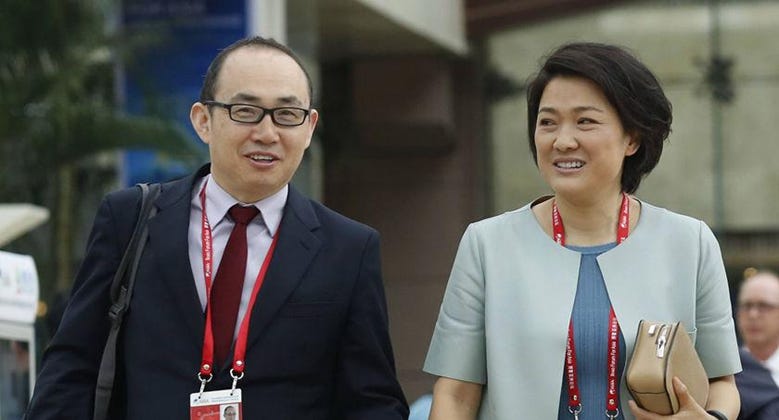
Pan Shiyi(潘石屹)stands almost exactly at the point where these changes meet.
The story of his wealth, and that of his wife Zhang Xin(张欣), contains nearly every defining feature of China’s three decades after reform and opening: real estate, urbanization, Hong Kong listings, offshore companies, global investment, international education, overseas assets, and family wealth management. They came of age in an era when Chinese asset prices were rising rapidly and cross-border capital allocation was steadily expanding. In that sense, the “Pan Shiyi dividend”(潘石屹红利)was never simply about how much money Pan himself made. It was the dividend of an entire era.
Now some of the institutional conditions that made that dividend possible are changing.
The most important feature of Announcement No. 21 is that China’s tax administration is moving more explicitly beyond the formal boundaries of companies, trusts, and passports in order to identify who actually controls assets and who ultimately enjoys their economic benefits. When a resident individual transfers property into an offshore trust, the taxable gain is, in principle, calculated on the basis of the property’s market value at the time of transfer, minus its original cost and reasonable expenses. Income subsequently generated by the offshore trust, or by offshore entities it controls or manages, may also have to be declared and taxed annually even if that income has never actually been distributed to the individual.
This reflects an important change in the way tax liability is understood. In the past, the key question was often: Has the money actually been paid into the individual’s own account? Increasingly, the question is becoming: Whose money is it in substance? Who put the assets there, who can decide how they are invested or disposed of, and who ultimately receives the economic benefit?
If the answer still points back to a Chinese tax resident, then in some circumstances the tax obligation may not disappear simply because a Cayman Islands(开曼群岛)company, an offshore trust, a nominee, or some other legal entity stands in between. This is what is meant by “look-through” taxation(穿透).
Announcement No. 21 goes further, touching on another issue long central to cross-border wealth planning: foreign nationality. Acquiring foreign citizenship or long-term or permanent residence abroad does not automatically sever an individual’s relationship with China’s personal income-tax system. If the person’s principal economic interests remain in China, that person may still, under the relevant conditions, be treated as a resident individual with domicile in China.
So a passport will increasingly be only one factor in determining a person’s tax position. Other questions become more important: Where does the person actually live? Where is the family based? Where are the businesses? Where does the main wealth come from? And who actually controls the assets?
In a globalized capital system, a person can hold one passport, register a company in another country, establish a trust in a third jurisdiction, and own investments across several continents. Tax authorities, however, are increasingly trying to piece these scattered legal relationships back together and reconnect them to a single person. That is what makes Announcement No. 21 important. It does more than impose another tax rule. It begins to redefine what counts as “your money.”
I
Pan Shiyi is therefore an unusually revealing figure through which to understand this moment.
The rise of SOHO China(SOHO中国)was itself part of China’s urbanization and real-estate boom. Beijing(北京)and Shanghai(上海)expanded rapidly, land prices rose, and office buildings became an important class of asset. Pan Shiyi and Zhang Xin seized that moment and developed a series of highly recognizable commercial properties. Later, they caught another wave: the globalization of capital. Chinese companies listed in Hong Kong(香港), offshore holding companies became common, and international banks, funds, and trust institutions entered the wealth-management world of Chinese entrepreneurs.
For the first time, large numbers of Chinese businesspeople were operating in a world where a company could make money in Beijing, list in Hong Kong, build a corporate structure in the Cayman Islands, buy property in New York(纽约), donate money in Boston(波士顿), and manage assets in London(伦敦). Today this may sound ordinary. Two or three decades ago, it represented a profound institutional change. Chinese private wealth had, for the first time, truly crossed national borders on a large scale.
This is the first key to understanding Pan Shiyi.
He was not the traditional kind of rich man who locked his money in a safe at home. The age he lived in taught entrepreneurs that assets could move, legal entities could be layered, ownership could be divided, and wealth could be allocated globally. There were boundaries between the individual and the company, between China and the outside world, between ownership and beneficial interest, and among settlors, trustees, and beneficiaries.
Those boundaries are part of modern commercial law. But boundaries can protect legitimate transactions, and they can also create room for tax planning. Over the past several decades, tax authorities around the world have faced the same basic problem: if one person’s wealth is spread across a dozen companies, several trusts, and multiple countries, can the traditional tax system still find that person?
The answer is changing.
II
The changes in the wealth of Pan Shiyi and Zhang Xin over the past two decades have therefore acquired a particular symbolic meaning.
Publicly available information shows that SOHO China continued to sell some of its assets after the peak of the property boom. At the same time, Zhang Xin participated in commercial real-estate investments in the United States, including prominent properties in New York. Both facts can be established. But an essential evidentiary boundary must be maintained: the fact that domestic asset sales and overseas investments occurred during overlapping periods does not prove that each sum raised in China flowed directly into a particular overseas account. Nor can a complete path of capital movement be drawn merely from chronological coincidence.
Commercial judgment and factual judgment must remain separate.
The frequently cited figure of 12.8 billion yuan also requires caution. Some financial media have estimated, on the basis of SOHO China’s past dividend payments and the couple’s shareholding, that the shares controlled by Pan Shiyi and Zhang Xin generated cumulative cash dividends of roughly 12.8 billion yuan. That figure has a basis for discussion. But “having received roughly 12.8 billion yuan in dividends over time” is entirely different from saying that “a particular offshore trust now contains 12.8 billion yuan.”
After money is received, it may be invested or spent. It may still be held, or it may have been converted into other assets. Taxes may already have been paid on some of it, while other portions may involve different tax years, different tax-residency statuses, and different legal entities. Without complete trust documents, records of asset changes, tax-residency information, and historical tax filings, outsiders cannot accurately calculate how much tax Pan Shiyi and Zhang Xin might owe.
That distinction matters. Tax law cannot be based on guesswork, and wealth cannot be treated as evidence of wrongdoing simply because it is large.
If tax authorities later determine, on the basis of law and fact, that taxable income exists, the tax should be collected. If tax evasion is established, penalties should follow. But before the facts are known, no one should issue a hypothetical tax bill of tens of billions of yuan simply because the person involved is wealthy. Taxation is not a matter of emotion.
III
Yet even if we do not know how much tax Pan Shiyi may ultimately owe, he remains an excellent case through which to understand Announcement No. 21, because the “Pan Shiyi dividend” depended precisely on boundaries.
In the past, registering a company offshore could make financing and listing easier. Establishing a trust could serve wealth succession, asset protection, and family governance. Investing through an overseas company could diversify geographic risk. Moving one’s residence could reorganize family life and wealth planning. None of these acts is inherently unlawful, and an offshore trust is not, by itself, a tool for tax evasion. Trusts are widely used around the world for ordinary family wealth management, charitable foundations, inheritance planning, and cross-border investment.
The problem appears elsewhere.
When the gap between legal form and economic reality grows too wide, tax authorities begin to look beyond the name written at the top of a contract. They ask further questions: Who really put up the money? Who really makes the decisions? Who ultimately receives the money? Who bears the risks and enjoys the returns?
This has become one of the clearest trends in global taxation over the past decade or more. Company names can change. Trustees can change. Passports can change. But effective control and ultimate economic benefit are becoming harder to hide behind those formal structures.
Announcement No. 21 is an important extension of that trend into the taxation of private wealth in China.
IV
The “Pan Shiyi trap”(潘石屹陷阱), then, does not mean that Pan’s earlier arrangements were necessarily unlawful. The real trap is that an arrangement that worked successfully under one institutional environment may face an entirely different regulatory logic twenty years later.
That is the heart of the issue.
One of the easiest mistakes for entrepreneurs to make is to treat temporary institutional conditions as permanent rules. Property prices will always rise. Cross-border capital movement will always become freer. Offshore structures will always retain the same tax effects. Once citizenship or residency changes, previous tax connections will automatically disappear. History repeatedly shows that none of these assumptions can be taken for granted.
Institutions change, and so does the capacity of the state.
Twenty years ago, a tax authority might not even have known which overseas companies a resident controlled. Today, global financial-account information exchange, bank compliance, beneficial-ownership registration, anti-money-laundering rules, and digital tax administration have transformed the information environment. In the past, information was scarce. Now what is becoming scarce is the ability to remain invisible.
That is the fundamental change confronting Pan Shiyi’s generation of wealthy Chinese. They accumulated their fortunes during an era in which globalization kept opening borders. Now, as they enter the stage of intergenerational wealth transfer, they find tax authorities around the world reconnecting those borders.
One era opened the doors. Another has begun asking who lives behind them.
V
Announcement No. 21 also contains a highly practical provision dealing with existing arrangements.
Under the announcement, certain offshore-trust tax matters from earlier periods are given a ninety-day filing window. Where the relevant conditions are met, taxpayers who come forward within that period may avoid the corresponding late-payment surcharge. The message to high-net-worth individuals is clear: some offshore wealth structures that have long existed in a gray area now need to be reviewed.
For tax lawyers, accountants, family offices, and private banks, the next step is unlikely to be a matter of filling out a single form. They may need to review an entire wealth structure: Who is the tax resident? Who has effective control? What kind of trust is involved? When were the assets transferred into it? What was their original cost? How much income has been generated over the years? How much tax has already been paid overseas? Has the status of any family member changed? Should the existing structure be kept at all?
These questions will directly shape the next round of wealth allocation among China’s high-net-worth families. That may prove to be the most important economic consequence of Announcement No. 21.
How much additional tax the authorities collect this year—tens of billions of yuan or hundreds of billions—certainly matters. But something else may matter more: a group of people with very large fortunes will now reconsider where they want to keep their assets over the next ten years.
Tax policy does not merely collect yesterday’s money. It also changes where tomorrow’s money goes.
VI
This brings us to a question much larger than Pan Shiyi himself.
The state has good reason to close tax loopholes. The monthly income of an ordinary salaried worker is relatively easy for the tax system to see. If someone worth tens of billions of yuan can place a few more companies and trusts between himself and his assets, adopt several legal identities, and thereby leave large amounts of income outside the tax system for long periods, the tax system will eventually lose its sense of fairness.
No society can sustain a system in which those who are easiest to see are the easiest to tax, while those wealthy enough to hire sophisticated lawyers are the easiest to make disappear. If the ability to escape taxation rises with wealth, an increasing share of the public burden will fall on wage earners and middle-class families who cannot move their assets across borders.
That is one of the most basic questions of tax fairness.
The wealthy have every right to reduce taxes legally, arrange their wealth, and invest internationally. But access to more expensive lawyers and accountants should not amount to the purchase of a kind of exemption from tax law that ordinary people could never afford.
That point is not especially controversial. The harder question comes next.
VII
The state has another responsibility besides collecting tax: it must keep the rules predictable.
This is often lost in emotionally charged debates over taxation.
Capital is practical. It looks not only at tax rates but also at whether the rules are likely to change abruptly. If a high-net-worth family expects its tax burden to rise, it may spend less or reallocate its investments. If it expects a particular tax-avoidance strategy to be closed, it may redesign its structure. These are normal economic responses.
But if people cannot tell whether a wealth arrangement that is lawful today will be treated completely differently ten years from now, they are no longer thinking only about tax rates. They are thinking about institutional risk. Their responses may then become much larger: entrepreneurs may reduce long-term domestic holdings, change tax residency earlier, move the next generation abroad sooner, or place the intellectual property, holding structure, and even the founding location of a new company outside China from the beginning.
This creates a genuine policy dilemma.
Governments naturally want more tax revenue. They also want to close loopholes, keep capital at home, encourage entrepreneurs to invest, and, if possible, prevent wealth from flowing abroad. The difficulty is that these goals cannot always be maximized at the same time.
Policy always has a cost.
There is no system in the world that can close every loophole, collect every possible tax dollar, and still leave capital completely unchanged in its behavior. That is what makes tax policy difficult.
VIII
For that reason, three things must be kept separate when discussing Announcement No. 21: legal tax planning, illegal tax evasion, and new tax obligations created by changes in policy. They are not the same thing.
A trust is not a criminal instrument. Overseas assets are not evidence of wrongdoing. Nor does earning money in China mean that a person’s wealth must remain in China forever. Cross-border investment, international asset allocation, and family migration are all normal features of a modern economy.
The idea that “money earned in one place must stay there forever” may express a simple moral intuition, but it is not a complete principle of modern tax law. Tax liability is determined by tax residency, the source and nature of income, the nature of the assets, control relationships, and the law itself.
The same applies to Pan Shiyi.
Every yuan of tax legally owed should be paid. But tax that is not legally owed should not be imposed simply because public opinion dislikes a wealthy person. That is one of the most basic boundaries of the rule of law.
IX
The “Pan Shiyi trap,” then, has two levels.
The first belongs to entrepreneurs. The greatest mistake is to believe that a legal structure found today can permanently protect wealth against tomorrow’s institutional changes. Wealth planning is never a one-time exercise. Changes in tax law, international rules, the status of family members, and the nature of assets can all make yesterday’s effective structure obsolete.
The second belongs to government. Governments, too, can fall into the illusion that tighter regulation will automatically deliver more tax revenue, greater fairness, more capital, and stronger confidence all at once.
It may not.
The stronger a state’s regulatory capacity becomes, the more important stable rules become. The more capable the state is of looking through the shells of companies, trusts, and passports, the more clearly taxpayers need to know when that power will be used, how far it will reach, and on what legal basis.
Otherwise, regulatory power itself becomes a kind of risk premium.
What capital fears most is not necessarily high taxation. Many countries have high tax burdens and still attract long-term capital. What capital fears more is not knowing how the rules will be applied tomorrow.
Institutional certainty is itself an economic asset.
X
Pan Shiyi’s story therefore carries a particular meaning for this moment in Chinese history.
When he was young, he entered a China whose borders were steadily opening. Cities expanded. Real estate became a machine for creating wealth. Private companies grew quickly. Chinese firms entered Hong Kong’s capital markets. Capital went global. For the first time, Chinese families began allocating wealth on a large scale in New York, London, Hong Kong, and Singapore(新加坡).
One door after another opened. Pan Shiyi understood those doors early, and that is how he captured the “Pan Shiyi dividend.”
Thirty years later, China is redefining the rules behind those doors. Behind a company, regulators now look for the controller. Behind a trust, they look for the beneficiary. Behind a passport, they look for tax residency. Behind an overseas asset, they look for the person who ultimately holds the economic interest.
This is not unique to China. Tax systems around the world have been moving from legal form toward economic substance, from individual accounts toward effective control, and from nationally segmented information toward cross-border information exchange.
But in China, this shift is taking place at an unusually sensitive moment. The property boom is over. Local governments face fiscal pressure. Household wealth is growing more slowly. Business confidence still needs rebuilding. Cross-border capital flows are under closer scrutiny. At the same time, China must deal with new questions created by concentrated wealth, tax fairness, and the globalization of private assets.
The ultimate test of Announcement No. 21, then, is not simply whether China can find money held in offshore trusts. The real test is whether China can establish a new balance: one in which wealth finds it hard to escape the tax system without feeling compelled to leave China; one in which the rich bear their proper share of public obligations without wealth itself being treated as a moral offense; and one in which the state has the power to look through complex ownership structures while entrepreneurs can still predict the basic rules ten years ahead.
That is where the real difficulty lies.
The “Pan Shiyi dividend” belonged to an entrepreneur who learned early how to use the borders opened by the age of globalization.
The “Pan Shiyi trap” appears more than twenty years later, when his generation may suddenly discover that the borders are still there, but the state has learned how to look across them and find the person behind them.
And the real question for China’s economy is not how much money can ultimately be collected from wealthy people like Pan Shiyi. It is a much larger question:
Once the state has gained the ability to find wealth, how can it make sure that wealth still wants to be created there?
That is the next question China must answer as it moves from the “Pan Shiyi dividend” to the “Pan Shiyi trap.”
No posts
Comments
Nothing yet. Say the first thing.
Sign in to join the conversation.