
“For though I do not think that poetry consists in self-expression, I am far from denying that much may be learnt of the poet’s self from his works and that his example may therefore reach many generations.”
—The Personal Heresy, C.S. Lewis
How many of us, when we think of C.S. Lewis, think of poetry? Yet how many of us who have read and reread C.S. Lewis have felt his words evoke something palpable, almost tactile? While prose can often do this, it is poetry whose express purpose is to elicit a “specific emotional response through language.”1 Before he ever penned a Christian or philosophical treatise, Lewis, not yet ten years old, was writing poetry in “the little end room” at his home in Belfast. Over the course of his life, Lewis was deeply inspired by poetry of all forms from authors like Longfellow, Thomas Browne, Milton, Edmund Spenser, and many more. While he is most known for his Christian and fiction writing, Lewis remained passionate about poetry, penning books like The Personal Heresy and Preface to Paradise Lost that showcased his love for the form.
Walter Hooper, Lewis’s private secretary in his later years and his biographer after his passing, writes that through C.S. Lewis’s poetry, we get a sense of his “spiritual odyssey.”2 Don King, a modern scholar who has studied Lewis’s poetry extensively, writes: “Lewis’ poetry matters because it illustrates the degree to which writing poetry (and being a poet) is fundamental to all his writing.” He agrees with Hooper that through Lewis’s poetry, we can chart his spiritual journey, watching him move from an atheist in despair while writing Spirits in Bondage, to someone seeking a deeper understanding of faith in The Pilgrim’s Regress, to being able to express that intangible joy attached to faith in Surprised by Joy.
If this is the case—if Lewis’s poetry, or even his mind as a poet, might enhance or illuminate the ways in which we experience his theological, philosophical, and fiction work—why aren’t more of us reading it?
Although I have read Spirits in Bondage and Poems cover to cover, I must admit that Narrative Poems—a collection of epic poems by Lewis—has always intimidated me. Regardless of the author, I can feel a bit like an imposter when I first sit down with a new book of poems. As I try to find the deeper meaning a poet has hidden within the text, I can’t help but wonder what I might be missing. Yet it is the treasure hunt within the words that excites me about reading poetry, the feeling that there is something concealed waiting to break free if only my mind can unlock it. It is also the very thing that sometimes acts as a barrier to my reaching for a new book of poetry.
Lewis, as it turns out, offered a simple roadmap for how to approach poetry:
The truth is that the value of literature, as of other utterances, has always been pretty well understood by the great mass of readers. Of any utterance, whether conversational or poetical, our first demand is that it should be interesting. I am afraid we cannot make it more definite than that. It may be interesting for all sorts of reasons; because it is so funny, because it is so true, because it is so unexpected, or because it does just what we were expecting so well, because it carries us away from daily life into such fine regions of fantasy, or because it brings us back to our immediate surroundings with such a home-felt sense of reality. I know that different things interest different people. It cannot be helped.
And in the second place, we demand that an utterance, besides entertaining, charming, or exciting us for the moment should have a desirable permanent effect on us if possible—should make us either happier, or wiser, or better. There is nothing ‘moral’ in the narrower sense about this, though morals come into it. It is all of a piece with what we want in other departments of life: a man wants his food to be nourishing as well as palatable, his games to be healthy as well as enjoyable.… The only two questions to ask about a poem, in the long run, are, firstly, whether it is interesting, enjoyable, attractive, and secondly, whether this enjoyment wears well and helps or hinders you towards all the other things you would like to enjoy, or do, or be.3
Whether poetry intimidates or excites you, I want to extend an offer to join us this summer in reading through three epic poems found in C.S. Lewis’s Narrative Poems. As we journey through each poem, one per month, we will be led by an expert guide who will share their understanding of what makes each poem unique and what we as modern readers can learn from them. While I do believe that reading Lewis’s poetry can help illuminate some of his other works, I would be remiss not to provide the warning he gives readers in The Personal Heresy:
The poet is not a man who asks me to look at him; he is a man who says “look at that” and points; the more I follow the pointing of his finger the less I can possibly see of him….
To see things as the poet sees them I must share his consciousness and not attend to it; I must look where he looks and not turn round to face him; I must make of him not a spectacle but a pair of spectacles: in fine, as Professor Alexander would say, I must enjoy him and not contemplate him.4
As we read through “Launcelot,” “The Nameless Isle,” and “The Queen of Drum” this summer, we may glean something of Lewis from them. But as he says above—that is not the point. We are to “enjoy him” as a tour guide illuminating elements of our humanity with words that inspire us or challenge us.
If you’d like to join the book club this summer, grab a copy of Narrative Poems. Our reading schedule will be as follows:
June: “Launcelot”
July: “The Nameless Isle”
August: “The Queen of Drum”
Below is a timeline of when Lewis began working on some of the poems in Narrative Poems, taken from Walter Hooper’s preface to the book. They shed some light on what parts of Lewis’s life the writing of these texts coincided with. For me, the most fascinating takeaway is that many of these poems were a work in progress over the course of years, as they all required what Lewis describes as an essential element of writing poetry: “The real poet is a man who has already escaped from that emotion sufficiently to see it objectively.”5
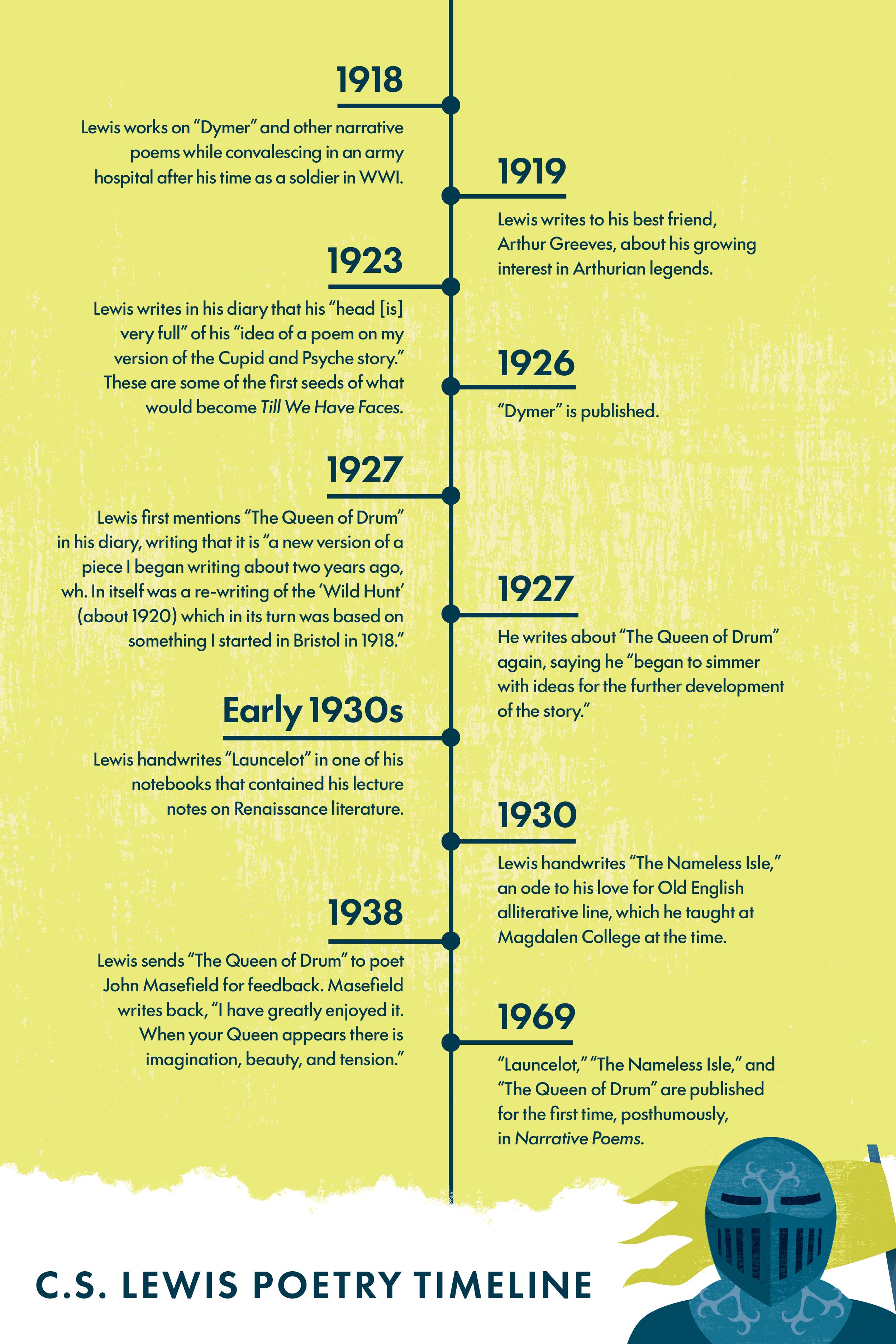
Walter Hooper, preface to C.S. Lewis, Narrative Poems (HarperCollins, 1969).
The Personal Heresy Copyright © 1939 by C. S. Lewis Pte. Ltd.
The Personal Heresy Copyright © 1939 by C. S. Lewis Pte. Ltd.
The Personal Heresy Copyright © 1939 by C. S. Lewis Pte. Ltd.
Comments
Nothing yet. Say the first thing.
Sign in to join the conversation.