

A hawkish Fed, the biggest hardware wallet failure in Bitcoin’s history, an $8.22 billion earnings loss, and a hedge fund that lost $35 billion in days. The damage was real, but smaller than it should have been.
⚡ Why last week’s four-hit combo barely dented Bitcoin, and what that tells you
📊 A quick price check on the majors as we open the week
📰 The CryptoTicker stories worth your click this morning
🗓️ The payrolls print on Friday and why it decides September
🧠 A trivia with a 1998 answer that fits last week uncomfortably well
Four things landed between 27 July and 2 August, and any one of them would normally be enough for a red week.
The Fed held, but not cleanly. Rates stayed put on 29 July, and three officials voted for a hike. A 9-3 split is loud. September tightening odds pushed above 60% off the back of it, which means the market is no longer pricing cuts, it is pricing the opposite.
Bitcoin’s worst hardware wallet failure to date. A firmware flaw in Coldcard devices was linked to roughly $70 million in drained BTC. That is not an exchange failing, it is the self-custody layer failing, which is exactly the part of the stack that is supposed to be immune. For context, Blockaid put total crypto hack losses above $1 billion in the first half of 2026 alone.
Institutional money leaned out. US spot Bitcoin ETFs posted a net outflow of $61.53 million for the week ending 31 July, with $265.4 million shed in a single session on the 31st. Zoom out and it is worse: July brought just $205 million in net inflows, the weakest month on record for the product. Ethereum ETFs added $27.42 million, and Solana ETFs took in around $2.82 million. The tilt toward ETH is now a pattern, not noise.
Earnings were ugly. Strategy booked an $8.22 billion quarterly loss on Bitcoin markdowns, and Coinbase missed again.
And the fifth thing, technically not crypto, but the one everyone was actually watching: Leopold Aschenbrenner’s Situational Awareness went from $45 billion to roughly $10 billion in a matter of days. Reported leverage of up to 400%, margin calls from three prime brokers, and a discounted fire sale of the public book to Citadel. The fund is still up on the year. That is the strange part.
So why is Bitcoin only down 4.31% on the week, holding above $62,500?
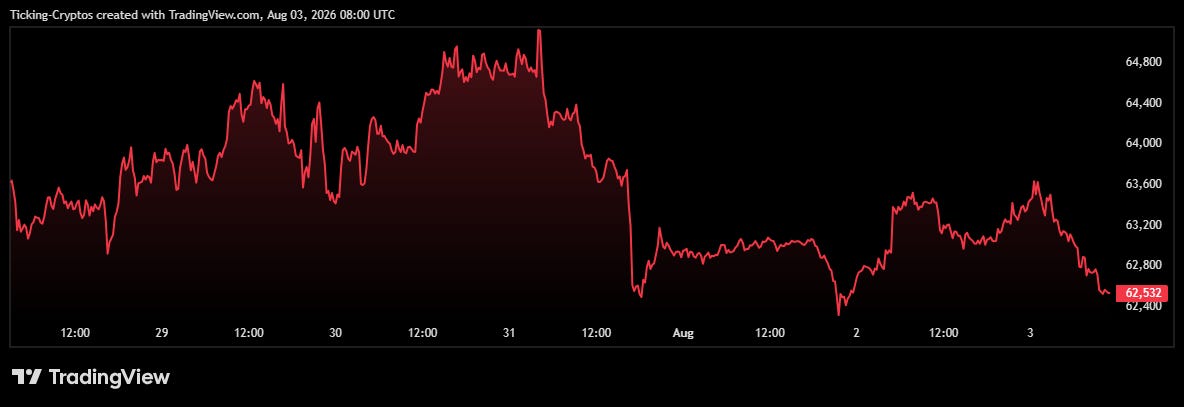
Because almost none of it was new information. Rate risk has been priced since June. Hack fatigue is real. Strategy’s loss is an accounting entry on coins it has not sold. The market took a hawkish central bank, a custody scandal, a treasury writedown and an AI deleveraging event, and gave back roughly four cents on the dollar.
That is a controlled bleed, not capitulation. Nobody should read it as strength. But a market that has already discounted this much bad news is also a market with less left to sell, and those are the ones that move hardest when the data finally turns.
One tell worth noting: the selling was not indiscriminate. Cardano is up 10.45% over the same seven days and Monero is up 3.62%, while Hyperliquid dropped 13.41% and Ethereum gave back 6.09%. That is rotation inside a weak tape, not a market-wide flush.
Top 15 assets as of Monday morning, with the seven-day move:
$BTC $62,586 (-4.31%)
$ETH $1,847.85 (-6.09%)
$BNB $581.61 (+1.12%)
$XRP $1.06 (-3.88%)
$SOL $72.49 (-5.52%)
$TRX $0.3254 (-1.92%)
$HYPE $52.10 (-13.41%)
$DOGE $0.06945 (-4.94%)
$LEO $9.76 (+0.44%)
$ZEC $473.21 (-6.17%)
$XMR $361.56 (+3.62%)
$ADA $0.1840 (+10.45%)
$LINK $8.23 (-6.87%)
Total market cap sits around $2.25T with Bitcoin dominance near 56%. BTC is still trading under its 50-day, 100-day and 200-day EMAs at roughly $64,680, $67,200 and $73,000. The level to reclaim is $64,567. Support sits at $61,400, then $59,070. Prices move fast, so check live before acting.
👉 Compare crypto exchanges side by side →
Leopold Aschenbrenner: How a $45 Billion AI Fund Collapsed in Days, and What It Means for Crypto
A 25-year-old ex-OpenAI researcher lost most of a $45bn fund in a week on 4x leverage. The mechanics, the FTX thread, and why Bitcoin shrugged.
Bitcoin Treasury Model Under Fire: Strategy Posts $8.22 Billion Loss as BTC Slips Below $63,000
Strategy booked an $8.22 billion quarterly loss and Coinbase missed again. Here is what crypto’s brutal earnings week means for Bitcoin.
Top 5 Altcoins to Buy in August 2026: Opportunities in Market Consolidation
Bitcoin is stuck just above $60,000 and altcoins have been crushed. Five low-priced tokens with real catalysts, and the risks that come attached.
Monday 3 August, after US close: Palantir reports Q2. Not a crypto name, but after last week it is the cleanest read on whether AI sentiment has actually stabilised or just paused.
Friday 7 August, 8:30 AM ET: US non-farm payrolls for July. This is the week. June printed 57,000 jobs against a 110,000 forecast, following a downward revision in May. A hot number pushes September hike odds higher and squeezes risk assets. A soft one does the reverse and gives Bitcoin room to test $64,567.
Friday 7 August, around this date: Senate summer recess begins, which effectively shuts the CLARITY Act’s 2026 window unless something moves fast. Prediction market odds on passage this year have already collapsed from the low 70s to the low 40s.
This week, day to be confirmed: the xrpld 3.3.0 release for the XRP Ledger is expected, carrying five proposed amendments including two features pulled earlier after bug reports.
Already on the horizon: Pi Network’s mainnet upgrade deadline on 11 August, US CPI for July on 12 August, and Jackson Hole from 27 to 29 August. Payrolls and CPI together will decide September, so this week and next are the whole story.
Situational Awareness has been compared all week to a 1998 blowup: a fund run by star traders and two Nobel laureates that used enormous leverage, unravelled in weeks, and forced the New York Fed to organise a rescue. What was it called?
A) Amaranth Advisors
B) Long-Term Capital Management
C) Archegos Capital
D) Bear Stearns High-Grade Fund
. . . (scroll for the answer) . . .
.
.
.
.
.
.
.
.
.
.
.
.
.
Answer: B) Long-Term Capital Management.
Founded in 1994 with Myron Scholes and Robert Merton on the roster, LTCM built enormous leveraged positions on the assumption that its models were right about how markets behave. In 1998 the Russian debt default proved otherwise, and the Fed organised a roughly $3.6 billion bailout from a group of Wall Street banks to stop the unwind spreading. The lesson has been relearned roughly once a decade since: Amaranth in 2006, Archegos in 2021, and now this. The thesis is rarely what breaks first. The financing is. 📉
This newsletter is for informational purposes only and does not constitute financial advice. Cryptocurrencies are volatile and carry significant risk. Always do your own research before making any investment decisions.
No posts
Comments
Nothing yet. Say the first thing.
Sign in to join the conversation.