

In the last month, the quantum threat officially became a human rights matter, the first ever live demo of BIP 360 at TABConf showed a real implementation of this BIP, and new breakthroughs that pushed the boundaries of what quantum hardware can do...including Quantinuum’s new quantum computer with 48 error-corrected logical qubits, and thoughts on Trezor’s new quantum-resistant wallet features.
Let’s dive in!
Human Rights Foundation’s report on the quantum threat to Bitcoin
Quantinuum unveils first QC with 48 error-corrected logical qubits
Trezor adds “quantum readiness”
First live SLH-DSA transactions at TABConf
CryptoSnake interview with Hunter Beast: the quantum threat explained
Bitcoin Rails episode with Martin Shkreli: Hacking Satoshi’s coins
Quantum computers cross 6,000 qubit mark
NVIDIA launches NVQLink for hybrid quantum-AI systems
Google’s Willow chip shows verifiable quantum advantage
Harvard runs a quantum computer for two hours straight
The Human Rights Foundation (HRF) published a report framing the quantum threat to Bitcoin as a human rights matter. It warns what we already know: Millions of coins could be liquidated once quantum computers break ECC, but with a twist.
They argue that Bitcoin is a tool used by dissidents, activists and independent journalists to receive support, safeguard savings and transact outside dictatorial controls.
Failing to upgrade Bitcoin before a cryptographically relevant quantum computer (CRQC) appears would mean:
• Secure donations get exposed.
• Private savings get compromised.
• Uncensored transactions get stopped.
So in this situation, people under repression risk losing way more than just coins.
The report highlights BIP 360 as a “signature‐scheme agnostic proposal that makes Taproot addresses quantum-resistant and provides a flexible framework for future post-quantum algorithms via a soft-fork.”
They also underline Hourglass as the only viable proposal to date being considered by the community for P2PK coins, beside burning and doing nothing.
Here’s an Anduro X thread that summaries the report:

You can also read the full HRF report for more detailed information.
Dubbed Helios, Quantimuum launched a trapped-ion quantum computer built on its Quantum Charge-Coupled Device (QCCD) architecture and manufactured by defense contractor, Honeywell.
The system operates with 98 physical qubits and demonstrates 48 error-corrected logical qubits with 99.99 % state-preparation and measurement fidelity.The near 50 % logical-to-physical ratio is achieved through efficient qubit reuse and overlapping error-correction cycles, allowing the same ions to support multiple logical operations without requiring hundreds of physical qubits per logical one (like in other quantum systems).
They also announced:
• A real-time control engine for hybrid quantum-classical programming.
• Guppy, a Python-based language for mixed workloads.
• Integration with NVIDIA NVQLink and CUDA-Q for future real-time error correction.
• Partnerships with Amgen, BMW Group, JPMorganChase, and SoftBank Corp.
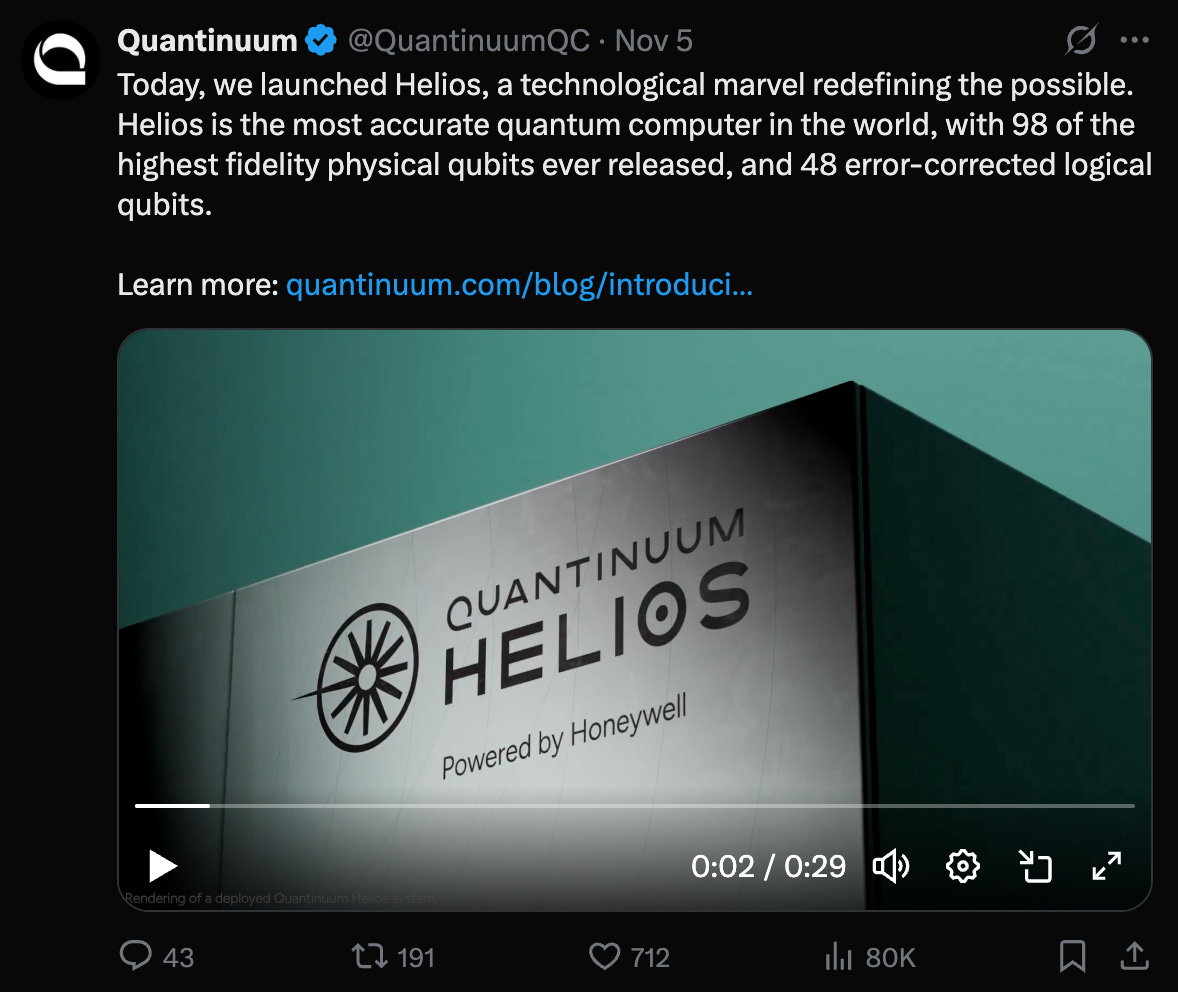
Because trapped-ion quantum computers prioritize fidelity and coherence over speed, they could only sustain long-exposure attacks, not the short-exposure attacks that require faster gate operations. Read the full release
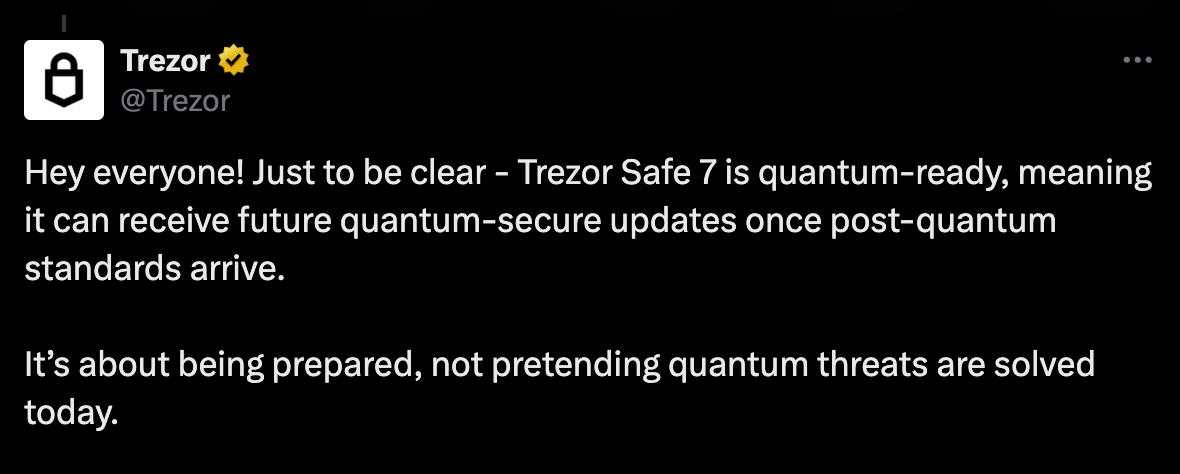
Trezor launched its Safe 7 wallet and called it “quantum-ready.”
This means it can receive future post-quantum updates once standards are finalized. It does not make the wallet fully quantum resistant, as for that to be true, Bitcoin should also be secured.
Read more: Trezor Guide
Quantum took center stage at this year’s TABConf.
Hunter Beast and the Anduro team showed the first working SLH-DSA transactions to Pay to Tapscript Hash addresses on Signet.
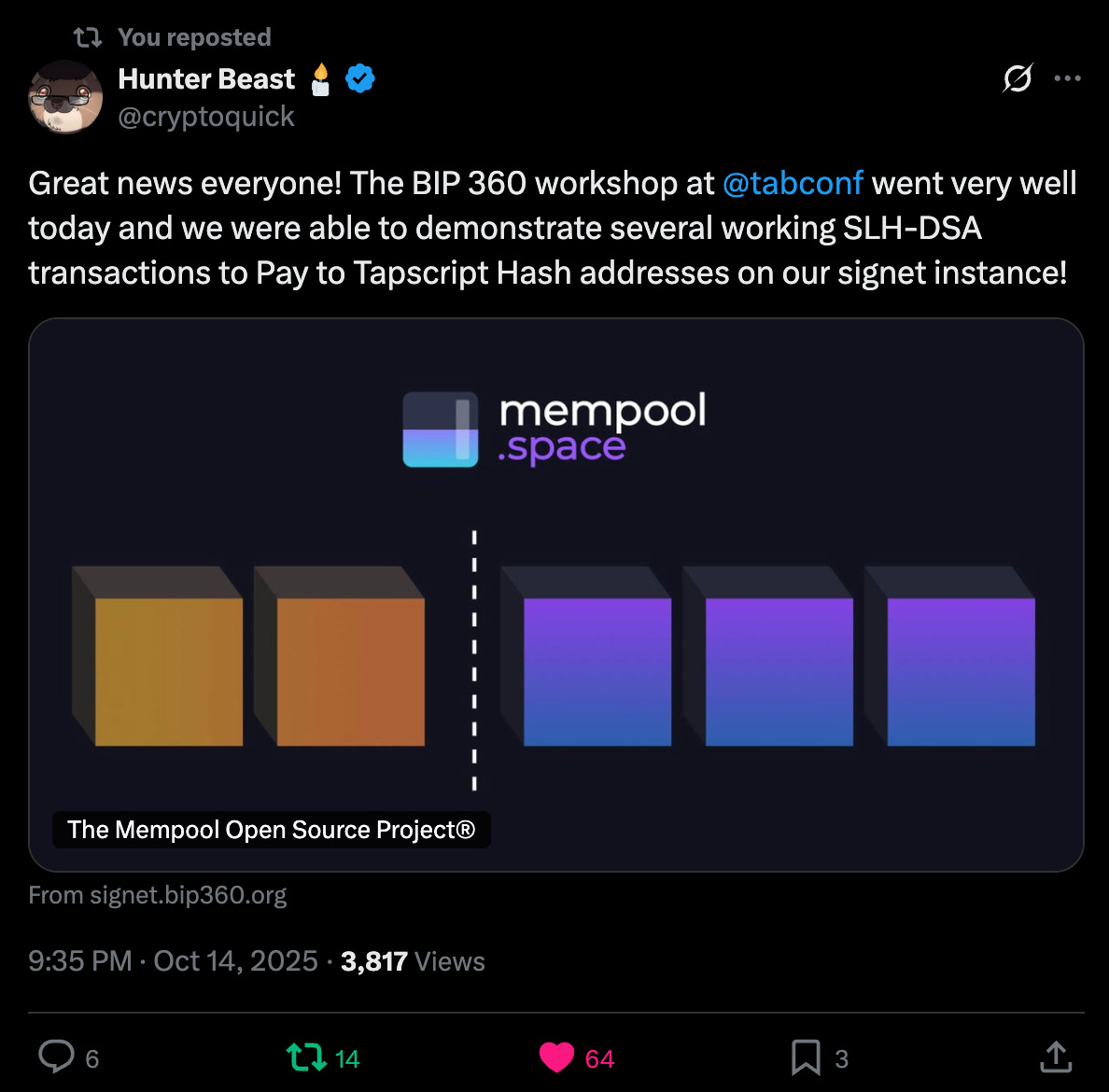
TABConf hosted eight sessions on quantum computing, signaling that Bitcoin developers are taking the threat seriously as quantum progress advances.
Michael Casey summed it up like this:
“The Bitcoin Interface team attended leading Bitcoin technical conference TABConf last week, which was quantum-resistance themed this year, validating a strong quantum focus at the protocol level. Three MARA team members were highlighted as key speakers: Hunter Beast, Isabel Foxen Duke and Mike Casey.”
Hunter joined CryptoSnake to explain how quantum computers could soon threaten Bitcoin’s elliptic-curve cryptography.
He traced the problem to early defense research and showed how new qubit designs are moving closer to running Shor’s algorithm.
He explained the difference between long-exposure and short-exposure attacks: Satoshi-era coins and reused addresses are most at risk, while SegWit and hashed outputs remain safe until spent.
Projects like Project 11 estimate that over 6.7 million bitcoin are vulnerable.
BIP 360 removes elliptic-curve spending paths and replaces them with hash-based scripts, introducing addresses that start with bc1z.
Martin Shkreli joined Isabel Foxen Duke on Bitcoin Rails to talk about how he’s raising funds to hack Satoshi’s coins.
Shkreli described two possible attack paths: quantum computing and AI-driven math.
The conversation covered why hacking Bitcoin would be the “ultimate mathematical achievement,” why quantum may pose a bigger risk to Bitcoin than to traditional tech, and why a real exploit would be unlike anything the network has faced before.
► 6,000 Qubit Milestone
Caltech physicists announced that quantum computers have surpassed 6,000 qubits with 99.98 percent accuracy. “Qubits aren’t useful without quality. Now we have both,” said researcher Gyohei Nomura. Read more
► NVIDIA NVQLink
NVIDIA announced NVQLink, an architecture that connects quantum processors with supercomputers and AI systems. The U.S. Department of Energy will use it to build hybrid quantum-classical machines for materials and chemistry research. Read more
► Google Willow
Google’s Willow chip achieved a verifiable quantum advantage. The new “Quantum Echoes” algorithm ran 13,000 times faster than classical methods, showing reproducible results across systems. Read more
► Harvard Breakthrough
Researchers at Harvard and MIT kept a quantum computer running for two hours straight by replenishing qubits as they decayed. The team believes fully continuous quantum operation could arrive within two to three years. Read more
Bitcoin’s path to quantum resistance is getting clearer. BIP 360 and other post-quantum efforts are building the framework for Bitcoin’s long-term resistance, while the subject keeps getting more and more traction in the space, as seen in TABConf.
But timelines matter. Quantum progress is accelerating, and coordination is key. We still have enough time to act.
Remember: Be prepared, not scared.
No posts
Comments
Nothing yet. Say the first thing.
Sign in to join the conversation.