
For much of 2026, the crypto industry believed it was witnessing history in the making.
After years of regulatory uncertainty, countless committee hearings, and endless debates over whether digital assets should fall under the SEC or the CFTC, Washington finally appeared ready to deliver a comprehensive framework for cryptocurrencies.
The CLARITY Act wasn’t just another piece of legislation.
It was expected to become the law that would finally answer the biggest questions surrounding Bitcoin, Ethereum, XRP, stablecoins, exchanges, token issuers, and the future of digital asset innovation in the United States.
Industry leaders celebrated.
Investors grew increasingly optimistic.
Prediction markets assigned overwhelming odds that the bill would become law before the summer ended.
Then, almost overnight, the momentum disappeared.
Instead of a historic Senate vote, lawmakers shifted their attention elsewhere. The legislation quietly slipped off the calendar, leaving one of crypto’s most important policy battles unfinished.
Now, what was once considered inevitable has become one of the biggest political questions facing the digital asset industry
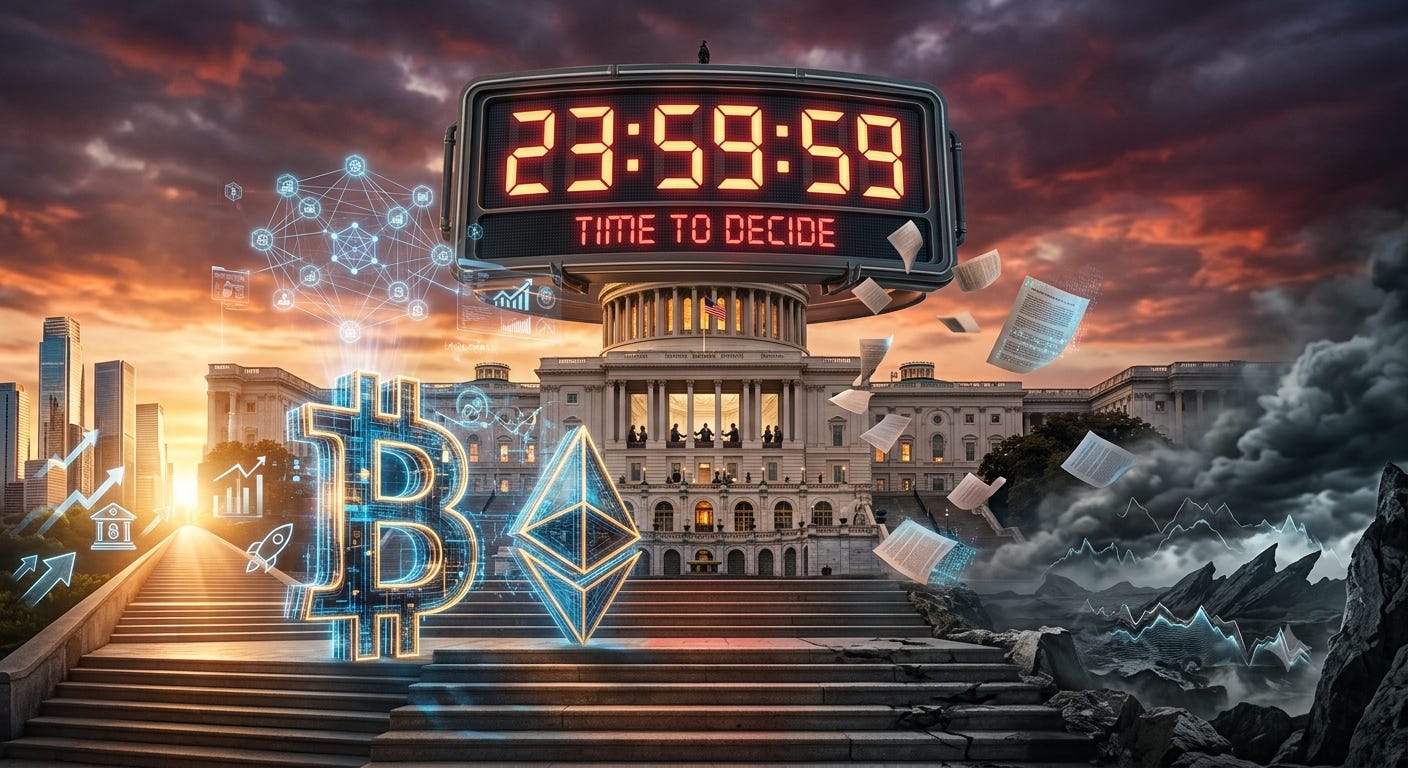
.
The latest version of the CLARITY Act is unlike any previous draft.
Rather than making small adjustments to earlier proposals, lawmakers combined multiple committee drafts into a single 616-page legislative package.
The merged version brings together work from both the Senate Banking Committee and the Senate Agriculture Committee while introducing entirely new sections covering ethics rules, law enforcement powers, anti-money laundering provisions, and sanctions.
Its goal is ambitious.
Instead of regulating cryptocurrencies through fragmented guidance and enforcement actions, the legislation attempts to establish a permanent legal framework for digital assets.
At its core, the bill separates cryptocurrencies into distinct regulatory categories.
Digital commodities would primarily fall under the Commodity Futures Trading Commission.
Investment contract assets would remain under Securities and Exchange Commission oversight.
Payment stablecoins would operate under a dedicated regulatory framework alongside existing stablecoin legislation.
Perhaps even more importantly, the bill introduces a pathway allowing blockchain networks to evolve. Projects that become sufficiently decentralized could eventually move out of securities regulation and into commodity status, providing developers and investors with long-term regulatory certainty.
For an industry that has spent years navigating legal ambiguity, that represents a significant shift.
Among hundreds of pages of legislative text, one section has generated extraordinary attention across the crypto industry.
The legislation introduces an Exchange-Traded Product grandfather clause.
While the wording may sound technical, its implications are enormous.
Under this provision, cryptocurrencies already supporting qualifying exchange-traded products before January 1, 2026 would automatically receive permanent non-security treatment.
That list includes Bitcoin.
Ethereum.
XRP.
Solana.
Dogecoin.
Instead of relying on changing regulatory interpretations or future enforcement decisions, these assets would receive clear statutory recognition under federal law.
For institutional investors, asset managers, and ETF providers, that level of certainty could dramatically reduce legal risk.
It’s one of the reasons so many industry participants viewed the CLARITY Act as a potential turning point for digital assets in the United States.
Ironically, the biggest obstacle facing the bill wasn’t Bitcoin.
It wasn’t stablecoins.
It wasn’t decentralized finance.
It was government ethics.
During negotiations, lawmakers introduced a new ethics title intended to strengthen public confidence in the legislation.
The proposal sought to prevent the President, Vice President, Members of Congress, and their spouses from sponsoring or issuing cryptocurrency projects while serving in office.
On the surface, the compromise appeared sensible.
It addressed growing concerns about potential conflicts of interest while allowing the broader legislation to move forward.
But the details quickly became controversial.
The responsibility for enforcing these ethics rules would rest exclusively with the Department of Justice.
That immediately raised concerns among several Democratic lawmakers.
Critics argued that assigning enforcement solely to the executive branch created an obvious weakness, particularly if allegations involved the President himself.
Instead of resolving political disagreements, the ethics provision created an entirely new dispute.
Several senators who had previously supported earlier versions of the legislation publicly withdrew their backing.
What was supposed to be the final compromise suddenly became the biggest reason the bill stalled.
As negotiations continued, the tone surrounding the CLARITY Act changed dramatically.
Only weeks earlier, supporters believed the Senate would quickly approve the legislation before beginning its summer recess.
Industry organizations encouraged supporters to contact lawmakers.
Executives expressed confidence that the finish line was finally within reach.
But inside Congress, momentum was quietly fading.
Instead of scheduling the anticipated floor vote, Senate leadership shifted its attention toward judicial nominations and other legislative priorities.
The CLARITY Act remained alive.
It simply stopped moving.
That distinction matters.
In politics, delays often prove just as significant as outright opposition.
Every week without action reduces legislative momentum, complicates negotiations, and introduces new political variables that can reshape the outcome.
For a bill requiring bipartisan support, timing is almost as important as the legislation itself.
Although this debate is unfolding in Washington, its consequences extend far beyond Capitol Hill.
The CLARITY Act isn’t simply another regulatory proposal.
It has the potential to determine how cryptocurrencies are classified, traded, regulated, and adopted across the world’s largest financial market.
For institutional investors, regulatory clarity reduces uncertainty.
For exchanges, it creates operational stability.
For developers, it establishes predictable rules for innovation.
And for everyday investors, it helps answer one of the biggest questions facing crypto today:
What exactly are digital assets under U.S. law?
That question remains unanswered—for now.
But as the Senate prepares to return in September, the industry’s most important legislative battle is far from over.
The CLARITY Act hasn’t been defeated.
But it has lost something that may prove just as valuable in Washington:
Momentum.
For most of this year, the legislation appeared unstoppable. Industry leaders spoke confidently about bipartisan cooperation, lawmakers described crypto regulation as a national priority, and investors began preparing for what many believed would become the most important digital asset law in American history.
Today, the mood is very different.
The Senate’s decision to postpone floor consideration until after the summer recess has transformed certainty into uncertainty. While the bill technically remains alive, every delay introduces new political risks, competing priorities, and fewer legislative days to finish one of the most ambitious financial reforms Congress has attempted in years.
For crypto markets, that uncertainty matters almost as much as the legislation itself.
One of the clearest signs of changing expectations can be seen in prediction markets.
Earlier this year, traders overwhelmingly believed the CLARITY Act would pass before the end of 2026. Optimism was fueled by successful committee votes, bipartisan negotiations, and public support from both lawmakers and industry organizations.
That confidence has now weakened dramatically.
As negotiations stalled and the Senate shifted its focus toward other legislative priorities, expectations for immediate passage declined sharply.
Markets are beginning to recognize an important reality:
Passing a comprehensive 616-page financial bill during an election cycle is never easy.
Every week without progress increases the possibility that the legislation could face additional amendments, new political compromises, or further delays.
None of those outcomes necessarily kill the bill.
But each one makes the path forward more complicated.
Despite the political uncertainty, one conclusion remains remarkably consistent.
Bitcoin’s position appears stronger than ever.
The merged draft continues to recognize Bitcoin as a digital commodity rather than a security, reinforcing the framework that institutional investors have increasingly adopted over the past several years.
For Bitcoin holders, this legislation is less about changing today’s market and more about protecting tomorrow’s.
Permanent statutory recognition would remove much of the regulatory uncertainty that has followed Bitcoin throughout its history.
Instead of relying on changing interpretations from different administrations, Bitcoin would receive legal certainty through federal legislation.
That stability could encourage additional institutional participation over the coming decade.
Ethereum also stands to benefit significantly.
Like Bitcoin, Ethereum would receive stronger legal clarity under the proposed framework, reducing uncertainty surrounding its regulatory treatment.
This matters because Ethereum continues to serve as the foundation for decentralized finance, tokenization, stablecoins, and thousands of blockchain applications.
Developers, institutional investors, and financial firms all benefit when the legal status of the underlying network becomes easier to understand.
Greater certainty often translates into greater investment.
Perhaps no major cryptocurrency is watching this legislation more closely than XRP.
After years of legal uncertainty, the proposed grandfather provision would permanently recognize XRP alongside Bitcoin, Ethereum, Solana, and Dogecoin as qualifying exchange-traded product assets.
For institutional investors, that’s more than symbolic.
It removes a major layer of legal ambiguity that has influenced investment decisions for years.
Many analysts believe regulatory certainty would strengthen the case for additional institutional products and broader adoption.
For XRP holders, the legislation represents something larger than another political debate.
It represents the possibility of finally closing one of crypto’s longest-running regulatory chapters.
Although disappointment surrounds the missed summer deadline, the story isn’t over.
Attention now shifts toward September.
When lawmakers return, the CLARITY Act will once again compete for valuable Senate floor time alongside government funding debates, nominations, and other legislative priorities.
Supporters still believe bipartisan agreement remains possible.
Critics continue demanding stronger ethics enforcement.
The outcome will depend on whether negotiators can rebuild the political coalition that weakened during July.
Every compromise matters.
Every amendment matters.
Every vote matters.
For an industry worth trillions of dollars globally, the stakes extend far beyond Washington.
The significance of the CLARITY Act extends well beyond regulation.
It reflects a broader question confronting the United States.
Can America establish clear rules for digital assets before innovation increasingly moves elsewhere?
Around the world, governments are accelerating their crypto strategies.
Some are building comprehensive licensing frameworks.
Others are encouraging tokenization, digital asset investment, and blockchain innovation through regulatory clarity.
Meanwhile, uncertainty continues to shape many decisions within the United States.
Developers delay projects.
Companies postpone expansion.
Institutional investors wait for clearer rules.
The longer uncertainty persists, the greater the competitive advantage for jurisdictions that have already established predictable regulatory environments.
That’s why the CLARITY Act matters even to people who never trade Bitcoin.
It influences the future of financial innovation itself.
The summer countdown may have ended, but the real battle is only beginning.
The merged draft remains one of the most comprehensive digital asset frameworks ever proposed in the United States.
Its core principles remain intact.
Its supporters remain committed.
Its opponents continue pushing for stronger safeguards.
September now represents more than another legislative session.
It may become one of the most important months in the history of American cryptocurrency regulation.
If lawmakers can rebuild bipartisan support, the CLARITY Act could finally deliver the regulatory certainty the industry has sought for years.
If negotiations fail again, uncertainty could continue well into the next political cycle.
Either outcome will shape Bitcoin, Ethereum, XRP, stablecoins, exchanges, and institutional investment for years to come.
One thing is already certain.
The crypto industry is no longer waiting for technology to mature.
It is waiting for Washington.
And the decisions made in the months ahead may prove just as influential as any blockchain innovation the industry has ever produced.

No posts
Comments
Nothing yet. Say the first thing.
Sign in to join the conversation.