
“For the first time in crypto history, the industry’s future may be decided not by the market... but by Congress.”
If you’ve spent the past few weeks watching Bitcoin prices, ETF flows, or the latest AI token rally, you may have missed what could become the single most important event in crypto’s history.
It isn’t another ETF approval.
It isn’t a new Layer-1 blockchain.
It isn’t even Bitcoin’s next all-time high.
Instead, it’s a piece of legislation quietly moving through the United States Congress.
The CLARITY Act.
For years, the crypto industry has operated in one of the most uncertain regulatory environments in modern finance. Companies have launched products without knowing which regulator would oversee them. Developers have built decentralized protocols while wondering whether their software might eventually be treated like a traditional financial institution. Investors have watched lawsuits unfold simply because no one could agree on a basic question:
When is a crypto asset a security, and when is it a commodity?
The CLARITY Act attempts to answer that question.
If passed, it would establish the first comprehensive federal framework for digital assets in the United States, creating clearer boundaries between the Securities and Exchange Commission (SEC) and the Commodity Futures Trading Commission (CFTC). It would also introduce rules for decentralized finance (DeFi), stablecoins, tokenized securities, fundraising exemptions, and blockchain developers.
In short, it could reshape the future of the entire crypto industry.
But despite strong bipartisan momentum, the bill now faces its biggest obstacle yet—not politics, but time.
The House has already approved the legislation with a decisive 294–134 vote, and the Senate Banking Committee advanced it by 15–9. Yet several contentious issues remain unresolved, including stablecoin rewards, developer protections, ethics provisions, and anti-money laundering requirements.
To become law, the bill still needs to clear the full Senate, where a 60-vote threshold makes every remaining day on the legislative calendar increasingly important.
Many analysts now believe that if Congress fails to pass the bill before the August recess, its chances of becoming law this year could diminish significantly.
For crypto, this isn’t just another legislative debate.
It’s a race against the clock.
And at the moment, the clock appears to be winning
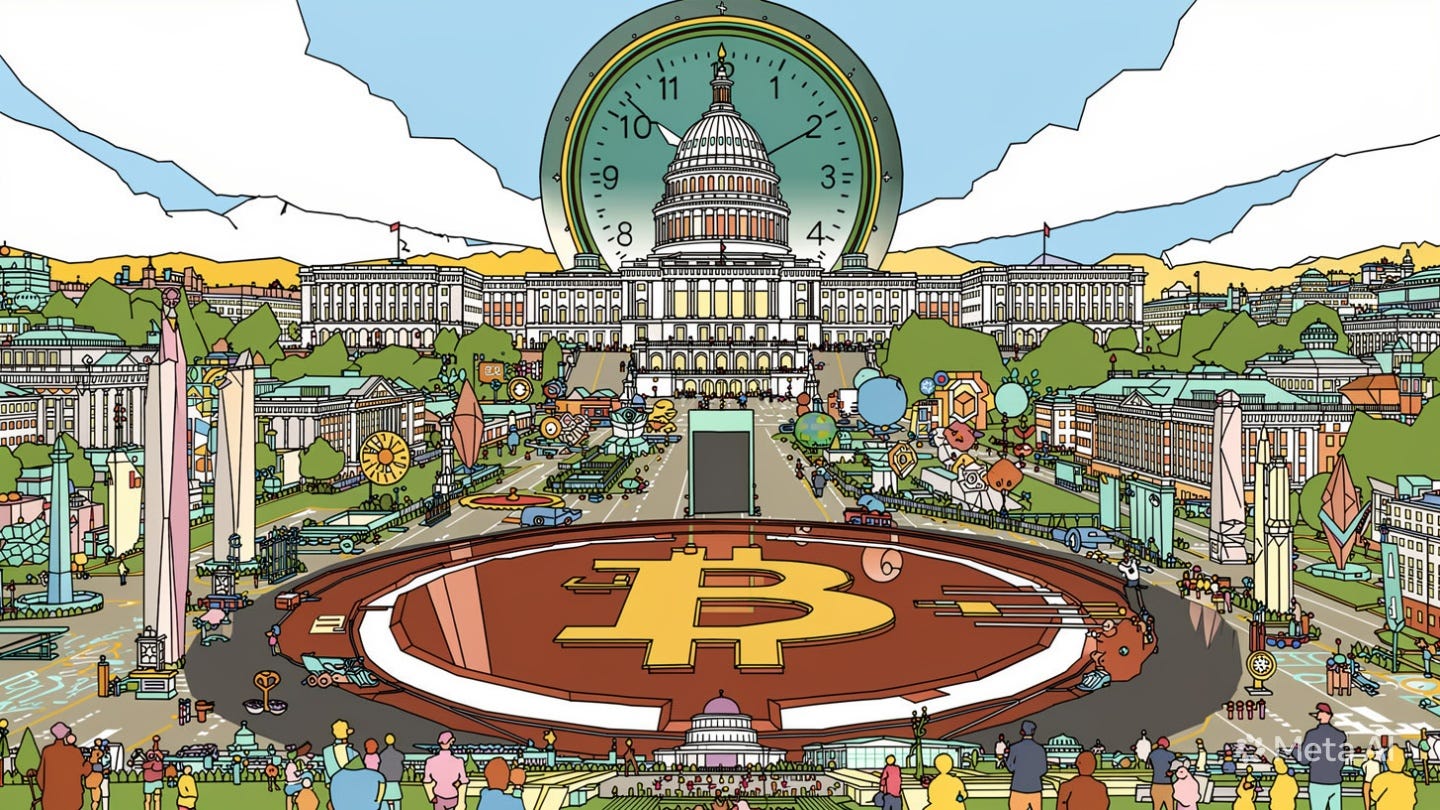
Before we dive deeper, here’s a snapshot of where things stand today.
✅ House Vote: 294–134 in favor
✅ Senate Banking Committee: Approved 15–9
🎯 Senate Floor Requirement: 60 votes needed
📅 White House Goal: Final passage before the August congressional recess
⚖️ Key Issues Still Under Debate: Stablecoin rewards, DeFi regulation, developer protections, ethics provisions, and banking concerns
⏳ Market Outlook: Analysts increasingly describe the next few weeks as the most important legislative window in U.S. crypto history.
Bitcoin ETFs changed how investors buy crypto.
The CLARITY Act could change how crypto itself operates.
That distinction matters.
An ETF influences capital flows.
Legislation determines the rules of the game.
Without regulatory clarity, every major participant in the digital asset ecosystem faces uncertainty.
Crypto exchanges don’t always know which regulator has jurisdiction.
Developers risk building products that could later be classified under entirely different legal frameworks.
Institutional investors hesitate to commit long-term capital because regulatory expectations remain fluid.
Even banks have been cautious about expanding crypto services due to unclear compliance obligations.
The CLARITY Act attempts to solve these problems by creating a more predictable legal framework.
Rather than treating every digital asset the same way, the bill recognizes that blockchain networks evolve over time.
Some projects begin as highly centralized ventures that resemble traditional securities offerings.
Others gradually decentralize until no single entity controls the network.
The legislation introduces a framework for recognizing that evolution.
In practical terms, a blockchain network that meets defined decentralization standards could eventually transition from SEC oversight toward CFTC supervision.
This may sound like a technical legal distinction.
It isn’t.
It fundamentally changes how projects raise capital, list on exchanges, attract institutional investors, and operate within U.S. markets.
For many crypto founders, this represents the regulatory certainty they’ve been requesting for nearly a decade.
To understand why this legislation is generating so much attention, it’s important to remember how fragmented crypto regulation has been.
Since Bitcoin launched in 2009, the industry has largely developed without a dedicated federal framework.
Instead, regulators have relied on decades-old securities laws written long before blockchain technology existed.
That approach has created years of legal uncertainty.
Different agencies have sometimes offered conflicting interpretations.
Companies have spent millions defending themselves in court simply to understand which rules apply.
The CLARITY Act doesn’t eliminate every disagreement.
But it provides something the industry has desperately needed:
A roadmap.
Under the proposed framework, the SEC would continue overseeing traditional investment contracts and tokenized securities, while the CFTC would supervise qualifying digital commodities and spot markets.
The bill also acknowledges that tokenization does not exempt an asset from existing financial regulations.
A stock remains a stock, even if it exists on a blockchain.
A Treasury security remains a Treasury security, even if ownership is represented digitally.
This distinction may prove essential as tokenized real-world assets (RWAs), stablecoins, and blockchain-based financial infrastructure continue expanding across global markets.
Rather than forcing blockchain technology into outdated legal definitions, lawmakers are attempting to modernize those definitions for a digital economy.
If successful, the CLARITY Act could become the legal foundation for the next generation of crypto innovation—not only in the United States, but potentially around the world.
“The biggest threat to the CLARITY Act isn’t a lack of support. It’s the growing list of issues that lawmakers still can’t agree on.”
For a bill that enjoys bipartisan backing, the CLARITY Act has encountered an extraordinary number of obstacles.
On paper, the legislation appears to have significant momentum. It has already cleared the House with an overwhelming bipartisan vote and survived committee review in the Senate.
Yet beneath those headline victories lies a much more complicated reality.
The debate has shifted away from whether crypto deserves federal legislation and toward what kind of crypto industry America actually wants to build.
That disagreement has created several political fault lines that could determine whether the bill reaches the President’s desk—or stalls indefinitely.
If there is one issue that has divided lawmakers, regulators, banks, and crypto companies more than any other, it is stablecoins.
On the surface, stablecoins appear simple.
They are digital tokens designed to maintain a stable value, usually pegged to the U.S. dollar.
In practice, however, they represent one of the biggest disruptions traditional banking has faced in decades.
Every dollar held inside a stablecoin wallet is potentially one less dollar sitting inside a commercial bank.
For banks, that matters enormously.
Deposits fund lending.
Lending generates profits.
If billions—or eventually trillions—of dollars migrate into blockchain-based payment systems, traditional banks risk losing one of their most valuable funding sources.
That concern has become the centerpiece of negotiations.
One of the most debated provisions in the CLARITY Act focuses on stablecoin rewards.
Crypto companies argue that users should be allowed to earn rewards for using stablecoins in payment networks, decentralized finance applications, or merchant ecosystems.
Banks see those rewards differently.
To them, rewarding users for holding stablecoins looks remarkably similar to paying interest on deposits.
Their concern is straightforward.
If stablecoins begin offering attractive returns while maintaining dollar stability, consumers may increasingly choose digital wallets over traditional savings accounts.
That possibility has sparked intense lobbying from the banking sector.
The compromise currently under discussion attempts to split the difference.
Under the proposal, issuers would generally be prohibited from paying rewards simply for holding idle stablecoin balances.
However, rewards linked to actual payment activity—such as spending, transfers, or network participation—could still be permitted under certain circumstances.
Neither side is fully satisfied.
Banks argue the distinction remains too narrow.
Crypto companies argue it unnecessarily limits innovation.
As a result, negotiations continue.
The second major conflict centers around regulatory authority.
For years, one question has dominated nearly every crypto lawsuit in America.
Who should regulate digital assets?
The Securities and Exchange Commission believes many tokens should fall under securities law.
The Commodity Futures Trading Commission argues that sufficiently decentralized assets resemble commodities.
The CLARITY Act attempts to draw a clearer line.
Rather than allowing overlapping interpretations, the legislation creates a pathway for digital assets to transition as networks mature.
Projects that remain heavily dependent on founders or centralized organizations would generally remain under SEC oversight.
Projects that achieve sufficient decentralization could eventually move under CFTC jurisdiction.
That transition represents one of the bill’s most important innovations.
Instead of forcing every blockchain project into a permanent legal category, lawmakers recognize that networks evolve over time.
Supporters believe this creates a far more realistic regulatory framework.
Critics worry the decentralization tests may still leave room for interpretation.
One of the least discussed—but potentially most important—sections of the legislation concerns software developers.
Today, many blockchain developers worry that simply writing open-source code could expose them to financial regulations originally designed for banks or payment processors.
That uncertainty has discouraged innovation.
The CLARITY Act attempts to address this through provisions often referred to as the Blockchain Regulatory Certainty Act (BRCA) or Section 604.
The basic principle is simple.
Developers who merely publish software—and who never control customer assets—should not automatically be treated as money transmitters.
Imagine someone creates a decentralized wallet application.
They don’t hold user funds.
They don’t execute transactions.
They simply write code.
Should that developer face the same regulatory obligations as a global financial institution?
Supporters say no.
Law enforcement organizations are less convinced.
Several agencies argue that broad developer exemptions could create opportunities for criminal organizations to exploit decentralized infrastructure while making investigations significantly more difficult.
This debate has become one of the most closely watched parts of the bill.
Finding the right balance between innovation and accountability remains a difficult challenge.
Even if lawmakers resolve the technical questions surrounding crypto regulation, another obstacle remains.
Politics.
Several Democratic senators continue pushing for stronger ethics provisions within the legislation.
Their argument is that government officials and elected leaders should face clearer rules regarding personal involvement in cryptocurrency businesses and investments.
Supporters believe stronger ethics language would improve public confidence in the legislation.
Opponents argue these provisions could unnecessarily complicate negotiations and delay passage.
The disagreement extends beyond ethics.
Lawmakers also continue debating anti-money laundering requirements, reporting standards, and consumer protection measures.
Every additional amendment improves some parts of the bill while making bipartisan consensus slightly harder to maintain.
Ironically, the CLARITY Act’s greatest challenge may no longer be political disagreement.
It may simply be time.
Congress operates according to a fixed legislative calendar.
Committee hearings...
Budget negotiations...
Appropriations bills...
Election priorities...
Judicial confirmations...
All compete for limited floor time.
That means every week of delay increases the likelihood that crypto legislation gets pushed behind other national priorities.
Many policy analysts now describe the period before the August congressional recess as the critical window.
If lawmakers fail to complete negotiations before then, attention could quickly shift toward election politics and year-end spending packages.
History shows that controversial legislation rarely becomes easier to pass as the calendar becomes more crowded.
For crypto, this transforms the next several weeks into a race against time.
Every unresolved issue reduces the probability of final passage.
Every postponed vote narrows the legislative runway.
And every political compromise becomes harder as competing priorities accumulate.
It is easy to view the CLARITY Act as simply another Washington policy debate.
That would be a mistake.
Regulation shapes markets.
Clear rules encourage investment.
Uncertainty discourages capital formation.
If this legislation succeeds, institutional investors gain greater confidence.
Banks receive clearer compliance guidance.
Developers know the legal boundaries within which they can innovate.
Tokenization projects gain more predictable operating environments.
Stablecoin issuers receive regulatory certainty.
Crypto exchanges finally understand which regulator oversees which products.
In short...
The bill doesn’t just regulate crypto.
It could redefine how the entire digital asset industry grows over the next decade.
“For years, the crypto industry has waited for regulatory clarity. Now, the biggest obstacle isn’t political support—it’s the calendar.”
At this point, the debate is no longer centered on whether Congress understands crypto.
The debate is whether Congress has enough time.
Legislative calendars are unforgiving.
Every session day is already packed with budget negotiations, appropriations bills, judicial confirmations, defense spending, foreign policy debates, and dozens of competing priorities.
Crypto is competing for attention in one of the busiest congressional calendars in recent memory.
That is why many policy analysts describe the next few weeks as the most important legislative window the crypto industry has ever faced.
If lawmakers can resolve the remaining disagreements before Congress leaves for the August recess, the CLARITY Act has a realistic path toward becoming law.
If negotiations drag into late summer or autumn, the probability of passage declines sharply.
History provides countless examples.
Bills that appear inevitable in early summer often disappear beneath election politics, fiscal negotiations, and year-end legislative packages.
Momentum matters in Washington.
And momentum is heavily influenced by timing.
The August congressional recess isn’t an arbitrary deadline.
It represents a natural break in the legislative calendar.
Once lawmakers leave Washington, priorities shift.
Campaign schedules intensify.
Committee work slows.
Political messaging begins replacing policymaking.
When Congress eventually reconvenes, lawmakers often focus on government funding deadlines, emergency appropriations, and must-pass legislation.
Complex policy reforms become increasingly difficult to advance.
For crypto, this creates enormous pressure.
Supporters of the CLARITY Act understand that every postponed vote reduces the probability of final passage this year.
The challenge isn’t necessarily opposition.
It’s available time.
Rather than obsessing over daily political headlines, investors should focus on three developments that are most likely to determine the bill’s outcome.
If lawmakers announce a compromise that satisfies both banking groups and crypto companies, confidence in the legislation could improve dramatically.
Stablecoin provisions remain one of the largest remaining obstacles.
Any breakthrough here would represent significant progress.
Committee approval is important.
Floor votes are decisive.
The moment Senate leadership officially schedules debate, markets are likely to interpret that as a sign that negotiations have reached their final stages.
Timing matters almost as much as the vote itself.
The House demonstrated unusually strong bipartisan backing.
The Senate will require similar cooperation.
Watch carefully for additional senators publicly endorsing the legislation.
Every bipartisan statement reduces uncertainty.
Every public disagreement increases it.
At this stage, two very different futures remain possible.
If Congress completes negotiations before the legislative window closes, the crypto industry enters an entirely new phase.
For the first time, exchanges operate under clearly defined rules.
Developers understand where legal boundaries exist.
Institutional investors gain confidence.
Banks expand blockchain services.
Stablecoin issuers receive regulatory certainty.
Tokenized assets become easier to integrate into traditional financial markets.
The conversation shifts away from regulation...
...and toward adoption.
That transition alone could reshape investment flows for years.
The alternative scenario is less dramatic—but potentially more damaging.
Negotiations continue.
Compromises remain unfinished.
Congress moves on to other priorities.
The legislation slips into the next session.
Crypto returns to operating under the same uncertain regulatory environment that has defined much of the industry’s history.
Lawsuits continue.
Agencies interpret existing statutes differently.
Companies hesitate before expanding.
Developers consider relocating overseas.
Institutional investors remain cautious.
Nothing collapses overnight.
But nothing truly changes either.
Sometimes uncertainty is more damaging than strict regulation.
Markets can adapt to rules.
They struggle to adapt to unknowns.
The CLARITY Act is often described as crypto legislation.
That description doesn’t fully capture its significance.
At its core, the bill addresses something much larger.
The future of digital finance.
Tokenized Treasury securities.
Blockchain-based payment systems.
Digital identity.
Tokenized real estate.
On-chain equity markets.
Programmable financial contracts.
Artificial intelligence agents capable of conducting autonomous transactions.
Every one of these innovations requires legal infrastructure.
Without regulatory clarity, adoption slows.
With regulatory clarity, innovation accelerates.
The legislation therefore affects far more than cryptocurrency prices.
It influences how financial infrastructure itself evolves.
Bitcoin was born during the global financial crisis.
It challenged assumptions about money.
Ethereum challenged assumptions about software.
Stablecoins challenged assumptions about payments.
Decentralized finance challenged assumptions about banking.
Tokenization is now challenging assumptions about ownership itself.
Each innovation has pushed the financial system toward a more digital future.
But innovation alone isn’t enough.
Markets eventually require rules.
Not because regulation creates innovation...
...but because certainty encourages investment.
The CLARITY Act represents the first serious attempt to build those rules at a national level.
Will it solve every regulatory question?
Certainly not.
Will everyone agree with every provision?
Probably never.
But perfection has never been the standard for meaningful legislation.
Progress has.
For years, crypto has existed in regulatory limbo.
Companies built products while waiting for clearer guidance.
Developers wrote code without knowing whether future regulators would classify them as software engineers or financial intermediaries.
Institutional investors watched from the sidelines, waiting for Congress to define the playing field.
That moment may finally be approaching.
Whether the CLARITY Act ultimately succeeds or fails, one conclusion has become impossible to ignore.
The conversation has fundamentally changed.
Washington is no longer asking whether crypto matters.
It is debating how crypto should be governed.
That shift alone represents one of the most important milestones in the industry’s history.
The next 30 days may determine whether the United States becomes the global leader in digital asset regulation—or whether the industry continues searching for certainty elsewhere.
One thing is clear.
The race has begun.
And for now...
the clock is still winning.
If you found this deep dive valuable, consider sharing Crypto Community News with fellow investors, builders, and blockchain enthusiasts.
Every week, we go beyond the headlines to explain what’s happening, why it matters, and what it could mean for the future of crypto.
Until next time,
Stay informed. Stay curious. Stay ahead of the market
.
No posts
Comments
Nothing yet. Say the first thing.
Sign in to join the conversation.