
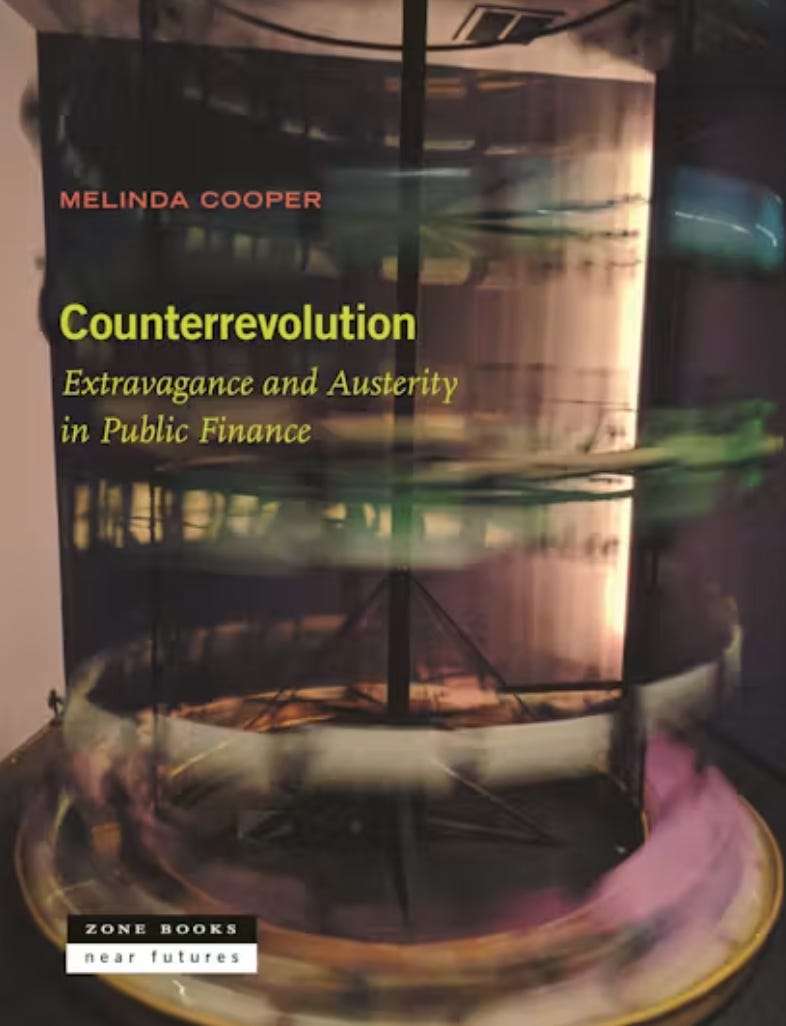
The story of counterrevolution in the United States, beginning in the 1970s, is neither an easy one to untangle nor explain, but it’s one we all should know about, understand, and share with others, so as to be prepared for a collective leftist revolution to once and for all overcome and smash the technofascist and neoliberal parasite class, who are not only threatening our collective and individual well-beings, but life on earth as we know it. Drawing from Melinda Cooper’s incisive, detailed, and skillfully analyzed study titled Counterrevolution: Extravagance and Austerity in Public Finance (Zone Books, 2024), I’ll explain why public austerity is fomenting action across classes of people and, ultimately, flattening economic differences between races, genders, and the sexes. Therein also lies the hope of this unfolding situation and the paradoxical tension of capitalism itself, i.e., race, class, and gender tensions are an inevitable piece of the economic system and can never be eliminated—indeed, it’s the modus operandi of capitalism to have these struggles built into the system (it’s a newer, more nuanced twist on Marx’s concept of the capitalist class vs. the proletariat class). But before digging into the nitty-gritty of Cooper’s text and how public austerity is working against capitalism itself, here’s a brief background on Cooper herself—first off, she is a sociologist and researcher at Australian National University. Her bio states that her “research focuses on the interaction between neoliberal and new conservative philosophies of power.” She is also interested in biopolitics. In 2017, she authored Family Values: Between Neoliberalism and the New Social Conservatism, arguing that the principle of family responsibility is a cornerstone of the relationship between neoliberal and new conservative practices of government. Cooper’s areas of expertise also include neoliberalism and new conservatisms; the far right; economic sociology; social and political theory; and feminist theory.
So, what did this long counterrevolution, which began in the U.S. during the 1970s, entail? What and, even more importantly, whom were the instigators after? Finally, how do we collectively fight back, and are we already fighting back?
To be clear, the 1970s were a period of intense economic volatility that pushed Keynesian capitalism and the welfare state1 to the brink, purportedly leaving policymakers and politicians to abandon their applications. While it is true that the welfare state was facing battles on many fronts—competition with foreign trade, skyrocketing oil prices, rising wages, and new social demands at home,2 Cooper makes it clear that the outcome we’re currently experiencing, especially in the U.S. and in Great Britain, and how things unfolded since then, was not a foregone conclusion, as many experts, both on the left and the right, and in various scholarly fields, contend. Indeed, other countries, such as Australia and France, reacted differently and, as she notes, took a “softer approach” to the eventual adoption of neoliberal economic policies. In the U.S., on the other hand, it became a laboratory of the most extreme forms of this harsh, inhumane, intolerable economic system under which the majority of people are now struggling to survive, many of whom are barely eking out a living to get by. Notably, the start of this neoliberal “shock therapy,” as Cooper notes, began under Reagan in the U.S. and Thatcher in Great Britain.3
Prior to this shock therapy, however, there was a massive battle between capital and labor during the 1970s. Those on the right, i.e., those who wanted the adoption of neoliberal economic policies, saw this as a fight for their lives, and in some cases, their souls. Furthermore, it wasn’t just about economics. This counterrevolution became conjoined with morality and religion, too, with abortion eventually becoming the right’s victorious battle cry, a calculated and strategic move that we’ve recently seen play out in the Supreme Court with the overturning of Roe v. Wade in the devastating case of Dobbs v. Jackson on June 24, 2022.
One of the major players and battlers on the right was the Virginia school economist James M. Buchanan (1919 - 2013). According to Buchanan, the country's economic travails in the 1970s and earlier resulted from a “behavioral revolution.” As Cooper quotes him, he asserted that the “‘generalized erosion in public and private manners, increasingly liberalized attitudes towards sexual activities, a declining vitality of the Puritan work ethic, deterioration in product quality, explosion of the welfare rolls, widespread corruption in both the private and the governmental sector, and finally, observed increases in the alienation of voters from the political process’”4 were all factors contributing to the fiscal and monetary crises of the decade and before.
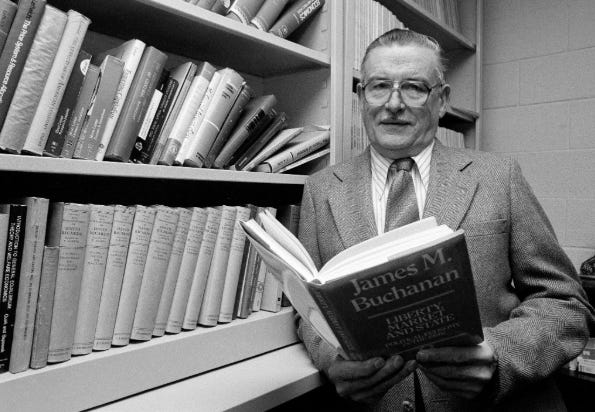
Buchanan delusionally feared the way in which student activists and Black political radicals “took aim at the nexus between the university, the petrochemical industry, and U.S. imperialism,” and viewed them as “new barbarians.”5 (This charged, racist language is not surprising, coming from the right, of course.) All of this was too overwhelming for the delicate Buchanan, and while he claimed he wanted to fight them on campus, he instead bought a farmhouse in Appalachia and fled there when things became too much.
He was not alone in having these sentiments. Arthur Laffer (1940 - ), as Cooper notes, a Chicago School economics graduate, supply-side economist, and scholar who was part of Gerald Ford’s Department of the Treasury, wrote similarly and apocalyptically, even going as far as to invoke God when speaking to a group of financial analysts in New York City. Laffer also felt that capitalism was perhaps doomed. Cooper adds, “Dwindling returns on financial assets and ever-expanding social budgets convinced Laffer that the future of capitalism was relentlessly bleak.”6 (If only that had turned out to be the case; we wouldn’t be facing climate catastrophe and a vicious white supremacist in the Oval Office now, but I digress.)
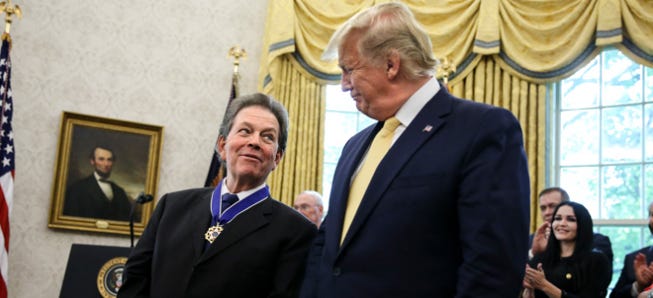
While these statements by Buchanan, Laffer, and other right-wing economists were greatly exaggerated, they provide us with insights into how the battle at that time, as Cooper points out, “was still in progress and victory was by no means assured.” It’s a good reminder to us, too, that it remains that way to this day, despite the victories that the far right, the Virginia Public School Choice economists, and the supply-side economists have gained on the fiscal and monetary battlefields. (Cooper illustrates the tools that we still have to fight back, and that many of our compatriots are now using. More on that at the end of the essay.)
While the Virginia public school choice theory and the visions of supply-side economists may seem incongruous at first glance, they soon became bedfellows. Here’s a quick description of the two schools of thought: The Virginia public school choice advocates for “constitutional limits to the tax and spending powers of the state at every level of government,” meaning its aim is austerity, whereas the supply-side school “advocated tax cuts without spending restraints or debt limits.” Cooper states that the supply-side economists, who were deeply tied to the U.S. Treasury Department as well as Wall Street traders, had a “more sophisticated analysis of government finance.” This sophistication, in part, comes from their ability to gauge a changing fiscal and monetary environment, once Nixon divorced the dollar from gold, with Columbia University economist and an eventual Nobel Prize winner Robert Mundell keenly aware of how the U.S. could take advantage of this situation with “its position as issuer of the world’s reserve currency to escape the zero-sum constraints binding other economies [across the globe].”7 Supply-siders also favored austerity for the majority of the population, while offering tax cuts and tax incentives only for private wealth creation, an austerity for thee, but extravagance for me mentality, i.e., the majority of the population needed to be ground into bits, while the rich needed to be pampered to the utmost degree, which we’re seeing in the most rapacious of ways today. In other words, as Cooper writes, “fiscal extravagance was possible then, but only in one direction.”8 The two movements agreed to spend only on “certain kinds of public spending,” and both despised Eisenhower Republicanism. This is how one can see a figure such as Newt Gingrich having no qualms about balancing the budget while simultaneously indulging in supply-side theories.
Another outcome of the counterrevolution, most evident, as I see it, in the Trump family, at least with it being in full public view, as there are surely many others like them, is the return of what Cooper describes as “dynastic capitalism.” Similar to the Gilded Age, but at an even more staggering level, is the concentration of wealth among a handful of U.S. families. Cooper adds, “[p]rivate, family-owned corporations have assumed a new prominence in American and global capitalism.”9 For example, families such as the Ellisons have organized corporations to meet their private needs. Some of these entities are unincorporated, “such as private equity firms, hedge funds, and venture capitalists, with [a] ruthless disregard for anything but capital gains in share prices.”10 Cooper describes this concentration of wealth as contributing to the rise of “family offices.” However, in the 1970s, few could have predicted this happening because of “business revanchism.”
This shift to family offices and dynastic capitalism is not, however, emblematic of a return to a form of feudalism, as such “family dynasts of our time enjoy a level of organized public support that medieval lords could only dream of.” Furthermore, their wealth is backed by “non-state-chartered (or shadow) money” and also “permanently backstopped by the world’s most powerful central and private family wealth soars in value with full collusion of fiscal and monetary authorities.”11 Some might argue that the wealthy, or private wealth, have always been protected in this way. However, Cooper asserts that the Federal Reserve has “socialized [my emphasis] the risks of private wealth as never before, while exposing mere wage earners to the full violence of the free market.”12 And violent it is for all of us, except, of course, for those at the top, who, as Cooper notes, are insulated from it and the ramifications of the financial risks they take—we’re the ones left cleaning up their financial messes, while they get off scot-free, and when that happens, the rest of us pay for it dearly.
The architects behind the 2017 Tax Cuts and Jobs Act were five supply-siders, former Tea Party movement terrorists, and prior alumni of the Reagan administration—Arthur Laffer, Stephen Moore, Steve Forbes, Lawrence Kudlow, and David Malpass.13 Inspired by Reagan’s Economic Recovery Tax Act (ERTA) of 1981, Trump implemented his own version. Interestingly, and sadly for the majority of the U.S. populace, Trump benefited enormously from Reagan’s ERTA, as Cooper calls him a “child of the supply-side revolution.” She calls him this because of the way in which the real estate sector received reinforced defenses for “its existing tax shelters, including more generous depreciation allowances and a reduction in the tax rate on rental and mortgage-interest income.”14 ERTA also reduced the marginal tax rate owed on their income. At the same time, supply-side economists in the Reagan Administration, with the assistance of the Federal Reserve, also jumped at any hint of wage or consumer price inflation, “help[ing] usher in a new organization of economic life in which asset price appreciation through debt leverage came to replace growth in the national product as the catalyst of wealth creation.”15 In other words, according to economist Jacob A. Robbins’ thesis, as cited by Cooper, wealth creation since the 1980s has derived from asset appreciation rather than investment savings. Put simply, this economic shift has since then solidified inherited wealth and wealth concentration at the top (hence the dynastic wealth of families like the Ellisons, the Kochs, the Waltons, and even lesser-known families who stay out of the limelight). Naturally, this model also entailed massive tax cuts for wealthy families and corporations.
So, while the wealthy enjoyed new levels of extravagance and do so now in a way that has never been experienced by any human beings to ever grace this planet, these tax cuts that provided them with this form of living, along with this major economic shift implemented by neoliberals, came with a major price tag, one that entailed a violent prick to the people’s collective finger. But it didn’t just end with a prick to the finger. Massive bloodletting of sorts was necessary for those at the top to enjoy lavish benefits, such as asset appreciation, tax cuts, and the concentration of wealth they so enjoy. While they are and were just a few in number compared to the rest of the population, their demands are high, but services and needs for all of us don’t stop as a result of the neoliberal shift in capitalist economics. Therefore, austerity for the public was a necessity, they claimed, and so its implementation at the micro level began in haste, even before the 1980s (recall that this story of neoliberalism and supply-side economics begins in the 1970s).
Here’s where white supremacy and class come into play, and also serve as a forerunner to Reagan’s national laboratory. Cooper homes in on New York City in 1975 as “supply-side ground zero.” At the time, the city was facing bankruptcy, so it turned to the federal government for a bailout. Enter Treasury Secretary William E. Simon, who was first appointed in 1974 by President Nixon as the 63rd Secretary of the Treasury, and then was reappointed by President Ford until 1977. Simon, an early proponent of supply-side economics and free-market capitalism, came in with a draconian, brutal restructuring plan for the city.

The financial crisis began quite abruptly after New York City was unable to “roll over its short-term debt and finance its current expenditures.” To make matters worse, it could no longer rely on banking partners it had done business with for years. As Cooper notes, “the city’s exclusion from the municipal bond markets was sudden and brutal.”16 New York City was not alone in this situation, as major cities, especially industrial ones in the Northeast and Midwest, were experiencing similar predicaments due to a decade of losses from property and tax revenue,17 and deindustrialization. In addition, the Nixon Administration cut off federal antipoverty programs, plus investment funds had left American bond markets. It was a perfect storm.
In addition, Cooper notes, New York City needed to be punished. She explains:
[T]he city’s long history of social and labor activism, nourished by generations of political refugees, an enduring commitment to rent control, its unique network of local hospitals, its City University offering free tuition to residents, and an initially militant public sector singled it out for a special kind of venom on the part of business reformers. When the city was forced to the brink of default in the spring of 1975, President Ford and his advisors (among them, Alan Greenspan, Donald Rumsfeld, and William Simon) were determined to make an example of it. Treasury Secretary William Simon . . . proved especially intransigent when it came to meting out punishment. The city, he wrote, was a victim of a Ponzi scheme that had relied on the taxes of its productive, private-sector workers to subsidize the salaries of municipal workers and their welfare clientele—eventually driving the productive out of the town. ‘Liberal politics, endlessly glorifying its own ‘humanism,’ has, in fact, been annihilating the very conditions for human survival.’18
President Lyndon Johnson’s War on Poverty and a multitude of critical welfare services came to an end, and with it, migrants, militant labor workers, Black and Brown urban dwellers, and others were left in the tsunami’s wake from the destructive path of a newly implemented neoliberal economic model. That was just the beginning, too, of course. On top of these savage punishments to the city’s populace, Treasury Secretary William Simon wasn’t done there. He had a few more tricks up his sleeve. He also came up with the notion of a “capital shortage,” “to account for problems in the bond market.” In fact, there was no shortage of capital, and having been a former specialist in municipal bonds, Simon should have known better that New York banks were actually flush with cash “after the oil price hikes of the early 1970s, Arab oil producers had deposited the bulk of their surplus petroleum dollars in New York banks, who were then entrusted with finding the best investment opportunities for their clients.”19 Fearing inflation in the U.S., however, the banks placed the investments in so-called developing nations, shifting their power to choose where and how much they could lend, either at home or abroad. As Cooper notes, and much like financial mobsters wielding bats, “bond investors were now in a position to bring cities to their knees.” This in turn forced state and city legislators to implement “balanced budgets.” Simon also “urged the city to increase its sales tax and extend it to food and medicine.” While the city didn’t follow his advice entirely, they did introduce regressive taxation plans, such as transit fees, tuition hikes at the City University of New York, and so forth.
One of the people in New York City who benefited the most from the fiscal crisis of 1975 was none other than the rapacious, amoral Donald Trump. As Cooper explains, he received his first tax abatement then. Cooper continues:
At forty years in duration, it remains the longest-lasting in the city’s history. The tax write-off allowed Trump to turn the dilapidated Commodore Hotel on Forty-Second Street and Lexington Ave into the luxury Grand Hyatt. Since Donald Trump, at twenty-nine years old, was still an unknown quantity, negotiations were overseen by his father, Fred, whose history of lucrative government housing contracts afforded him a direct line to city officials. In addition to hundreds of millions of dollars in gifts he received from his father, most of it artfully protected from the estate tax . . . Today, the city’s finance department calculates that the annual loss in tax revenues from the Grand Hyatt deal alone has been colossal, rising from $6.3 million in 1983 to $17.8 million in 2016. But the Grand Hyatt was only the first of the fifteen Manhattan construction projects that Trump would pursue over the following years, each time exploiting a range of tax exemptions on offer and never hesitating to turn to hardball litigation when the city tried to thwart him . . . All up, city tax records indicate that Trump has reaped at least $885 million in tax breaks to construct his real estate empire of luxury apartments, hotels, and office buildings.20
New York City, as Simon wrote in his free-market manifesto, ironically titled A Time for Truth, was just a microcosm of what was to come for the rest of the United States. Of course, as he saw it, as already mentioned above, the city was running an overall “Ponzi scheme,” because, God forbid, there be robust public services and equity, such as free education, rent control, labor activism, and a healthy system of local hospitals, all of which mostly supported Brown and Black USers along with migrants.
Another major turning point, which began what Cooper calls the “tax revolts,” was Proposition 13 in California, otherwise known as the Jarvis-Gann Amendment in 1978. Here we must return to one of the economic extremists mentioned earlier: James M. Buchanan. Buchanan correctly surmised in the late 1960s that there would be collective backlash, especially among white voters, against Johnson’s War on Poverty and his Great Society Programs.
Cynically, Buchanan believed that this had to do with how tax dollars were being spent on “the kind of person they had to be shared with,” meaning, of course, good ol’ fashioned racism needed to be fostered to drum up racial resentment, especially toward Black people. Using populist and progressive reformist language, Buchanan “arrived at dramatically opposing positions on tax and spending.” For starters, there needed to be constitutional limits on the government’s ability to tax and spend in order to protect the taxpaying minority from majority rule. When it came to populism, he turned the villains into the opposite camp; i.e., instead of the bankers on Wall Street and land speculators being the bad guys, it was the welfare poor and public-sector workers whom he viewed as “unproductive parasites.” Propertied whites, too, were to be protected at all costs against Black people and poor white people. Proposition 13 in California was his ticket to something eventually on a grander, national scale. So, what was it exactly?
Proposition 13, or Prop 13, won with 65% of the vote, a resoundingly high figure, meaning it was extremely popular. Prop 13, the Jarvis-Gann Amendment of 1978, was a knee-jerk response from suburban homeowners “who had seen their property tax assessments ratcheted up under the influence of house price inflation.”21 The amendment curtailed the ability of state and local governments to tax, lowered property taxes to 1% of assessed market value, and imposed a 2% per year cap on tax assessments for as long as homeowners continued to occupy their homes.22 Most importantly, it placed significant constitutional limitations on how local governments—city councils and special districts—could tax. After Prop 13 was enacted, several other propositions followed. Soon thereafter, Proposition 4 came about. Prop 4 hamstrung local governments' ability to make appropriations, weakened their powers, and compelled them to reimburse taxpayers if they exceeded annual limits.23 In 1986, Proposition 58 was also passed, “exempting houses bequeathed from parents to children from market value reappraisal at the moment of transfer.” All of these moves made home ownership central to building wealth, effectively creating a division between renters and homeowners. Even worse, this tax revolt would be replicated across the country, triggering a multitude of tax revolts.
This has also given Republicans in California tremendous veto power over government revenue decisions, and we all know what that means for spending on public services, as Cooper notes.
The tax revolts were successful for two intertwined reasons: white supremacy and racism. White people have long forgotten, willfully so, I would argue, that they have received, as Cooper aptly notes, asset-based welfare during the New Deal and shortly after World War II. By the 1960s and 1970s, as mentioned already, a mass exodus was occurring, and white people were fleeing from the cities for the white spaces of suburbia, all the while they were proudly telling themselves that they had built their neighborhoods from their own sweat and hard work. But that was far from the truth. It was a blatant lie. Again, they had received asset-based welfare from the government. Meanwhile, and without an ounce of irony, they were resentful of Johnson’s Great Society programs and the influx of federal money going into the cities where mostly Black and Brown people live, along with immigrants.24
Then a watershed moment occurred for supply-side economists, neoliberals, and the right: Ronald Reagan was elected as president in 1980, and shortly thereafter, as already mentioned, he and his cronies passed sweeping tax cuts, officially called the Economic Recovery Tax Act (ERTA) of 1981. And, as we now know, fast-forward, in homage to ERTA, Trump passed the 2017 Tax Cuts and Jobs Act and eventually the One Big Beautiful Bill Act (OBBBA),25 a gutting, more radical form of Reagan’s initial tax cuts that further concentrated wealth at the top.
Another critical piece to this story is how the radical right, including supply-side economists and neoliberals, fused evangelicals and Catholics, making them one-issue voters on the matter of abortion. This fusion, however, was initially tricky. At one point, as Cooper notes:
The Catholic philosophy of life, and the radical opposition to abortion it inspired, was deeply alien to American Protestant sensibilities. Born-again Christians were fervent defenders of moral purity, to be sure, but the notion that abortion constituted an assault on unborn life was too closely embedded in natural-law doctrine to warrant their blessing. Indeed, up until the mid-1970s, even the most conservative Baptist and fundamentalist churches in the South expressed support for the legalization of therapeutic abortions within certain time limits.26
But as more time passed, and these conservative groups felt themselves alienated by the changing culture around them, the so-called “liberalization” of American life, as Cooper describes it, they began to “set aside doctrinal differences in the interest of united action.” Abortion suddenly became a galvanizing issue of the moral decay of American society for evangelicals and Catholics alike. This form of moral decay centered on the threat of the (white) family unit collapsing, which is why the family needed protection. Central to this issue was that of the welfare state and taxation.
Interestingly, the term “right to life,” as Cooper points out, first appears in the writing of Catholic social philosopher John Ryan “as a defense of the male breadwinner family wage.”27 Ryan argued, based upon Catholic natural law, that every man who worked had a right to a “living wage” as a result of the sanctity of human life.
Much of the of Catholics opposition to abortion goes back to the 1920s with Margaret Sanger’s efforts to spread birth control. Sanger also aligned herself with the eugenicist movement “at the same time when coercive population control measures very often targeted fellow Catholics from the fringes of Europe.”28 Not surprisingly, yet regrettably, the Catholics never forget this history.
The right made its first foray into forging a relationship with the right-to-life movement when they extended an invitation to Dr. Mildred Jefferson in 1975 to attend the Conservative Political Conference. Jefferson was the daughter of a Methodist minister, a Texas Republican, a black woman, and the first to graduate from Harvard Medical School.29 At that point, she had just been elected president of the National Right to Life Committee, and her mission was to align Catholics and Protestants, as well as white and Black activists together. Jefferson not only worked on the anti-abortion movement, but was also involved with anti-school busing efforts, too.

Her work, however, with the National Right to Life Committee soon became a critical testing ground, as she was asked to train 30 other anti-abortion activists in national campaigns across the country. Then another opportunity came along in 1976 with Catholic Congressman Henry Hyde (R-I), who put forth a proposed amendment to a bill that would ban Medicaid’s funding of abortions. The amendment successfully passed in the House. As soon as it passed in the House, Jefferson’s National Right to Life Committee launched into a high-drive effort to ensure it would pass in the Senate. As the bill's sponsor, Hyde slyly invoked arguments that included both Catholic right-to-life and small-government perspectives. He took it even further to suggest that the unborn who suffered the most came from “the ghetto.” Hyde argued that he was willing to pay for these suffering, aborted babies, so that they could “get an education, decent housing, and adequate clothing.” (Imagine any Republican arguing that today about the unborn growing up and being taken care of!)
But as Cooper notes, not all Republicans made such arguments. On the contrary, Orrin Hatch (R-UT) asserted that federal funding for abortion was a “dangerous diversion of tax dollars to finance the destruction of the family.”30 Hatch went on to falsely argue that funding abortions was directly tied to the dizzying growth of national debt. (Notice, too, how the autonomy of women or pregnant people is not once mentioned in these arguments?)
In 1977, the Senate voted in favor of the Hyde Amendment, which Cooper sees as a major turning point with lasting changes in the history of the anti-abortion movement and the reproductive rights of women and gender-expansive people who can give birth. While some Bishops were unhappy with welfare cuts and the burgeoning relationship between the religious right and the GOP, their ultimate staunch commitment to so-called unborn life trumped everything.
In the end, as we’ve seen and mentioned above, the right won this victory, at least in part, with the overturning of Roe v. Wade in Dobbs v. Jackson on June 24, 2022, and it won’t end there, as these radical extremists continue to threaten full bans on abortion, which, again, boils down to the autonomy of women and gender-expansive people who can become pregnant.
Important questions now remain: Have people passively accepted these massive tax cuts over the years? How are people responding now? What are ways in which we can fight back collectively? There are complex answers to all of these questions, and Cooper does an excellent job in threading them together. The bright spot in her overall grim text is that people have indeed been fighting back, but more can be done. For one, and as I mentioned in the opening of this essay, we are all being weighed down by austerity as a result of austerity, excessive tax cuts, and the concentration of wealth at the top. To be clear, however, that does not mean that our lived experiences are the same. That is critical to note. What does bind us together, however, is public austerity. Cooper also mentions numerous ways in which people are pushing back. For instance, after the Dobbs debacle in 2022, she notes that mutual aid exploded across the country. The left has also been reawakened overall. While it might not be close to the right, it has resurged. For example, socialism now resonates with a number of USers (66% of Democrats view socialism positively). This may seem like nothing, but as Cooper notes, “[b]y far the most insidious legacy of the neoliberal counterrevolution was its foreclosure of the political imagination.”31 One must also note the explosion of Occupy, which began in Zuccotti Park on September 17, 2011, and spread like wildfire across the entire country, a movement that denounced the 1%, making demands for the 99%. Out of this movement grew the Occupy Debt movement that eventually became the Debt Collective, a group that, while I was not directly involved with, I played a direct role in other efforts to quash student loan debt myself when I founded my own nonprofit called All Education Matters, which I ran for close to a decade. Returning to the Debt Collective, along with related groups, as Cooper explains:
have coordinated a series of strategic defaults involving a much broader array of personal debt, with a view to consolidating them into an effective counterforce against the combined powers of private finance and the state. Via its Rolling Jubilee, the collective has purchased on secondary markets with the express purpose of cancling the associated debt. By the time unpaid debt has been sold on to the secondary market, it has lost much of its market value in the eyes of creditors . . . While the Debt Collective claims to have annulled an impressive $852 million of personal debts, its interventions are worth far more than this. By rescuing debtors from the devastating personal ordeal of being hounded by debt collectors for years on end, mass debt cancelation deactivates the entire disciplinary mechanism that sustains the economy of private credit. Collectivized debt default, in this instance, plays much the same role as full employment in Michael Kalecki’s reflections on Keynesianism: it is one method by which the neoliberal antisocial state can be forced to reckon with its limits.32
While I was an activist, too, for student loan debtors, I also insisted on the cancellation of student loan debt. As a result of this messaging, President Joe Biden canceled around $188.8 billion for between 5.3 and 5.9 million borrowers while in office. It shows that being loud and consistent can reach the upper echelons of government and make a difference.
Cooper also mentions the importance of public- and private-sector workers being aligned, as their interests overlap. In this case, she brings up the General Motors strike of 2019 when 48,000 UAW workers walked off the job to protest sagging wages and bad working conditions. Just like the student loan debtors who were angry about the banks on Wall Street being bailed out in 2008, they were also resentful that General Motors had been bailed out by the U.S. Treasury a decade earlier for nearly $50 billion. Cooper adds, “The action was successful in the short term: striking workers managed to secure wage gains and a guarantee of job security in exchange for the closure of Lordstown, Baltimore, and Warren transmission plants.”33
Again, what joins all of us together—white-collar workers, blue-collar workers, university students, “gig workers,” people of different sexes, races, and genders—is the draconian public austerity measures that the neoliberals, supply-side economists, and the Virginia School public choice theorists have foisted upon all of us, as if we were all the same lab rats in a laboratory. As Cooper notes, we all need to work strategically and collectively to better implement coordinated labor strikes, rent strikes, debt defaults, urban defaults, and occupying public space to hurt the value of private wealth.34 With the way in which people have turned out in droves against the Trump Administration for the No King’s Marches, the largest marches in U.S. history, I have hope that coordinating more aggressive efforts that she lists is more than possible. This, again, goes back to reclaiming political imagination. Those of us who have that imaginative political spark and see it in others as well must get to work to alight that flame in others. The good thing is, it’s already there. Millions of people are already politically aflame. Again, it’s just a matter of all of us coming together and getting to work. I trust in us; do you?
Related Reading
Part II: A Continued Discussion with Quinn Slobodian
·
Feb 12

[Interviewer’s Note: Dr. Quinn Slobodian teaches international history at Boston University. His books include Globalists, Crack-Up Capitalism, and Hayek’s Bastards. The last book was a finalist for the National Book Critics Circle Award for criticism. His forthcoming book with Ben Tarnoff is
Part I: A Talk with Scholar Quinn Slobodian
·
Feb 10

[Interviewer’s Note: Dr. Quinn Slobodian teaches international history at Boston University. His books include Globalists, Crack-Up Capitalism, and Hayek’s Bastards. The last book was a finalist for the National Book Critics Circle Award for criticism. His forthcoming book with Ben Tarnoff is
The Racist Bastards We All Need To Know
·
December 15, 2025
Book reviews don’t often start this way, but I feel compelled to say it anyway. But first, let me say this: Quinn Slobodian’s Hayek’s Bastards: Race, Gold, IQ, and the Capitalism of the Far Right is absolutely a must-read. You need to get a copy today. Put down what you’re reading, and buy a copy right no…
Named after British economist John Maynard Keynes (1883 - 1946), Keynesian capitalism is an economic system in which, during recessions or depressions, the market and private enterprise are heavily regulated by government intervention.
Melinda Cooper, Counterrevolution: Extravagance and Austerity in Public Finance (Zone Books, 2025), 7.
Since Cooper focuses on the U.S., she does not mention the shock therapies that South American countries, such as Chile, underwent when the “Chicago Boys” helped implement neoliberal economic policies and so-called free-market reforms under dictatorships like Augusto Pinochet's there from 1973 through 1990, but it’s important to note as well.
Cooper, Counterrevolution, 8.
The loss of tax revenue was directly related to white flight from cities.
Cooper, Counterrevolution, 44.
I want to be clear here: Any group receiving welfare when it’s critical is not a bad thing, but what’s important to note is that white people like to insist that they haven’t benefited from receiving ample amounts of support from the federal government as well.
Incidentally, the name of this bill has got to be the dumbest one of all time.
Cooper, Counterrevolution, 317.
Comments
Nothing yet. Say the first thing.
Sign in to join the conversation.