
When the MAHA Commission ordered a federal reassessment of SSRI safety,
The American Psychiatric Association (APA) was quick to respond with a warning: questioning antidepressants could have “serious deleterious consequences.”
The message was clear. Don’t criticize, don’t doubt, and certainly don’t suggest our drugs might be overprescribed or overrated.
Under the “safe and effective” evergreen, the APA pointed to “decades of rigorous research” supporting the current use of antidepressants. Yet it cited no actual evidence; it simply asserted that the commission’s safety concerns cast doubt on
“this research”.
This defense deserves scrutiny.
So what does the evidence actually show?
There are three main types of studies used to evaluate antidepressants:
The randomized placebo-controlled trial (RCTs)
The long-term observational study
The discontinuation trial
RCTs are considered the gold standard of medical evidence. They are designed to isolate the drug effect by comparing an active medication to an inert placebo. If the drug works, the difference between the two groups should be large. If it doesn’t work, the difference will be small.
Since the first meta-analysis by Kirsch et al. in 1998, hundreds of antidepressant trials have been pooled into meta-analyses, looking at all the available evidence combined (Table 7).
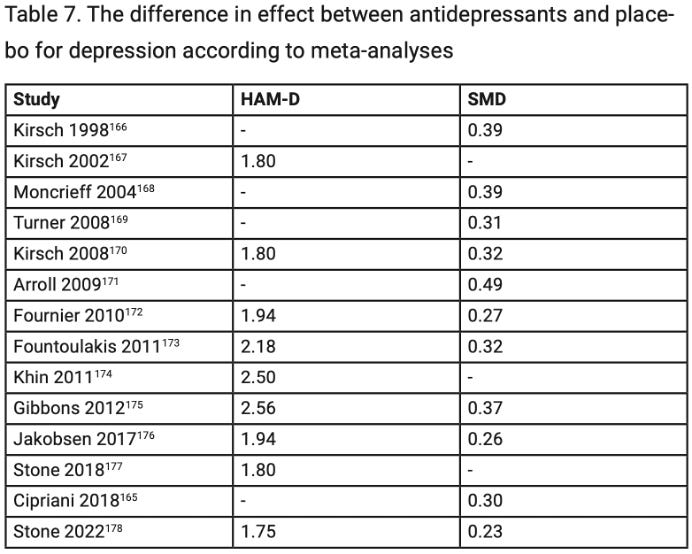
Across meta-analyses, antidepressants outperform placebo by, on average, about two points on a 52-point depression scale.
Two points.
For context, the threshold for a ‘minimal improvement’ is 7 points, while the threshold for ‘much improvement’ is 14 points.
In other words, no meta-analysis to date has shown a clinically significant average effect of antidepressants over placebo. The effects are the same.
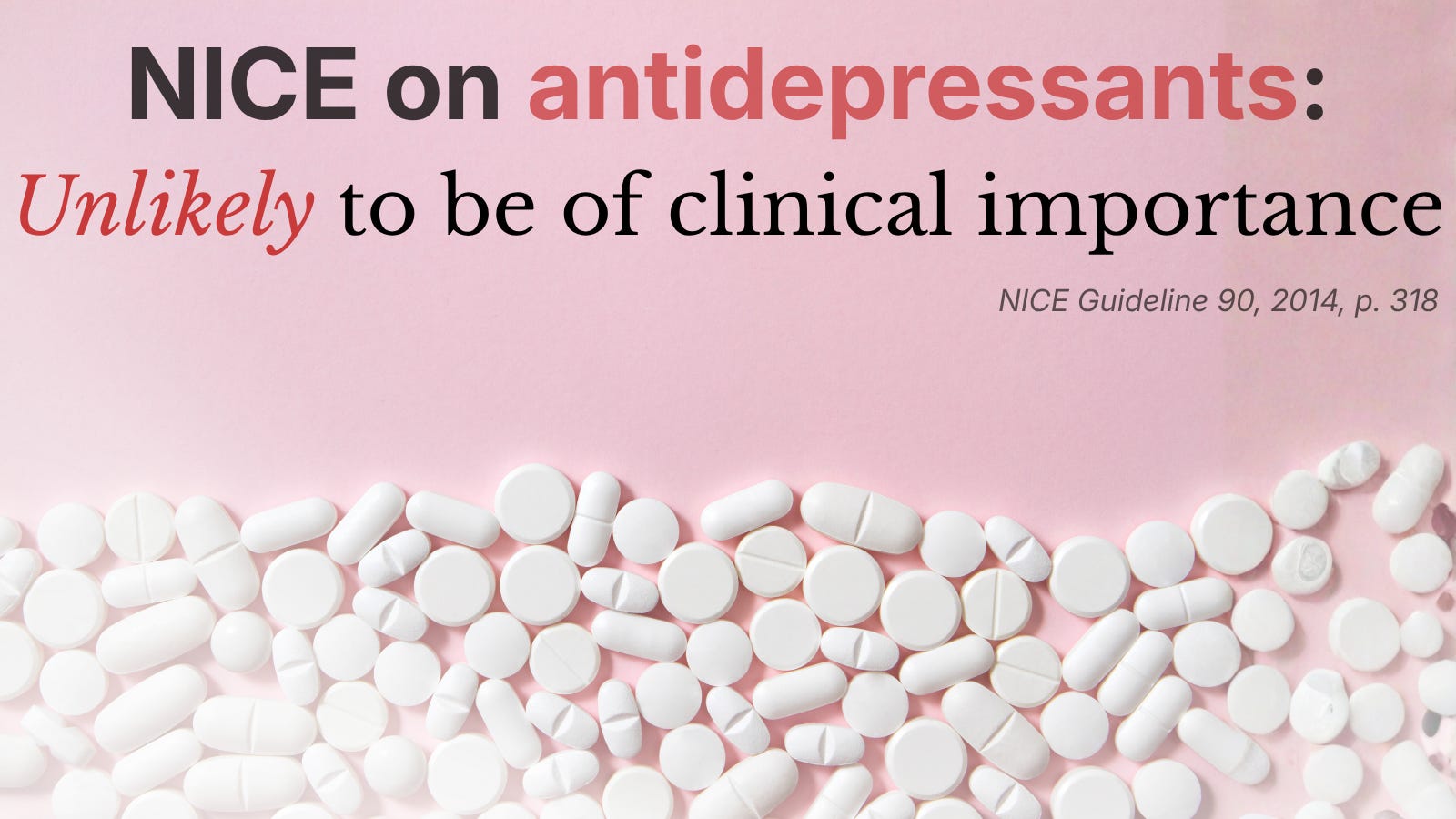
Fun fact: Even the National Institute for Health and Care Excellence (NICE) acknowledged this already in their 2014 guidelines. They write, on page 318:
“The size of this difference [between antidepressants and placebos] is unlikely to be of clinical importance”.
And for anyone who needs proof, here it is:

This does not mean antidepressants have no benefit. It means that much of the benefit people experience stems from factors other than the drug itself – placebo effects, expectancy, hope, time passing, crises resolving naturally, and the meaning attached to treatment – given that nearly the same improvement occurs regardless of what is in the tablet.
This is the essence of a therapeutic illusion: improvement occurs after treatment and is therefore attributed to the treatment.
And even that tiny effect has been challenged by research methodologists. Known problems of these trials include:
Placebo run-in bias – removing early placebo responders before the trial even begins.
Drug washout effects – stopping participants’ prior medication before entering the study, which can produce withdrawal effects that contaminate baseline or early trial outcomes.
Publication bias – negative trials are less likely to see daylight.
Patients breaking blind, because side effects can reveal who is on the active drug.
All of these biases inflate the drug-placebo difference, meaning the true drug effect could be even lower than the two points.
Most RCTs last just 6 to 12 weeks. Yet most people take antidepressants for years.
So what do long-term studies show?
Here, the picture becomes uncomfortable for mainstream psychiatry.
Long-term observational studies and naturalistic follow-ups have generally not shown better outcomes with continued antidepressant use and, in some cases, have reported higher relapse rates, greater chronicity, and poorer functional outcomes among patients who remain on antidepressants long-term compared to those who do not – even after adjustment for baseline severity. (Fava 2003; Pigott et al. 2010; Hengartner 2020; Coryell et al. 1995, Goldberg et al. 1998, Patten 2004).
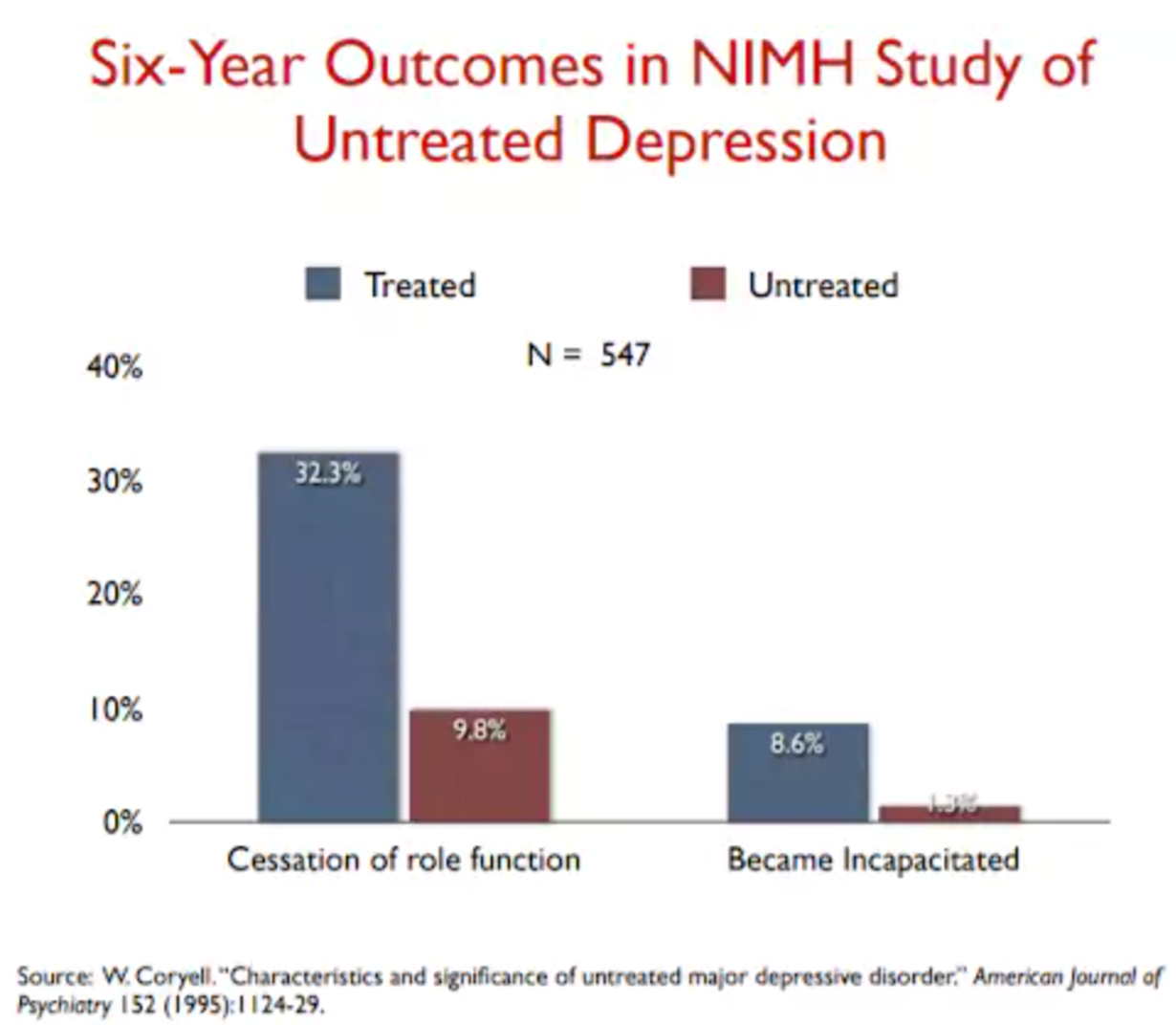
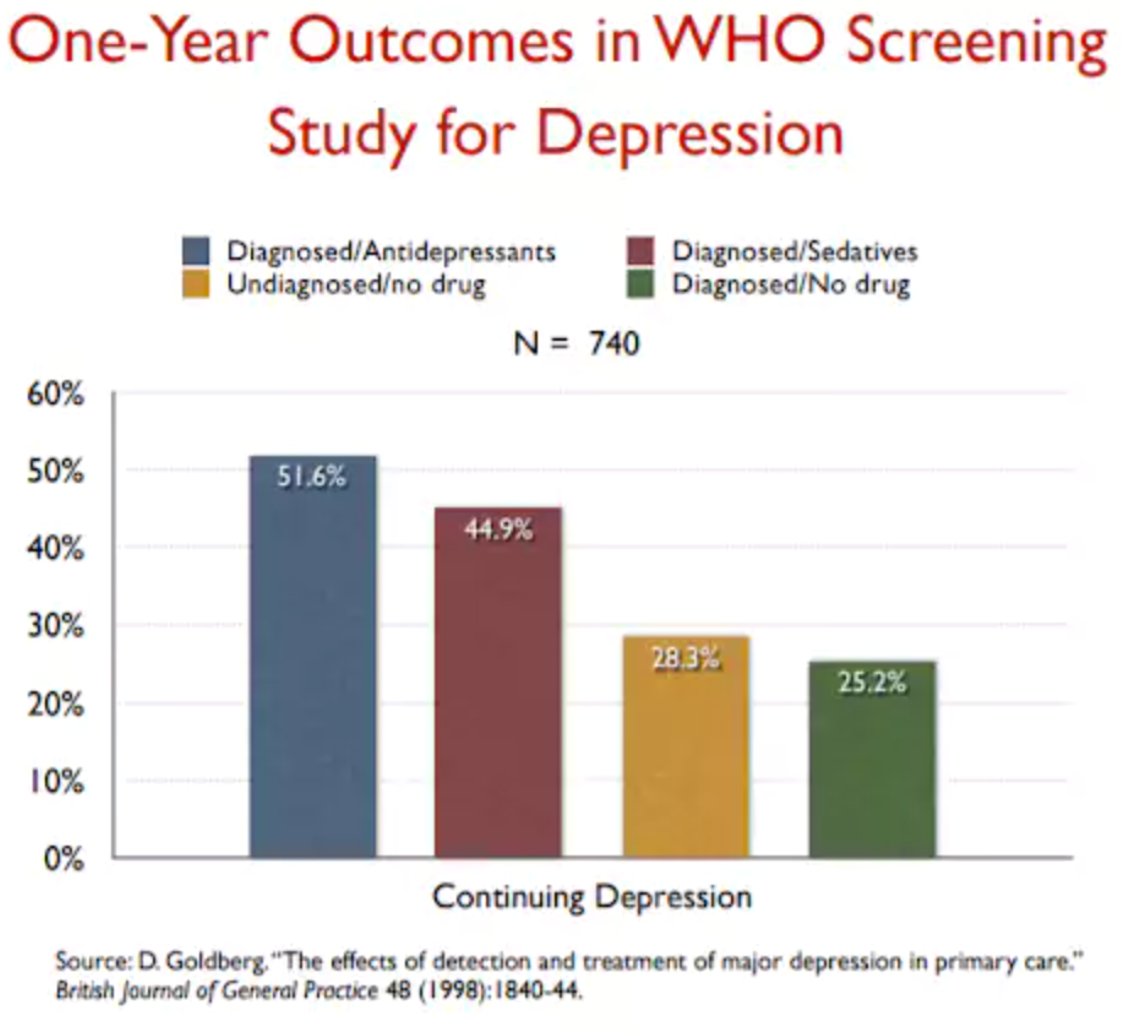
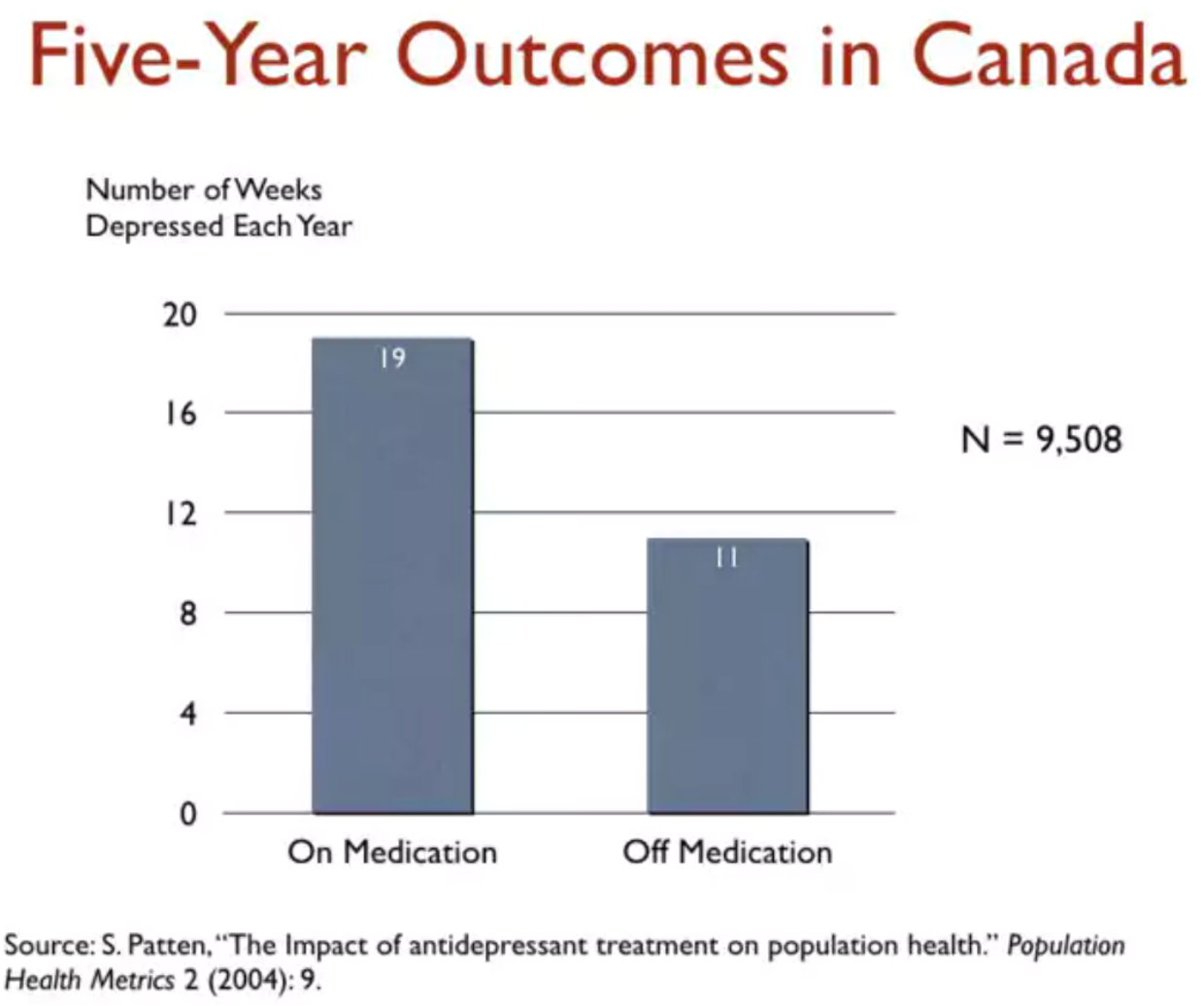
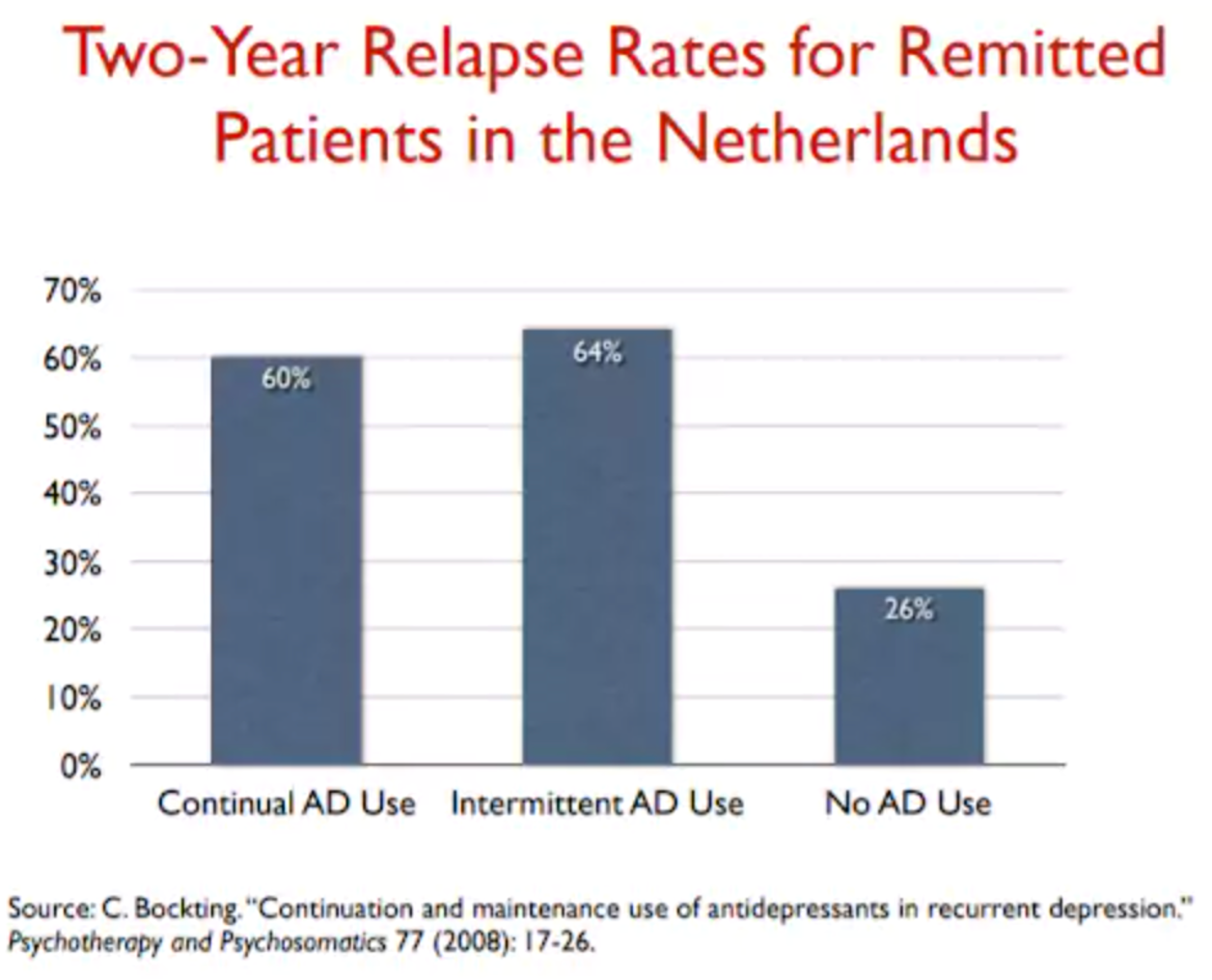
(Graphs from www.madinamerica.com)
Importantly, these are the only studies that tell us what happens to people over the many years that antidepressants are actually prescribed in routine clinical practice.
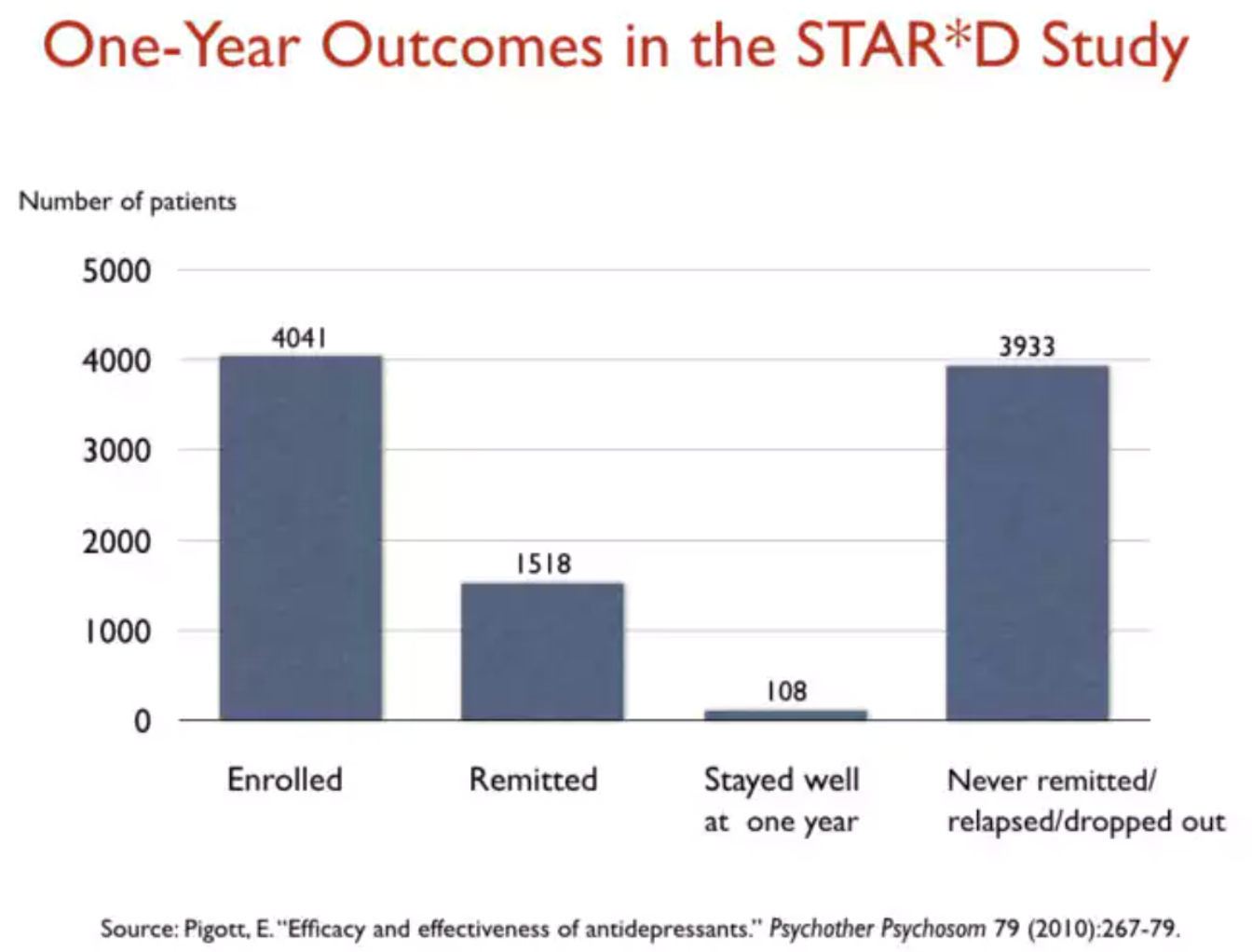
One particular study deserves highlighting: the STAR*D trial, the largest and most expensive antidepressant study ever conducted.
Designed as a real-world effectiveness study, it followed thousands of patients over one year.
Despite receiving state-of-the-art treatment – including dose increases, switching antidepressants, and augmentation strategies – only about 3% of participants achieved both remission and remained well throughout the full year of follow-up (Pigott et al. 2010).
If antidepressants are long-term treatments for depression, why do the best long-term studies show such poor outcomes?
Psychologically, this is not surprising. Dampening painful emotions and distress may provide short-term relief, but it does not necessarily help people process loss, resolve conflicts, adapt to difficult life circumstances, eat cleaner, get out of their heads and into their lives, or address whatever stressor caused the depression in the first place. Over time, the drug may become a substitute for the emotional work that lasting recovery often requires.
While observational studies cannot prove causation, the fact that these findings often persist after adjustment for baseline severity – and in some studies worsen with greater cumulative exposure – makes them difficult to dismiss as confounding alone.
That may help explain why, paradoxically, many long-term studies find higher relapse rates and poorer functional outcomes among people who remain on antidepressants for years.
Discontinuation trials are often cited as proof that antidepressants prevent relapse. But these studies are built on a fundamental design flaw.
Here’s how they work:
Select people who are stable or in remission while taking an antidepressant.
Randomly assign half to continue the drug.
Abruptly or rapidly discontinue the drug in the other half and switch them to placebo.
Measure which group deteriorates.
Unsurprisingly, the discontinued group fares substantially worse.
In the three major meta-analyses of these trials, stopping antidepressants was associated with a 65-70% higher risk of “relapse” compared with continuing treatment (Kaymaz et al. 2008, Glue et al. 2010, Geddes et al. 2003).
Here’s the bias. Withdrawal symptoms and relapse symptoms overlap extensively, including insomnia, anxiety, agitation, fatigue, depressed mood, panic, intrusive thoughts, and suicidal ideation.
As a result, these studies cannot tell us whether patients are relapsing or experiencing withdrawal.
Not a single discontinuation trial to date has adequately controlled for this by tapering gradually (hyperbolically) and allowing withdrawal symptoms time to resolve before concluding a relapse had occurred.
In the major meta-analyses, antidepressants were stopped in “fewer than 11 days”, “on average 17 days”, and “less than a week” (Kaymaz et al. 2008, Glue et al. 2010, Geddes et al. 2003). Any subsequent deterioration was then counted as a relapse, making the drugs appear highly protective.
So, these are indeed discontinuation trials, not relapse prevention trials.
They show what happens when you stop antidepressants -
not what happens when you taper antidepressants.
(NB: This is how antidepressants can come to seem indispensable: people stop, feel markedly worse, interpret this as the return of their illness, and restart the drug, reinforcing a “chronic mentally ill” self-story.)
If the APA has robust evidence that antidepressants produce clinically meaningful benefits, improve long-term outcomes, and prevent relapse independent of withdrawal effects – as they claim – I urge them to share it with the public.
If such evidence exists, let’s see it.
Comments
Nothing yet. Say the first thing.
Sign in to join the conversation.