
NOTE: Substack tells me me this is too long for email, so please click through to the website or view it in the app to see the whole thing.
Hi everybody, thanks for clicking! Welcome to Crone Life.
Last week was the first of my four-week break, the soi-disant “Hot Crone Summer.” The unbearable July 4th heatwave was followed by three chilly, rainy days, completely upending my plans of getting outside. Instead, I went to the movies and watched the World Cup. Then Wednesday was a perfectly beautiful day, warm and sunny with low humidity. I could sit outside on my deck and read, a simple activity that I’ve been longing to do for weeks. I also got to join my husband and son for their daily walk.
Thursday was unremarkable, or at least I don’t remember much of it. I watched more of the World Cup and tried to go for another walk with my family, but my plantar fasciitis was really painful and I ended up going off by myself for a shorter walk. I knew I couldn’t keep up with them and it would be annoying for all of us.
Friday I went to Storm King Art Center, which is across the river, near Newburgh, about 45 minutes from where I live. This is the third time I’ve been there. It was the first time the weather was conducive to walking around outside. There was a cool breeze, the humidity wasn’t in the 90s and the temp was in the low 80s, in contrast to my other visits. Building on my previous experience, I got there as soon as I could after 10am when it opened. I thought it would be cooler and less crowded, In the end, I was there for more than two hours, which foiled my attempt to avoid the hottest part of the day. It was the Free First Friday, rescheduled from the Fourth when it was Too Hot For Anyone To Go Outside. Normally, admission is $25 per person.
The first thing that you need to understand about Storm King is that it’s BIG. Five hundred acres big. You can’t see everything in one day. Even the tram tour only takes you through part of it. You’ll need sturdy footwear, a water bottle and plenty of sun protection.
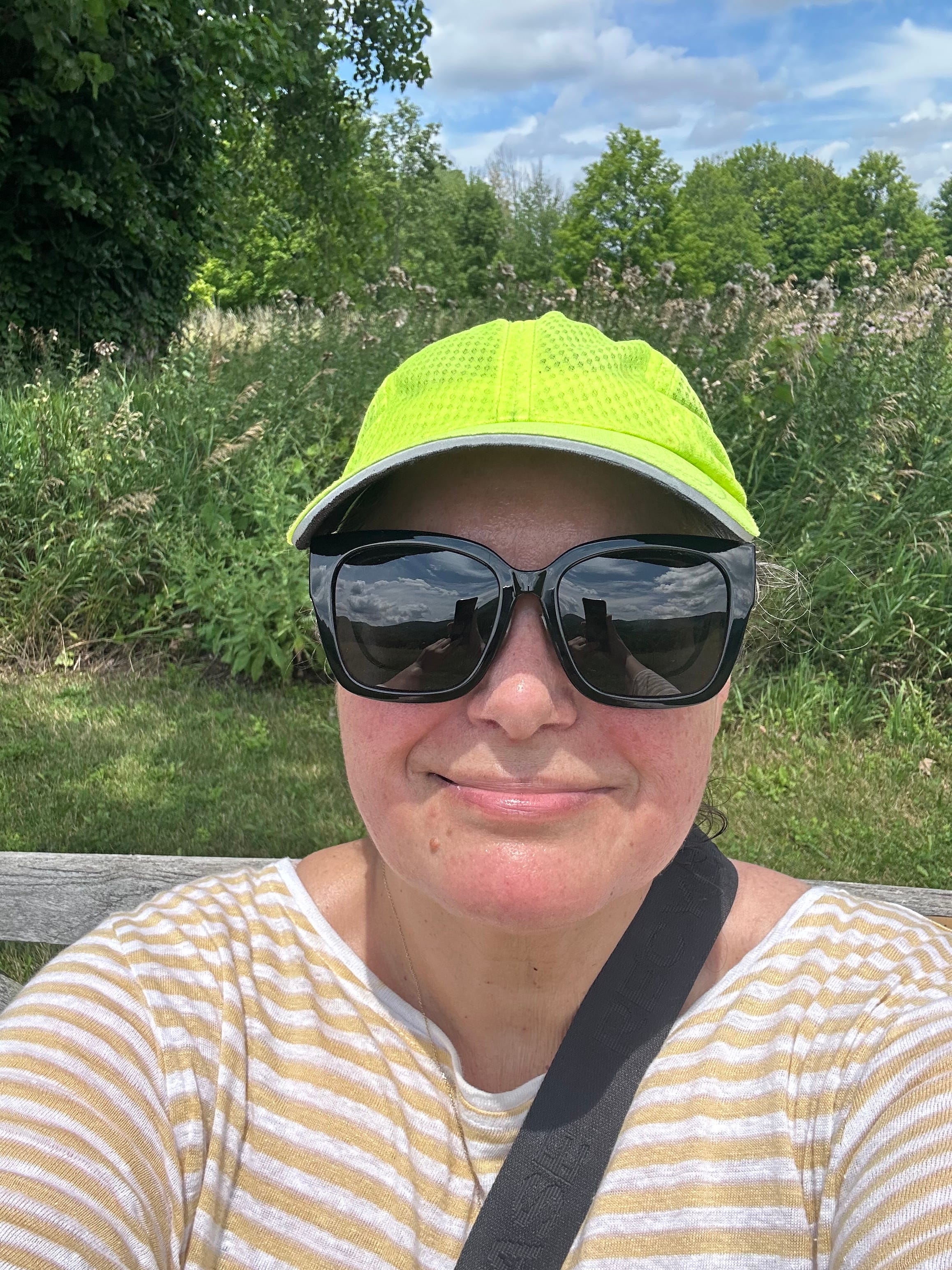
The map that Storm King provides is terrible. The map is on one side, with numbers, and then the identification key that tells you which sculpture is number 601 is on the other side. You’re constantly having to flip back and forth the long way and I think it could be better designed. You could flip it the short way. It would be much easier! The numbers aren’t even in order! The numbers of some sculptures shown on the map aren’t listed on the other side! If I had the money I would pay for a redesign.
You might as well wander and see what you see.
I deliberately did not wear a watch because I wanted not to think about time. It made me anxious, though, so I pulled my phone out fairly frequently to start. I’m used to this feeling. Once I sink into the experience, I know, I won’t care what time it is.
This time I explored the area that runs along the New York State Thruway. In the past, I’ve avoided it because I hate the traffic noise, especially the blare of the diesel semis. It’s a continuous roar. You can’t get accustomed.
That part sucks, though, because that part of Storm King is really, really beautiful. It’s a combination of ponds and meadow and wooded area, and you can only glimpse the works until you’re right on top of them. They are hidden in the undulations of the topography and behind trees and flowering plants. The many oak trees are so perfectly shaped they’re like sculpture themselves.
The area is called the South Ponds. Without specifically intending, I mostly saw work by women sculptors, including Maya Lin,1 Anicka Yi, Alicja Kwade, Liz Glynn, Alice Aycock and Magdalena Abakanowicz. 2
When you first come into the sculpture park, there’s a big grassy area with scattered oak trees and giant sculptures looming on the horizon like the dinosaurs in Jurassic Park. The first piece I saw up close was Open House (2017-2026) by Liz Glynn,
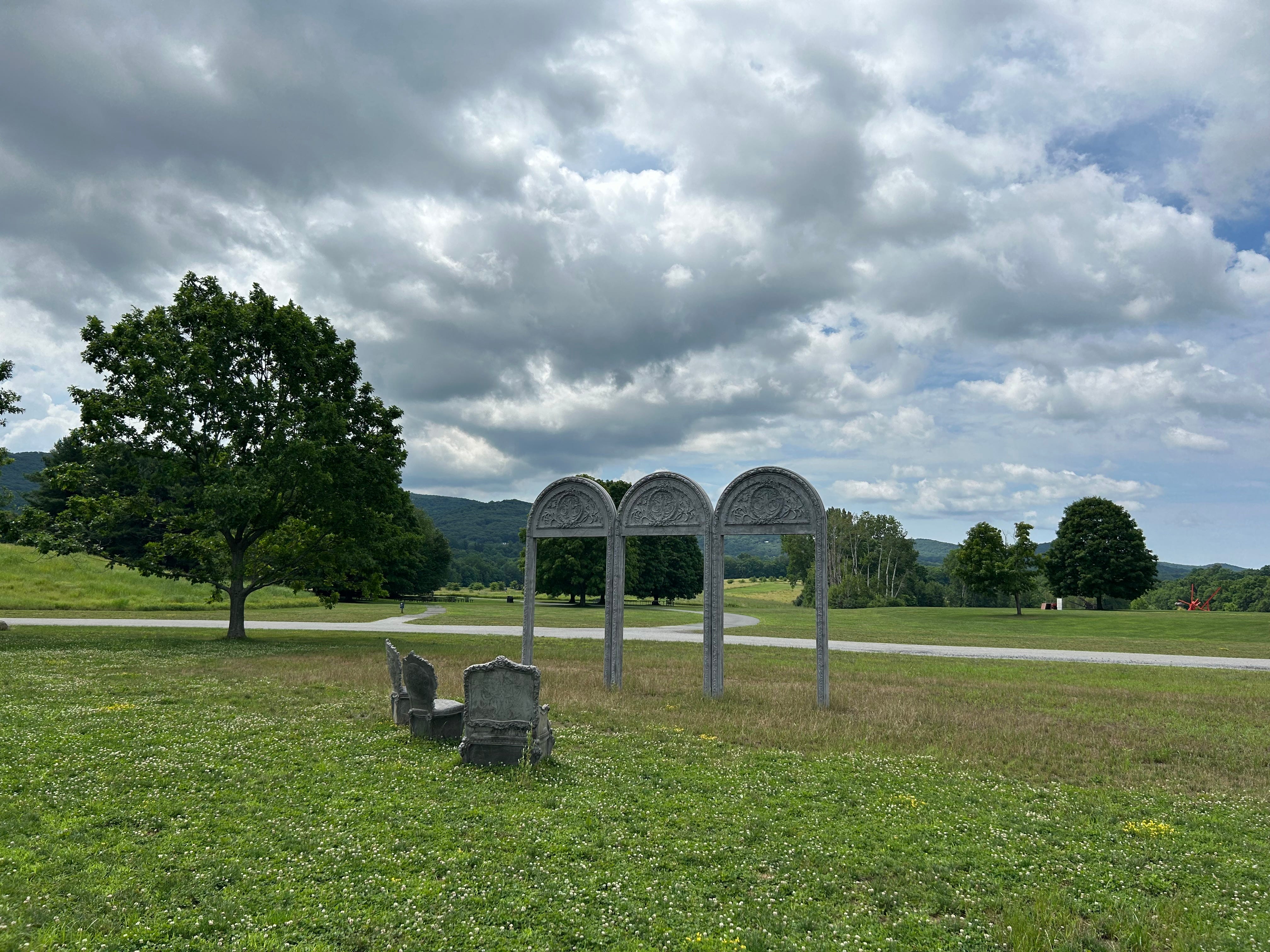
a recreation of the original Whitney ballroom from the Gilded Age.3 It was where “The Four Hundred,“ the 400 best families of New York Society, would gather once or twice a year for balls. It was a big deal in terms of social status. The sculpture itself is spread out and sparse like a ruin. There are various groupings of cast-concrete couches, chairs and footstools in the late Victorian style, supposedly reproductions of the original furniture. In a nice touch, the casts reflect the texture of the brocade. It’s sited in a big flat area (Tippett’s Field, if you can find it on the map), a meadow of grass and wildflowers, buzzing with honeybees visiting clover blossoms. It might have been an exclusive space in its heyday but now anyone can wander through. Even bugs.
Moving through another, more overgrown meadow, accessible via a mown path, I find a piece by Magdalena Abakanowicz called Sarcophagi in Glass Houses (1989).
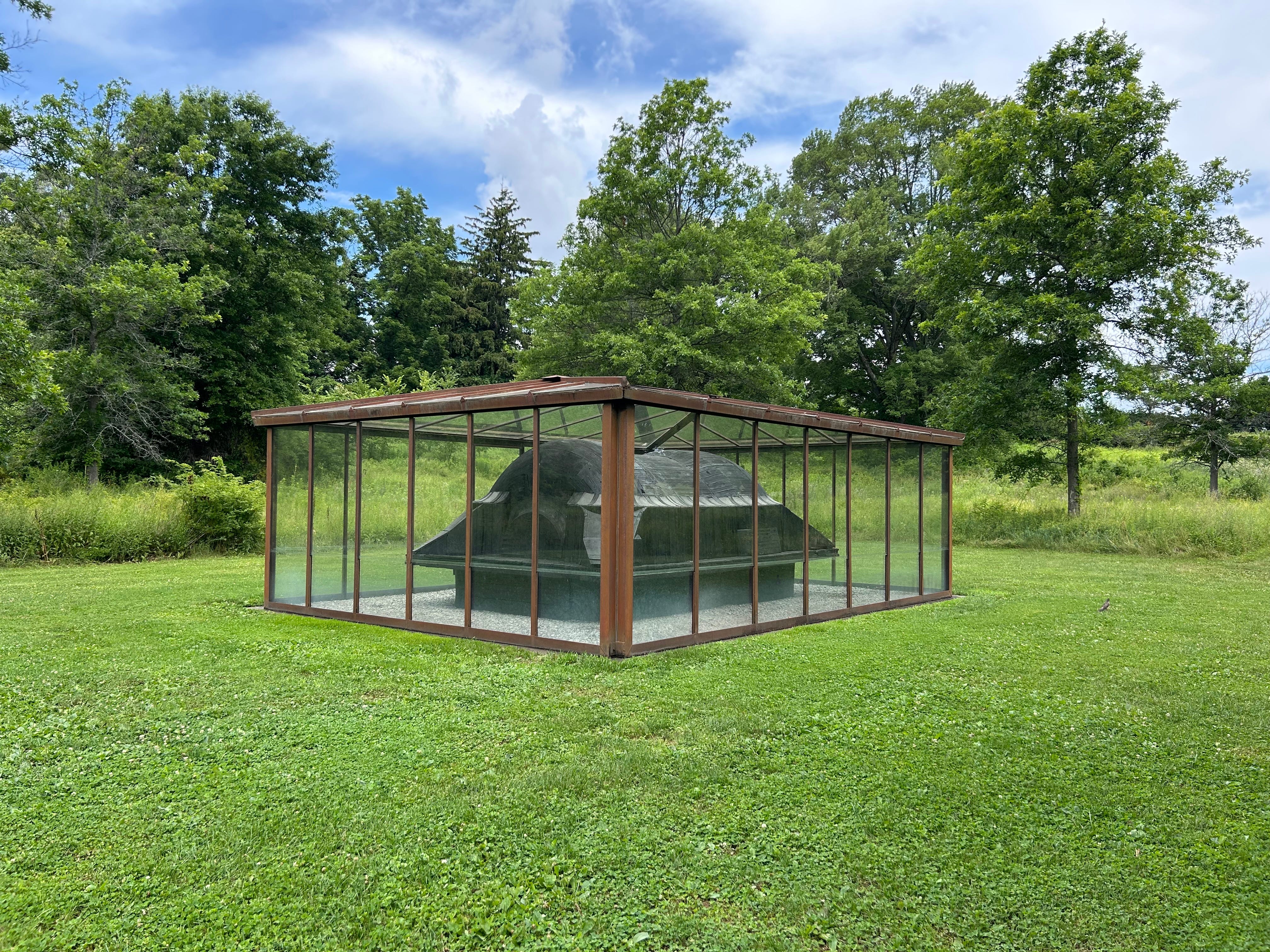
They remind me of memorial bomb shelters or miniature car dealerships. There are rusty metal and glass structures shaped like greenhouses, and inside of those are large sarcophagi made of wood, capsule shaped, with hemispherical ends. The structures are not air tight. If you look closely, you can see hatches–they’re locked, but someone could enter for maintenance. I probably wouldn’t be thinking about car dealerships if I couldn’t hear the noise from the Thruway. The structures have a classical feeling (think Edward Lutyens) combined with industrial baroque vibes. The sarcophagi within reminded me of both Darth Vader’s helmet and human breasts. The wood, painted matte black, appears yielding and organic.
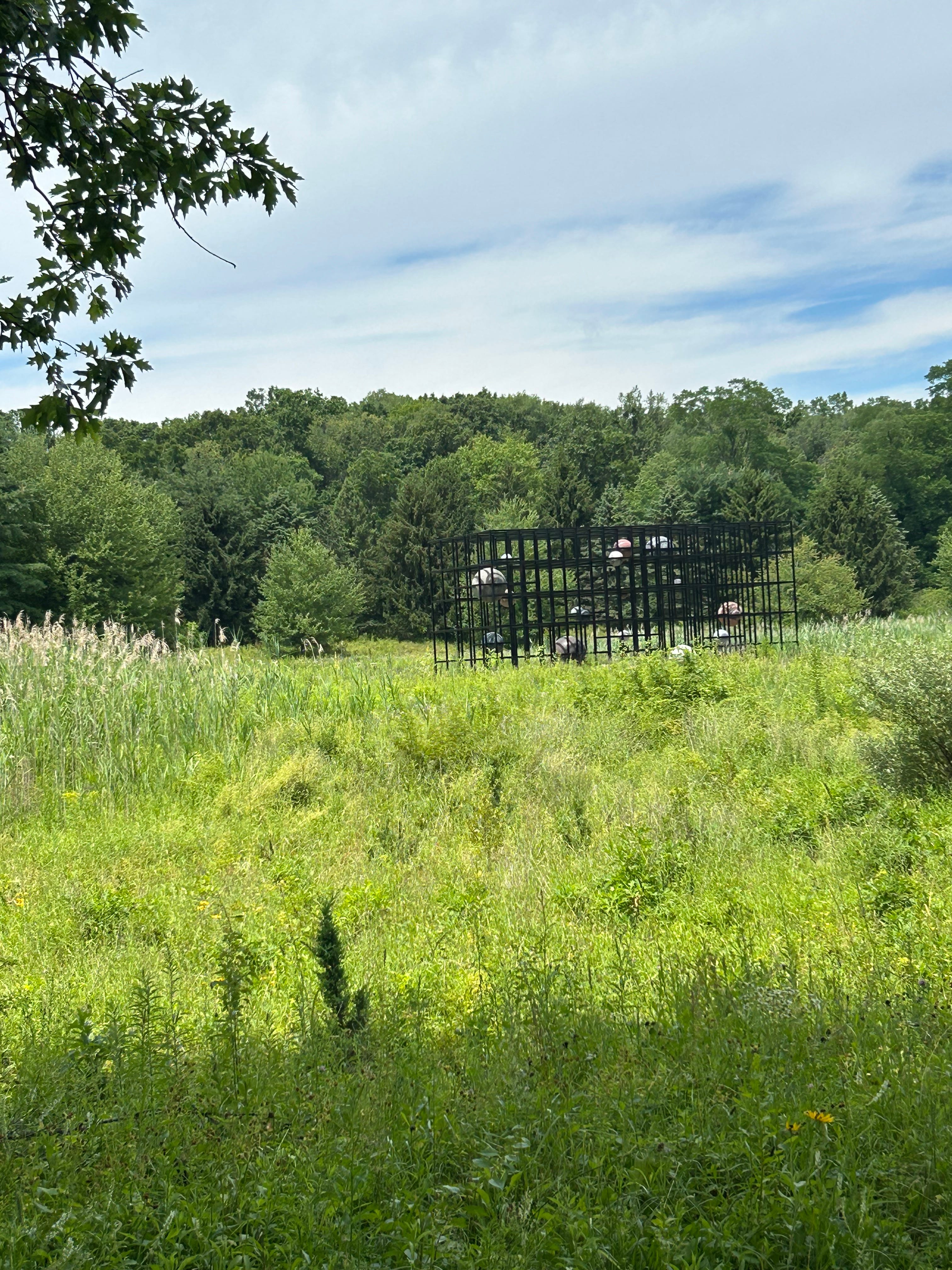
I then walk over to Alicja Kwade’s LinienLand (2018). It consists of a giant rectangular box of steel girders filled with marble orbs in various sizes like models in a planetarium. I liked it the best because you can see it from afar and it looks like a box of cosmic space. Later, when I approached it from the other side and found the descriptive plaque, I discovered there’s a way to walk through it. I was intimidated by the signs that said not to climb it, so I missed my chance.
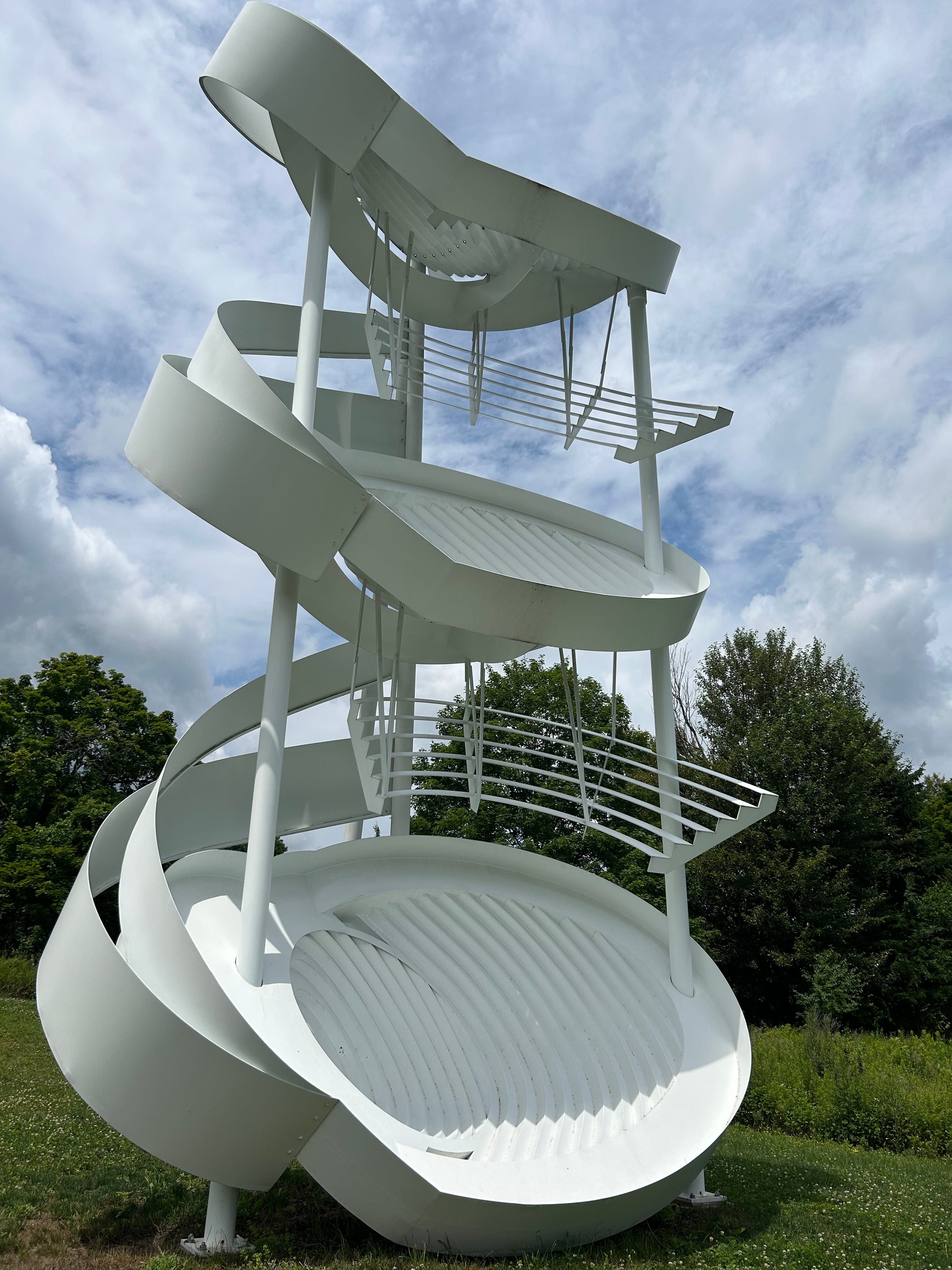
On the slope above LinienLand ( or “Cosmic Box,” as I like to call it), there’s a three-story white metal tower by Alice Aycock, Three-Fold Manifestation II (1987), fabricated in painted steel. It looks tiny compared to the giant metal sculptures by Mark Di Suvero and Richard Serra that dominate the horizon.
I walk as far as I can go to sit on a bench overlooking Storm King Wavefield by Maya Lin. It’s a series of earthworks designed to replicate an oceanic wave pattern. It covers 11 acres but it doesn’t seem that big in context. The site is where the gravel pit used for the construction of the New York Thruway was, so I suppose its location makes sense. You’re only allowed to walk around in it during the second two weeks of each month, so I could only observe from afar.
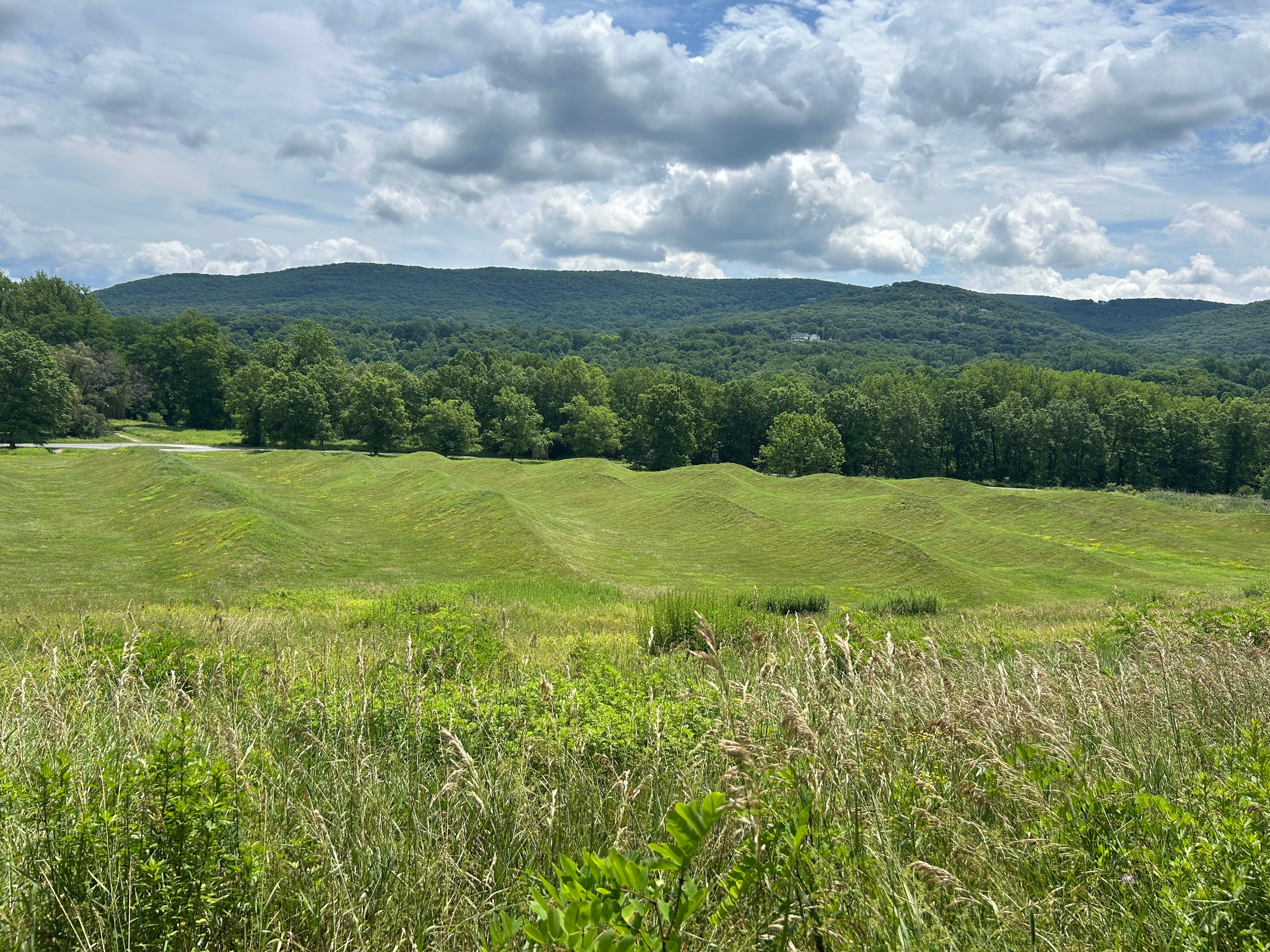
I’m still annoyed that I have to hear the trucks grinding by.
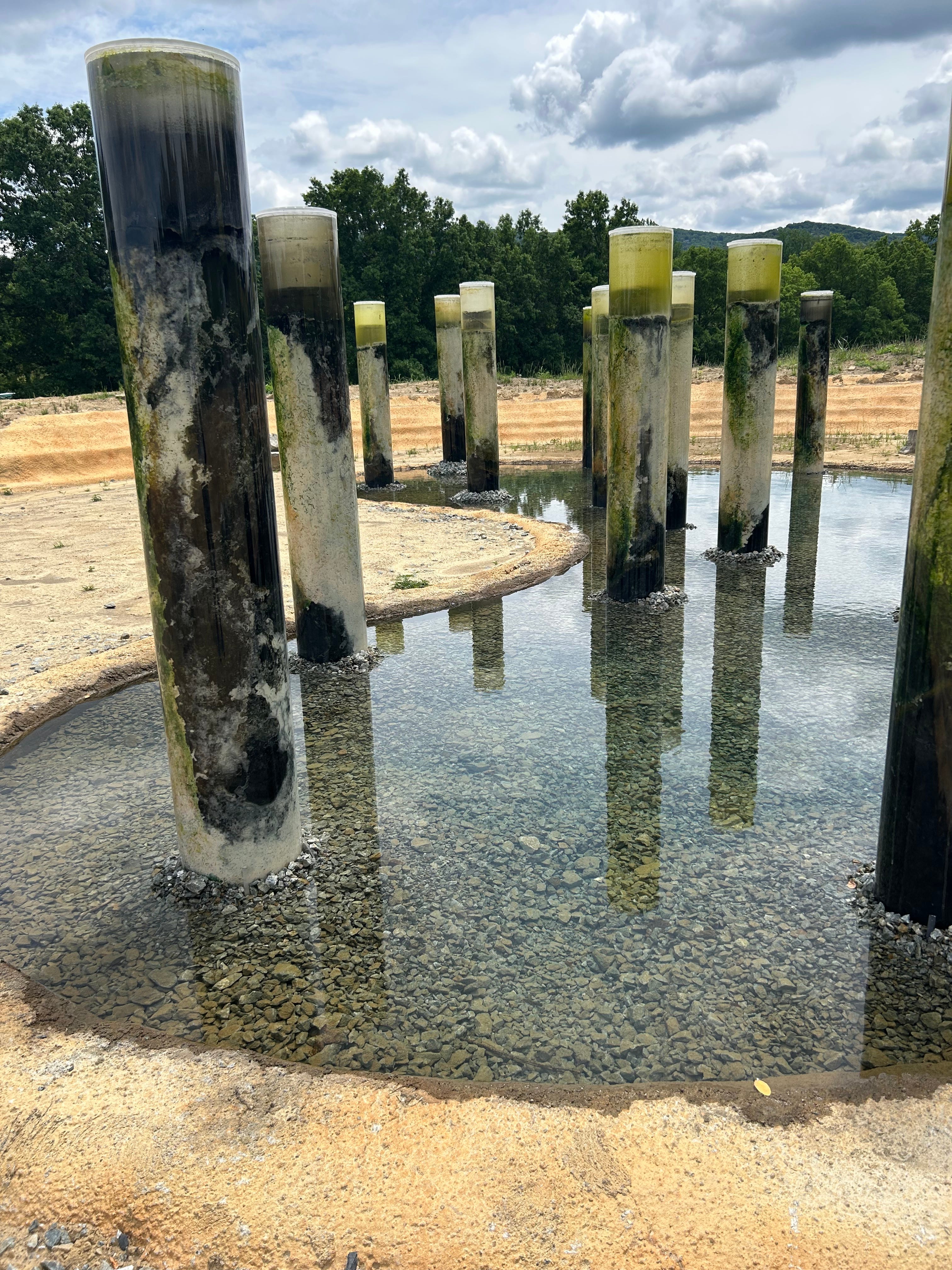
I follow the slope down to the paved road that goes along the ponds. From there I walk up to the special exhibition by Anicka Yi, Message From the Mud (2026). It looks like an abandoned pier, with its own tiny beach, accompanied by random architectural bits. It’s cool, actually; I love decaying waterfronts. The acrylic cylinders contain a nutrient mixture designed to facilitate the growth of microorganisms, but it just looks like black slime to me. It’s all a bit bleak. I feel like I should be able to smell the ocean, although it’s a hundred miles away. I suspect this was not the artist’s intention.
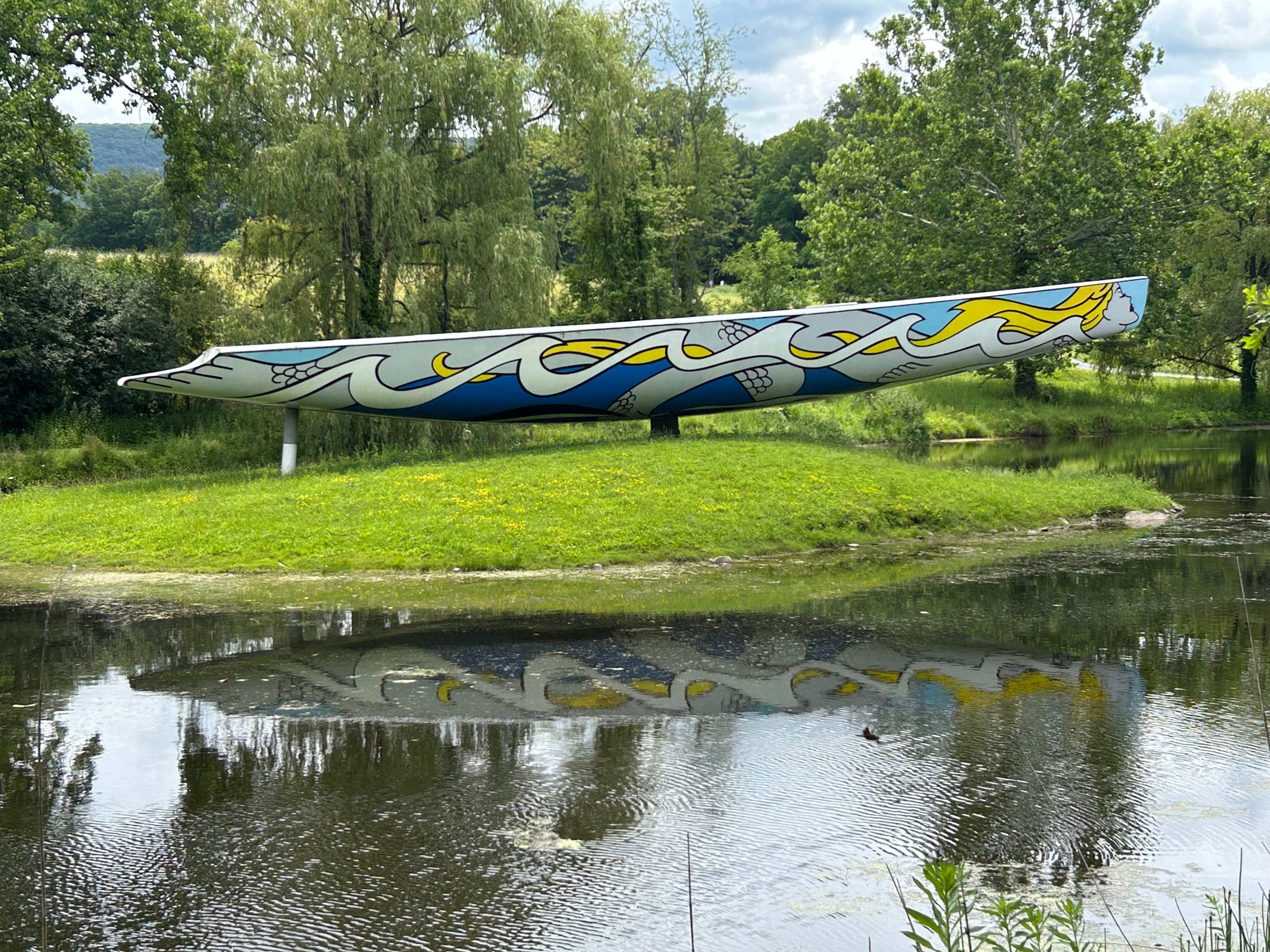
By now my feet hurt and I can feel I’m getting sunburnt despite my SPF application. I head back to the tram route and walk along the ponds, where I find Mermaid (1994) by Roy Lichtenstein, on its own private island. It’s shaped like a canoe with a Pop-Art mermaid depicted on the side. I love it.
I can’t believe I’ve seen so many sculptures and I’ve barely explored one corner. Storm King is huge, like its namesake, a horizontal ridge of granite that sticks out into the Hudson River like a fist. Retracing my steps, I come back to the entrance, passing Open House again to return to the parking lot. I’m exhausted but happy. And, of course, hot.
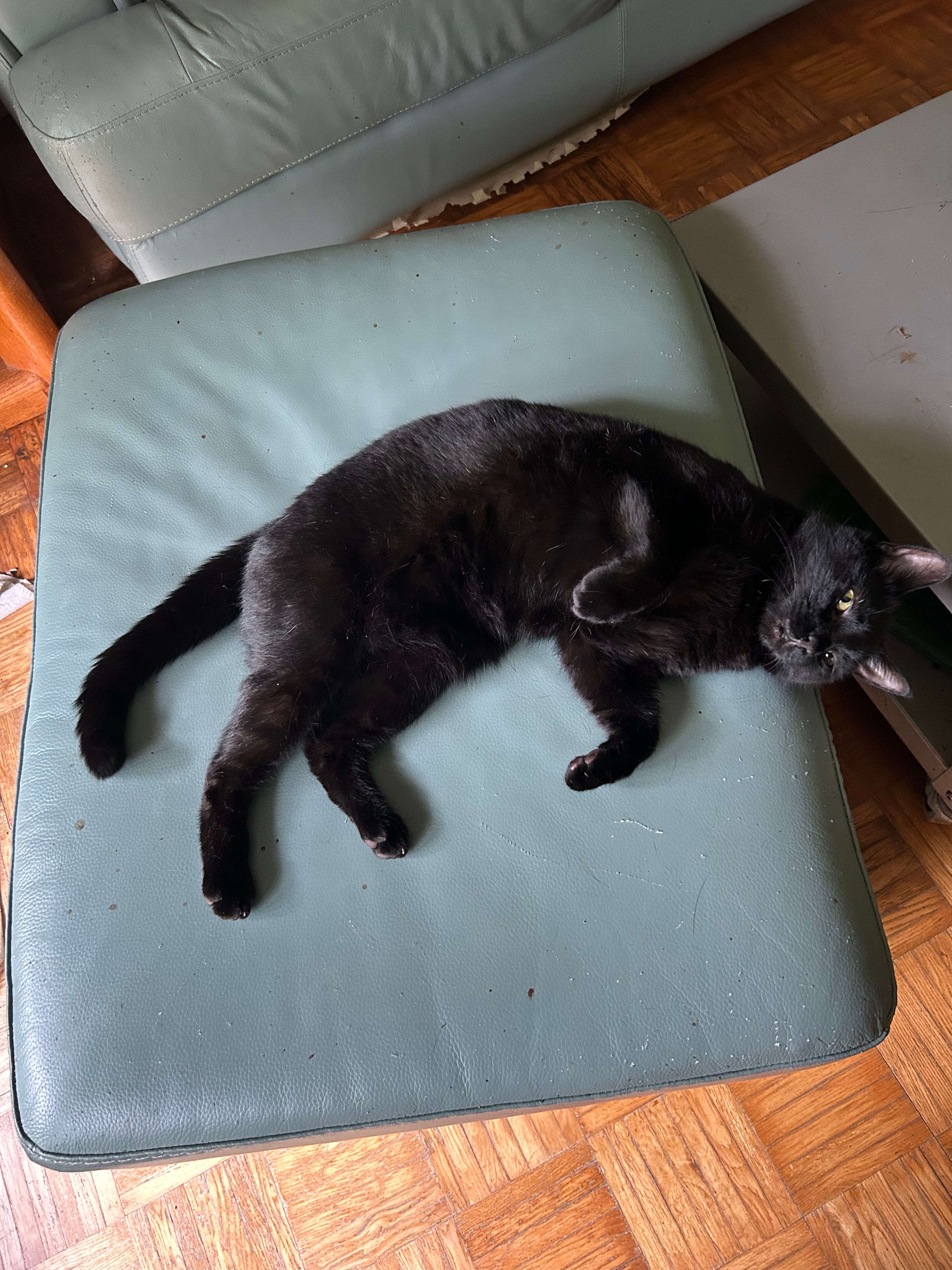
She is living her best life, enjoying hunting bugs outside and spying on the birds nesting in the bushes. She likes to lounge on the hassock and be petted. Sometimes she gets so relaxed she slides right off.
Maya and I overlapped at Yale and were in several classes together. She was very quiet and nerdy and we didn’t interact. Of course I’ve followed her subsequent career with interest.
I tried to link to the artists’ sites where possible; Abakanowicz died in 2017 and doesn’t seem to have one.
The era, not the TV show.
Comments
Nothing yet. Say the first thing.
Sign in to join the conversation.