
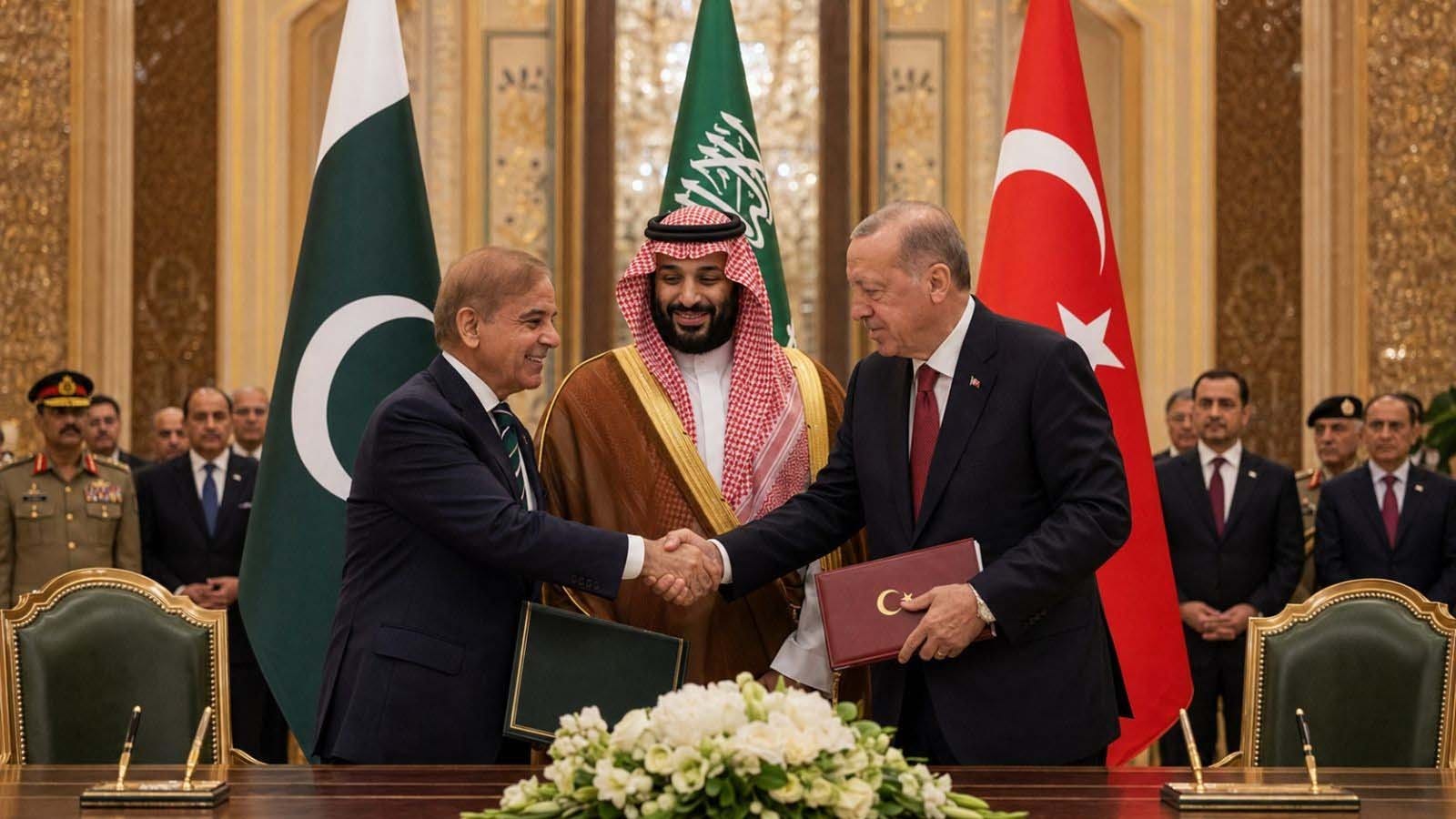
On August 7, 2026, in Mecca, Turkish President Recep Tayyip Erdoğan, Saudi Crown Prince Mohammed bin Salman, and Pakistani Prime Minister Shehbaz Sharif signed a trilateral mutual defense agreement declaring that an armed attack on any one of Turkey, Saudi Arabia, or Pakistan would be treated as an attack on all three. The joint statement framed the agreement as collective deterrence against aggression; a Turkish official clarified that the treaty is purely defensive, not directed at any specific actor, and open to other regional states; a Saudi official denied that it constituted a military axis or carried any nuclear dimension. The text has not been released. It was signed within hours of a senior Saudi official telling Reuters that the kingdom was bracing for attacks from Iranian proxies in Yemen and Iraq, which supplies the occasion for the agreement.
The argument of this brief is twofold. First, the pact is theater: a declaration of collective defense unsupported by the capacity or the intention to provide it. Second, there is a reason why states nonetheless keep staging such declarations. A mutual-defense pact in the Middle East operates as an instrument of signaling rather than of warfighting, a message addressed to Washington, to Tehran, and to domestic and pan-Islamic audiences.
The Mecca Joint Defense Agreement is the third iteration of a single Saudi effort, opened by the American non-response to the 2019 Iranian strike on the Abqaiq oil facilities, driven forward by the Gaza war, and sharpened by Israeli strikes on Doha and the war with Iran, to assemble a deterrence substitute for a diminished American security umbrella. Each iteration has publicly promised more while, operationally, committing to less. That effort has now produced a NATO-style clause among three states that are unlikely to fight one another’s wars, which is to say the quadrilateral discussed in the spring minus its fourth member, Egypt—though Egypt’s absence is not what empties this agreement of collective-defense substance, since the three remaining states would not amount to a functioning alliance even with Cairo present. Most importantly, this is just the latest expression of a regional pattern rather than a departure from it. The modern Middle East has generated many collective-defense agreements, and they have generated pomp and circumstance rather than defense. In the region’s security politics, the vocabulary of collective defense is often detached from the activity of defending, and the announcement has repeatedly turned out to be the whole of the content.
No posts
Comments
Nothing yet. Say the first thing.
Sign in to join the conversation.