

Canadian PM Mark Carney just announced the creation of the “Canada Strong” sovereign wealth fund (SWF). These SWFs are pools of capital managed by states. These funds can invest in a wide range of projects, though they are typically large-scale industrial or infrastructure projects and targeted toward fostering national development. Increasingly, both developed and developing capitalist-states are using SWFs, along with public pension funds, in order to foster domestic capital accumulation.
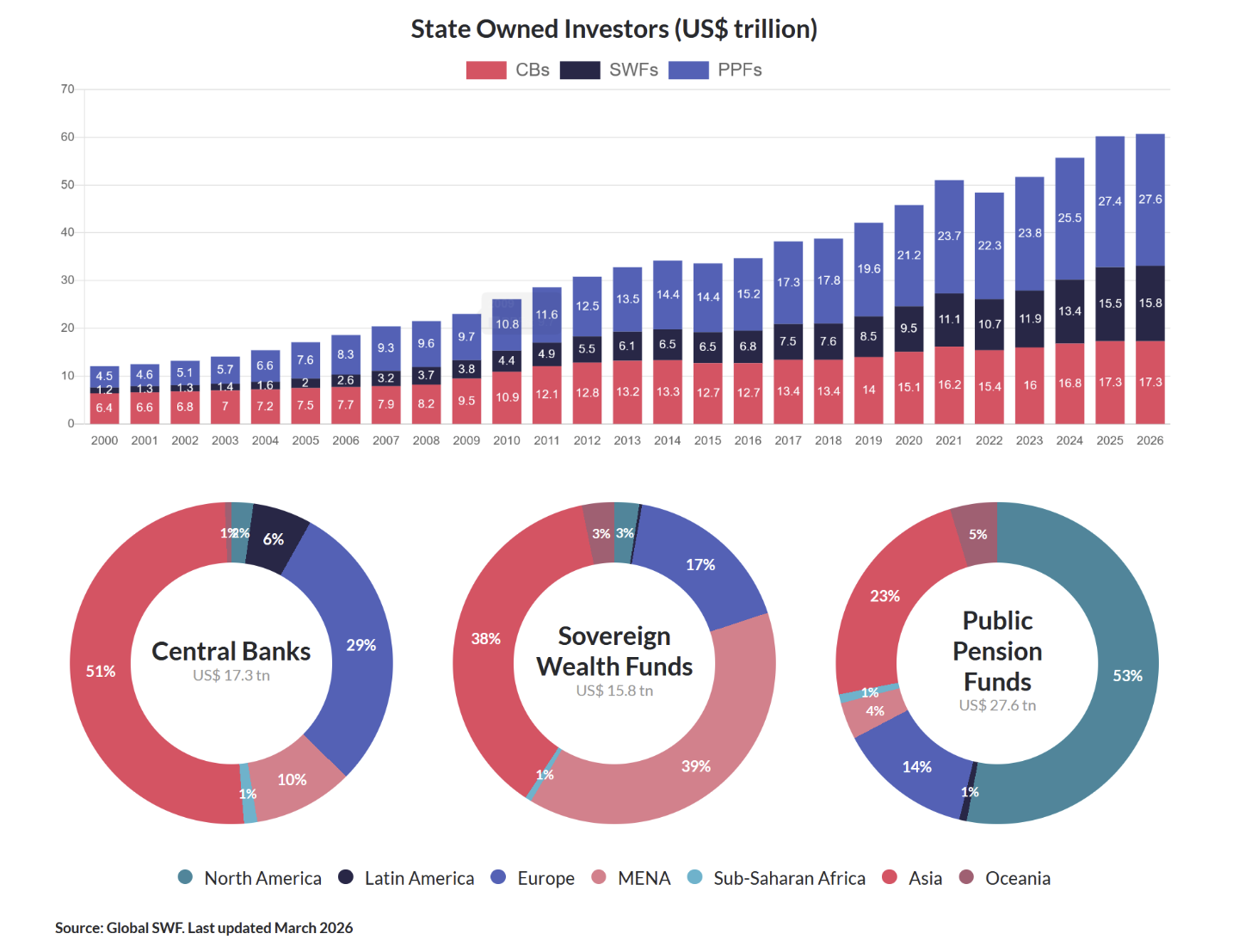
I’m not going to explain here the importance of these massive pools of capital to contemporary capitalism, as I’ve written about this elsewhere. However, I want to make some immediate comments about what we can expect out of this announcement. Much of the dynamics we will likely see with this fund were discussed in my recent infrastructure series, but in particular Parts 6, 7, and 8 are about the Canadian context.
First, this fund will likely be used as the vehicle to build the massive infrastructure projects that Carney has been promising. Last year’s Bill C-5, which essentially allows the federal government to fast-track “nation-building” projects, is slowly being supported by more concrete financial and bureaucratic mechanisms.
For example, early this April, the government announced a $51 billion “Build Communities Strong Fund,” and I assume this SWF will work in tandem with it. Odds are this SWF will be run by professionals from the financial sector, particularly the asset management world. People often bring up that Carney was employed at Brookfield, but they forget the firm is also the world’s largest (private-sector) infrastructure investor.
Second, the fund will likely “de-risk” massive infrastructure projects for private investors through the use of public-private partnerships. In practice, this money will be used to guarantee revenues for whatever private partners (the builders or operators) are involved in producing these projects. This state capital will be used to guarantee private sector profits, socializing the risk and privatizing benefits.
Third, Carney will probably use this as a way to have off-balance-sheet spending so he can look like he’s saving money while also investing in big projects. I assume it will be a Crown Corporation like the Canada Infrastructure Bank, and that it will be filled with corporate actors running it.
Finally, I want to discuss the wording Carney uses to describe the fund as a “people’s” institution. Carney commented:
“This will be a Government of Canada fund, but more importantly, this will be a people’s fund. It will be your fund.”
Is this Commandante Carney coming out? What do we make of this? In the future, I will write a piece about how we can understand the socialization of economic activities, but for now, it’s important to go beyond the idea that “state = social.” In theory, all state property is social property of the people. However, in practice, this is a very weak form of socialized property. While it is the product of pooled social resources such as labor—a feature of all massive forms of both money and real capital—it is not run collectively in any meaningful sense of the word.
To call this a “people’s” funds ignores that socialized property is more than just pooled resources produced and managed socially. A people’s institutions has real political content, meaning its an organization that works towards the empowerment, development, and liberalization of the masses. There is nothing inherently good about a public fund. A public institution can be used to foster education, provide healthcare, and develop human capacities. But in this case, it will more likely be used to support corporate power, maximize profits, and build infrastructure for Canada to help the U.S. and its allies pillage across the globe. We must not be naive but rather more critical about the nature of these institutions.
When judging the potential effects of a fund, you have to ask the right questions. What matters is: 1) the kinds of projects that are invested in, 2) the governance structure (is it democratic?), and 3) what its purpose is (social reproduction of people or of capital). There are examples of financial institutions being tools of human development and working-class power, such as Costa Rica’s Banco Popular, an institution 100% owned and run by social groups within the state (not without contradictions).

However, if we are frank, this institution will be nothing but an extension of finance capital’s power. It will work to dispossess and exploit the working class, make Carney and his colleagues richer, and build the means to support global imperialism. Only the creation of institutions that foster popular power can lead us to a better future.
If you enjoy my work and want to support it, the best thing you can do is like, repost and share it on other platforms. The most important thing is that people learn something from my work!.
You can also become a paid subscriber on Substack or make a one time donation of a ★🚩revolution🚩★ here . If you’re Canadian, I accept e-transfers by email instead of going through Stripe, this avoids fees and taxes for me and the exchange rate for you.
Comments
Nothing yet. Say the first thing.
Sign in to join the conversation.