
Welcome to a joint installment of Critical Supply and Weaponized Economy, two newsletters on trade, energy policy, economic security, and critical supply chains. We are Eduardo Castellet Nogués and Rachel Ziemba, the authors of these newsletters.
We recently attended the SAFE Summit in Washington, DC, aptly titled “The Pillars of Power,” where we joined hundreds of leaders from government, think tanks, and the private sector. The conference created a unique space to discuss energy security, from critical minerals and oil shocks to the state of the grid. This week, we bring the most important points to you.
Washington events tend to reinforce existing bubbles — this was not the case. The Summit was full of individuals from different backgrounds: financiers, venture capitalists, technology leaders, miners, start-up creators, and high-level government officials, as well as Substack authors trying to fit in. This would have been hard to imagine ten years ago.
The Summit made, if anything, a clear point: the private sector and government are no longer two isolated islands. When it comes to critical minerals and energy, Washington and state governments are listening to companies and what they need. This was made particularly clear when representatives from EXIM and the USTDA joined panels alongside companies, speaking wonders about their partnerships and working together. Project Vault, EXIM’s stockpiling initiative, is a shining example of this trend. Perhaps because of this collaboration, we heard many voices suggesting that the US should not pick winners and losers in the private sector, instead focusing on securing the ecosystem. This was one of many tensions in the approach, along with US domestic supply chains, what role China should have in the supply chain, and which partners should be prioritized. Still, this all comes at a time when, in general, policymakers get the importance of the problem even more so than when we attended similar meetings a few years ago.
SAFE, the organizer, stands for “Secure America’s Future Energy,” and the conversation and message were indeed targeted at America’s challenges. Despite the Canadian government’s sponsoring the event and repeated mentions in the panels, however, the only thing missing was the allies. Speakers recognized that the only solution to address dependencies on China is a plurilateral effort with the allies (EU, Australia, Japan, etc). But calls to get these allies to align with US policy priorities should include them, as we saw in this year’s Critical Minerals Summit, hosted by Secretary Rubio.
In between panels, there was a great deal of talk about the Lobito Corridor, an EU-US-backed railway connecting the copperbelt regions of the DRC and Zambia with the Angolese port of Lobito. Attendees saw the project as a model project to replicate elsewhere and build on. This recognition underscores that the US government’s support for transport infrastructure is coordinated with foreign policy efforts to derisk projects. It also highlights the US shift from development aid to development finance, and the willingness to use a range of investment and statecraft tools, a point emphasized during the DFC head’s speech.
Vitally, all speakers agreed on an item: regulatory uncertainty is a price premium. There have been constant changes in energy policy in the US, seen in the creation and elimination of the Inflation Reduction Act, and other subsidies for oil, gas, and green energy. Combined with supply chain crises and export controls, these shifts are making the price of every kilowatt more expensive.
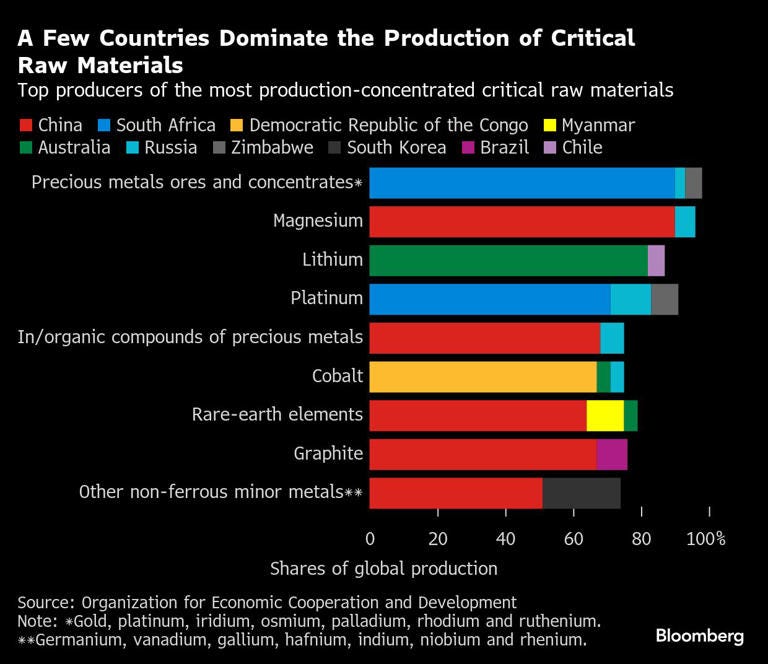
One of the largest concerns regarding China’s chokehold on critical minerals, other than banning their export, is its ability to dump volume and thus prices at will. Reported spectacularly in Henry Sanderson’s “Volt Rush,” China relies on a network of commodity traders, export regulations, and subsidies that allow it to dump prices of specific minerals when they want to a) win a tender or b) drive a Western firm out of business. This predatory pricing strategy is what has made mining in the West impossible for private actors.
In the Summit, panelists spoke of “Price Floors as Market Guarantees,” but there was disagreement on how to implement them. The topic is not new, and Rachel has covered it before. The US government has made steps to ensure private firms can remain competitive by establishing price floors in public tenders for rare earths, seen in the recent MP materials deal with the US Department of War. But mineral-specific solutions can be costly — not every agreement can have a US government top-up directly.
Thus, the US government is looking at going bigger and using different tools: recent MOUs with the EU, Japan, South Korea, Australia, and others have a common point: implementing pricing mechanisms to create fairness in the market. The G7 aims to create its own secretariat to focus on these issues. The most discussed proposal so far has been a price-adjusted tariff that would automatically make any price dumping impossible. Some analysts advocate for a plurilateral, political agreement amongst the US and its allies to create a common shield, while others argue that doing so would take forever, and in the meantime, the US should initiate a Section 232 investigation now and have the allies follow after. In practice, we find the US government is likely to pursue both and may have different agreements with different countries.
Back to our previous point about conversations with allies, one must wonder: how will developing countries react to a price-adjusted tariff? Their comparative advantage is their ability to dig or refine critical minerals at a lower cost than in the West. But if we tariff these minerals, their advantage will just not matter. Projects like Lobito or the DFC programs in Africa will have failed unless an exemption for the tariff is applied to these countries or Western-backed firms. At the same time, many countries are looking to use their own leverage to move up the value chain. Once pegged as resource nationalism, countries ranging from Chile to Indonesia to Namibia are all looking to do more work locally and create jobs. Other countries like Saudi Arabia and the UAE want to position themselves as processors and feed into local manufacturing supply chains.
Another plan to disarm China’s predatory pricing and market control involves stockpiling, which was discussed as a path to buy time and leverage. If, but most likely when, China restricts once again the export of refined rare earths to the US or other allies, prices of these commodities will skyrocket, and governments may have to ration deeply needed materials or businesses cut back supply. This pressure would force the US into a rapid response to Beijing’s threats, but a stockpile, just like in oil, would allow Washington to have more time to address the issue, coordinating a better response and protecting the companies. Some allies have already started stockpiling projects to counter that, with the EU starting a pilot program, Canada trialing different structures and options, and Australia launching and funding its own stockpile.
Project Vault does exactly that: it builds the stockpile. Only that this is not EXIM telling companies what to hold, all the opposite — it’s companies stockpiling the items they use under the protections of the US government, and more importantly, trading them. Reserves of any mineral within the stockpile can be traded amongst the firms in the system, creating a US-backed marketplace outside of China’s influence. This project can thus be a path towards trading and financialization of lightly traded metals. At the event, there was some consternation about the fact that Chinese supplies would be among those purchased, but that reflects the state of today’s market. The broadening of the market beyond the three initial trading firms is positive, we think.
One of the main themes of the Summit was the Chinese electric vehicle industry. During the conference, the industry was described as a national security threat and a competitiveness issue for US manufacturers. We argue, however, that both cannot be true at the same time, not in a policy sense. In a panel on this subject, the speakers mentioned how some Chinese EVs have experienced danger in their remote control, with third-party actors intervening in the vehicles in multiple cases. The prospect, as scary as it is, is only worsened by concerns regarding spying allegations on vehicles, which have the capabilities to access phones, listen to conversations, and access files on devices to which the car is connected. If all the aforementioned is true, the issue with these vehicles is not that they are driving US and European manufacturers out of business — the issue is that they are an active spying and national security threat, and those vehicles should not be allowed on the road.
The other side of the coin is that those concerns may be overblown, and at any rate, this is where most of the policy conversation is at the moment. From an economic security standpoint, the Chinese EV industry, led by BYD, is driving European and US automanufacturers out of business, making it impossible to compete with both economies of scale within China and the CCP industrial policy machine. ITIF’s Rob Atkinson, however, whom we thank for his years of policy leadership at the front of ITIF, made a great point — we tend to look at this issue through the way we were all trained: the Riccardian model. We assume that China has a “comparative advantage” at producing EVs, but the truth is that this is not a natural advantage, it’s a policy choice — and the only way to respond to policy is with more policy. China, thanks to subsidies and state support, has now actually out-innovated European and US EV manufacturers in some technological fields — they are not just cheap, they are great pieces of technology. The only way to counteract that is by a) placing barriers on those vehicles coming into the Western market, but most importantly b) supporting our own automanufacturers with a matching innovation and policy ecosystem. To the panelists, however, underscores a larger issue — the fact that not enough policy makers are intimidated by China’s EV prowess makes it evident to the speakers that the US public has forsaken the idea that a strong civilian manufacturing base is directly related to a strong defense industrial base. And of course, it’s not as easy or quick to change minds.
Separately, we continue to hear questions about the potential for Chinese investment in the US auto sector, something President Trump floated earlier in his term. US/North American auto incentives are designed to incentivize local investment — this is a pathway that has been off-limits to China, but has been well trodden by developed Asian and European counterparts. In theory, potential partnerships with China to produce these EVs in the US would reduce some economic security arguments, as they would involve some US labor and investment, but in practice, all national security and data concerns would remain. Congress and many members of the cabinet would be quite wary of such an approach. In the interim, we will be watching to see if the large US automakers begin to pitch joint ventures with Chinese companies, or if, on the other hand, European automakers that already have partnerships with Chinese firms look to start production in the US. For now, US regulatory barriers like the connected vehicle restrictions, which are popular in Congress, would make this very difficult or require data links to be ring-fenced from Chinese jurisdictions and entities.
Throughout the Summit, panelists kept bringing up issues that, while not directly related to energy policy, were creating constraints in the field, chief amongst them were skilled labor, AI, cutting red tape, and electricity costs.
The most repeated concern was the labor base. The US and allied governments are pouring billions into investments targeted at energy and critical minerals. But the fact of the matter is that very few people have wanted to work on a mine in the last 75 years, and that number is likely to keep declining. If we are to continue and expand these investments, the West needs a new generation of miners, oil drillers, refinery plant workers, etc, to enter the labor force. Community colleges and trade schools may be part of that solution. Like many fields, mining and processing are AI-enabled.
Panelists during the Summit made an interesting point about electricity costs being a national security imperative. If developing and refining critical minerals and rare earths are a national security imperative and require vast amounts of electricity, then so is the electricity generation on which this process relies. Given other demands on power, including the rapid buildout of data centers, the US may still find it useful to develop a “metals club” with allied countries to incentivize production within each member’s borders rather than focusing on energy-heavy metals like Aluminum. This metals club would not run into the tension with America First, which would prioritize as much production at home, increasing competition away from China, and diversification of supply. Another path forward is to rebuild the US electricity grid. Unfortunately, blackouts are becoming more common throughout the entire country, and this will only get worse as we add more high-power users to the grid — rebuilding the entire grid is too high a bar; however, modernizing and refurbishing specific grids is not. Electricity constraints, as well as local protests, are a major potential delaying factor behind projects.
Lastly, but perhaps more importantly, is red tape. Dozens of panelists and fellow lunch-break-enjoyers spoke of the brutal burden brought by NEPA and a myriad of environmental, labor, electricity, and industrial regulations. Panelists spoke of mining projects taking over ten years just to get approved, and enormous amounts of overhead on projects for regulatory compliance, rising up to 20% of the project’s entire budget. If Washington’s goal truly is to create a reliable supply chain, become competitive on the global stage, and reduce existing dependencies on China, then it must address its internal barriers. While the administration and state governments have started making progress, there is still great work to be done.
One of the more fascinating moments during the Summit was two segments about space. Two companies spoke to us attendees about manufacturing chips in space, due to its dust-and-gravity-free environment that is so expensive to replicate on Earth, and mining Helium 3 on the Moon, which promises to be a very effective fuel. We must recognize that we are very far away from mining the Moon, which would make Helium 3 cost about $5,000 / kg for a Lunar base. However, the individuals who spoke were most inspiring, and in a Summit filled with earthly discussion about geopolitics and energy many are familiar with, this was a true break to activate our imaginations and think of what humanity can achieve.
When President Trump and Chairman Xi meet this week, how should the American side react to potential threats to restrict the export of rare earths?
What will it take to bring on US allies to align their energy, supply chain, and industrial policies with Washington? What carrots and sticks are available? Do we have the right coordination structures? Are we being realistic about timelines?
If the United States installs a price floor on critical minerals, how will developing countries exporting raw ore and refined minerals react? What can Washington do to address any frustrations? Is the US ready to share jointly created technology?
If energy prices continue to increase due to regulatory blows and supply chain crises, will inflation become structural? How should central banks react?
What lessons can we draw from recent challenges to Western battery plants (Morrow)?
Throughout the conference, we heard a number of interesting statistics from speakers, including these:
Chinese Electric Vehicles make up 15% of the Mexican market.
The digital economy requires around 200-300kg of copper/person.
China went from producing 5% of the world’s steel in the 1970s and aluminium to over 60% now. Recent Aluminum tariffs barely budged this number.
Recycling critical minerals should be seen as the restarting point of the mineral supply chain, as quality does not degrade significantly for many minerals.
There are a few critical minerals in an F-35, and that’s because many of the minerals used are not described as “critical” by the USGS. Need for a unique list that factors in defense production.
China’s Next-Generation Industrial Policy — Rhodium Group
Downstream Ambitions: Saudi Arabia’s Move Toward Rare Earth Processing — AGSI — Said Bakr
Making Critical Minerals Bankable — World Economic Forum
How I Got My Career in Foreign Policy — CFR— Matthias Matthijs
US-China Competition in the Global South — ITIF — Rodrigo Balbontin
The Next AI Race — Washington Post Intelligence — Mohammed Soleiman
King Charles’s Truths to Power — FT — Simon Schama
No posts
Comments
Nothing yet. Say the first thing.
Sign in to join the conversation.