
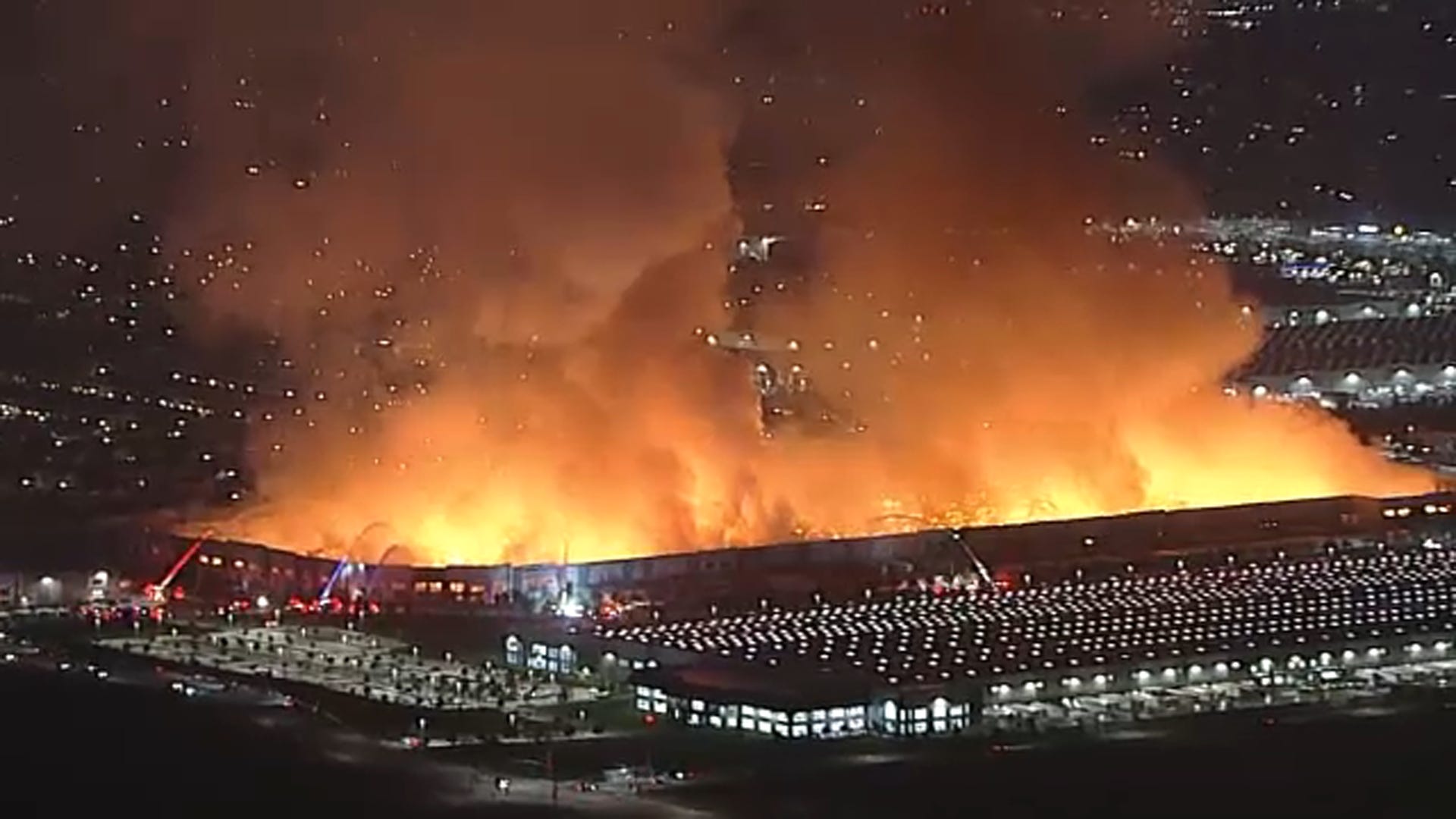
Chamel Abdulkarim clocked in for his shift at the NFI-operated Kimberly-Clark distribution center in Ontario, California, just before midnight on April 6, 2026. He was 29, a forklift-area worker on the midnight third shift. By 12:30 a.m. on April 7, he was lighting pallets of Scott toilet paper on fire and posting the video to his own Instagram account.
The building covered 1.2 million square feet. It held an estimated $500 to $650 million in Scott, Kleenex, Huggies, Cottonelle, and Kotex inventory — Bloomberg Intelligence would later put the lost distribution capacity at more than 3% of Kimberly-Clark’s annual U.S. sales. About twenty third-shift workers evacuated. No one was hurt. Roughly 175 firefighters from twenty engines shifted to a defensive exterior attack after the roof collapsed. By morning, the building was gone.
In the video he filmed as he lit the pallets, Abdulkarim said:
All you had to do was pay us enough to live.
There goes your inventory.
If you’re not going to pay us enough to live, at least pay us enough not to do this.
In phone calls and texts to others in the hours that followed, according to the federal affidavit, he said:
And he compared himself to Luigi Mangione, the UnitedHealthcare CEO assassination suspect.
He was arrested two miles away in Eastvale within hours. Ontario Fire Deputy Chief Mike Wedell announced the fire was “very quickly identified as suspicious.” Fire Chief Mike Gerken later said the behavior inside the building was “uncharacteristic,” the rapid spread unlike anything they would have expected for a structure that size. San Bernardino County DA Jason Anderson filed one count of aggravated arson plus six counts of arson of a structure, triggering a ten-years-to-life exposure because losses exceeded $10.1 million. On April 9, First Assistant U.S. Attorney Bill Essayli filed a federal complaint charging arson of a building used in interstate commerce under 18 U.S.C. § 844(i) — a five-year mandatory minimum, twenty-year maximum. Abdulkarim pleaded not guilty on April 13. He is held without bail.
At his charging press conference, Essayli said something worth reading closely:
America is founded on free enterprise and capitalism. Anyone who attacks our values, our way of life, our system which provides the best goods and services to the most people, we’re going to come after aggressively.
That is not the language of an arson charge. That is the language of something else.
Abdulkarim was not a Kimberly-Clark employee. He worked for NFI Industries, the third-party logistics firm that operates the warehouse. NFI’s Cal Cartage subsidiary was ordered in 2018 to pay roughly $3.5 million for wage theft affecting 1,500 workers. Ontario forklift operators make between $37,000 and $49,000 a year, against one-bedroom rents of about $2,000 a month in the Inland Empire. Kimberly-Clark has been executing a $1.5 billion restructuring since 2024 that involves workforce reductions and plant closures scheduled to wrap by the end of 2026. The company’s Beech Island, South Carolina plant — itself the subject of a major new $2 billion supply-chain buildout — suffered an unexplained fire in October 2025 that RBC Capital warned would cause K-C to miss Q4 2025 revenue consensus. That fire’s cause was never publicly adjudicated.
According to the company’s own SEC filings, Kimberly-Clark earned $21.5 billion in net income between 2015 and 2025. Over the same period, it paid out $22.8 billion to shareholders in stock buybacks and dividends. The company paid Wall Street 106 percent of what it made. Stock buybacks — using profits to repurchase and retire shares, inflating the value of what remains — were an illegal form of stock manipulation until Reagan’s SEC deregulated the practice in 1982. CEO Michael Hsu made $48 million in total compensation over three years; for an average Kimberly-Clark worker to earn what he made in 2025 alone would take 275 years.
The grievance is legible. You don’t need to reach for a political ideology to read those texts. You don’t need a manifesto, a cell, a cadre, a reading group. The sentences do the argument themselves: all you had to do was pay us enough to live. The frame is older than the labor movement. It is older than fire.
What makes the moment new is that a man stood inside a billion dollars of inventory, filmed himself setting it alight, and named Luigi Mangione as his model. What makes it new is that he was right. The TikTok comments under the news coverage weren’t condemning the act. Many of them were naming the building, the company, the layoffs, the CEO pay. Many of them quoted the lines.
The fire is not the story. What the fire made legible is the story.
Kimberly-Clark is the clearest case because the grievance is so unambiguously economic, and because Abdulkarim left a recorded and written record. But it is not the only one, and it does not sit alone.
Since the start of 2026, at least a dozen corporate warehouses, federal immigration facilities, and private-prison conversions have been hit with confirmed or attempted incendiary attacks. They do not share a network. They do not share a manifesto. Several are individual actors with no known political history. Several are unsolved. What they share is a target set, and the target set is specific.
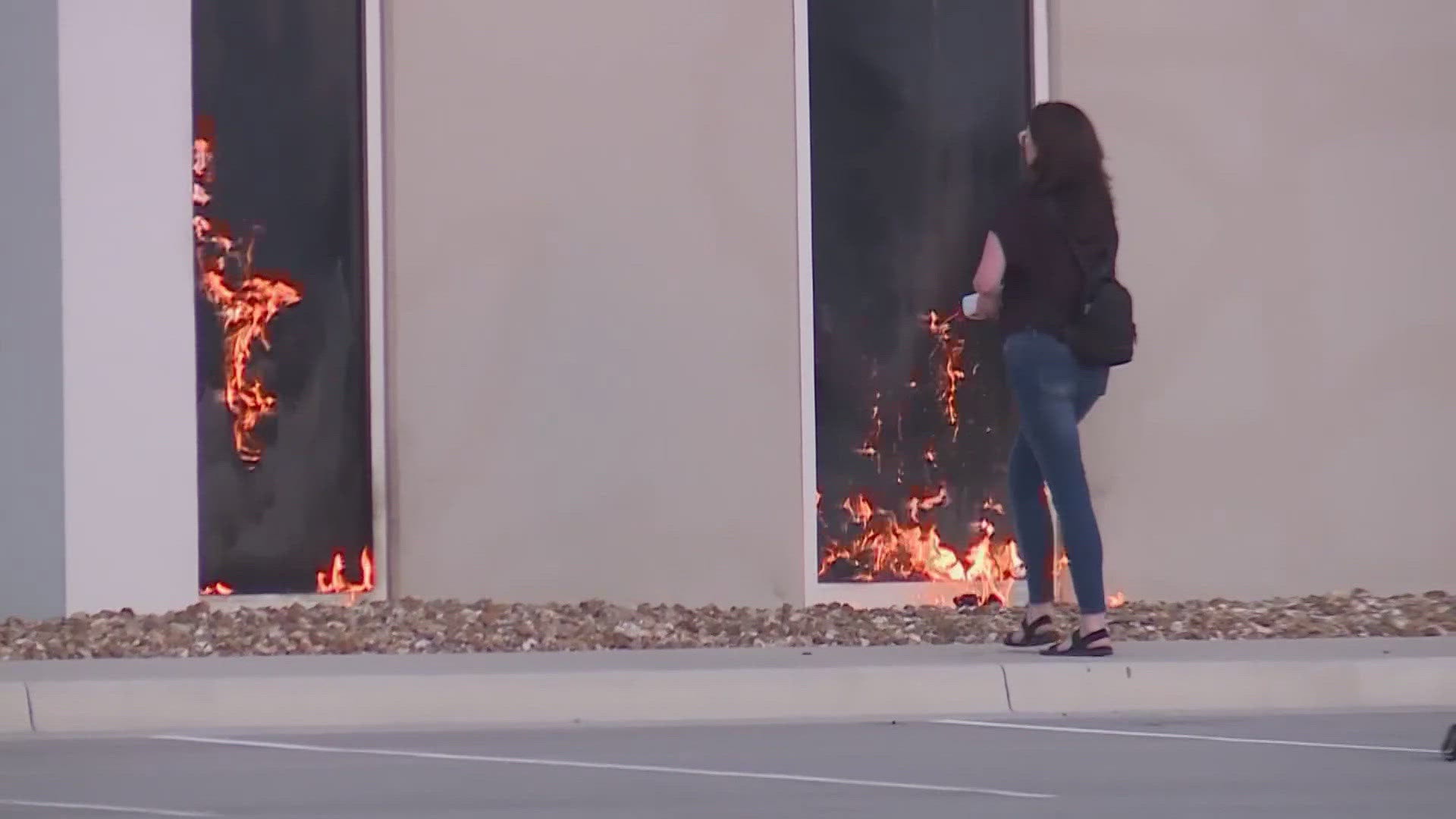
On February 12, an unidentified woman approached a 900,000-square-foot warehouse in south Kansas City, Missouri, sprayed accelerant on the windows, and set it alight. The building was owned by Platform Ventures. DHS and ICE had toured it in January to evaluate its conversion into a 10,000-bed detention facility. Platform Ventures announced that morning it would not move forward with the sale, citing “baseless speculation, inaccurate narratives, and serious threats toward our leadership.” The fire came hours later. KCFD extinguished it before it spread. Mayor Quinton Lucas called the planned facility “cages inside distribution warehouses.” No arrest has been made.
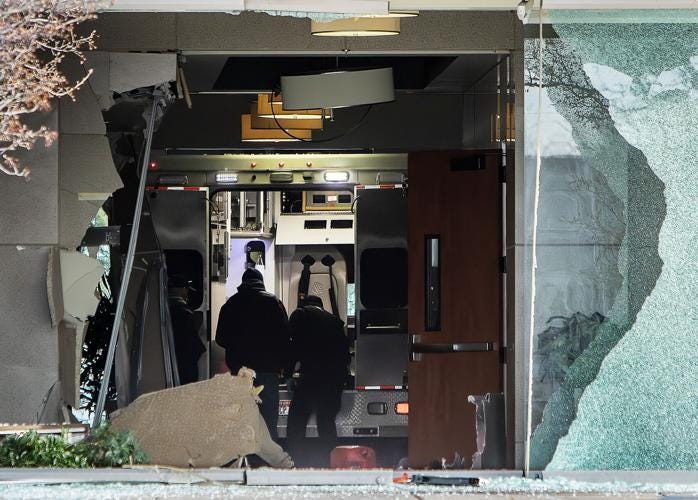
On February 18, Sarah Elizabeth George, 43, of Boise, stole a Canyon County Paramedics ambulance from a bay at St. Luke’s West hospital in Meridian, Idaho. She drove it to gas cans she had pre-staged in nearby bushes, loaded them, and rammed the vehicle at about 25 miles per hour through the south entrance of a building housing DHS and ICE offices. She poured gasoline across the lobby floor. CCTV captured her. She did not successfully ignite it before fleeing. Investigators traced a Walmart security-footage purchase of lighter fluid to her Boise residence and arrested her five days later. A Facebook post attributed to her that morning read:
If it can be destroyed by the truth then it should be destroyed; it was built in lies anyways.
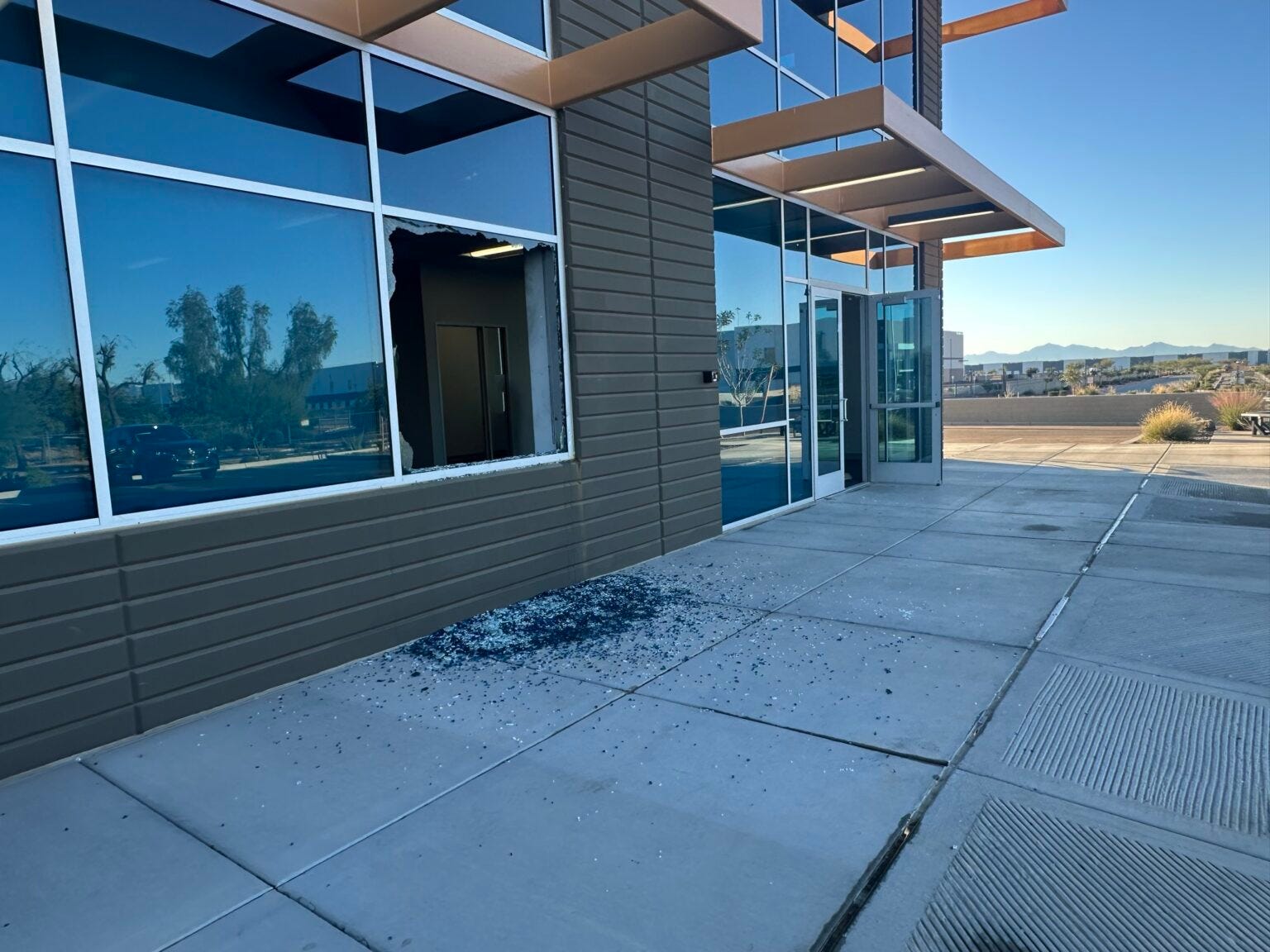
On February 21, a suspect smashed a window, ignited a fire, and threw a propane tank into a newly purchased ICE warehouse in Surprise, Arizona, slated to become a 1,500-bed detention facility. Interior sprinklers extinguished the fire. FBI Phoenix opened an investigation with ATF assistance. The attack followed a Surprise City Council meeting at which more than a thousand residents had turned out to oppose the facility. No arrest.
On March 10, a small exterior fire burned along the back wall of a 640,000-square-foot warehouse at 542 Southeast Loop 410 on San Antonio’s East Side — a facility ICE had recently purchased for more than $66 million and announced plans to convert into a 1,500-bed processing center. SAFD opened an arson investigation. Damage was minor. Mayor Gina Ortiz Jones had asked the city’s federal delegation on February 11 to not fund the facility. Councilmember Marc Whyte said the conversion would be “tremendously unfortunate.” No arrest.
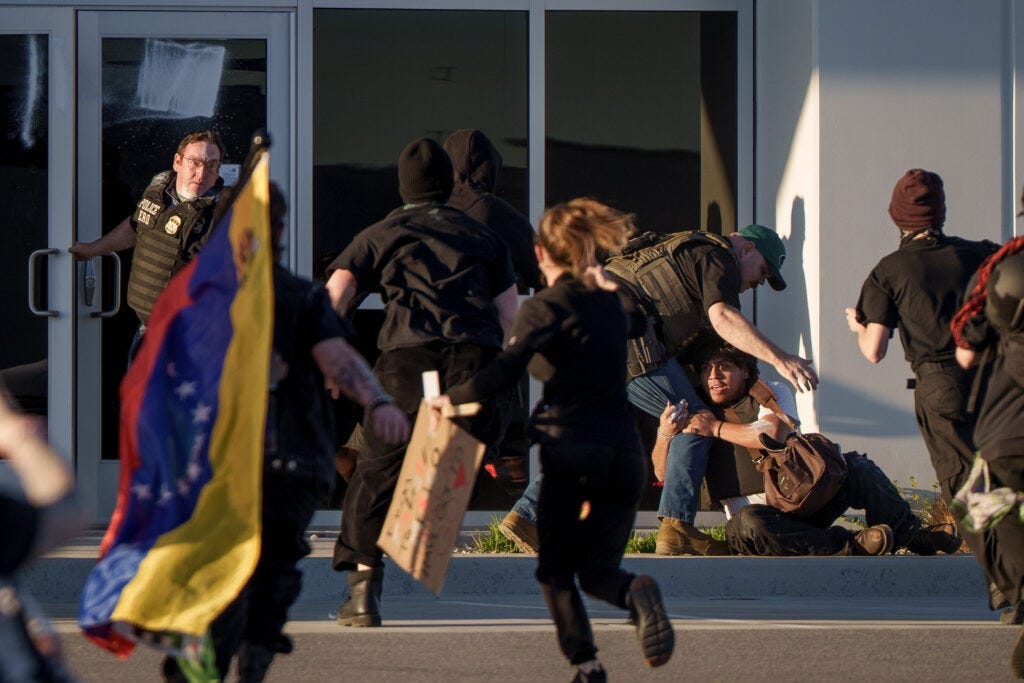
On March 18, hundreds of people marched on a $145.4 million warehouse in Salt Lake City purchased by ICE from Delaware-based RREEF CPIF. A splinter group broke windows, threw paint, and spray-painted graffiti including a crossed-out swastika and “Kill all Nazis.” Rev. Monica Dobbins of the First Unitarian Church had invoked the Topaz internment camp in her remarks. Chase Taylor Fredrickson, 18, was arrested on state felony charges of property damage and riot. Two juveniles were also arrested. Salt Lake County Mayor Jenny Wilson wrote DHS urging it to abandon the project. Utah Governor Spencer Cox acknowledged the concerns and said the federal government could proceed regardless.
Every one of these targets was either newly purchased, under conversion, or proposed — not an operating detention center. The tactic is not liberation. The tactic is to raise the cost of standing up new capacity before it comes online.
The reason the target set is specific is that the buildout is specific. In the same twelve months the warehouses started burning, CoreCivic reported a nearly 70% increase in annual profit, to $116.5 million. GEO Group reported a 700% increase, to a company-record $254 million. On their February 12, 2026 earnings calls, both firms told investors ICE was now their fastest-growing customer. CoreCivic doubled its ICE revenue from $120 million in Q4 2024 to $245 million in Q4 2025. GEO Group grew detention capacity to 26,000 beds and added roughly $520 million in new ICE revenue. Both companies explicitly credited the Trump administration’s $45 billion ICE expansion budget, which aims to double the number of large-scale mega-detention centers and add 50,000 or more beds plus 10,000 detention officers.
The specific contracts the buildout is flowing through include a fifteen-year, billion-dollar deal at Delaney Hall in Newark, which is set to become the largest ICE processing and detention center on the East Coast. A reactivated 2,400-bed family detention facility at Dilley, Texas, where detainees have described conditions as moldy food, putrid water, and measles outbreaks. A 1,000-bed Midwest Regional Reception Center at a former federal prison in Leavenworth, Kansas. Reactivations in Virginia, Tennessee, and Oklahoma. Six CoreCivic facilities total in the pipeline.
And then there is the warehouse initiative.
GEO Group’s incoming CEO George Zoley told analysts on the February earnings call that the federal government is pursuing coast-to-coast warehouse conversions for detention, “predominantly in the Sunbelt states, predominantly in red states, to be very frank about it.” ICE announced in 2025 that it would purchase and renovate eight large-scale non-traditional facilities to house 7,000 to 10,000 detainees by November 30, 2026. The Kansas City, San Antonio, Salt Lake City, Surprise, and Hutchins, Texas buildings were all purchased or considered under that program. They are the buildings that have been catching fire.
The pattern is not mysterious. It is what happens when a state builds infrastructure faster than the communities hosting it can process through the available democratic channels. Thousand-person council meetings did not stop Surprise. A mayor’s letter did not stop Salt Lake. A city council’s opposition did not stop San Antonio. The fires are what arrived next.
The same pattern is visible outside the detention buildout, in the other two economies running hot in 2026: AI infrastructure and automated distribution.
In Indianapolis on April 6 and 7, City-County Councilmember Ron Gibson and his eight-year-old son woke to thirteen bullets fired into their home just before 1 a.m. A handwritten note reading NO DATA CENTERS was left on the doorstep. Gibson had voted five days earlier for a 6-2 rezoning approval of a $500 million, fourteen-acre Metrobloks data-center project in Martindale-Brightwood. Nobody was hurt. It is not arson. It is targeted political violence against an elected official over an AI-infrastructure vote, and it should be understood as sitting on the same continuum.
On April 10, Daniel Moreno-Gama, 20, of Texas, allegedly threw a Molotov cocktail at Sam Altman’s San Francisco home around 3:40 a.m., then drove to OpenAI headquarters and tried to break in with a chair, telling security he wanted to burn it down and kill anyone inside. He was arrested with kerosene, incendiary materials, and a manifesto listing names and addresses of AI executives. His attorney has claimed an acute mental-health crisis. Two days later, a separate pair of suspects was arrested for allegedly firing a round at Altman’s home from a passing car. The motive in the second attack remains unclear.
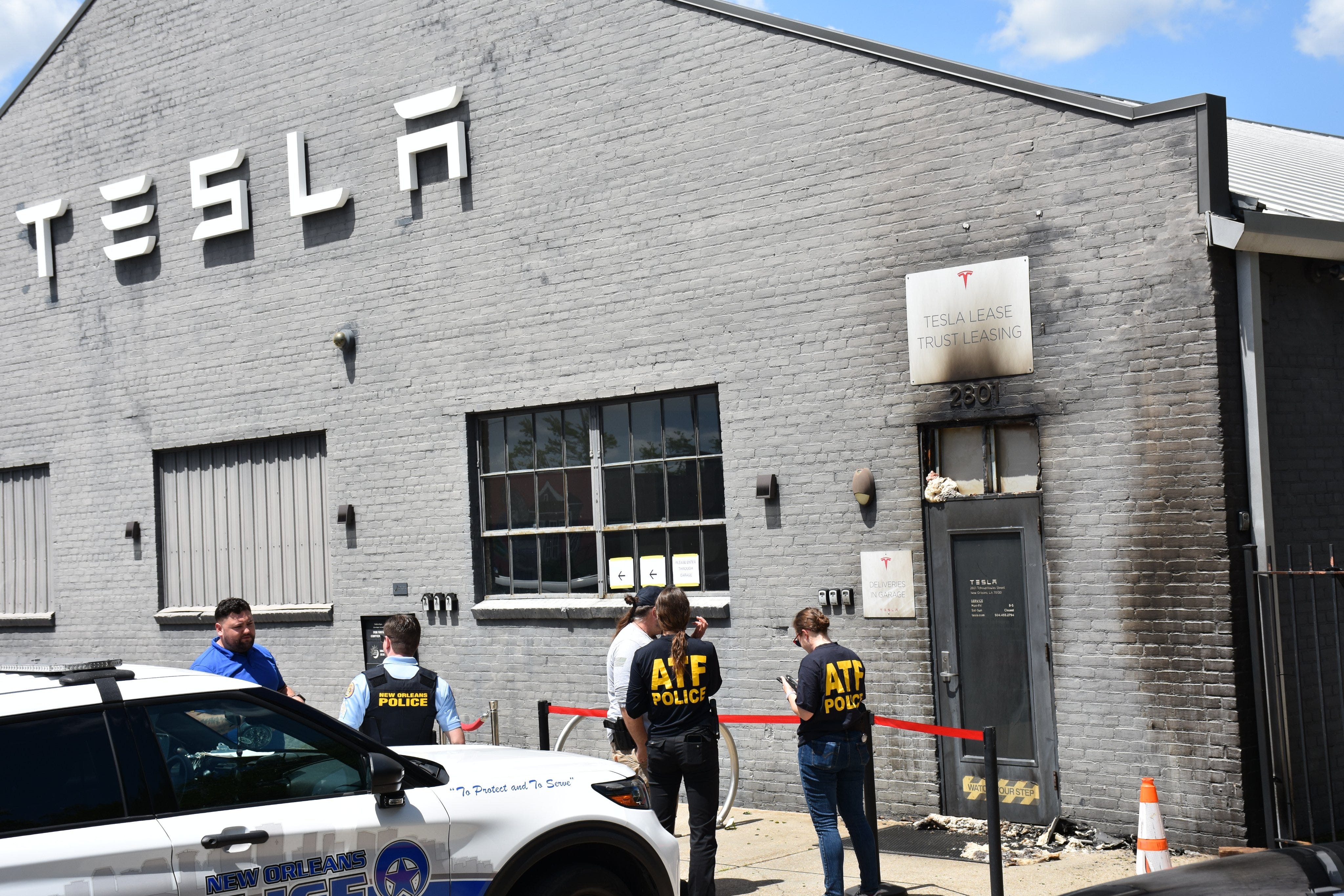
The Tesla arson wave that began in early 2025 has slowed, but it has not stopped. A New Orleans service center was hit with a Molotov on April 14. In January, Ian William Moses, 35, of Mesa, Arizona, received sixty months in federal prison for a Cybertruck arson in which he had spray-painted a misspelled THEIF.
These are different ideologies, different targets, different rhetorics. What they share with the warehouse fires is that the actor is almost always individual, almost never organized, and the action is directed at physical infrastructure whose political implications the actor experiences as unanswerable through normal channels. This is what happens when the channels close.
Abdulkarim’s texts and Moreno-Gama’s manifesto and the NO DATA CENTERS note and the Salt Lake City spray paint are not the same document. They do not share a politics. But they share a shape.
The Bondi DOJ entered 2026 with an architecture built to treat left-coded political violence as domestic terrorism, and it has spent the first four months of the year testing that architecture in court.
The September 2025 executive order designating Antifa a domestic terrorist organization has no statutory authority — federal law provides no mechanism for designating domestic groups as terrorist organizations, which is why the designation operates as rhetoric rather than as a legal instrument. National Security Presidential Memorandum-7, issued three days later, identifies “anti-Americanism, anti-capitalism, anti-Christianity, support for overthrow of USG, extremism on migration, race, and gender” as common threads of targeted ideologies. Attorney General Pam Bondi’s December 4, 2025 implementation memo, leaked days later, directed federal prosecutors to charge aggressively under more than twenty statutes including 18 U.S.C. § 2339A (material support for terrorism), RICO § 1962, § 111 (assault on federal officers), § 844 (arson), and § 371 (conspiracy), with mandatory pursuit of the § 3A1.4 terrorism sentencing enhancement. An NSPM-7 Joint Mission Center staffed by ten agencies was created inside the FBI.
The Prairieland verdict on March 13 was the test case, and readers of this publication know its details. Eight of nine defendants convicted of material support for terrorism. Seven co-defendants already pleaded guilty to the same charge. A prosecution theory that wearing black bloc, using Signal, bringing medical kits, and operating a zine press can constitute material support when the predicate offenses appear on the federal terrorism statute’s list. Before Prairieland, § 2339A had been used in one of 226 domestic terrorism cases from 2014 to 2019, according to the START/PIRUS database. That is 0.05%. After Prairieland, Bondi said the verdict would “not be the last.” FBI Director Kash Patel promised “24/7 commitment” to dismantling Antifa.
Since Prairieland, no individual-actor warehouse arsonist has been charged under § 2339A. Abdulkarim, George, Moreno-Gama, Fredrickson, the Tesla defendants — all remain on § 844(i) or § 844(f) rails. Trenten Barker, who set fire to Portland’s ICE field office in June 2025, pleaded guilty in November 2025 under § 844(f) and awaits sentencing; his case is the federal arson baseline the current ICE-facility attackers will sit on top of. The federal arson statutes carry serious penalties on their own. But the charging language is no longer matching the rhetorical frame. U.S. Attorney Essayli at Abdulkarim’s press conference did not speak the language of § 844(i). He spoke the language of NSPM-7. He named capitalism as the value under attack. He described the warehouse fire as a political message requiring an aggressive federal response. The charge stayed narrow. The frame did not.
Four days after Abdulkarim’s federal charging, San Bernardino County DA Jason Anderson — the same prosecutor handling Abdulkarim’s state case — filed sixteen felony counts against Luis Javier Gallegos, 28, for setting multiple fires inside stores at Ontario Mills mall three days after the Kimberly-Clark fire. No political motive had been established. Gallegos did not work at the mall. Police said they were still working to identify why he had done it. Anderson’s charging statement didn’t wait: If criminal conduct is how you show concern about the economy, I know a place you can go to get a free bed, free food, free clothes. The frame had arrived before the evidence did. That is the architecture.
Today, April 21 — as this piece was being finalized — a federal grand jury in Montgomery indicted the Southern Poverty Law Center on eleven counts of wire fraud, bank fraud, and conspiracy to commit money laundering, over its confidential informant program that had paid sources inside the Ku Klux Klan, Aryan Nations, and neo-Nazi groups since the 1980s. Acting Attorney General Todd Blanche, flanked by FBI Director Kash Patel, announced that SPLC was "manufacturing the extremism it purports to oppose." The organization that has spent fifty-five years documenting right-wing domestic terrorism is now under federal indictment. The Prairieland defendants are convicted of terrorism for bringing medical kits to a protest. The architecture does not pretend to be neutral.
The question over the next six months is whether the next Kansas City, the next Surprise, the next Abdulkarim gets folded into a § 2339A theory, or stays on arson. Thomas Brzozowski, the retired former DOJ Domestic Terrorism Counsel, predicted publicly that § 2339A would be used more aggressively in the coming year. The Prairieland defense motions for new trial, citing juror misconduct and a Brady violation around Lt. Gross drawing his weapon first, are pending. Sentencings are expected in June. The Georgia Court of Appeals is hearing the Cop City RICO appeal on the May calendar. These are the three fronts on which the architecture is being tested.
What is already visible is that the architecture will try to fold economic grievance, anti-surveillance action, anti-AI action, and anti-ICE action into a single charging category. The Brennan Center’s Rachel Levinson-Waldman put it directly: anything that feels at odds with this administration’s policies could be considered domestic terrorism and will be pursued with the full force of the federal government. Abdulkarim did not know Sarah George. Sarah George did not know the person who threw the propane tank in Surprise. None of them knew the Prairieland defendants. The state is building the framework under which they will be treated as though they did.
That is the damage that will outlast the fires.
What this moment looks like, honestly, is the beginning.
Not the beginning of a movement — movements have infrastructure, demands, spokespeople, meetings. This does not. What this looks like is the beginning of what happens when the channels close. When a thousand people at a council meeting does not stop a detention warehouse. When a mayor’s letter does not stop a fifteen-year billion-dollar contract. When a councilmember votes yes on a data center and his eight-year-old wakes up to thirteen rounds through the siding. When a forklift operator reads the earnings call and does the math between his rent and the shareholders’ quarterly distribution and decides to film it.
The fires are not the strategy. The fires are what arrives when strategy has been foreclosed. Individual actors with no cadre, no network, no written theory, lighting specific infrastructure whose political function they experience as unanswerable. The state’s response — NSPM-7, the Bondi memo, the § 2339A experiment — is an attempt to foreclose that too, by collapsing the distance between action and organization so that any actor can be prosecuted as though a cell existed behind them.
What to watch for, in the coming months:
The charging decisions on Abdulkarim’s future co-defendants if any are identified, and on the Kansas City and Surprise suspects if they are found. Whether those cases get charged under § 2339A or stay on § 844. Whether the language of Essayli’s press conference — our values, our way of life, our system — migrates into the indictments themselves.
The Prairieland sentencings in June. The terrorism enhancement under § 3A1.4 is where a ten-year arson charge becomes a thirty-year one. Whether Judge Pittman applies it at the top of the range will set the template for every case that follows.
The Cop City appeal. If the Georgia Court of Appeals upholds the RICO dismissal, the state-level framework for prosecuting protest networks as criminal enterprises takes a significant hit. If it reverses, Carr’s template travels.
The texts. The notes on the doorsteps. The Facebook posts from the morning of. Watch what the actors are saying, because what they are saying is what the prosecutions will be arguing over. The state is not going to charge against graffiti. It is going to charge against manifestos, texts, and communiqués — the documentary residue of political intent. Didn’t see the shareholders picking up a shift is the sentence that turns a § 844(i) arson into an NSPM-7 test case.
Abdulkarim faces ten years to life for destroying insured inventory. The men named in the Epstein files face nothing. The architecture is not neutral. It is being built in a specific direction, by specific people, to protect specific interests.
Abdulkarim’s coworkers lost their jobs that night. Kimberly-Clark’s stock recovered within the week. The toilet paper was insured. The Bondi DOJ took notes.
The building is gone. The sentence remains.
Comments
Nothing yet. Say the first thing.
Sign in to join the conversation.