
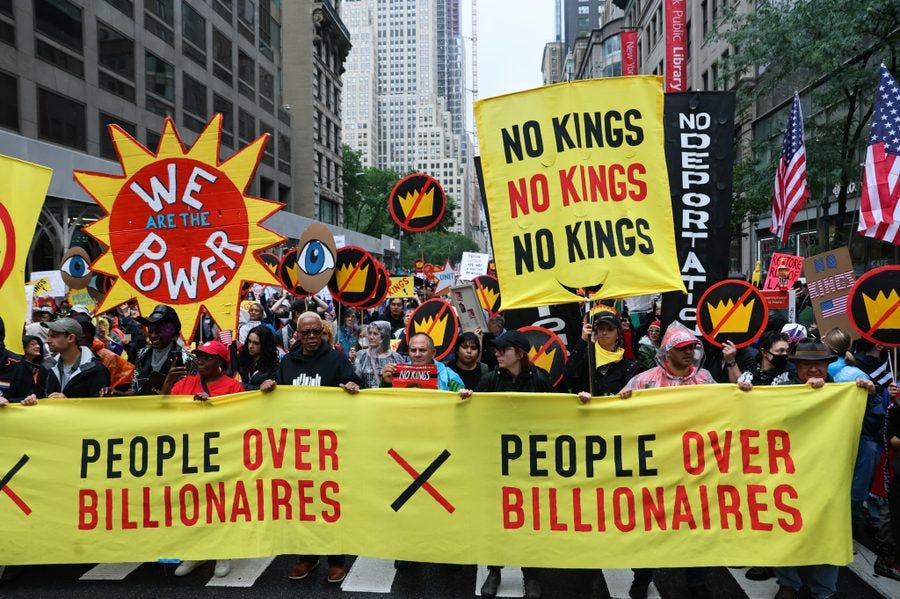
This Saturday, people across the country will gather for the third national No Kings protest. Some will stand on sidewalks with signs. Some will listen to speeches. Some will go home afterward and wait for the next scheduled event.
And some will remember that they don’t need permission.
In Prairieland, Texas, nine people are facing 10 to 60 years in prison for a noise demonstration outside an ICE detention facility on July 4, 2025.
One person fired a weapon and the officer was treated and released the same day. The other eight didn't fire a shot. Some weren't even there.
The charges include material support for terrorism. The legal theory: wearing matching clothes and standing together constitutes providing “personnel” to a terrorist organization. The prosecutors argued that the defendants’ bodies served as “camouflage.” An artist moved some pamphlets. A teacher who removed someone from a Discord server days later faces fifty years.
This is the legal environment you’re operating in Saturday.
Read the full investigation here →
Here’s what you need to hold in your head simultaneously:
~1,600 January 6 defendants have been pardoned. Stewart Rhodes, who coordinated armed men to converge on Washington and stored weapons at a hotel for a “quick reaction force,” had his 18-year sentence commuted. Enrique Tarrio received a full pardon and was photographed at Mar-a-Lago.
9 Prairieland defendants face decades in prison. One fired a weapon. Eight did not. Some weren't present at all.
The administration will call you a terrorist regardless of what you do. House Majority Whip Tom Emmer has already described No Kings participants as “the terrorist wing” of the Democratic Party. Transportation Secretary Sean Duffy told Fox News the protests are “antifa, paid protesters.”
This is worth understanding clearly: compliance buys you nothing. They will characterize permitted sidewalk marches the same way they characterize direct action. The question isn’t whether they’ll call you an extremist. The question is what you’re willing to do anyway.
At the October No Kings protests, a group of 5-10 people in a mid-sized city showed up with a banner, a flyer, and a couple of megaphones. By the end, they had rerouted the entire march — thousands of people — into an unpermitted street action that left the official organizers behind.
That wasn’t a national organization. That wasn’t months of planning. That was a handful of people who decided to lead.
Another account from the same day:
“What the hell are people talking about it being ‘dangerous’ to be at No Kings? It’s dangerous for us NOT to be there.”
The regime has crashed the economy, alienated every demographic except online fascists, and destroyed the legitimacy of federal institutions. People are furious and looking for something beyond symbolic dissatisfaction. Unless you are in an exceptionally vulnerable group, the most dangerous thing you can do is stay home and wait for conditions to improve.
The basics:
Water, snacks, cash (no cards if possible)
ID (or not — know the tradeoffs in your jurisdiction)
Comfortable shoes — you may be walking longer than planned
Weather-appropriate layers
A way to contact someone not at the protest if you need pickup or support
Phone security:
Consider leaving it home, or bring a burner
If you bring your phone: airplane mode, disable biometrics (use a PIN), disable lock screen notifications
Know that cell site simulators (Stingrays) are deployed at large protests
If you need secure communication: Signal with disappearing messages
What not to bring:
Anything you wouldn’t want to be arrested with
Anything that could be characterized as a weapon
Contact lenses (tear gas; bring glasses instead)
Documentation:
If you’re documenting, know that your footage can help and harm — faces of participants can be used against them
Document cops, document counter-protesters, document far-right infiltration attempts
Consider metadata: photos contain location data unless you strip it
If you want to follow the official program: That’s fine. Be present. Numbers matter.
If you want to do more:
People who’ve been documenting what works at No Kings rallies have identified several approaches:
Bring a megaphone and some friends. You don’t need an organization. Five people with a banner and a voice can shift the energy of thousands. The official organizers often bring no sound equipment and lead no chants. Fill the vacuum.
Have a follow-up ready. Bring flyers for something that happens next — a meeting, a skill share, an action, a way to connect. The rallies themselves are symbolic. The work that continues afterward is what builds power. Don’t just show up; bring a reason for others to stay connected.
Publicize the Prairieland defendants. At the October No Kings rally in Asheville, protesters distributed thousands of red bandanas — invoking Appalachian labor history — as a gesture of solidarity with the Prairieland defendants. This works: it connects people to something concrete, gives them something to take with them, and makes the stakes visible.
Know your targets. Federal buildings, ICE facilities, offices of complicit corporations — these exist in your city. If the energy is there, a permitted rally can become an unpermitted march to something that actually matters to the regime.
Know your rights:
You have the right to remain silent. Use it.
You do not have to consent to searches.
You do not have to answer questions about your immigration status, your political beliefs, or your associations.
If you are detained, say: “I am going to remain silent. I want to speak to a lawyer.”
Legal support:
Save the National Lawyers Guild hotline for your city in your phone (search “NLG legal observer [your city]”)
If mass arrests occur, try to note badge numbers and the time
Jail support: someone not at the protest should know you’re going and be prepared to coordinate if you don’t check in
Medical:
If you encounter tear gas: move upwind, don’t touch your face, rinse eyes with water or saline (not milk — it breeds bacteria)
Know where street medics are stationed if present
If you have a medical condition, bring necessary supplies and ensure someone with you knows
The buddy system:
Go with people you trust
Have a check-in plan: if separated, where do you meet? How do you confirm everyone is safe?
Don’t leave anyone behind
Here’s what I believe:
The people in Prairieland are facing decades in prison for exercising the rights you’re going to exercise this weekend. The precedent their case establishes — that attending a protest in matching clothes constitutes material support for terrorism — is designed to make you afraid.
Fear is the point. The asymmetry is the point. They pardon people who stormed the Capitol and imprison people who stood outside a detention facility with noisemakers.
You can be afraid and show up anyway. You can take precautions and still take risks. You can understand the stakes and decide they’re worth it.
The people who built the labor movement, the civil rights movement, the movements that won every freedom we take for granted — they faced worse odds and didn’t wait for permission.
Neither should you.
This is what separates a symbolic event from a movement: what happens next.
Debrief with your people. What worked? What didn’t? Who did you meet? What would you do differently?
Follow up on connections. If you met people who wanted to do more, reach out within 48 hours. Momentum fades fast.
Support the Prairieland defendants. prairielanddefendants.com — follow the case, share it, contribute to legal defense if you can.
Document and report. If you witnessed far-right activity, infiltration attempts, or police misconduct, report to SPLC (splcenter.org/submit-tip) or local journalists. Not federal agencies.
Plan the next thing. Don’t wait for someone else to call it.
Saturday isn’t the moment that determines everything. It’s one day in a longer struggle.
But it matters whether you show up. It matters whether you bring energy or wait for someone else to provide it. It matters whether you connect with people or go home and wait for the next scheduled event.
Nine people in Texas are facing decades in prison for showing up.
Show up anyway.
For the full Prairieland investigation: Attending a Protest Is Now Terrorism
Analyses - In-depth breakdowns examining the systems driving democratic collapse—exposing threats, tactics, and timelines to empower informed resistance.
Playbooks - Actionable strategic guides that directly respond to each analysis, providing comprehensive step-by-step resistance plans designed for immediate implementation.
Insights - Timely, targeted pieces highlighting critical events, emerging threats, and essential context—keeping you ahead of developments as they unfold.
Profiles – Investigative deep dives into the individuals driving America’s authoritarian shift—tracking how key figures build influence, shape institutions, and operate without public accountability.
Strategy - Concise tactical guides for active resistance in motion. These pieces distill complex threats into clear pressure points and practical actions—equipping you to disrupt systems, fracture narratives, and apply strategic force where it counts.
Subscriber Fee Transparency: Subscription fees directly support independent journalism, critical research, and resources for resistance.
Prefer a one-time support option?
Comments
Nothing yet. Say the first thing.
Sign in to join the conversation.