
Any journalist who interviews President Trump goes in knowing that apart from the ridicule they can expect from him—especially if they are women—they may also encounter plenty of it from the audience, and even fellow journalists.
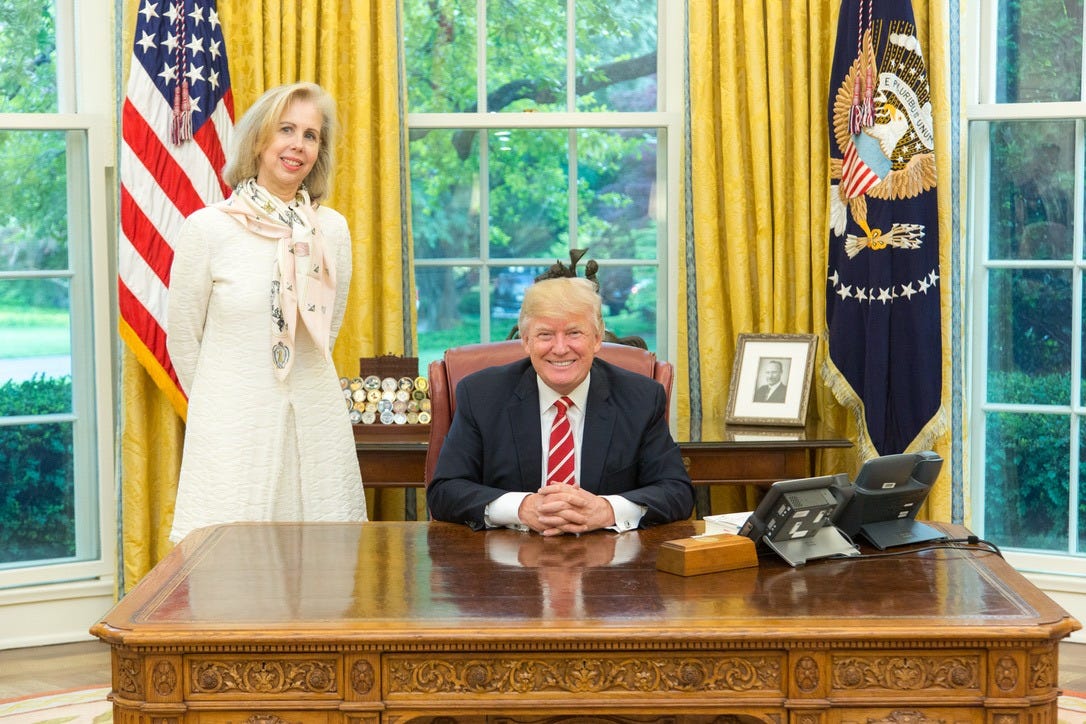
If I look less happy in this picture than the president, it’s because I knew those odds.
From the right, the attacks usually echo the president’s, that the “fake news” is always looking to discount his achievements and distort his record.
And maybe the reporter didn’t smile enough.
From the left, and sometimes from other journalists, the criticism focuses on fact checks and filibusters, on whether the reporter allowed the president to spread conspiracies without pushback.
I sympathize with any reporter interviewing any president–I’ve interviewed five, and under the best of circumstances, it takes hours of preparation and planning and some measure of luck to succeed. Normally the challenge is finding a way to get a president to say something new and revealing, that they haven’t said a thousand times before.
With President Trump, “new and revealing” is seldom the problem; his reality evolves in real time and no thought goes unspoken.
The challenge is to get him to say things that are true and respond in real time when he doesn’t.
Because his style is to bully, bluster and bulldoze, the interviewer needs a particular playbook. This is not a conversation; normal rules don’t apply. Interruption is essential, interviewers will feel rude, and have to not care. It will almost certainly escalate into conflict, as night follows day: the president will say something untrue, and when asked for evidence, erupt.
For more than a decade journalists and debate moderators have weighed how to audit the president in real time. When a public figure, especially a president, says something incendiary– this person is a crook, that election was rigged–the threshold response is simple.
“What’s your evidence?”
The court of public opinion, like a court of law, should make it possible for voters to trust, but verify. Journalists who demand evidence are public defenders, and it is revealing when an invitation to provide proof provokes a tantrum.
For June 7’s Meet the Press episode, NBC’s Kristen Welker clearly went into the encounter prepared. In pressing the president about the Iran War, the economy and his “anti-weaponization fund,” she interrupted the president multiple times to inject basic questions and challenges.
How do you know that?
There’s no evidence of that.
“No evidence.”
More than a dozen times.
Until he walked out, after telling her she was either “crooked, or stupid.”
Commentators called the interview “fiery,” “contentious,” especially when it came to his allegations that American elections were rigged.
“That is some wild, unhinged stuff from the President,” CNN’s Jake Tapper posted, defending Welker’s performance.
Meanwhile the headline in conservative PJ Media was “I Think President Trump Really Enjoys Trolling Kristen Welker.”
For more than ten years, it’s gone like this. Axios co-founder Jim Vandehei once observed of Trump that “In some ways his love language is confrontation.” Axios’ Jonathan Swan delivered a master class in managing Trump in an interview that saw the president repeatedly forced to confront evidence disputing his assertions. But other encounters were train wrecks. As former Face the Nation and CBS Evening News anchor John Dickerson points out, the request for evidence is often the trigger: When pressed to back up his flamboyant allegations with actual proof, President Trump either lashes out or walks out. He did it with Dickerson in 2017, and last month when the New York Times’ David Sanger asked about the point of restarting the bombing of Iran. “That is a totally false question by a fake guy. You are a fake guy, David. Your paper is fake, and your reporting is treasonous. As Dickerson argues, unfounded accusations are…
“corrosive for a reason researchers can measure. Suspicion, once introduced, does not need proof to do its work. Psychologists call it the continued-influence effect:2 a claim keeps shaping what people believe even after it’s debunked, even after the accuser admits he has nothing. A retraction rarely undoes the damage—the doubt outlasts the correction. …Sloppy, unverified claims about an election—lies, we like to call them—are incendiary enough to put people in the street, as they did in 2020, when Trump supporters stormed the Capitol to overturn 81 million votes for the other man.
So, of all claims, fraud should be the one a politician can back up in a sentence. It should be a slam dunk, or you don’t take the shot. The fuzzy version is poison.”
These patterns have persisted for so long that news organizations have debated the value of interviewing the president at all. Some avoid taking his events live, so that they can build in the time to wrap false allegations in fact checks. At least in an interview, a reporter can jump in, cut off the false statements, set up a tollbooth: to keep asserting this claim, Mr. President, you must supply evidence, or you can’t keep going down this road.
But the president drives a monster truck, his foot never off the gas, his eyes never on the road. Some interviewers have managed better than others, but very few walk away unscathed.
Just months into the president’s first term, TIME did a cover “Is Truth Dead?”
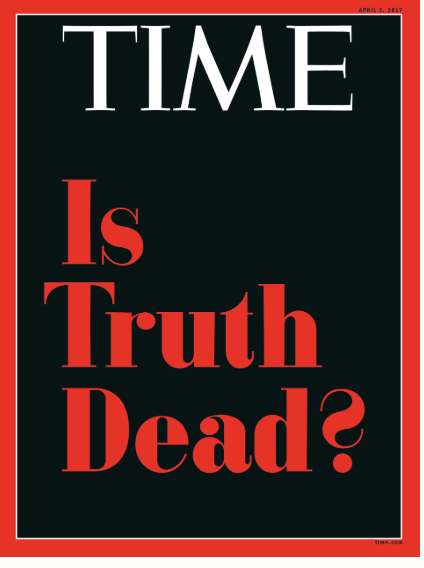
In my editor’s letter, I wrote about the challenge:
Like many newsrooms, we at TIME have wrestled with when to say someone is lying. We can point out, as we often do, when a President gets his facts wrong. We can measure distortions, read between lines, ask the follow-up question. But there’s a limit to what we can deduce about motive or intent, the interior wiring of the whopper, as opposed to its explosive impact. Even the nature of coverage becomes complicated: social scientists have shown that repetition of a false statement, even in the course of disputing it, often increases the number of people who believe it.
For Donald Trump, shamelessness is not just a strength, it’s a strategy…But indicting Trump as a serial liar risks missing a more disturbing question: What does he actually believe? Does it count as lying if he believes what he says?…
Trust is a transaction between leaders and those they lead. Throughout our history, the deeply held beliefs of various Presidents have taken the nation into war, delayed the pursuit of peace, alienated allies, appeased enemies. At other times, presidential beliefs have conquered the continent, freed the slaves, taken us to the moon because the President firmly believed we could get there. As citizens, it is vital that we be able to believe our President; it is also vital that we know what he believes, and why. This President has made both a severe challenge.
What was most revealing about that cover package was Trump’s willingness to sit for an interview about his dishonesty. The peerless Michael Scherer pressed him repeatedly about the risk to his presidency of saying so many things that were demonstrably false.
“Hey, look,” Trump finally said. “I can’t be doing so badly, because I’m President and you’re not.”
As a factual matter, Scherer noted, “the last part of this statement is indisputably true.”
And still is.
No posts
Comments
Nothing yet. Say the first thing.
Sign in to join the conversation.