
It’s a Thursday evening, May 5th, 2022, at a house eight miles north of Pine Ridge, South Dakota. Holly Wilson has just cooked steak for dinner. Her grandchildren are piled onto the living room couch, the way kids stack themselves in a house that’s always full. One of them is six years old. His name is Logan.
The dogs don’t bark. Nobody hears a car. What the family hears next, they first think is fireworks.
It isn’t fireworks. Someone has fired approximately fourteen rounds into the side of an occupied home. Logan Warrior-Goings — a few months from starting kindergarten — is hit in the head trying to get down off that couch. He dies at the scene. No one else in the room is struck.
Four years later, the FBI is offering fifty thousand dollars for information. Nobody has ever been arrested. And the reason this case sat quiet for four years has almost nothing to do with a shortage of evidence — and almost everything to do with what happens to evidence after it’s collected, on land the system was never resourced to actually serve.
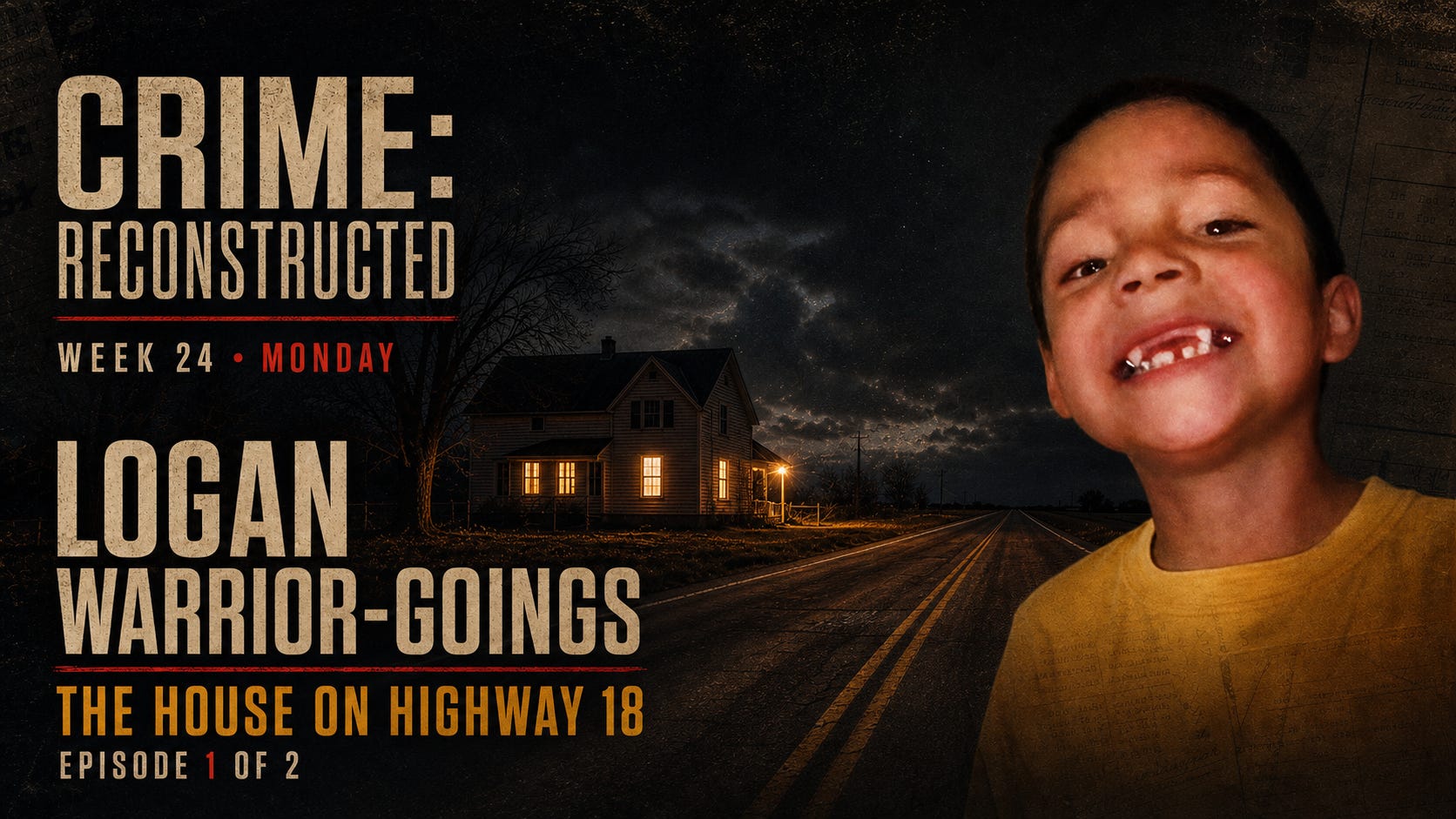
He had a Lakota name — Peta Zi Hoksila. Born October 2nd, 2015, in Pine Ridge, to Miles Goings and Brandi Warrior. Three siblings: Michael, Mylo, and Izabella. Raised day to day by his maternal grandmother, Holly Wilson, in the Payabya Community, a rural stretch of the Pine Ridge Reservation known locally as the Number 4 Community.
He was about to start kindergarten. “Grandma, I’m gonna go to school,” his grandmother remembers him saying. “And I’m gonna make a best friend.” He’d had a hard start in life — “we didn’t know if he was gonna live or die,” she said of his birth — and he caught up to every kid his age. At his grandmother’s place, that meant horses, baseball, a trampoline, and a house full of cousins. His obituary runs three paragraphs deep just naming family: a dozen grandparents, twenty-two aunts and uncles. That’s not filler. That’s what an actual, functioning extended family looks like on paper.
Seven weeks before Logan died, that same family buried another child — his teenage cousin, who passed away at his own home nearby. I won’t tell you how, because I can’t independently confirm it, and I’d rather leave a fact out than get it wrong on a case involving a family that had already carried enough. What I can tell you: this was a family already grieving, less than two months into another loss.
The record is consistent across the FBI, the Department of Justice, and the family’s own account: at approximately 9 p.m. on May 5th, 2022, one or more unidentified individuals fired roughly fourteen rounds into the Wilson family home. Logan, sitting with his cousins, was struck once, in the head, while trying to get down. He died at the scene. The shooter or shooters were gone before tribal police arrived. No suspect has ever been publicly named. Family accounts describe an unknown vehicle; I’ll note, because it matters, that no official FBI or DOJ document uses that word — a detail worth holding precisely rather than smoothing over.
The family held Logan’s wake and funeral May 14th and 15th, 2022, at the Pine Ridge Elementary School Gymnasium, and buried him at the Wilson Family Cemetery. Weeks later, Holly Wilson spoke at an anti-gun-violence rally in Rapid City and described a push for a tribal ordinance the community wanted to call Logan’s Law. For the next four years, that’s roughly what this case looked like from the outside: a grandmother who kept showing up, and a file that, as far as the public record shows, didn’t move. It sat inside a larger, harder number South Dakota’s own U.S. Attorney has spoken about publicly — the state’s high volume of missing and murdered Indigenous persons cases, a category his office and the FBI have said they owe real attention to, not just a line in a press release.
In June 2026, the FBI’s Minneapolis Field Office announced a $50,000 reward. FBI Special Agent Matthew Vogel, who’s worked the case, said it plainly: “We are never going to stop looking for the killer of Logan.” Three days later, federal officials revealed something bigger: “Operation Ballistic Backlog,” a joint FBI–ATF–Oglala Sioux Tribe initiative to test a backlog of roughly 500 firearms tribal police had seized over the years and never had the capacity to run through NIBIN — the national database that reads the microscopic signature a gun leaves on a spent shell casing.
This wasn’t invented for Logan’s case alone. It’s one piece of a larger federal effort called Operation Steadfast Promise, which has rotated something like seventy FBI agents through tribal lands nationwide. A companion piece, Operation Not Forgotten, is now in its fourth year of surging investigative resources into unresolved violent crime in Indian Country — and it’s what finally surfaced the number that matters here: five hundred guns, seized in real cases, sitting untested in one department’s custody.
Five hundred guns. Sitting in evidence. Never tested — not for lack of will, but for lack of a lab.
They brought a mobile testing unit onto Pine Ridge itself, test-firing weapons at the Tribe’s own Criminal Justice Center. And it hit: the shell casings from Logan’s scene matched a firearm recovered elsewhere in South Dakota. Not a name. Not an arrest yet. A weapon — identified four years after it was fired, because the tools to read it finally showed up.
U.S. Attorney Ron Parsons put it plainly: “For years, a great many firearms and other ballistic evidence... have sat unexamined — not for any lack of will, but because caseloads have been overwhelming, and laboratory testing capacity has been stretched thin.” Tribal Attorney General Jessica Four Bear was sharper: “Many in our communities live in continued apprehension and fear from hearing gunshots throughout the night. This is not acceptable, and it is not the Lakota way of life.” Tribal police chief Jason Lone Hill added, simply: “Working with our federal partners strengthens our ability to protect the community with our limited resources.” Notice what he didn’t say. He didn’t say his department failed. He said limited resources — and that phrase does most of the real explaining in this entire case.
Officials pointed to a precedent that already worked: in 2016, Vincent Von Brewer III was killed outside the SuAnne Big Crow Boys and Girls Club, not far from Pine Ridge. That case sat unsolved for years too, until NIBIN testing connected it to two men from Denver, convicted in 2021. Same tool. Same reservation. It’s already closed one case like this.
This is the structural condition I’m naming today, because it’s the spine of everything we do Thursday: the Untested Casing. Not a cold case that ran out of leads — a case where the lead sat physically in an evidence locker the entire time, waiting on capacity that hadn’t arrived yet.
This case is now live in the OpenUnsolved and HOLMES system — built to route a real tip straight to the agency working Logan’s case, instead of into a hotline nobody’s checking. If you know anything about the night of May 5th, 2022, near the Payabya Community or Oglala, that’s now a place it can go. The FBI tip line is 1-800-CALL-FBI, or tips.fbi.gov.
Logan Warrior-Goings was excited to make a best friend in kindergarten. He rode horses at his grandmother’s place. He was loved by a family big enough to fill three paragraphs of an obituary with names. Everything else — the fourteen rounds, the four years, the five hundred untested guns — is what got built on top of him.
Next episode: the Master Class. Why the officer who answered that call in 2022 isn’t where this case’s failure lives — and how a piece of evidence can sit inside a perfect chain of custody for four years and still do nothing.
Comments
Nothing yet. Say the first thing.
Sign in to join the conversation.